The hard truth about health care - The Washington Post: "Everyone knows — or should know — that the United States spends much more than any other country on health care. But the Kaiser Family Foundation broke that spending down into two parts: the government’s share and the private sector’s share (both measured as a percentage of total gross domestic product), then compared the results to figures from 12 other countries that are members of the Organisation for Economic Co-operation and Development. And here’s the shocker: Our government spends more on health care than the governments of Japan, Australia, Norway, the United Kingdom, Spain, Italy, Canada or Switzerland."
And we are are not as healthy as the citizens of the countries paying much less for their health care.
Wednesday, June 8, 2011


Tuesday, June 7, 2011
Bruce Bartlett: Health Care Costs and the Tax Burden - NYTimes.com
Bruce Bartlett: Health Care Costs and the Tax Burden - NYTimes.com: "Last week I showed that total taxes at the federal level — individual and corporate income taxes, payroll taxes and so on — are at a 60-year low as a share of the broadest measure of income, the gross domestic product.
Some readers took issue with my failure to include state and local taxes in the calculation. I have now done that, using data from the Organization for Economic Cooperation and Development, which represents the major developed countries. Among its most important responsibilities is the collection of internationally comparable data on a wide variety of topics, including taxes and health care spending.
The table below shows total taxes, including state and local government taxes, as a share of G.D.P. in 2008, the latest year for which there is complete data. The table makes clear that the United States has very low taxes by international standards."
Why Bankers Need to Be Put Into Little Boxes - Justin Fox - Harvard Business Review
Why Bankers Need to Be Put Into Little Boxes - Justin Fox - Harvard Business Review: "The six biggest 'banks' (Bank of America, JPMorgan Chase, Citigroup, Wells Fargo, Goldman Sachs, and Morgan Stanley — although Wells looks more like a traditional bank than the others), Wilmers writes, make most of their money trading securities and derivatives, and are now able to do so with close-to-explicit government backing as too-big-to-fail institutions. Meanwhile, the rest of the country's banks, which make most of their money from banking, have a load of new consumer-protection rules to contend with, plus continued competition from the surviving parts of the shadow banking system. So basically (and I'm still paraphrasing Wilmers here), we've taken the part of the financial system that caused the crisis and put it back on its feet so it can go back to paying people staggering amounts of money for work of possibly negative economic value, while adding more burdens to the part of the financial system that didn't cause the crisis.
'The inability to differentiate between Wall Street and Main Street by Washington, as well as by the public at large, has hurt the image of Main Street banks and increased their cost of operations. One has to question whether we haven't created the makings of the next financial crisis or, indeed, disrupted the balance in our society between rich and poor.'"
The quote is from a bank president.
Decline and fall of the American empire | Business | The Guardian
Decline and fall of the American empire | Business | The Guardian: "Let me put an alternative hypothesis. America in 2011 is Rome in 200AD or Britain on the eve of the first world war: an empire at the zenith of its power but with cracks beginning to show.
The experience of both Rome and Britain suggests that it is hard to stop the rot once it has set in, so here are the a few of the warning signs of trouble ahead: military overstretch, a widening gulf between rich and poor, a hollowed-out economy, citizens using debt to live beyond their means, and once-effective policies no longer working. The high levels of violent crime, epidemic of obesity, addiction to pornography and excessive use of energy may be telling us something: the US is in an advanced state of cultural decadence."
The experience of both Rome and Britain suggests that it is hard to stop the rot once it has set in, so here are the a few of the warning signs of trouble ahead: military overstretch, a widening gulf between rich and poor, a hollowed-out economy, citizens using debt to live beyond their means, and once-effective policies no longer working. The high levels of violent crime, epidemic of obesity, addiction to pornography and excessive use of energy may be telling us something: the US is in an advanced state of cultural decadence."
Sunday, June 5, 2011
Deconstruction of current events by the Beeb
The BBC gets a little trippy in this video that plays as if written for a social anthropology tutorial, but that makes some very memorable points. The interview with Joseph Stiglitz is wonderful.
‘Animal spirits’: poised for secular exhilaration?
If the unemployment rate drops below its adaptation level, consumer sentiment should improve markedly.

The yield curve certainly is not signaling recession:

And my “animal spirits” metric, A = –(U – UMEAN)/Sigma(U), correspondingly seems poised to go positive.

However note the divergence of the survey measure and the adaptation-level-theoretic measure.
It can be said that the main reason the unemployment rate went up last month was that there were a quarter of a million entrants into the labor force. Hence, the more optimistic those on the sidelines become and the higher the civilian participation rate, the more likely it is that the unemployment rate—which is still the headline rate—will go up. The labor market is at generational lows in terms of overall employment and the ability of unemployed persons to get a job.
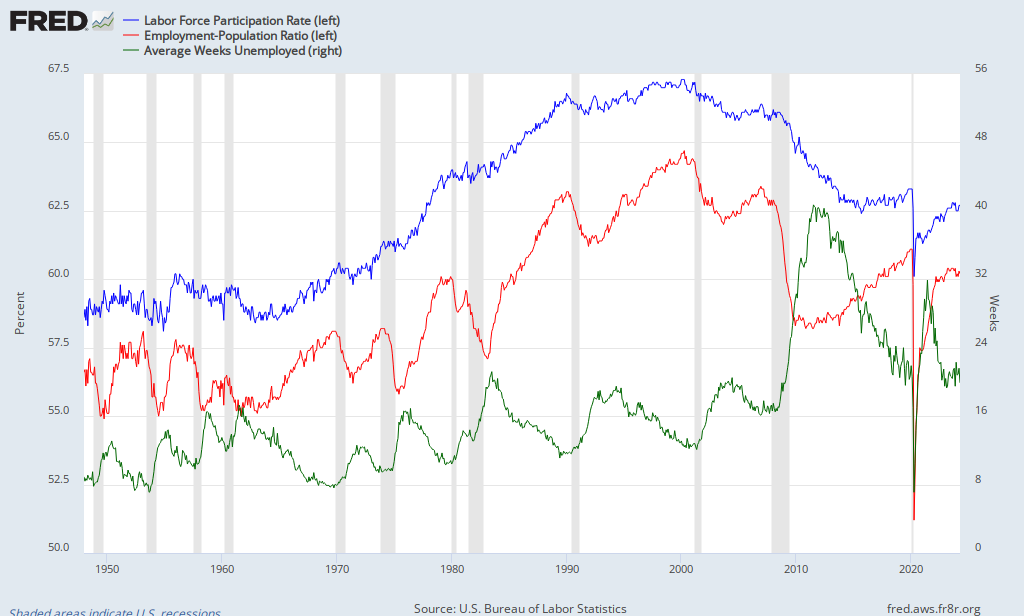
Look for massive stimulus measures, overt or covert, as America ramps up for the presidential election. I continue to expect any exhilaration to be short-lived, as it was in the early ‘Seventies, and for unemployment to make new highs this decade. Any pronounced move toward fiscal austerity will likely cause a deflationary collapse rather quickly. Hence, I believe Obomba or Romney or whoever is the next puppet of the military-industrial-financial complex will take America into a wider, inflation-inducing war than the three we are already in. There may a big deflationary hiccup that precipitates the final escalation. A currency-depreciating inflation is the wet dream of all mainstream economists, and many in business, and to a certain extent, it makes sense: if the dollar tanks and oil becomes more expensive, American labor becomes cheap and America becomes a good place to invest and manufacture.
Unfortunately, a world war would probably strengthen the dollar.
And who knows what derivative liabilities would be triggered in a deflationary collapse? Bernanke confused keeping the banks open with bailing them out. He did not permit their bad loans to charge off. Until the bad debts in the world banking system are charged off, there will be no healthy growth. This is the lesson of Reinhart and Rogoff (see references on left). The Bretton Woods II supernova has flashed, and now we are waiting for gravitational collapse. It will come. Note how quickly debt-to-GDP declined during the Depression.

Thursday, June 2, 2011

Subscribe to:
Posts (Atom)