Michael Hudson’s masterful exposition of the forces of financial imperialism at play in the Ukraine, from both sides, came out a couple of days ago, but if you haven’t read it—it’s owrth the long read, as it covers the neocon/neoliberal “Great Game” strategy in historical context. Via nakedcapitalism.com
Showing posts with label Fed. Show all posts
Showing posts with label Fed. Show all posts
Sunday, May 18, 2014


Saturday, May 17, 2014
When will rates rise? -- reprise
Bernanke Shocker: "No Rate Normalization During My Lifetime" – Zero Hedge
As I pointed out recently in Interest rate reality check I agree that it will be quite a while until rates normalize. The analytical criterion is of course when the ratio of monetary base to GDP returns to longer term averages, which would require the ratio to drop to about 25 percent of its current level of ~0.22.
One way for this to happen would be for the Fed to charge off all the bad debt it is hiding for the banking system, and to stop paying them interest on fictitious reserves.
I don’t know how bad the debt in the monetary base is—no one does, even within the Fed, apparently—but this (absent a huge increase in GDP growth) is what would have to happen. And as base has been growing at >20 percent annual rates and GDP at… well, you know.
John Hussman deserves credit for saying that it is the illusion of solvency created by FAS 157 that has sustained the (stock market) recovery.
Will the Western banks do this? Not a chance. The Fed and ECB seem determined to kill their economies and start another world war.
Another indication that the big tiger may leapfrog us is Jim Rogers’ assertion that the PBOC is actually requiring banks to charge off bad debts. A sharp contraction followed by really robust growth (after a couple of years) would be the implied forecast.
Even Barry Ritholtz is questioning whether FAS 157 should remain in place.
But it won’t matter, if the Fed keeps buying up and hiding all the bad debt, will it? Thanks Alan, thanks Ben. Martin Armstrong says his sources in the big “banks” (i.e., Goldman et al., the hedge funds stealing money from the American people via the discount window and Fed largesse in general) tell him the Fed is saying they’re only going to bail out depositors next time—which is exactly what I said they should have done last time, which would have let the system clear and avoided a hell of a lot of moral hazard—and to get their trading risk models tuned accordingly.
We shall see. I hope Janet is up to the task.
Thursday, May 8, 2014
Interest rate reality check
There is a lot of talk about when “the Fed” is going to “raise rates.” Rates are actually determined mostly by supply and demand in the money market. Without getting into an academic fracas, I am going to present some graphs representing very strong empirical regularities that suggest interest rates, long or short, are not going up any time soon.
I’ve presented one of these before, the long term chart; here I’ve added the 3-month T-bill. These graphs show the relationship between interest rates and the ratio of the St. Louis monetary base to GDP. Data is to April or first quarter 2014. The ratio of base to GDP is ~0.23 currently.


Here is the trajectory of the base/GDP ratio. Can you spot the taper?

Here is the trajectory of base:

From these empirical regularities I draw the following conclusions:
- Interest rates aren’t going up any time soon. The “taper” is really a reduction in the rate of addition to base, not a reduction of base.
- Nor is inflation taking off any time soon, except for stagflationary cost-push. Negative real interest rates will continue. The labor market has no power; the reserve army of the unemployed (whether they are categorized as such or “not in the labor force”) is growing. There is no wherewithal for a wage-price spiral to get started.
This mirrors the experience of the Thirties. ZIRP in that period lasted until near the end of WWII. It took a war to get the inflation started. Federal debt exploded. But America had relatively less sovereign debt going into that war; we are already at comparable levels.
So people who suggest that the Fed “raise interest rates” are really asking the Fed to reduce the size of the monetary base a huge amount. There is no question the Fed would crash the stock market if they did this, purely because of the “optics,” so it won’t happen. Moreover, if the Fed sent all those bad debts back into the banking system they’d be subject to “stress testing” (heaven forbid they were actually marked to market) that I somehow doubt the Fed does on the stuff they hold. (Comment if you know better than I, please.)
Plutocracy World, the Global Casino, rocks on for years to come. The banking system hangs like an albatross around the neck of the world economy. China seems to be making the same mistakes; it will be interesting to see what they do with all their bad debt.
The great economic task of the first half of the twenty-first century will be to reform the world’s monetary system.
Wednesday, March 26, 2014
After QE; Piketty and neo-feudalism
There is a lot of nonsense going around about interest rates going up post-QE. Following John Hussman's lead, in a recent post I showed the empirical regularity governing the relationship between central bank balance sheet as a percent of GDP and long-term interest rates proxied by the 10 year T-bond.

Long rates will remain low and the bad debt clogging the banking system will remain impacted, that much seems assured for years to come.
What is a somewhat lower probability outcome is that the dump-the-dollar movement internationally gains sufficient momentum that the Fed has to buy up more and more (perhaps virtually all) new Government debt. This might be called the MMT-by-force-majeure outcome, as there is little chance that such additions to the Fed's balance sheet will ever go away.
In this latter case rates will not go up because of the empirical regularity shown above, but as the dollar falls on the foreign exchange markets due to weak demand to hold or trade in dollars, there will be import inflation domestically in the US. This will cause a further collapse of effective demand--already afflicting the bottom 80 percent or so of Americans--as real purchasing power of consumers is decimated. The US will become an even less attractive place to invest, and capital flight will occur. The US's status as a banana republic will be cemented.
This is the essence of the dreaded global currency reset: the dollar falls on international markets, import inflation slams domestic real demand, but neither short-term nor long-term interest rates rise (short rates exhibit a similar empirical regularity to that shown above). A domestic stagflation occurs. The Fed, ever the servant of Capital, will fight the inflation with modest rises in short rates (this can be done administratively in the short run) sufficient to beat any thought of asking for higher wages out of the heads of workers even though labor cost-push inflation exists only as a curiosity in economic history textbooks.
In the final chapter plutocrats of various "nationalities" (with allegiance to none) will divvy up Plantation America, keeping the best parts of it private, for themselves and their would-be-royal progeny.
Enter the Anti-Mainstream Economist
Certainly Thomas Piketty is the most important economist of the past 80 years, since the last Fourth Turning (Keynes got it that time). I highly recommend The New Yorker's review of his big book (here). A Frenchman, Picketty came to the US at 22 as a young economics superstar and to his great credit, became immediately disenchanted (disgusted is a better word, probably) with the status-quo-supporting mathematical fictions he encountered at MIT. (Disgust afflicted your correspondent upon entering economics at the graduate level in search of "science" after an undergraduate career studying literature.) Son of a leftist French couple, Piketty imbibed the Marxist notion of capital increasingly displacing labor leading to the reserve army of the unemployed and set out to study the issue of the distribution empirically, probably sensing that only real world data could displace the mathematical fictions of the self-congratulating, narcissistic mathematical economist-priests ruling policy in the West.
Piketty's concerns over where the world is going are as dire as mine. He is the Anti-Mainstream economist on the white horse that I thought could never possibly arrive. The New Yorker disappointingly pooh-poohs Piketty's suggestions that we need to raise taxes on the incomes and wealth of the plutocrats as politically infeasible. (But of course The New Yorker’s readership inhabits the status quo, so what else could they say?)
Democracy will have to be reborn to prevent a return to out-and-out feudalism.
It couldn't happen here, of course (although Piketty now has a stateside ally in fellow French-born Berkeley economist Emanuel Saez). Piketty turned tail after a couple of years in the US and returned to Paris, where he has remained since.
[Editor: spelling of Piketty's name corrected 3/27/2014]
Recently Base/GDP has been about 0.22, so we are way out on the right end tail. It would take a reduction of the ratio of about 15 percent of GDP to begin to raise long rates, or about $2.6 trillion at current rates of GDP. The St. Louis base is currently at $3.7 trillion, and has been growing at over 20 percent a year since the last recession.Now, "tapering" is a reduction in the rate of increase of additions to the base, not a reduction of the base. The chart looks to me like a very strong empirical regularity indeed. So the chance that long rates will rise anytime soon is remote in the extreme, as the Fed has no announced plans whatsoever to actually reduce the base.
Long rates will remain low and the bad debt clogging the banking system will remain impacted, that much seems assured for years to come.
What is a somewhat lower probability outcome is that the dump-the-dollar movement internationally gains sufficient momentum that the Fed has to buy up more and more (perhaps virtually all) new Government debt. This might be called the MMT-by-force-majeure outcome, as there is little chance that such additions to the Fed's balance sheet will ever go away.
In this latter case rates will not go up because of the empirical regularity shown above, but as the dollar falls on the foreign exchange markets due to weak demand to hold or trade in dollars, there will be import inflation domestically in the US. This will cause a further collapse of effective demand--already afflicting the bottom 80 percent or so of Americans--as real purchasing power of consumers is decimated. The US will become an even less attractive place to invest, and capital flight will occur. The US's status as a banana republic will be cemented.
This is the essence of the dreaded global currency reset: the dollar falls on international markets, import inflation slams domestic real demand, but neither short-term nor long-term interest rates rise (short rates exhibit a similar empirical regularity to that shown above). A domestic stagflation occurs. The Fed, ever the servant of Capital, will fight the inflation with modest rises in short rates (this can be done administratively in the short run) sufficient to beat any thought of asking for higher wages out of the heads of workers even though labor cost-push inflation exists only as a curiosity in economic history textbooks.
In the final chapter plutocrats of various "nationalities" (with allegiance to none) will divvy up Plantation America, keeping the best parts of it private, for themselves and their would-be-royal progeny.
Enter the Anti-Mainstream Economist
Certainly Thomas Piketty is the most important economist of the past 80 years, since the last Fourth Turning (Keynes got it that time). I highly recommend The New Yorker's review of his big book (here). A Frenchman, Picketty came to the US at 22 as a young economics superstar and to his great credit, became immediately disenchanted (disgusted is a better word, probably) with the status-quo-supporting mathematical fictions he encountered at MIT. (Disgust afflicted your correspondent upon entering economics at the graduate level in search of "science" after an undergraduate career studying literature.) Son of a leftist French couple, Piketty imbibed the Marxist notion of capital increasingly displacing labor leading to the reserve army of the unemployed and set out to study the issue of the distribution empirically, probably sensing that only real world data could displace the mathematical fictions of the self-congratulating, narcissistic mathematical economist-priests ruling policy in the West.
Piketty's concerns over where the world is going are as dire as mine. He is the Anti-Mainstream economist on the white horse that I thought could never possibly arrive. The New Yorker disappointingly pooh-poohs Piketty's suggestions that we need to raise taxes on the incomes and wealth of the plutocrats as politically infeasible. (But of course The New Yorker’s readership inhabits the status quo, so what else could they say?)
Democracy will have to be reborn to prevent a return to out-and-out feudalism.
It couldn't happen here, of course (although Piketty now has a stateside ally in fellow French-born Berkeley economist Emanuel Saez). Piketty turned tail after a couple of years in the US and returned to Paris, where he has remained since.
[Editor: spelling of Piketty's name corrected 3/27/2014]
Sunday, March 23, 2014
“Pushing on a string”—because the status quo
When I learned my macro, it was accepted that increasing reserves of the banking system when it was already in a substantial excess reserves position would have no effect on real output; hence it was called “pushing on a string,” an expression that I believe was coined in the Great Depression with respect to the excess reserves of the day.
In the Liquidity Trap, monetary policy was considered to be useless.

Now we have the trickle up theory of asset inflation, openly acknowledged by the Fed. Janet Yellen says the trickle down happens after the trickle up. But of course, the Fed does not acknowledge that asset inflation is inflation; it’s just wealth effect. John Hussman has pointed out that even the wealth effect is caused by an illusion, that the banking system is solvent, courtesy of FAS 157. Nevertheless, the Fed feels compelled to sweep the bad assets under the carpet before they can be audited. In the end we’ll have Good Bank, Bad Bank, with the Bad Bank being the Fed.
The non-economists readers of this blog need to be aware that current Fed policy, QE, goes against everything the entire mainstream macroeconomics canon says, but you won’t find an academic economist to admit it. If they’re conservative, like the Establishment Blowhard Gregory Mankiw, they like it because it lines the pockets of their clientele, the 1 percent (the “because capitalism (the banks want it) otherwise martial law” argument). If they’re liberal, like Paul Krugman, they like it because liberals always like accommodative monetary policy; it always serves their clientele, government, through monetization of the debt.
So mainstream academic economics has aligned itself with the status quo, and established its lack of intellectual integrity beyond any doubt.
The two political parties and their mainstream economist cheerleaders both support the status quo, while the structural rot continues. You just need to know they’ve abandoned everything the discipline has been saying for over thirty years in doing so.
Thursday, March 20, 2014
Janet Yellen interview
I have just watched the Janet Yellen interview (available here) from forthcoming movie, Money for Nothing: Inside the Federal Reserve, and I must say I found Ms. Yellen's Brooklyn folksy I'm-your-friendly-Berkeley-macro-teacher persona absolutely nauseating.
Questioned aboat the steps taken to resolve the financial crisis in 2008 she presents the same tired "we had to do something of the system was gonna collapse" without the slightest seeming awareness that when FDR, one of her putative heroes, I would guess, attacked the same structural problem in the 'Thirties he took structural actions to remedy them.
She certainly has never made a loan and has no understanding of what bad debt is, debts that will never be repaid and should be charged off by the bank with the bank taking the loss.
It's the same old Hank Paulson, either/or, bail Wall Street out, ignore the fraud, let them increase their bonuses in coming years on the backs of the taxpayers--or it's martial law.
And these macro people still think the Phillips Curve works!
I could go on, but I can't. It was just sickening.
Janet Yellen will do Wall Street's bidding and like Bernanke cash in afterwards.
I hope I outlive the Fed. It will be great day for America when the Fed is abolished.
Fiat money = funny money => Fed must screw labor
h/t Mish for pointing out an article by Adair Turner, former Chairman of the United Kingdom’s Financial Services Authority, a member of the UK’s Financial Policy Committee and the House of Lords, suggesting that the Fed or any fiat money central bank might accept conversion of assets on its balance sheet, i.e., Treasuries, into zero coupon perpetuities, and so create "helicopter money" and permanent monetization of the sovereign debt.
I suggested just this strategy as a joke some time ago (here).
However, we all knew that the Fed can and does print money. But stating it as baldly as this brings me back to the problem this causes in the labor market.
As I have said repeatedly, inflation (a sustained wage price spiral inflation) is always and everywhere a labor market phenomenon accommodated by monetary policy.
Thus, with the vast overhang of base the Fed must worry about inflation in the long run, even if not so much right now. Why not now? Because prosumers are overburdened with debt and inflation is nowhere raising its ugly head. Looking more deflationary now, it is.
But should actual deleveraging take place by some other means than a few bad debts actually being charged off (imagine that!), such as bad debts being recognized as such (FAS 157 thrown out, good riddance) and debtors finding relief as the (unpaid) debts hit statute of limitation dates with no more recourse--then the Fed would have to worry about a wage-price spiral getting going.
In other words, the Fed is intrinsically anti-labor and always will be. What did Paul Volcker teach us, if not that? You got to recruit some cannon fodder, some inflation fighters to win the war on inflation.
There's an interesting wrinkle in here in that Janet Yellen has allegedly stated her desire to see the labor force participation rate improve, while at the same time worrying that it will adversely impact the unemployment rate (duh!) and hence, confidence. (My readership is small but highly intelligent and knows that if discouraged workers are included the unemployment rate is well above 10 percent by the governement's own questionable figures.)
I do believe the Fed economists are aware of the psychological importance of the unemployment rate that the unknown economist whose work I channel has established, and which the econophysicists seem to appreciate far more than the professional economist (i.e., generally establishment cheerleaders) community does.
Sometime within the next few years the unemployment rate will meet its falling adaptation level and rise above it. That is when we will see the next collapse of confidence. So the model predicts.
In passing I note that MMT does not really offer a way out of the wage price spiral problem. They just seem to be willing to inflate the debt out, disco style. However, the danger of hyperinflation may be greater this time, given the size of the base, and they seem oblivious (to me) to the Austrian distributional implications that those who get new money first can increase their wealth at rates much faster than those depending on increasing real wages can expect.
To bing this discussion full circle, let's ask what comes next for the international monetary system? Does an IMF ADR basket currency make the central banks love labor any more? I think not. Unless they're playing competitive devaluation games, they still can't afford too much inflation ("a little inflation is a good thing, but not too much"--this is the mainstream cant).
Given the plutocratic distribution in the world today, it seems to me that any fiat money system broadly adopted is going to result in labor continually getting screwed, absent really aggressive incomes policies (guaranteed basic income and health care, for example; or even better, enforced limits on wage contours, now being challenged even in Sweden, such is the prevalence of greed in the current historical moment).
History shows that a metal based system achieves stable prices over long periods. Sorry, "Rich Dad, Poor Dad," you're not a genius for investing in real estate. To paraphrase Paul Samuelson, during an inflation every fool is a great financier. It takes no brains to load up on debt when inflation is guaranteed.
Are there financial crises under a metal standard? Yes, just like under fiat banking as it rides into its sunset. The answer to cyclical variations is always to let them happen, to concentrate on stabilizing people and not "the business cycle," to take care of displaced persons during the adjustment. And to keep banks out of the business of speculation with other people's money.
Tuesday, March 18, 2014
What currency shall we trade in?
From my reading and YouTubing it would seem that the question on the mind's of the Russians and others who resent the dollar's hegemony as a reserve currency is this:
How destabilizing would it be to accept payment in another currency for our oil (Saudis), gas (Russia), or other heavily traded good?
The Chinese stopped accumulating Treasuries a year ago but along with the Japanese still own a bundle, and would like for the purchasing power of those securities not to fall while they're buying up real assets (land, capaital goods) in places like Africa.
My entirely subjective estimate is that if the Russians started asking for gold or Euros for their gas that the dollar would swoon but not collapse. As Yves pointed out the other day, that would technically speaking increase the desirability of our export goods, while dosing those of us stateside with some cost push inflation on our imported goods (oil, i.e., gasoline for most of us and other goods).
Meanwhile the Chinese are letting their yuan swoon a bit within a wider trading band, indicating that they are still in the race to the bottom as far as currency devaluation goes. The Russians are reported to be fighting the decline of the ruble by raising gas prices.
I keep hearing about the currency reset, how the feds will split off an international ("scheiss") dollar that will be about a third less valuable than the current dollar. I really don't know how you do this except through forex market interventions to debase the dollar by flooding the market with them. Could happen by dint of others' interventions as well. But as I say, not everyone abroad wants to see the dollar collapse.
Sunday, March 9, 2014
The Ukraine: the dollar's Waterloo?
Very trenchant analysis from www.thegoldenjackass.com:
The desperation of the Anglo-American leadership, guided by the steady corrupt banker hands, has never been more acutely high, nor obvious in full view. The entire Ukraine situation is a travesty. It includes Langley agents killing police and street demonstrators from rooftops, the confirmation coming from the Estonian Embassy (translation of scripts). It includes thefts of official Ukrainian Govt funds, again sent to the Swiss hill sanctuary. It includes sanctions delivered by a US Paper Tiger, sure to cause horrific backlash. It involves the last gasp attempt to obstruct the Gazprom energy pipelines, which will inevitably corner the European market in monopoly. It involves subterfuge with the NATO card (aka Narcotics And Treachery Outlaws) with missiles placed on the Russian borders. Look for NATO members to find a back door to exit the spurious treaty. It involves playing with nitro-glycerine in the Petro-Dollar room. It involves putting tremendous risk for much more clear isolation of the United States. The more the USGovt pushes, the more the US will be isolated. Remember that Nazis steal from their enemy states, de-fraud from their allied states, and force themselves into an isolated state. In Ukraine, the United States has over-played its weak hand. Already, a secret document was leaked in London that the UKGovt would not support the US-led sanctions against Russia.
History repeats itself from the Kremlin phone calls made during the Syrian conflict just a few months ago, when the UKGovt withdrew its support and left the US isolated, looking very weak. Already, Putin has threatened to dump USTreasury Bonds. Putin aptly calls the Anglo-Americans as Mutants. Imagine the lunacy of trying to cut off the only Russian warm water military naval port in the Crimea. Just as stupid as the Trans Pacific Partnership faux pas, trying to cut off China from its Asian neighbors and partners in trade. The intelligence level of the USGovt has never been more stupid, destructive, and in full view. The lost ground for the United States is obvious and glaring in the Persian Gulf, the Mediterranean Sea, and the Caucasus region.
IMMEDIATE PETRO-DOLLAR RISK
If the Kremlin demands Gold bullion (or even Russian Rubles) for oil payments, then the interventions to subvert the Ruble currency by the London and Wall Street houses will backfire and blow up in the bankster faces. Expect any surplus Rubles would be converted quickly to Gold bullion. If the Chinese demand that they are permitted to pay for oil shipments in Yuan currency, then the entire Petro-Dollar platform will be subjected to sledge hammers and wrecking balls. The new Petro-Yuan defacto standard will have been launched from the Shanghai outpost. If the Saudis curry favor to the Russians and Chinese by accepting non-USDollar payments for oil shipments, then the Petro-Dollar is dead and buried. The rise of the Nat Gas Coop run by Gazprom is in progress, its gas pipelines to strangle the OPEC and its bastard Petro-Dollar child. The entire USDollar foundation with the USTreasury Bond bank reserve structure is at risk is collapsing, as consequence to the desperate adventure and criminal activity conducted in Ukraine. Just like with Syria, a hidden giant energy deposit is concealed under the table. Off the Lebanese and Syrian coast, a massive off-shore energy deposit was recently discovered. The US & UK & Israeli oligarchs wish to take it all. Confusion is their game. In the western plains of Ukraine, a massive gas deposit was recently discovered. The US & European oligarchs wish to take it all. Confusion is their game.
The danger level has never been higher. No resolution to the Global Monetary War can come, which we have been seeking, without a climax. It is hardly just a financial crisis amidst a stubborn economic recovery. The nature of the currencies and their underlying sovereign bond foundation is highly toxic, which requires a strong replacement as solution, using an alternative to the USDollar alongside its reserve ledger item the USTreasury Bond. A return to the Gold Standard is coming, but the birth will have loud pangs and possibly broad damage suffered. The Global Currency Reset is better named the Return to the Gold Standard. The United States and London will not give up their control of the Weimar Printing Press easily, used for elite self-dole of extreme wealth. It has served well as the Elite credit card. They will not go quietly, and assume their place in the backwater without taking the world to the brink. No climax can occur without enormous risk and loss. The Global Paradigm Shift is in full gear, with attendant risk huge here and now. My Jackass firm belief is that the US/UK fascist team face a Waterloo event in Ukraine, the victim to be the Imperial Dollar. This bulletin will not be a comprehensive note, as the situation is too vast. The information in the Hat Trick Letter is used to interweave a story of the impending removal of the USDollar from its corrupt throne.
UNITED STATES TRAPPED AND CORNERED
The Anglo Americans have fallen into a carefully designed trap by the Russians and Chinese in a clever designed sequence. More Sun Tzu tactics have been put into practice, which utilize the momentum from the enemy to be thrust back on them. Planning for final steps must have taken place during high level Putin meetings with Xi from the elite Sochi viewing box. The unfolding of events has been more carefully engineered and orchestrated than what appears. The US/UK team has been caught in a vise for months, as the rejection of the USDollar as global reserve currency is in high gear, the refusal of the USTBond a recognized trend in diversifications. The death process is slow and grueling. Much of the American Hemisphere is surrounded and controlled by Russia & China, whether the canal, the port facilities, the oil supply, the mineral deposits, even Yuan Swap facilities. Africa has largely gone under Chinese control, with Russia playing a hidden role as well.
The Persian Gulf is in transition, with the critical protectorate role shifting to China. The Qatar royals have just ordered a dismissal of USGovt ambassadors from their nation. Note that Qatar is the site of a giant USNaval base. To be sure, the Sochi Olympic Games are over, a successful event. The gloves have thus come off. The risks have reached acute levels. The US leadership seems cavalier to the risks that over half the USGovt debt is in foreign hands, over 30% of it in Russian & Chinese hands. A severe backlash cometh. The most vulnerable player in the room is the most aggressive, arrogant, vile, and obnoxious. The instability of the situation is far beyond acute. The victim will be the USDollar and its sidekick the USTreasury Bond. The USTBonds will be kicked out of the global banking system. The Third World awaits the United States, for its domestic betrayals, its financial failures, its criminal deeds, and its war aggression.
THE RUSSIAN BACKLASH TO BE SUDDEN
Russian President Vladimir Putin will slam the West, and very soon. The initial salvo might be a natural gas cutoff by Gazprom, the Russian giant which has fast moved into the global monopoly position. Eventually, Putin might demand gold payment for the natgas in the captured pipelines, that being the plan according to The Voice. Russia supplies one quarter of Western European gas needs. It will be the opening salvo for Gold Trade Settlement, for which the Iran workarounds to the sanctions provided the critical prototype. Combined with a formal announcement of USTreasury Bond sales in volume by Russia & China, the impact would be tremendous, even devastating. The reverberation will be soon seen as the pending demise of the defacto Petro-Dollar Standard, dictated by crude oil sales in USD terms. It will also be soon seen as the end of the USTBond as the global reserve standard in banking systems. Notice for over two years, the primary buyer of USGovt debt (and its refunded rollover) has been the US Federal Reserve via bond monetization, an absolute heresy to central banking. Hyper monetary inflation cannot stand as fixed policy. The world has responded by constructing an alternative to trade settlement. The forum has been the BRICS conferences and the G-20 Meetings of finance ministers. The US & UK will gradually be excluded from both forums, a process well along. Even traditional allies like Japan are buying gold in high volume, with suppressed lowball data so far. This is game over for the USDollar, the direct victim of Ukraine backlash. The war against Russia has been veiled, but the Jackass has exposed it.
VEILED ATTACKS AGAINST RUSSIAN GAZPROM
First was the attack against Russian Gazprom in Cyprus. It was a hidden attack made to look like a bank confiscation event. Notice no bank account confiscations outside the small but important island nation. The entire Russian banking clearance system had been done through Cyprus. Also, Russia was making significant transactions to purchase Gold bullion using Cyprus as clearing house for the purchases. Second was the attack against Russian Gazprom in Syria, another complicated event. The US had used the Libyan Embassy as a weapons running facility (major diplomatic violation), after which the US lost Egypt as a transfer station on the weapons running. The false flag attack in Syria was made to look like a chemical weapons event. However, the Saudis were the guilty party. The motive by the US was to block the advance of Russian Gazprom pipelines, which are to connect to the vast Iran supply centers. Iran has far more oil & gas than Iraq. In fact, Iran is the linchpin nation, which will throw its support toward Russia. Iran will push the Nat Gas Coop certain to eclipse Saudi Arabia and the loud gaggle of OPEC members. With the Russian Gazprom, together Iran and the Nat Gas Coop will usher in the Petro-Yuan Standard and bury the Petro-Dollar, the price set by Russia, the contracts set in Shanghai. Thus the Saudis will be expendable, and their Gold in London to be totally stolen.
Move to the present. Third was the attack against Russia Gazprom in Ukraine, done by the CIA and its partner security agents from the small ally nation on the SouthEast Med corner. The old game of destabilization, popular uprising, bank thefts, and now data files stolen has been put into action. The theft of significant funds in Ukraine has only started, funds gone to Swiss banks. The full betrayal will be seen soon. The US & UK have a lunatic plan to corral the Ukraine pipelines and possibly the vast farmlands of Ukraine. The wrong-footed plan will backfire, when Putin cuts off the natgas supply to Europe, when Putin demands a new type of energy supply payment structure, and when Putin engineers certain other steps. They might execute a Nat Gas Coop double in price, much like the OPEC event in 1973. Witness the upcoming Birth of the Eurasian Trade Zone, the birth pangs heard in Ukraine. The United States and Great Britain will not be included. The Eurasian Trade Zone will span 14 time zones and will settle in gold.
IRAN WORKAROUND AS KEY PROTOTYPE SOLUTION
The Anglo Americans have disrupted a key nation with longstanding historical and religious ties to Russia. The land of Ukraine also contains Russia's only warm water naval port in the Crimea, the site of a recent suspicious earthquake. The response will be swift and firm. The Eastern nations (led by China & Russia) have been making detailed preparations in the last couple years to launch the alternative trade system founded in Gold Settlement. Its launch lacks a potential open door trigger, possibly offered by the Ukraine situation. The Gold Standard could return in a baptism by fire. The open door trigger appears to be the Western interventions into Ukraine, since the Western banking structures will not be permitted to collapse, the ugly reality. The abuse of the central bank monetary expansion and fraudulent bond redemption has gone totally out of control, forcing an endless cycle of alternative preparations and motivated reactions, including the Iran workaround with Turkey as intermediary in gold provision. Other attacks have taken place in the last few months against the Russian Ruble by Wall Street firms. The reaction will possibly be the launch of what could eventually be understood to be a gold-backed Ruble currency, combined with natgas cutoffs to Europe and USTBond dumps. At first it could be perceived as the oil-backed Ruble, but its quick hidden conversion to Gold bullion could be revealed later on. The USDollar will be discarded as obsolete, even toxic. The USDollar debt basis might be widely accepted to be the cause of the global financial crisis, and the USFed Quantitative Easing be widely understood to be the cause of the global financial collapse.
EUROPE AS KEY REGION TO TIP EASTWARD
Events inside Western Europe could unfold rapidly. Behind the scenes, much is happening. The important German-French Axis is breaking down, weakened by each passing month and bailout exercise. The motive for much of the German support of bailouts and rescue plans, as faulty as they have been, is the oversized German ownership of both French Govt debt and big French banks. They will fail, both the French sovereign debt and the big French banks. Germany must undergo a split, with a restructure from the devastating damage due to Southern European sovereign debt and related big bank losses. At the same time, Germany is on the verge of turning East to Russia. Already Russia is a large energy and mineral supplier to Germany, the heavy railway facilities in place. The core of Nordic Europe is firm. Austria and Finland are aligned with the pragmatic forces in Germany and the Netherlands. Italy is being transformed, but Spain might be lost to chaos. Turkey is also undergoing change during chaotic reform. The entire NATO Alliance has never been weaker. The military action in Ukraine is framed as a supposed NATO exercise to honor a treaty. Watch the loose end like Turkey fall off the NATO wagon, while Finland falls off the Euro currency wagon. The Jackass is eager to see the Snowden NSA files reveal key data on the illicit usage of NATO bases for narcotics distribution, the origin being Afghanistan. What a bombshell it would be if Turkey announced that their government would no longer permit heroin shipments from USMilitary aircraft on their Incirlik Airbase.
A key player in the mix is Israel. They have a Tamar floating platform, whose natgas has been pledged under contract to Russian Gazprom. The tiny nation is possibly changing its alliances out of pragmatism, seeing its drained weakened host that has duly served its purpose. The next big step is for Western Ukraine to suffer the drain of remaining resources (financial and agricultural) to the West, using all the diplomatic tools the Euro Elite can muster. The people in the East will realize that they have been betrayed once more by the Western powers. This is the critical final step. Several swing nations will consequently align with Germany, if only to make being integrated by Russia less painful. During all the transitions, China will take care of Asia in this game. The remaining overriding question is whether the US & Britain will go quietly in the night of faded empires, or else to wreck the world with nukes and viruses. The main exports out of the United States and its royal handlers have been fraudulent bonds, military hardware, genetically modified food, fast food with diabetes, pharmaceuticals, surveillance software, computer viruses, and jamming software technology. Such is the nature of the fascist transformation.
RUSSIA CANNOT BE ISOLATED
The West is in for a gigantic surprise in the sequence of events to unfold. They have placed criminal oligarchs into top government positions in Ukraine. Doing so might suit the West but not the Ukrainian people. The political brain trust in Berlin shows extremely errant strategy, still kowtowing to the USGovt and London Elite in an incomprehensible manner. The West cannot isolate Russia, which is the latest absurd bone-headed strategy. They need Russia in vital ways that will become apparent when the West faces energy supply cutoff or forced Gold payments during an open global USDollar rejection. The US will quickly feel the lost Petro-Dollar gear mechanisms. China has already aligned itself beside Russia, which makes isolation impossible. Consider the Russian commodity supply and Chinese industrial power, the new axis to the Eurasian Trade Zone.
The West cannot continue to bully Russia & China. Poking a stick in the bear's face will not work for long. Disrespecting the Chinese creditor is deep folly. The risk that coincides is for the two Asian superpowers to threaten or actually execute a dumping initiative of USTreasury Bonds, and force the United States to use its last card in a grotesque display of hugely amplified monetary expansion. The US would collapse by falling on its own sword, the event occurring in the Weimar chamber. A super high volume bond monetization machine to cover globally dumped USTBonds is a strong likelihood as climax event, with a broken derivative mechanism that is revealed during its fracture. The London banker murders (another Jackass correct forecast, made in mid-2011) indicate a motive to keep covered up the extreme $100 billion JPMorgan derivative losses at the hands of the London Whale Bruno Iksil, first sighted in May 2012. The accelerated hyper monetary inflation in response to Russian & Chinese joint retaliation would finally kill the USDollar. The echo event, born from failure, would be for the USGovt to launch the new split Scheiss Dollar. Then the USGovt could have its domestic currency finally, and then wreck it with an assured painful sequence of devaluations. The fundamentals for the US domestic only currency are truly horrible, typical of a Third World nation. Ukraine is about the last gasp of the USDollar. It has no viable defense.
UKRAINE AS WATERLOO FOR THE USDOLLAR
Ukraine is the Waterloo event for Team Obama and the Wall Street handlers, the true controllers of the White House puppet. Ukraine will lead to wreckage to the USDollar and its USTBond partner in crime. Witness the death of the USDollar and the Birth of both the Gold Trade Standard, on the new Eurasian Trade Zone landscape. Neither Russia nor China will cooperate on the IMF super sovereign reformed currency basket at this point, not during extreme hostility and conflict. Hope and pray for cooler heads to prevail, since already many serious military attacks have occurred with advanced weapons off the Syrian coast. The Western Press prefers to frame the Ukraine situation as one more curious Orange Revolution event staged in Eastern Europe, akin to the other deceptive Arab Spring events. The old Soviet Union was trapped years ago, forced to use hyper monetary inflation in defense, as the nation imploded financially. The United States is now trapped in an ironic parallel manner, and will be exposed for its heretic inflationary response that ramps up to obscene volumes, followed by financial implosion. In fact, the events from here onward are the final hurrah for the USDollar regime and the criminal cabal.
Now has never been a better time to own a big stack of gold & silver coins & bars, stored in a secure place outside the United States, outside England, outside Switzerland, even outside Canada. The people must defend against a climax of systemic failure, led by arrogance, stupidity, desperation, and delusion, even armed aggression. It remains to be seen whether the Kremlin has some secret allies who might emerge in time, from other worlds. But that is an entire other story to be told someday maybe. We earthlings will all find out soon enough. Times are changing fast, and better to be alert than to get hurt. The Global Currency Reset lies directly ahead, complete with its doubled Gold price and doubled Silver price. The Russians & Chinese are motivated to respond to a military prod, poke, and nudge by delivering a financial response. The rejection of the USDollar is near. The rapid diversification away from the USTreasury Bond is near. The arrival of the new Global Gold Standard is imminent.
How monetary policy drives foreign policy
It should now be evident that America's foreign policy is to an extent being driven by our banking mess. Again and again, we see Washington, including Wall Street's handmaiden, the Fed, exporting monetary chaos implicitely in order to weaken the status of potentially competing reserve currencies:
- Wall Street sent a tsunami of bad AAA-rated mortgage debt to Europe, much to Germany, the locus of power for the Euro (and again, implicit admission of guilt is seen in the apparent fronting of billions of bailout dollars to the European banks by the Fed after the crisis);
- Washington has apparently fomented or supported a coup in the Ukraine that increases the likelihood of war in Europe dramatically therefore sending the gigantic pools of liquid financial assets in the world scurrying into the greenback and US Treasuries, which the Chinese have stopped gobbling up;
- the other factor is that the military-industrial complex needs war to get its funding, and when drone-bombing rag-heads can't provoke a serious attack, destabilizing a former Eastern bloc nation and provoking a somewhat justifiably paranoid Russian leader into military action guarantees at least a shot in the arm of crisis funding.
Russia has repeatedly stated over the past decades that an EU move on the Ukraine crosses a red line. The EU ignored the warning, and with the US's help and the ire of Ukrainians sick of a corrupt government crossed Putin's red line. What the Ukrainians want is democracy and relief from their corrupt plutocrats (see previous post's article by Paul Craig Roberts).
The US has no compelling strategic interest in the Ukraine, or in the Crimea remaining part of the Ukraine. Yes, the Ukraine has been looted by its oligarchs, just as Russia was, and just as the US is being looted by its oligarchs right now; incomes of a majority of American households are falling so the banks can collect on bad debts. It would be nice for people everywhere if they could break the grip of the plutocrats over their livelihoods. In the Ukraine, to substitute debt servitude to Western banks for the domination of the oligarchs would only accelerate the collapse of the EU. And it's not clear the EU, if it offers help, won't be ripped off by the oligarchs as well. The new government in the Ukraine has already increased the power of the oligarchs by giving them provinces to rule, so it's not clear the Western "rescuers" are even able to help solve the fundamental problem at all, and might end up losing their shirts again, as they have in Greece, Portugal, et al.
Until democratic governments around the world become strong enough to counteract the power of the plutocrats by taxing them, both their income and their wealth (as Sweden does) the revolving looting of sovereign governments and demolition of middle classes by the plutocrats and their corporations will continue.
A couple of posts ago I said the scariest thing I've heard recently was Catherine Anne Fitts saying what the world needs now is a global debt for equity swap. I should say I generally like Ms. Fitts' analysis and suspect she may even have misspoken when she made this comment. Such a move would concentrate ownership of the world's assets sufficiently to create even more of a Plantation Earth than we have currently.
She identified the problem, but not the solution. What the world needs now is a global jubilee, debt forgiveness. The debt that the Fed is shoving under the carpet via QE is what is known in banking circles as "bad debt." It is loans that never should have been made because they will never be repaid. In honest not crony capitalism such debts come out of the profits (as losses) of the banks that made them. In crony capitalism, with a central bank controlled by the banks, such debts are "paid back" by being monetized and put on the backs of the taxpayers either directly or through inflation.
The austerity programs Europe has put in place so that Wall Street and European banks can be paid back bad debts have destroyed more than one economy and more are probably yet to fall. (The idea promoted ten plus years ago of "convergence" of interest rates in the EU between periphery and core caused me to gag at the time.) Debt slavery to Western banks is not the answer. (China is apparently making similar mistakes; it will be interesting to see what they do with the bad debt. I suspect their strong central government will tell the bankers to go stuff it.) Ms. Fitts suggests that sooner or later the plutocrats will destroy the banks in order to buy them cheap and collect the rents themselves, canny suggestion indeed.
Chaos in the world = a strong dollar. Until it doesn't. Chaos has a way of being unpredictable.
Capitalism has killed democracy. "Free" markets dominated by monopolies and oligopolies are not what Adam Smith had in mind. It's time for democracy to be reborn. There are degrees of economic inequality that are simply immoral and destructive and humankind has the right to reject them. When the top 85 families own as much as the bottom 3.5 billion people, as recently reported, we have reached such a point.
Wednesday, December 11, 2013
Taper -- not... Competitive bubble blowing at the Fed
What do you wanna bet Janet doesn't have the cojones to taper (much)?
Wall Street will undoubtedly exert its control over the West Coaster, to get her trained.
But more importantly as John Hussman points out it is the relationship between the stock of assets on the Fed's balance sheet and GDP that matters, and a mere slowing of asset purchases won't much change that.

This confirms my view that rates will stay low for years to come, that we are following in broad outline the Thirties, and that a return to "normal" rates will not occur until a resolution of the Crisis is within sight (ZIRP persisted in the Great Depression until about 1942).
Sunday, October 20, 2013
My favorite blog posts from the week
Tax Rates, Inequality, and US Deficits – Barry Ritholtz. Sometimes no one nails it like Barry.
Its Friday, after what was for me a long and annoying 17 days. But the shutdown is over, US markets are at all time highs, and Bob Shiller got his Nobel (more on this tomorrow).
You might think that I would be at peace with the current state of the world, but life is never that simple. You see, I have assumed the task of explaining things which require explaining. By some quirk of fate and an odd academic background, I find myself with skills in simplifying complex matters. Whether OCD or over-compensation for some other defect, this is my lot in life. (I made peace with it long ago).
As we discussed yesterday, amongst all of the background nonsense since October 1, the noise about the deficits was not really about budget deficits at all. Rather, it was about a decidedly narrow ideology held by a small percentage of Americans. Their belief is that government should be much smaller. This is a legitimate political ideology, one that has persisted over the centuries.
Their approach to this philosophy, however, is far less intellectually honest. Rather than having a full on debate on that subject — a debate they are likely to lose — they have chosen a very different approach. This time around, they made the deficit a proxy.
Because of what I do for a living, I found this offensive. Deficits impact fixed income, an important part of portfolio planning. They impact available credit, capital for investment, in a broad and varied way. Hence, the deficit is a genuine issue, a real problem that should be addressed in a mature and responsible way. It can be easily solved using intelligent solutions, but for the ideologues in Washington DC (and elsewhere) who refuse to treat it as the basic mathematics and accounting problem it actually is. The way the Tea Party and others have treated the deficit reminds me of the approach Meredith Whitney took to Municipal Debt. Both groups are stunningly ignorant about their subjects, while possessing the skills to allow them to exploit the topic, hog the spotlight for themselves and other tangential pet issues.
The Tea Party, like Whitney, turned an important question of debt and credit and solvency into one giant PR clusterfuck.
Back to our issue of taxes (next week, I will address spending). Amongst Industrialized Nations, the United States has amongst the lowest tax rates in the world, especially for those folks (like myself) who reside at the top of the income scale.
To demonstrate this, I want to point to the IMF’s World Economic and Financial Surveys: Taxing Times. It is chock full f great charts and data and other interesting results of the IMF survey.
The two below caught my eye. They are rather instructive for our discussion of taxes and deficits in the US.
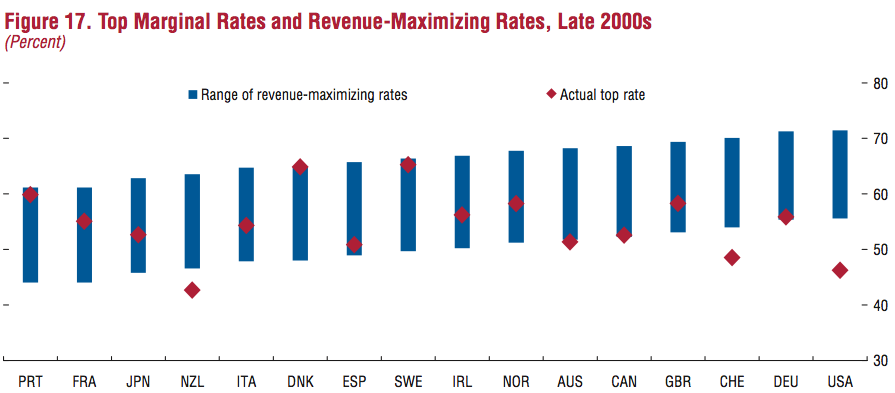
The first looks at major industrial nations, and compares what the IMF calls their Revenue-Maximizing Tax Rates (blue line) versus their actual top rate (red dot).
As you can see, some countries — Denmark and Sweden — are at the top of the revenue maximizing ranges. Other countries — Canada and Germany — are at the bottom of their revenue maximizing ranges.
Then there is the United States, which is simply far off the scale, way below the bottom of its revenue maximizing range.
If your concern is deficits, than you must take notice of how much money the USA is leaving on the table. I am not suggesting that the role of government should be to maximize their tax revenues, but rather to suggest that if you want to close the deficit, you need to at least be in a defendable range. The US is not.
click for ginormous charts

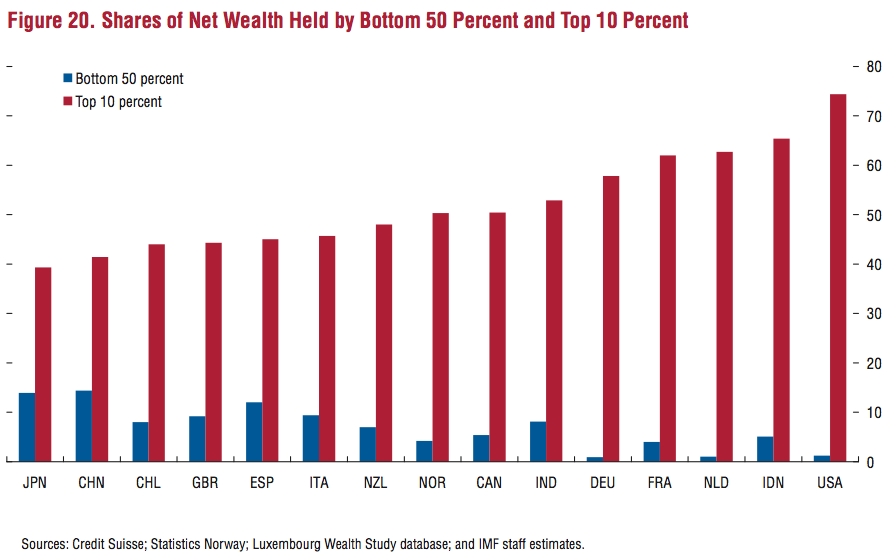
Source: IMFNot coincidentally, when we look at shares of Net Wealth held by the bottom 50% of he population versus the top 10%, the United States is off the scale. We are the most unequal nation in the world.

Source: IMFThe inescapable conclusion presented to us by this data is that our tax policy is responsible for both the world’s greatest inequality among developed nations, and our ongoing deficits.
If you have a better explanation for our current conditions, or the net results of our tax policies, I would love to hear it.
Source:
Fiscal Monitor Taxing Times
World Economic and Financial Surveys
IMF October 2013
http://www.imf.org/external/pubs/ft/fm/2013/02/fmindex.htm
Did Monetary Policy Cause the Recovery? – John Hussman. A very nice demolition of our monetary policy charade for Janet Yellen to consider. Let’s hope she has the guts to make some heads roll [i.e., to bring back honest accounting].
[…] To address this question, a proper understanding of the credit crisis is essential. Much of the present faith in monetary policy derives from the belief that it was the central factor in ending the banking crisis during what is often called the Great Recession. On careful analysis, however, the clearest and most immediate event that ended the banking crisis was not monetary policy, but the abandonment of mark-to-market accounting by the Financial Accounting Standards Board on March 16, 2009, in response to Congressional pressure by the House Committee on Financial Services onMarch 12, 2009. The change to the accounting rule FAS 157 removed the risk of widespread bank insolvency by eliminating the need for banks to make their losses transparent. No mark-to-market losses, no need for added capital, no need for regulatory intervention, recievership, or even bailouts. Misattributing the recovery to monetary policy has contributed to a faith in its effectiveness that cannot even withstand scrutiny of the 2000-2002 and 2007-2009 recessions, and the accompanying market plunges. This faith is already wavering, but the loss of this faith will be one of the most painful aspects of the completion of the present market cycle. […]
The simple fact is that the belief in direct, reliable links between monetary policy and the economy - and even with the stock market - is contrary to the lessons from a century of history. Among the many things that are demonstrably nottrue - and can be demonstrated to be untrue even with simple scatterplots - are the notions that inflation and unemployment are negatively related over time (the actual correlation is close to zero and slightly positive), that higher inflation results in lower subsequent unemployment (the actual correlation is positive), that higher monetary growth results in subsequent employment gains (the correlation is almost exactly zero), and a wide range of similarly popular variants. Even "expectations augmented" variants turn out to be useless. Examining historical evidence would be a useful exercise for Econ 101 students, who gain an unrealistic sense of cause and effect as the result of studying diagrams instead of data.
Thursday, September 19, 2013
The Fed is (probably) insolvent; bank margins to suck more
John Hussman has come and said what many have believed for some time now, that the Fed is probably insolvent (here).
The Fed has become the dumping ground for bad assets. Here’s what happens: they take them in from the banks at some highly notional (what is called “mark to unicorn”) value and hold them as “reserves” against the bank’s putatively active lending; which may or may not occur because the Fed now pays interest on reserves even as the reserves are likely deteriorating in value.
The Fed is the proverbial carpet under which the bad debt of the banking system is swept. Hence, the creditors and owners of banks and bank holding companies are relieved of having to recognize losses, and the fiction of “simulative monetary policy” is maintained. As Zero Hedge is fond of pointing out, the only known transmission mechanism from loose money to anything is to asset bubbles, the current one being stocks again, with a bubblet appearing in real estate.
This is capitalism without failure writ large. The antidote, in the view of the “Washington [/New York] consensus” (to borrow a term) is “more of the same.”
Like Bernanke, Janet Yellen didn’t a thing coming of the last crisis (even though the world-wide ramp-up of housing pricing made front page news in “The Economist,” as I recall.
And I can say from personal experience that many in retail banking wondered what would happen to Consumption when the housing ATM was shut off.
Thus I believe MMT will win out in the end, as war and/or infrastructure projects demand funding. Whether a major inflation or hyperinflation gets going remains an open question to me, as I believe an inflation (wage-price spiral) is a labor market phenomenon accommodated by monetary policy, and there seems little indication that the PTB have any intention of raising anybody’s wages.
Bad debts, those destined for charge-off, don’t go away by themselves; they have to be charged off. A major deflation will occur when that reconciliation finally takes place. Even if accounting fiction remains in place, the fact that such debts when returned to the banking system do not contribute revenues tells us bank margins are going to get a lot thinner in the future. A bank may be able to dress up its balance sheet but not so much its income statement.
Friday, January 11, 2013
Another comment on Modern Monetary Theory
I continue to believe that the attraction of MMT to modern liberals like Jamie Galbraith and Warren Mosler (I consider myself a classical liberal) is that something like the trillion dollar coin enables an end run around the fecally impacted banking system to get an inflation going, when the debt-deflationary forces in the private economy and banking system—in which, it is true to say, all money is debt—are overwhelming even Helicopter Ben’s attempts to get a nice, mild inflation going.
It might work, especially if accompanied by starting (or expanding) a significant war effort, but of course the fundamental problem is the Fed, especially since that great conservative Richard Nixon took us off the gold standard (he also opened the door for that gi

Source: Rogoff via businessinsider.com
The fact an establishment economist like Rogoff could present such material at the annual economics meetings, and that Krugman and the White House won’t issue non-denial denials that they are taking this seriously, tells me that we are very close to the unraveling of the Bretton Woods II monetary system, and possibly to some fundamental change in the way the Fed operates. There are rumors of a new monetary system in the works, and the way this is being sent out suggests to me it’s a trial balloon—so that they can come up with “the better idea.”
I just can’t imagine that the better idea will not involve some attempt to accelerate inflation, given the grip of the creditors on the sovereigns, and aggregate inability to clear bad debt out of the system.
Europe is showing the world what austerity looks like, and it ain’t pretty.
Wednesday, September 26, 2012
QEternity demolished
Via: What If the Fed Has It All Wrong
Hard not to pile on when monetary policy has become such a joke, but here is a thorough demolition of QEternity that addresses where the heads of the consumer, the ruling elite, the central bankers, and the youth of the world are at, and it ain’t pretty. The whole article is must reading. From the concluding remarks:
While the Fed waits for the wealth effect to take effect, the European Central Bank is also waiting for its own Godot following Draghi's magic with the ECB rules and regulations. Super Mario's "whatever it takes" promise is powerful, but not without pitfalls:
- When, if ever, will the Eurozone achieve the necessary banking and fiscal unions?
- Will Spain and Italy surrender before it is too late?
- Will ever more austerity finally work?
- When will the debt spiral stop?
- How much longer will the Germans put up with the situation, accepting that the ECB ruins its balance sheet taking unlimited risk on behalf of the German taxpayers, risking their fiscal sovereignty to save the "reckless Southerners"?
- How much longer will the hordes of unemployed young Europeans put up with the situation?
Bankers have indeed delivered. In truth, however, they are merely experimenting with totally unproven ways and means, hoping to gain enough time until more responsible politicians emerge. Given the significant risk still facing us until Godot arrives, investors should await more evidence that either earnings resume their uptrend or some kind of miracle(s) happen.
Equity holdings should be trimmed to conservative levels. Sustainable income should be favored. Cash earns essentially nothing, but is safe for now. Gold remains attractive for many, many obvious reasons.
Thursday, September 13, 2012
Ben’s bubble theory of monetary stimulus
Via: www.zerohedge.com
I am quoting liberally because this coverage of today’s press conference gets to the heart of the matter, that the only tool the Fed has to deal with an economy struggling under a debt load it can’t handle is to inflate it out. But Ben, the American people are scared stiff of the stock market and have come to the conclusion that Wall Street is a rigged game, are scared stiff of buying a home (if they can come up with the down payment). The other prescient insight, this one offered by Charles Hugh Smith also on zero, is that the only monetary surprises left are negative, which taken together with the fact that last several stock market advances have been undergirded by QE or Twist activities, could mean either that (1) the market will take off now for an extended upward leg, or (2) it won’t; it will collapse as the economy undeniably goes into recession. Speaking on behalf of John Q. Public, who is quaking in his boots about holding on to his job and possibly his house, I don’t find those odds appealing. We are heading into a period of unprecedented monetary instability.

The Punchline In His Own Words: Bernanke Advocates Blowing Asset Bubbles As The Antidote To Depression
If there was one absolutely must see moment exposing everything that is broken with the Fed's brand new policy of QE-nfinity, it was this exchange between Reuters' Pedro da Costa and the Chairman. It explains, beyond a reasonable doubt, that the only goal the Fed now has is to reflate the stock market bubble to previously unseen levels, to focus on generating jobs although not for everyone but only for Wall Street, consequences be damned, because by the time the consequences arrive, and they will (just recall that subprime is contained) they will be some other Fed chairman's problem. Bernake's term mercifully runs out in January 2014.
From the official transcript:
QUESTION: My question is -- I want to go back to the transmission mechanism, because speaking to people on the sidelines of the Jackson Hole conference, that seemed to be the concern about the remarks that you made, is that they could clearly see the effect on rates and they could see the effect on the stock market, but they couldn't see how that had helped the economy.
So I think there's a fear that over time this has been a policy that's helping Wall Street, but not doing that much for Main Street. So could you describe in some detail, how does it really different -- differ from trickle-down economics,where you just pump money into the banks and hope that they lend?
BERNANKE: Well, we are -- this is a Main Street policy, because what we're about here is trying to get jobs going. We're trying to create more employment. We're trying to meet our maximum employment mandate, so that's the objective. Our tools involve -- I mean, the tools we have involve affecting financial asset prices, and that's -- those are the tools of monetary policy.
There are a number of different channels -- mortgage rates, I mentioned other interest rates, corporate bond rates, but also the prices of various assets, like, for example, the prices of homes. To the extent that home prices begin to rise, consumers will feel wealthier, they'll feel more -- more disposed to spend. If house prices are rising, people may be more willing to buy homes because they think that they'll, you know, make a better return on that purchase. So house prices is one vehicle.
Stock prices -- many people own stocks directly or indirectly. The issue here is whether or not improving asset prices generally will make people more willing to spend.
One of the main concerns that firms have is there's not enough demand. There are not enough people coming and demanding their products. And if people feel that their financial situation is better because their 401(k) looks better or for whatever reason -- their house is worth more -- they're more willing to go out and spend, and that's going to provide the demand that firms need in order to be willing to hire and to invest.
And there you have it.
Wednesday, August 1, 2012
Pictures of monetary instability
Via: FT
In line with my thesis that the coming years will feature a degree of monetary instability unprecedented in human history, beginning with ubiquitous negative real rates that are the scourge of banks….
Negative rates as a precursor to the death of banking
Posted by Izabella Kaminska on Jul 31 16:02.FT Alphaville has presented its case on negative rates and zero deposit rates here andhere (amongst other places).
What we believe is that rather than stimulating the lending market — and the economy along with it — such a rate policy could have a disastrous impact on collateral markets and money market funds, not to mention the net interest income of lending institutions. All of which could unleash a protracted deflationary spiral.
The move could also presage the death of banks and lending institutions completely. […]
Check out the pictures of some major yield curves around the world:
UK:

Australia:

Switzerland:

If you buy the argument that central banks this far gone down the path of excessive accommodation lo this past forty years have only one option left to serve their masters, the fiscal authorities and the creditors, inflate or die, then keep in mind that historically, the quickest way to get an inflation going is to start a big war.
I am beginning to see why Charles Nenner says there is no free will—yet I retain hope that there is.
Tuesday, June 12, 2012
Kindleberger: cutting to the chase
Professors DeLong and Eichengreen have an oh-so-hagiographic foreword to a new edition of Kindleberger’s classic text, which I will admit to not having read. However, as a believer that financial fundamentals matter, as much as politics, in a political economy, I find their worship and Kindleberger’s analysis strangely obtuse. Kindleberger’s three main points about financial crises make no mention of leverage.
First, panic. Kindleberger argued that panic, defined as sudden overwhelming fear giving rise to extreme behaviour on the part of the affected, is intrinsic in the operation of financial markets.[…]
Kindleberger’s second key lesson, closely related, is the power of contagion.[…]
[T]he third positive alternative of international institutions with real authority and sovereignty is pressing.”
(source)
Well, doh! We created a fiat monetary system that confers huge benefits of seigniorage on banks (just as MMT would do for governments) and one thing you can say about human primates is that, historically speaking, they’re as greedy and nasty as chimpanzees. What group of humans given the ability to print money wouldn’t end up abusing the privilege?
Once the banks capture the regulators, leverage shoots up, and the potential for entirely rational panic, and rationally justifiable contagion, skyrocket.
Only Acemoglu and Robinson get it, fundamentally. Mainstream economics is still discussing mechanical models of the economy in the Newtonian mode.
There will be no economic recovery until there is political reform. And that won’t happen as long as Citizens United vs. US stands as is.
The priests of the status quo always look to the pope for the solution….
As we write, the North Atlantic world appears to have fallen foul to his bad outcome (c), with extraordinary political dysfunction in the US preventing its government from acting as a benevolent hegemon, and the ruling mandarins of Europe, in Germany in particular, unwilling to step up and convince their voters that they must assume the task.
I love that—a “benevolent hegemon”! If only I could believe that what they don’t mean by that is transferring more bad debt onto the backs of taxpayers, whether overtly or through monetary debasement, aka QE.
Monday, October 17, 2011
The central bank shell game
Per David Rosenberg, h/t www.patrick.net
Banks pump and dump bad debt on to securitization markets (with the help of greedy fee-earning Wall Street banks and whoring ratings agencies)… bad debt spreads to banks across the face of the Earth, destabilizing financial markets… central banks buy up bad debt to hide it on their opaque balance sheets… sovereign governments back the bad debt purchased by the central banks… commercial banks in the meanwhile load up on sovereign bonds to have some assets on their balance sheets while consumers and businesses are not doing a lot of borrowing… and, mirabile dictu, the sovereigns start to wobble and the commercial banks are back where they started from….
Thanks Richard Nixon, for putting the world on fiat money. Thanks Alan Greenspan and Ben Bernanke for saying there’s no loan that can’t be made.
If the Republicans win the White House, we will have fiscal contraction that will precipitate a second financial crisis as the bad debt pigeons come home to roost (not to mention the trillions of dollars of derivative bets that were made by institutions collecting “free money” by selling un-backed “protecition” on sovereign debt and all manner of other hideous paper out there….
Out of options – David Rosenberg
Saturday, October 1, 2011
Meltdown
h/t zerohedge.com
Part 1 here. This Aljazeera documentary is chockerblot with high-profile insiders from the Western financial world. What does that tell you?
If you haven’t watch Inside Job, watch it now. It used to be available for free online, but I don’t find it now.
Subscribe to:
Posts (Atom)