Showing posts with label China. Show all posts

Saturday, May 17, 2014

Waiting for that Nixon-in-China moment

The US strategy toward Russia and the Ukraine is following the neocon playbook: contain Russia, prevent the pan-Asian trade zone from happening.

At one time I believe we fought (another illegal) war in Vietnam to “contain” China, a vast country on the brink of abandoning old-style Communism well before the Soviet Union fell.

Nixon went to China in 1972, before the fall of Saigon. Deng beat out Mao’s chosen successor in the late Seventies and started liberalizing the economy in about 1980, just as the US was abandoning capitalism for right-wing plutocracy.

Subsequently trade with China helped the diminishing American middle class via inexpensive imports, even as it aided its diminishment by taking some of its jobs.

Wouldn’t it be nice if, instead of vilifying Gorbachev, Putin could take Gorbachev’s advice and permit democracy to flourish? And if Obama could see that Russia, like China, is a huge market with little sovereign debt that we are going to lose?

But we seem to be on the downside of a long wave in a time when confidence fails everywhere, a time, as Martin Armstrong points out, in which governments almost everywhere exist in a state of sclerotic corruption and codependency with the international plutocracy that seems ultimately to serve only the families of the plutocrats.

May the meek inherit the Earth on the other side of this. And meanwhile, pity the poor broke Ukrainians, caught between two mad plutocracies who want the black Ukrainian soil but not their debts and who are trying to figure out if a war might give them clear title.

Saturday, March 22, 2014

Petrodollar alert

In case you missed it, ZeroHedge caught the announcement of a non-dollar-denominated energy deal between Russia and China:

Petrodollar Alert: Putin Prepares To Announce "Holy Grail" Gas Deal With China

China will sell US Treasuries to buy Russian oil, and Russia will stop borrowing from Western banks, is the general idea.


Tuesday, April 24, 2012

Acemoglu and Robinson’s blind spot

Today’s must read is a compelling expression of nausea at the state of American political economy by itself and compared to that of the Chinese.  As someone who has spent a little time in China, I can say that there is a greater sense of the collective welfare there than in America, perhaps driven by higher kinship coefficients across the population.

When I try to explain my politics to folks I generally say something like, “I’m out there at the intersection of Noam Chomsky and Ron Paul and Simon Johnson and Acemoglu and Robinson and Richard Wilkinson…,” and if their eyes glaze over that’s generally the end of the conversation.  The learned helplessness of the American people is stunning, but they keep falling for the lies of the false god of Econ spun by the politicians.

I believe the wedge that will drive reform—if we escape falling into a repressive neofeudalism that could persist for a century—will be a Constitutional amendment to repeal Citizens United, to state once and for all (and these are terms that people should be able to understand) that corporations are not people, money is not speech.

From The American Conservative:

China’s Rise, America’s Fall

Tuesday, August 31, 2010

Links 8/31/2010

The Paradox of the Zero Bound – Hussman  The first intelligent discussion of why the yield curve might not work predicting recession in a Zero Interest Rate Policy environment, using Japanese data and data from America in the 1930s, when the relationship broke down.  I will revisit this issue in the next “animal spirits” update.

http://www.youtube.com/watch?v=pObxCXhf9-E&feature=channel  What GM is doing in China with SAIC.  Are you aware of the $60 billion China expo, themed “Better City, Better Life”?  Check it out.

Beware those who think the worst is past Carmen Reinhart and Vincent Reinhar (h/t yves).  These are the folks who have looked at what over-indebtedness does to economic growth across virtually all available data:  growth slows down.

However, “recessions” or business slumps in the classic sense are characterized by a failure of confidence and negative skewness of the growth rate.  The next failure of confidence does not appear to be imminent—not to say we can’t have a negative quarter of GDP growth here and there, as the forecast is for negligibly positive real growth into the next slump, which is going to be a doozy.

Thursday, September 17, 2009

What it’s like in China today

First-rate video journalism.  China has seen 20 million migrant workers from the countryside lose their jobs in the past year and slip away back into the countryside.  Factory owners seem typically to run away leaving only a paper notice that the business has closed.  Stratfor has opined that disparities between city and countryside are the Achilles heel of the Chinese polity, and this video confirms that social unrest may be rising in the form of greater demands for “human rights.”  Workers from the countryside are alleged to “forfeit their civil rights” when they migrate to the cities.  As with America, the problem of collapse of effective demand is distributional in the near term.  How is Chinese capitalism any different from the American variant, and why should the tendency toward neo-feudalism be any less--if not pronouncedly greater?  This is the problem posed by “the end of history,” or the “triumph” of neo-liberal-conservative sometimes “democratic” capitalism.

Growth theory tells us that a dollar or Yuan saved is not necessarily lost to final demand—it may be spent on capital formation.  The Chinese need only to use their savings internally instead of loaning them to us to achieve massive amounts of capital formation.  The government is firing up big infrastructure programs to do just that, while blowing some of its other bucks on energy and resource deals worldwide while the greenback is still worth anything.

I taught in Taiwan about a dozen years ago in an executive MBA program.  The buzz in that part of the world then was incredible.  I was surprised at the attitude of the Taiwanese toward the mainland, which at that time was beating up on Taiwan verbally pretty badly, with all kinds of threats of taking them over. 

“We are all Chinese,” they said. 

Friday, September 11, 2009

Last one investing in America is a rotten egg

Via:  www.nuwireinvestor.com h/t www.orlingrabbe.com

What Happens If The Yuan Replaces The Dollar As The Main Reserve Currency

Published on:

Wednesday, September 09, 2009

Written by:

Keith Fitz-Gerald

The chance that the dollar will be replaced by the Chinese yuan seems to be growing, as is China's determination to make it happen. With China's banking system holding 25 times the reserves of the US Federal Reserve, and the US adding trillions more to their debt, the days of the dollar's dominance may be nearing an end.

[snip]

The list of potential implications is very long, and includes several scenarios that are almost apocalyptic. But most of the outcomes raise as many questions as they answer.
Let’s consider the Top Five:

  • Global Gloom Leads to U.S. Doom: The U.S. dollar goes into freefall for the simple reason that if no country has to hold dollars any longer, they won’t. Instead – thanks to the ragged state of the U.S. government’s finances – many countries will dump greenbacks fast as they can, which will only put additional pressure on an already-strained U.S. financial system, which in turn will further damage our economy.
  • Inflation Inflates: Inflation will strike here with a vengeance, as anything bought, sold or priced in dollars will instantly rise in price to offset this fall.
  • Repatriation Risk: With the dollar serving as the world’s de facto currency, U.S. companies bear very little exchange rate risk when the time comes to repatriate assets or make currency-related adjustments. That would change overnight and prices throughout the value chains would rise sharply to compensate.
  • Money Costs More: The cost of money itself would rise. If the dollar falls, not only will there be massive selling pressure against it, but the cost of borrowing it will rise dramatically as lenders raise rates to cope with the increased risk of dollar-based transactions.
  • Death By Debt: And finally, if there is another reserve currency, other countries will no longer have to buy our debt, and you can guess where that will leave us – especially given the fact that we’ve taken on trillions in new debt to help finance our way out of our current mess.

My best guess is that we won’t see any one of these things in isolation, but will instead experience a blending of several or all of them. To the extent that China continues to absorb our inflationary influences, buy our debt in measured doses and maintain its reserves, we’ll probably have a measured decline in the value of the dollar – but not the catastrophic fall many in the doom, gloom and boom crowd are predicting. At the same time, I also see the IMF change course in the next few years to reflect China’s increasingly substantial influence and monetary power.[…]

Tuesday, September 8, 2009

China likes gold

Via:  Telegraph

China, Bernanke, and the price of gold

By Ambrose Evans-Pritchard Economics Last updated: September 7th, 2009

China has issued what amounts to the "Beijing Put" on gold. You can make a lot of money, but you really can't lose.

I happened to see quite a bit of Cheng Siwei at the Ambrosetti Workshop, a gathering of politicians and global strategists at Lake Como, including a dinner at Villa d'Este last night at which he listened very attentively as a number of American guests tore President Obama's economic and health policy to shreds.

Mr Cheng was until recently Vice-Chairman of the Communist Party's Standing Committee, and is now a sort of economic ambassador for China around the world — a charming man, by the way, who left Hong Kong for mainland China in 1950 at the age of 16, as young idealist eager to serve the revolution. Sixty years later, he calls himself simply "a survivior".

What he said about US monetary policy and gold – this bit on the record – would appear to validate the long-held belief of gold bugs that China has fundamentally lost confidence in the US dollar and is going to shift to a partial gold standard through reserve accumulation.

He played down other metals such as copper, saying that they could not double as a proxy currency or store of wealth.

"Gold is definitely an alternative, but when we buy, the price goes up. We have to do it carefully so as not stimulate the market," he said.

In other words, China is buying the dips, and will continue to do so as a systematic policy. His comment captures exactly what observation of gold price action suggests is happening. Every time it looks as if the bullion market is going to buckle, some big force steps in from the unknown.

Investors long-suspected that it was China. We later discovered that Beijing had in fact doubled its gold reserves to 1054 tonnes. Fait accompli first. Announcement long after.

Standing back, you can see that the steady rise in gold over the last eight years to $994 an ounce last week – outperforming US equities fourfold, even with reinvested dividends – has roughly tracked the emergence of China as a superpower in foreign reserve holdings (now $2 trillion).

As I have written in today's paper, Mr Cheng (and Beijing) takes a dim view of Ben Bernanke's monetary experiments at the Federal Reserve.

"If they keep printing money to buy bonds it will lead to inflation, and after a year or two the dollar will fall hard. Most of our foreign reserves are in US bonds and this is very difficult to change, so we will diversify incremental reserves into euros, yen, and other currencies," he said.

This line of argument is by now well-known. Less understood is how much trouble the Fed's QE policies are causing in China itself, where they have vicariously set off a speculative boom on the Shanghai exchange and in property. Mr Cheng said mid-level house prices are now ten times incomes.

"If we raise interest rates, we will be flooded with hot money. We have to wait for them. If they raise, we raise."

"Credit in China is too loose. We have a bubble in the housing market and in stocks so we have to be very careful, because this could fall down."

Of course, China cold end this problem by letting the yuan rise to its proper value, but China too is trapped. Wafer-thin profit margins on exports mean that vast chunks of Chinese industry would go bust if the yuan rose enough to close the trade surplus. China's exports were down 23pc in July from a year before even at the current exchange rate, and exports make up 40pc of GDP. "We have lost 20m jobs in this crisis," he said.

China's mercantilist export strategy has led the country into a cul-de-sac. China must continue to run its trade surplus. It must accumulate hundreds of billions more in reserves. Ergo, it must buy a great deal more gold.

Where is the gold going to come from?

Wednesday, June 17, 2009

On the coming neo-feudalism

It does seem as if the vast majority of people in the United State of America are going to become like medieval serfs, living at what feels in the post-gilded-age new realities like subsistence, watching a small slice of society from a distance as they jet in and out of the country, monopolize the ski resorts, continue to live in big houses with two or three thousand square per person, and so on.

The Baby Boom doesn’t have enough money to retire (quaint notion) and will be working till they drop, which will actually extend their lives.  The Gen X’ers will continue to live on scraps.  The Millennials are idealistically waiting their turn to be heroes while trying to find a way to support themselves in a workforce that is top-heavy with whining Boomers and cagey Gen X’ers.  Most of us will work for large or small corporations at a wage that is enough to support a modest lifestyle, but holidays will be spent close to home.  We will worry that we may be next to join the ranks of the unemployed, many of whom and whose stories we know—stories of lost jobs, houses, children’s sense of security in forced moves to strange communities.  The health consequences of the current crisis are no doubt predictable.  In a PBS special on other countries’ health programs, a German was asked if unemployed people lose their health benefits there.  Of course not, he said.  They are under great stress and risk to their health.  They need health benefits more than anyone. 

For a developed nation, America is a barbaric place.

Demand will not recover.  The Stimulus, piling upon preexisting terrifying trillions in deficits courtesy of Bush, will not work.  Spending will be cut to satisfy our external creditors.  The sheer weight of the debt will slow the economy.  The narrow U3 unemployment rate will rise into the double digits and stay there through the president’s term.  The “real” under- and unemployment rate U6 will hit twenty percent, and stay in the high teens. 

The poor and disenfranchised may even take to the streets at some point.  Americans are pretty timid now, worried that they’ll be called terrorists and disappear in the night or be put on the no-fly list.  Habeas corpus is gone.  Last September Hank Paulson said we may need martial law.  The government has been preparing for it.  There are empty prison camps standing ready, according to reliable reports.  (Many were built by Halliburton, allegedly.)  The Katrina experience showed us what to expect:  mercenaries will disarm the public; impose martial law; tell you to stay in your house or get shot.  FEMA’s National Level Exercise scheduled for late July is supposedly a counter-terrorism drill, but I would bet it involves practicing how to impose martial law.  Some believe the true purpose of the exercise itself will be to disarm the public.  Lots of luck with that.  That might provoke the first shots of a revolution.  But perhaps that is the intent, to show force and discourage any further dissent.  Like Iran now.  Like China twenty years ago.

Will President Obama be able to prevent this?  I don’t think so.  His government has thrown trillions at financial institutions, but we don’t even have workfare or income support for the long-term unemployed, and not everyone is even covered by unemployment insurance.  There are 25 million people in the U6 category today.  What happens when there are 50 million?  Will the government help them, or try to lock them all up?  We have a higher percentage of our population behind bars than any other developed country.  Will the fortunate just sit in their houses and hope that the Xe guys (formerly Blackwater—great name for a mercenary outfit) will protect them and their property from roving gangs? 

Americans have lost confidence in their government and themselves.  Their elected representatives do not listen to them.  The President is an agent of the status quo.  He has enabled the largest wealth transfer to a privileged elite in American history during the financial crisis, at the expense of the American taxpayer for years to come.  Does any American believe the new financial regulations will break the grip of the rich upon the resources of the nation?  Will we all come together all can-do, gung-ho style and pitch in together and the income distribution suddenly become more equal as it did in World War II and pull ourselves out of this? 

It ain’t happening.

These problems, of course, are replicated in many other countries, including our ostensible long-term rival and enemy, China.  Which is why the next ten years are a breeding ground for fascism around the world, and for the seeds of war.  We went into Iraq to build military bases to protect “our” oil, if push comes to shove.  But our military policies are backward-looking to the last war, as John Robb and others point out.  We will look pretty stupid when someone pulls off what Robb calls a systempunkt right here at home while we’re blowing billions in Afghanistan.  We don’t require our kids to get educated well.  Obama is backing off a single-payer health insurance plan, the one preferred by the American people and the one that makes the most sense from an insurance point of view.  The American social contract is broken.

People say Europe will be a museum in a decade, a lot of pretty castles and tourist attractions and mamoni hanging around at cafes.  America might be like a ski resort, with some beautiful neighborhoods in the cities and trailer parks outside where the workers and retired people live.  The Chinese will buy up real estate and companies and immigrate in large numbers, as they did to Vancouver from Hong Kong, having bought enough members of Congress to get their way.  They won the financial war, fair and square.  They might even teach us how to make state capitalism work, as the Japanese taught us how to make quality automobiles.

Or we could try democracy, for a change.

Tuesday, June 16, 2009

Tight Spot for Fed, Blind Spot for Investors

Via:  Caijing.com.cn  h/t Zero Hedge.  Pretty well sums up the macro circus of the last four decades.  I liked the fact that he recognizes the role of “animal spirits” in what’s happening now.

Market chatter over green shoots and rising prices has fueled a bear market rally that won't last, despite policymaker 'noise.'

By Andy Xie, guest economist to Caijing and a board member of Rosetta Stone Advisors Ltd.

(Caijing Magazine) A combination of growth optimism and inflation fear has catapulted asset markets in the past few weeks. These two concerns should drive markets in different directions: Inflation fear, for example, should limit room for stimulus and prompt stock markets to retreat. But the investment camps expressing these opposite concerns go separate ways, each pumping up what seems believable. As a result, stock and commodity markets are mirroring the behavior seen during the giddy days of 2007.

Regardless of what investors or speculators say to justify their punting, the real driving force is the return of animal spirit. After living in fear for more than a year, they just couldn't sit around any longer. So they decided to inch back. The resulting market appreciation emboldened more people. All sorts of theories began to surface to justify the market trend. Now that the rising trend has been around for three months globally and seven months in China, even the most timid have been unable to resist. They're jumping in, in droves.

When the least informed and most credulous get into the market, the market is usually peaking. A rising economy and growing income produces more funds to fuel the market. But the global economy is now stuck with years of slow growth. Strong economic growth won't follow the current stock market surge. This is a bear market rally. People who jump in now will lose big.
Over the past three weeks, the dollar dove while oil and treasury yields surged. These price movements exhibited typical symptoms of inflation fear, which is complicating policymaking around the world. The United States, in particular, could be bottled in. The federal government's fiscal stimulus and liquidity pumping by the Federal Reserve are twin instruments for propping up the bursting U.S. economy. The fiscal deficit could top US$ 2 trillion (15 percent of GDP) in 2009. That would increase by one-third the total stock of federal government debt outstanding. Such a massive amount of federal debt paper needs a buoyant Treasury to absorb. If the Treasury market is a bear market, absorption becomes a huge problem.

U.S. Treasury Secretary Timothy Geithner recently visited China to, among other things, persuade China to buy more Treasuries. According to a Brookings Institution estimate, China holds US$ 1.7 trillion in U.S. Treasuries and GSE paper (about 15 percent of the total stock). If China stops buying, it could plunge the Treasury market into deep bear territory. If China does not buy, the Treasury market will get worse. But China can't prop up the market by buying.

In the past few years, purchases by central banks around the world have dominated demand for Treasuries. Central banks have been buying because their currencies are linked to the dollar. Hence, such demand is not price sensitive. The demand level is proportionate to the U.S. current account deficit, which determines the amount of dollars held by foreign central banks. The bigger the U.S. current account deficit, the greater the demand for Treasuries. This is why the Treasury yield was trending down during the bulging U.S. current account deficit period 2001-'08.

This dynamic in the Treasury market was changed by the bursting of the U.S. credit-cum-property bubble. It is decreasing U.S. consumption and the U.S. current account deficit. The 2009 deficit is probably under US$ 400 billion, halved from the peak. That means non-U.S. central banks have much less money to buy, while the supply is surging. It means central banks no longer determine Treasury pricing. American institutions and families are now marginal buyers. This switch in who determines price is shifting Treasury yields significantly higher.

The 10-year Treasury yield historically averages about 6 percent, with about 3.5 percent inflation and a real yield of 2.5 percent. This reflects the preferences of marginal buyers in the United States. Foreign central banks have pushed down the yield requirement substantially over the past seven years. If marginal buyers become American again, as I believe, Treasury yields will surge even higher from current levels. Future inflation will average more than 3.5 percent, I believe. Some policy thinkers in the United States believe the Fed should target inflation between 5 and 6 percent. The Treasury yield could rise to between 7.5 and 8.5 percent from the current 3.5 percent.

A massive supply of Treasuries would only worsen the market. The Federal Reserve has been trying to prop the Treasury market by buying more than US$ 300 billion – a purchase that's backfired. Treasury investors are terrified by the inflation implication of the Fed action. It is equivalent to monetizing national debt. As the federal deficit will remain sky-high for years to come, the monetization could become much larger, which might lead to hyperinflation. This is why the Treasury yield has surged in the past three weeks.

One possible response is to finance the U.S. budget deficit with short-term financing. As the Fed controls short-term interest rates, such a strategy could avoid the pain of high interest rates. But this strategy could crash the dollar.

The dollar index-DXY has fallen 10 percent from the March level, even though the U.S. trade deficit has declined substantially. It reflects the market's expectations that the Fed's monetary policy will lead to inflation and a dollar crash. The cause of dollar weakness is the outflow of U.S. money, in my view. It is the primary cause of a surge in emerging markets and commodities. Most U.S. analysts think the dollar's weakness is due to foreigners buying less of it. This is probably incorrect.

The dollar's weakness can limit Fed policy options. It heightens inflation risks; a weak dollar imports inflation and, more importantly, increases inflation expectations, which can be self-fulfilling in today's environment. The Fed has released and committed US$ 12 trillion (83 percent of GDP) for bailing out the financial system. This massive overhang in money supply could cause hyperinflation if not withdrawn in time. So far, the market is still giving the Fed the benefit of the doubt, believing it will indeed withdraw the money. Dollar weakness reflects the market's wavering confidence in the Fed. If the wavering continues, it could lead to a dollar collapse and make inflation self-fulfilling.

The Fed may have to change its stance, even using token gestures, to assure the market it won't release too much money. For example, signaling rate hikes would soothe the market. But the economy is still in terrible shape; unemployment may surpass 10 percent this year. Any suggestion of hiking interest rates would dampen growth expectations. The Fed is caught between a rock and a hard place.

Oil prices have doubled since a March low, even though global demand continues to decline. The driving forces again are expectations of inflation and a weaker dollar. As U.S.-based funds flee, some of the money has flowed into oil ETFs. This initially impacted futures prices, creating a huge gap between cash and futures prices. The gap increased inventory demand as investors tried to profit from the gap. Rising inventory demand caused spot prices to reach parity with futures prices. Rising oil prices, though, lead to inflation and depress growth. It is a stagflation factor. If the Fed doesn't rein in weak dollar expectations, stagflation will arrive sooner than I previously expected.

Stagflation in the 1970s spawned the development of rational expectation theory in economics. Monetary stimulus works by fooling people into believing in money's value while the central bank cheapens it. This perception gap stimulates the economy by fooling people into demanding more money than they should. Rational expectation theory clarified the underpinning for Keynesian liquidity theory. However, as they say, people can't be fooled three times. Central banks that tried to use stimuli to solve structural problems in the '70s saw their stimuli didn't work. People saw through what they tried again and again, and began behaving accordingly, which translated monetary stimulus straight into inflation without stimulating economic growth.

Rational expectation theory discredited Keynesian theory and laid the foundation for Paul Volker's tough love policy, which jagged up interest rates and triggered a recession. The recession convinced people that the central bank was serious about cooling inflation, so they adjusted their behavior accordingly. Inflation expectations fell sharply afterward. The credibility that Volker brought to the Fed was exploited by Alan Greenspan, who kept pumping money to solve economic problems. As I have argued before, special factors made Greenspan's approach effective at the same. Its byproduct was asset bubbles. As the environment has changed, rational expectation theory will again exert force on the impact of monetary policy.

Movements in Treasury yields, oil and the dollar underscore the return of rational expectation. Policymakers have to take actions to dent the speed of its returning. Otherwise, the stimulus will lose traction everywhere, and the global economy will slump. I expect at least gestures from U.S. policymakers to assuage market concerns about rampant fiscal and monetary expansion. The noise would be to emphasize the "temporary" nature of the stimulus. The market will probably be fooled again. It will fully wake up only in 2010. The United States has no way out but to print money. As a rational country, it will do what it has to, regardless of its rhetoric. This is why I expect a second dip for the global economy in 2010.

While inflation expectations are causing some in the investor community to act, the rest are betting on strong economic recovery. Massive amounts of money have flowed into emerging markets, making it look like a runaway train. Many bystanders can't take it any longer and are jumping in. Markets, after trending up for three months, are gapping up. Unfortunately for the last-minute bulls, current market movements suggest peaking. If you buy now, you have a 90 percent chance of losing money when you try to get out.

Contrary to all the market noise, there are no signs of a significant economic recovery. So-called green shoots in the global economy are mostly due to inventory cycles. Stimuli might juice up growth a bit in the second half 2009. Nothing, however, suggests a lasting recovery. Markets are trading on imagination.

The return of funds flowing into property is even more ridiculous.  A property burst usually lasts for more than three years. The current burst is larger than usual. The property market is likely to remain in bear territory for much longer. The bulls are talking about inflation as the bullish factor for property. Unfortunately, property prices have risen already and need to come down even as CPI rises. Then the two can reach parity.

While rational expectation is returning to part of the investment community, most investors are still trapped by institutional weakness, which makes them behave irrationally. The Greenspan era has nurtured a vast financial sector. All the people in this business need something to do. Since they invest other people's money, they are biased toward bullish sentiment. Otherwise, if they say it's all bad, their investors will take back the money, and they will lose their jobs. Governments know that, and create noise to give them excuses to be bullish.

This institutional weakness has been a catastrophe for people who trust investment professionals. In the past two decades, equity investors have done worse than those who held U.S. market bonds, and who lost big in Japan and emerging markets in general. It is astonishing that a value-destroying industry has lasted so long. The greater irony is that salaries in this industry have been two to three times above what's paid in other sector. The key to its survival is volatility. As markets collapse and surge, possibilities for getting rich quickly are created. Unfortunately, most people don't get out when markets are high, as they are now. They only take a ride.

Indeed, most people who invest in the stock market get poorer. Look at Japan, Korea and Taiwan: Even though their per capita incomes have risen enormously over the past three decades, investors in these stock markets lost money. Economic growth is a necessary but not sufficient condition for investors to make money in the stock market. Most countries, unfortunately, don't possess the conditions for stock markets to reflect economic growth. The key is good corporate governance. It requires rule of law and good morality. Neither is apparent in most markets.

It's a widely accepted notion that long term stock investors make money. Actually, this is not true. Most companies don't last for more than 20 years. How can long term investment make money for you? The bankruptcy of General Motors should remind people that this notion is ridiculous. General Motors was a symbol of the U.S. economy, a century-old company that succumbed to bankruptcy. In the long run, all companies go bankrupt.

Property on the surface is better than the stock market. It is something physical that investors can touch. However, it doesn't hold much value in the long run either. Look at Japan: Its property prices are lower than they were three decades ago. U.S. property prices will likely bottom below levels of 20 years ago, after adjusting for inflation.

China's property market holds even less value in the long run. Chinese properties are sitting on land leased for 70 years for residential properties and 50 years for commercial properties. Their residual values are zero at the end. The hope for perpetual appreciation is a joke. If you accept zero value at the end of 70 years, the property value should only be the use value during those 70 years. The use value is fully reflected in rental yield. The current rental yield is half the mortgage interest rate. How could properties not be overvalued? The bulls want buyers to ignore rental yield and focus on appreciation. But appreciation in the long run isn't possible. Depreciation is, as the end value is zero.

The world is setting up for a big crash, again. Since the last bubble burst, governments around the world have not been focusing on reforms. They are trying to pump a new bubble to solve existing problems. Before inflation appears, this strategy works. As inflation expectation rises, its effectiveness is threatened. When inflation appears in 2010, another crash will come.
If you are a speculator and confident you can get out before it crashes, this is your market. If you think this market is for real, you are making a mistake and should get out as soon as possible. If you lost money during your last three market entries, stay away from this one – as far as you can.

Tuesday, June 9, 2009

The new realities

The demand for short-term Treasuries spikes as doubts grow about Fed Chairman Ben Bernanke’s ability to contain inflation and to prevent depreciation of the dollar on the foreign exchange markets:

image

Via:  Telegraph

The head of China's second-largest bank has said the United States government should start issuing bonds in yuan, rather than dollars, in the latest indication of the increasing importance of the Chinese currency.

How insulting!  Forecasting is difficult and should be practiced often, but I am sticking with my basically deflationary view in the near term.   Reasons?  (1)  There is simply too much excess capacity in the world; (2) consumers in the rich world are flat on their backs along with their banks; (3) the Fed has shown a preference for instigating asset bubbles rather than wage-price spirals since Greenspan and the clueless central bankers of the fiat funny-money systems of the world are all imitating the Fed; and (4) the Fed doesn’t deflate asset bubbles (it actually seems to like them).  We may get consumer price inflation, but it will take years.

One of the “secrets” of financial management, taught in virtually every introductory finance textbook, is that recessions are predictable with a high degree of confidence.  Each time the yield curve has inverted over the postwar business cycle a business slump has followed within an average of 13 months.  Nitpickers will say the 1965 inversion was a failure—but notice that I said “slump”—the economy’s growth rate in 1966 during the guns-and-butter boom dropped about ten percentage points but didn’t quite quality as a recession.  The yield curve was steeply inverted in 1929 as well.  Here is a chart of the 1/10 yield curve:

image

Those who are looking for a W-shaped double dip recession such as occurred in 1980-1982 are going to have to show me an inversion of the yield curve to convince me it’s going to happen (although I like the irony immensely, as it was George W. who fatally busted the U.S. government’s budget—and the Republican party—in one fell swoop).  And from these levels of steepness and absent tightening by the Fed that is not going to happen anytime soon it would take a massive change in demand patterns from domestic and international holders of U.S. Treasury debt to accomplish an inversion.  The U.S. may enjoy relatively low short-term rates for quite a while.

I am not saying the economy is going to grow rapidly or that unemployment will stop going up.  My baseline case calls for the standard measure of unemployment to exceed 11 percent within a year.  But the economy will soon stabilize and grow slowly, cramped by the debt load on Americans.  My suggestion for an appropriate government policy is livable workfare and national health care for the unemployed, and let the market and investment tax credits take care of the rest.  To do nothing (“Cut government spending!  Let it play out!  Cut welfare for the bums at the bottom!”) is just to shout out to the world, “The social contract in America is broken!”  (See this for my take on the big picture.)  The recently publicized statistics on our national health relative to other countries bears out that our social brokenness has physical health consequences.

My recession forecasting model (update here) saw trouble coming way back in 2005, and saw the end of the recession in first half 2009 from early 2008.  The economy has its own dynamics; the causal attributions we read about in the press are illusory.  Confidence or “animal spirits” largely drives turns in the business cycle, and the confidence of Americans is coming back (you can’t panic forever).  The economy was going to stabilize in first half 2009 no matter what the government did, including the massive transfer of wealth to some of the richest people in the country that happened with the banking bailout.  That was Panic of 2008 greed-grabbing under the guise of preventing “total financial meltdown.”  You gotta hand it to Hank Paulson—he actually threatened that the country would need to go under martial law if he didn’t get his way (watch this).  At least the government lent most of the money to the banks, and didn’t buy the toxic assets at par as Paulson would have done.  The taxpayers should get their TARP money back over time at 5 percent.

Not that the ruling class is no longer fearful of social chaos.  FEMA is practicing for martial law this summer with “National Level Exercise 2009” that should be interesting as it is a matter of public record that several large-scale “counter-terrorism training exercises” were under way during 9/11.

Source:  http://www.fema.gov/media/fact_sheets/nle09.shtm

National Level Exercise 2009 (NLE 09)

National Level Exercise 2009 (NLE 09) is scheduled for July 27 through July 31, 2009. NLE 09 will be the first major exercise conducted by the United States government that will focus exclusively on terrorism prevention and protection, as opposed to incident response and recovery.

NLE 09 is designated as a Tier I National Level Exercise. Tier I exercises (formerly known as the Top Officials exercise series or TOPOFF) are conducted annually in accordance with the National Exercise Program (NEP), which serves as the nation's overarching exercise program for planning, organizing, conducting and evaluating national level exercises. The NEP was established to provide the U.S. government, at all levels, exercise opportunities to prepare for catastrophic crises ranging from terrorism to natural disasters.

NLE 09 is a White House directed, Congressionally- mandated exercise that includes the participation of all appropriate federal department and agency senior officials, their deputies, staff and key operational elements.  In addition, broad regional participation of state, tribal, local, and private sector is anticipated.  This year the United States welcomes the participation of Australia, Canada, Mexico and the United Kingdom in NLE 09.

EXERCISE FOCUS

NLE 09 will focus on intelligence and information sharing among intelligence and law enforcement communities, and between international, federal, regional, state, tribal, local and private sector participants.

The NLE 09 scenario will begin in the aftermath of a notional terrorist event outside of the United States, and exercise play will center on preventing subsequent efforts by the terrorists to enter the United States and carry out additional attacks. This scenario enables participating senior officials to focus on issues related to preventing terrorist events domestically and protecting U.S. critical infrastructure.

[…]

I am disappointed to hear on NPT last night that the President’s suggestion to raise taxes on the rich to help finance health care reform is dead on arrival in Congress.  Raising marginal tax rates on the rich is one way to take the wind out of the sails of the ruling class (see these graphs) as Franklin Roosevelt did in the 1930s. 

I stick by the Strauss and Howe hypothesis that it will take a crisis worse than anything we can imagine now to knit the country back together—or not.  (See this and this.)  Be prepared for a new dark age, neofeudalism, stylishly mentioned as one of the “next big thing[s]” by Foreign Policy. 

The ruling class is going to keep a very tight grip on the country.  As Dmitri Orlov says, make friends with your local law enforcement or warlord, as the case may be.

Tuesday, June 2, 2009

Coppock update and Chimerica speculations

The blogosphere is rich with content this morning, so I am just going to confirm that the Coppock curve has indeed sent a buy signal (as have Coppock curves around the world; see this):

image

With P/Es over 100 a retest of the recent lows—or a false signal as in 2001-2002—would seem to be in prospect, as I view the current apparent stabilization of the economy and upturn in “animal spirits,” while real, to be merely an interruption of the U.S. economy’s descent into depression.  The fundamental problem has not been solved:  because of the inequality of the income distribution, most households simply don’t have enough money (and many have too much debt) to sustain a true recovery.  See this for my take on the really big picture.

George Friedman of stratfor.com thinks that China faces as great a problem with inequality between the coasts and the interior, pointing to a recurring pattern in Chinese history of opening up to the West, experiencing rapid growth along the trading coasts and relative stagnation in the agricultural interior, and a final turning away from outside engagement as social tensions force a turning inward.  If depressions are caused by massive income inequality, China is at risk. 

Niall Ferguson compares the Chinese-American relationship to a marriage between a spendthrift and a saver here.  China faces risk of depression over the next ten years if a collapse in export demand cannot be made up domestically in short order.  But China resembles the U.S. in 1930 in being the world’s greatest creditor.  It could emerge from the ~2020 crisis we anticipate in far better shape than the U.S.  But they would have to pull off the miraculous equalization of the income distribution that America experienced in World War II to have it happen, if our hypothesis is correct.

This is research, not investment advice.  You invest at your own risk.

Tuesday, May 19, 2009

WARNING: United States Credit Risk

Via: Market-Ticker   h/t orlingrabbe.com

Federal financial fascism on the march:  a federal government backstop to the states and localities is being contemplated.  Sooner or later America’s fiscal policies will cause a sell-off of the dollar, at which time it will be probably unbearably tempting to trick up some international chaos in the form of some sort of war or terrorist event to drive investors back to the good old greenback.   In this context Paul Krugman’s lecturing of the Chinese on currency valuations (who took us off the gold standard, Paul?) is truly bellicose.  See Krugman in China for this story.

In the context of our working hypothesis that the American social contract is broken and heading toward a crisis in about ten years, the implications of federalization of state and local debt (“financial fascism”) are these:  the states and localities are invited into moral hazard, just like Fannie and Freddie, as the article points out; the Constitution is further abrogated, as the states are strong-armed into obeying the federal government; the potential for vastly misguided macro policies at the national level is elevated and macro volatility increased (the Founders seemed to understand that sparsely connected networks are more stable than densely connected ones); ultimately, even after we’ve tried to scare the world into greenbacks, the BRICs, Euroland and Japan will figure out a way to go around us, and we will run up a good inflation to depreciate the debt while the BRICs are taking it out of our hide in currency devaluation; and without further change in the income distribution (see Debt and income inequality for some graphs suggesting that the real reason for our current collapse of effective demand is that income inequality has become so great most people simply don’t have enough money to spend to support recent levels of output)—that is to say, without a fundamental renegotiation of the American social contract such as occurred miraculously during World War II, that America a generation from now will be a banana republic with a tiny ruling class who will send their children to the right schools to get the right jobs in the right businesses and government agencies with the high pay that will be denied to the vast majority of working stiffs, who will be locked out of this calcification of the American dream in a class system that will be effectively feudal.  There will be lords and ladies, and serfs serving them, is the way it will feel.  Sound familiar?  Could get much worse.

How might a new social contract come about, when our elected representatives lie to us so easily (“Yes we can!”), so powerless themselves to change the status quo?  (I credit President Obama with making health care his top priority, as the bottom half are going need help as the depression matures.)  How we truly change America is the question for the next decade.  Think about it, and please don’t hesitate let us know your thoughts.  For background see this and this.

Warning: United States Credit Risk

Yes, it really is at risk.

Through the first seven months of the fiscal year, the federal deficit has mounted up to a record $802.3 billion, compared with $153.5 billion at the same time last year. Income-tax receipts are down nearly 31% for the fiscal year so far.

People who are not making money - who are either unemployed or if self-employed are not profitable - don't pay taxes.

Ramping spending into such a situation is idiotic.  It is similar to you losing your job and going on a spending spree, running your credit cards to the moon before they are cut off.

You may rest assured that they WILL be cut off if you continue this behavior for very long.

Perhaps Japan is warning us of an impending cut-off?

Japan has been a major buyer of US government bonds, helping the US finance its Federal budget deficits.

But, he added, it would continue to buy bonds only if they were denominated in yen - the so-called samurai bonds.

We have not issued any so-called "samurai" bonds.  They should be better-called "Seppuku Bonds", because that is what they will do to The United States if we ever issue them.

To be fair, Japan's Democratic Party has poor prospects in their upcoming elections.  But should they actually gain enough sway to change policy, things get very interesting very fast for The United States, and not in a good way - more in a "Chinese Curse" sort of way.

See, in order to have a hyper-inflationary collapse of an economy, such as Weimar Germany, you must have debt denominated in some currency other than your own.  Iceland, for example, blew up in no small part due to a decent amount of their debt being denominated in other than their native currency.  Borrowers in Eastern Europe have discovered recently the danger of home mortgages written in Swiss Francs.

Such foreign-denominated debt seems to foreign borrowers to be "more fair" in that it places the risk of currency devaluation on the nation that undergoes it.  But what is often missed is that currencies don't always change value due to the actions of just one nation - that is, Japan's Yen could strengthen due to the actions of Japan, just as the the dollar could weaken due to the actions of The United States.

The insidious (and dangerous) reality of such a circumstance is that it creates a perverse incentive for the nation buying the debt denominated in its own currency to take actions that strengthen their currency, because doing so increases the value of the note they hold!  That is, they can increase your indebtedness by practicing fiscal restraint in their nation.

To permit such an event to occur is akin to walking around with a loaded pistol in your mouth with the slide gripped between your teeth, offering the grip end to anyone who walks by.

That is not a recipe for a long, healthy life.

Speaking of The United States doing dumb things that could destroy the nation, we've got this:

Fox Biz is reporting that the House Financial Services Committee is set to take up legislation this week that would establish a federal backstop for all Municipal bonds and muni insurance.

This would, of course, represent another massive expansion of the government's guarantees and turn all states into Fannie and Freddy.

Oh no, this bill is much worse than that.

Does anyone remember the "Drive 55" game the government played back during the energy "crisis"?  The threat was simple: either pass a 55mph speed limit for all roads, including those that were not interstate and thus not under federal jurisdiction in any way, shape or form, or lose all federal highway funding.

So what is this really about?  Let's be clear: It is about The Federal Government attempting to finalize the full federalization of every state in the union, removing any and all remaining sovereignty.

This sort of action is a blatant and outrageous attempt to rewrite The Constitution without actually doing so, by making the states subservient to The Federal Government's demands under threat of having their heroin supply interrupted.

This must not stand; those states that have passed or are considering resolutions declaring their rights under The Constitution must immediately upgrade those "resolutions" to laws, and be prepared to back them up with whatever is necessary.

Our Republic was designed with relatively strong states and a relatively weak Federal Government for a reason.

Simply put, it is more difficult to corrupt a government that is closer to the people.  An example can be found here:

The Washington Post reported last month on more than $150 million in federal funds that Murtha directed to the airport, which has six arriving and departing flights per day. Among the improvements, Murtha directed the Pentagon to give the airport a new, $8 million, state-of-the-art radar tower that has not been used since it was built in 2004, and $30 million for a new runway and tarmac so the airport could handle large military planes and become an emergency military base in case of crisis.

Now if The State Government wants to appropriate $180 million in state tax revenues for improvements based on those funds bringing more than $180 million in benefit to the state, so be it.

But when The Federal Government appropriates these funds they can take them from people 2,500 miles away, who have no use for the project and derive no benefit from it.

Another example of the same sort of outrage comes in the laws for state-chartered banks in many states that prohibit a state bank from accepting a deposit while that bank has a negative net equity position - that is, while it is insolvent.

There is no such law at the federal level, which is part and parcel of why we are in this economic mess and why over a trillion dollars, including $180 billion "passed through" AIG, was literally stolen from each and every American.

The Federal Government must not be allowed to insert its talons into each and every state's funding mechanisms. 

If it does, we will no longer be a union of states; the separation of states and their governments will quite literally disappear, and our nation will have been irretrievably damaged, no longer conforming to The Constitution as set forth by The Founders more than 200 years ago.

And you can bet that "Seppuku Bonds" will, subsequent to that act, once The Federal Government has placed the noose around the neck of the several states, be issued.

The clock for our republic is running out.

Disclosure: Can I short The United States?

Sunday, April 26, 2009

Bankrupt Euroland and the rise of Chimerica

Via: Telegraph

The capital well is running dry and some economies will wither

The world is running out of capital. We cannot take it for granted that the global bond markets will prove deep enough to fund the $6 trillion or so needed for the Obama fiscal package, US-European bank bail-outs, and ballooning deficits almost everywhere.

By Ambrose Evans-Pritchard
Last Updated: 8:49AM BST 26 Apr 2009

Unless this capital is forthcoming, a clutch of countries will prove unable to roll over their debts at a bearable cost. Those that cannot print money to tide them through, either because they no longer have a national currency (Ireland, Club Med), or because they borrowed abroad (East Europe), run the biggest risk of default.

Traders already whisper that some governments are buying their own debt through proxies at bond auctions to keep up illusions – not to be confused with transparent buying by central banks under quantitative easing. This cannot continue for long.

Commerzbank said every European bond auction is turning into an "event risk". Britain too finds itself some way down the AAA pecking order as it tries to sell £220bn of Gilts this year to irascible investors, astonished by 5pc deficits into the middle of the next decade.

US hedge fund Hayman Advisers is betting on the biggest wave of state bankruptcies and restructurings since 1934. The worst profiles are almost all in Europe – the epicentre of leverage, and denial. As the IMF said last week, Europe's banks have written down 17pc of their losses – American banks have swallowed half.

"We have spent a good part of six months combing through the world's sovereign balance sheets to understand how much leverage we are dealing with. The results are shocking," said Hayman's Kyle Bass.

It looked easy for Western governments during the credit bubble, when China, Russia, emerging Asia, and petro-powers were accumulating $1.3 trillion a year in reserves, recycling this wealth back into US Treasuries and agency debt, or European bonds.

The tap has been turned off. These countries have become net sellers. Central bank holdings have fallen by $248bn to $6.7 trillion over the last six months. The oil crash has forced both Russia and Venezuela to slash reserves by a third. China let slip last week that it would use more of its $40bn monthly surplus to shore up growth at home and invest in harder assets – perhaps mining companies.

The National Institute for Economic and Social Research (NIESR) said last week that since UK debt topped 200pc of GDP after the Second World War, we can comfortably manage the debt-load in this debacle (80pc to 100pc). Variants of this argument are often made for the rest of the OECD club.

But our world is nothing like the late 1940s, when large families were rearing the workforce that would master the debt. Today we face demographic retreat. West and East are both tipping into old-aged atrophy (though the US is in best shape, nota bene).

Japan's $1.5 trillion state pension fund – the world's biggest – dropped a bombshell this month. It will start selling holdings of Japanese state bonds this year to cover a $40bn shortfall on its books. So how is the Ministry of Finance going to fund a sovereign debt expected to reach 200pc of GDP by 2010 – also the world's biggest – even assuming that Japan's industry recovers from its 38pc crash?

Japan is the first country to face a shrinking workforce in absolute terms, crossing the dreaded line in 2005. Its army of pensioners is dipping into the collective coffers. Japan's savings rate has fallen from 14pc of GDP to 2pc since 1990. Such a fate looms for Germany, Italy, Korea, Eastern Europe, and eventually China as well.

So where is the $6 trillion going to come from this year, and beyond? For now we must fall back on the Fed, the Bank of England, and fellow central banks, relying on QE (printing money) to pay for our schools, roads, and administration. It is necessary, alas, to stave off debt deflation. But it is also a slippery slope, as Fed hawks keep reminding their chairman Ben Bernanke.

Threadneedle Street may soon have to double its dose to £150bn, increasing the Gilt load that must eventually be fed back onto the market. The longer this goes on, the bigger the headache later. The Fed is in much the same bind. One wonders if Mr Bernanke regrets saying so blithely that Washington can create unlimited dollars "at essentially no cost".

Hayman Advisers says the default threat lies in the cocktail of spiralling public debt and the liabilities of banks – like RBS, Fortis, or Hypo Real – that are landing on sovereign ledger books.

"The crux of the problem is not sub-prime, or Alt-A mortgage loans, or this or that bank. Governments around the world allowed their banking systems to grow unchecked, in some cases growing into an untenable liability for the host country," said Mr Bass.

A disturbing number of states look like Iceland once you dig into the entrails, and most are in Europe where liabilities average 4.2 times GDP, compared with 2pc for the US. "There could be a cluster of defaults over the next three years, possibly sooner," he said.

Research by former IMF chief economist Ken Rogoff and professor Carmen Reinhart found that spasms of default occur every couple of generations, each time shattering the illusions of bondholders. Half the world succumbed in the 1830s and again in the 1930s.

The G20 deal to triple the IMF's fire-fighting fund to $750bn buys time for the likes of Ukraine and Argentina. But the deeper malaise is that so many of the IMF's backers are themselves exhausting their credit lines and cultural reserves.

Great bankruptcies change the world. Spain's defaults under Philip II ruined the Catholic banking dynasties of Italy and south Germany, shifting the locus of financial power to Amsterdam. Anglo-Dutch forces were able to halt the Counter-Reformation, free northern Europe from absolutism, and break into North America.

Who knows what revolution may come from this crisis if it ever reaches defaults. My hunch is that it would expose Europe's deep fatigue – brutally so – reducing the Old World to a backwater. Whether US hegemony remains intact is an open question. I would bet on US-China condominium for a quarter century, or just G2 for short.

Sunday, April 19, 2009

America close to the tipping point

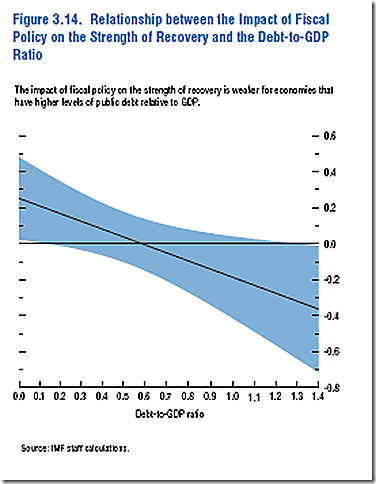
Recently released IMF analysis (via Telegraph)  indicates that federal debt/GDP ratios in excess of 60 percent tend to become deflationary black holes.

"The impact becomes negative for debt levels that exceed 60pc of GDP," said the Fund.

While no countries were named, this would raise questions about Japan, Germany, France, Italy and ultimately Britain and the US after their bank rescues.

The IMF said the US is at the epicentre of this crisis just as it was in the Depression, setting the two episodes apart from normal downturns. However, the risks are greater this time. "While the credit boom in the 1920s was largely spec­ific to the US, the boom during 2004-2007 was global, with increased leverage and risk-taking in advanced economies and many emerging economies. Levels of integration are now much higher than during the inter-war period, so US financial shocks have a larger impact," it said.

The IMF said the global financial system is still under acute stress, with output tumbling and inflation falling towards zero in key nations. "The risks of debt deflation have increased," it said.

Abrupt halts in capital flows can have "dire consequences" for emerging economies, it said. Eastern Europe has already suffered the effects, with a 17.6pc fall in industrial production in February. The region is highly vulnerable to the credit crunch since it owes more than 50pc of its GDP to Western banks.

image

The U.S. nominal GDP is about $14 trillion, the gross federal debt is $10 trillion, or 71 percent (the ratio is 46 percent if debt held by the public is used.  (I am not going to go into the issue of which number is “correct,” but the latter is most commonly used.)  Neither of these debt figures, both from fourth quarter 2008, include any of the multifarious bailout commitments.  Just adding a projected $2 trillion fiscal deficit for 2009 to the debt and assuming no growth in GDP takes the ratio using debt held by the public squarely to 60 percent.

Obama’s budget will tip America into a debt-deflationary downward spiral if the IMF is right.  No wonder the American public is slow to warm up to the stimulus plan—and why the public views the banking bailouts as throwing good money after bad.

The American people have a low opinion of government spending and contracting programs.  We read creditable stories about missing billions in Iraq and missing trillions throughout the federal budget.  We have seen how this administration has furthered Wall Street’s class warfare on the American people in its handling of the banking “bailout.”  President Obama looks more and more like a fiscal Manchurian candidate.

So, again, I propose a “middle way”:  let the objective be to take care of the American people, not to achieve some figment of “potential output.”  The Democrats may have good intentions, but they’re listening to the wrong economists, Keynesians who have been out of power for too long and who now are listening to a scribbler of 70 years ago (that they read in their halcyon graduate school days), a Keynes, most of them seem not to realize, who was preaching to an America that was the largest creditor nation in the world, not the greatest debtor.

Let the economists go yell at China, today’s great creditor nation.  China seems to be listening.


IMF links via Econbrowser:

MF World Economic Outlook

Tuesday, April 7, 2009

Deconstructing the “savings glut”

There is an old technique in mind control and psyops that involves accusing your enemy of exactly the sins you yourself are committing.  With its subtle invocation of gluttony, the accusation that the Chinese have created a “savings glut” to somehow take advantage of us poor innocent virtuously consuming Americans is a perfect example of this gambit, which I like to call perfectly symmetrical hypocrisy.

The gluttony was ours.  To accuse a nation as historically thrifty and hardworking as the Chinese of a “savings glut” is obscene.  It should stop.