Showing posts with label yield curve. Show all posts

Monday, February 17, 2014

When will long rates rise?

Answer: After a whole lot of taper.

John Hussman has a famous graph of short rates plotted against the ratio of monetary base to GDP. I’ve never seen anyone plot the same for long rates, so I did it:

image

Recently Base/GDP has been about 0.22, so we are way out on the right end tail. It would take a reduction of the ratio of about 15 percent of GDP to begin to raise long rates, or about $2.6 trillion at current rates of GDP. The St. Louis base is currently at $3.7 trillion, and has been growing at over 20 percent a year since the last recession.

Tuesday, August 31, 2010

Links 8/31/2010

The Paradox of the Zero Bound – Hussman  The first intelligent discussion of why the yield curve might not work predicting recession in a Zero Interest Rate Policy environment, using Japanese data and data from America in the 1930s, when the relationship broke down.  I will revisit this issue in the next “animal spirits” update.

http://www.youtube.com/watch?v=pObxCXhf9-E&feature=channel  What GM is doing in China with SAIC.  Are you aware of the $60 billion China expo, themed “Better City, Better Life”?  Check it out.

Beware those who think the worst is past Carmen Reinhart and Vincent Reinhar (h/t yves).  These are the folks who have looked at what over-indebtedness does to economic growth across virtually all available data:  growth slows down.

However, “recessions” or business slumps in the classic sense are characterized by a failure of confidence and negative skewness of the growth rate.  The next failure of confidence does not appear to be imminent—not to say we can’t have a negative quarter of GDP growth here and there, as the forecast is for negligibly positive real growth into the next slump, which is going to be a doozy.

Friday, May 7, 2010

‘Animal spirits’ update

The primary insight driving the business cycle forecasts on this web site is that recessions and depressions are primarily psychologically driven collapses of demand caused by conditions in the labor market as measured by the unemployment rate becoming worse than what people are accustomed to over the past four years. 

The increase in the unemployment rate caused mild downtick in the confidence of Americans, but “animal spirits” are still chugging upward toward the next cyclical high in about 2012-2013.  There is no recession in sight, although demand is fundamentally unbalanced by the extreme inequality in incomes and wealth, and will probably enter a sustained collapse in the next downturn due to debt deflation.

image

“Animal spirits” is given by A = – (U-UMEAN)/Sigma(U).  U is still above adaptation level, signifying that “animal spirits” are depressed.  Given my freehand forecast of unemployment, “animal spirits” should become marginally positive at just about the time of the next presidential election.  Although it is too far out to forecast with a high degree of confidence, the next recession should arrive in 2013-2014.  I expect this collapse to be a full-fledged depression.  This will begin the final stage of Strauss and Howe’s generational crisis; it will begin the long-wave winter’s coldest days.

Unemployment volatility will probably peak soon, and this will contribute to the rising good feelings over the next couple of years.  The stability will be short-lived, and garnered at the government’s expense.  It is well known that the government recently has been spending more on extended unemployment benefits than it has on federal salaries.  In the final crisis the government’s access to funds will dry up.  The markets will refuse to lend, and the rich will tell their Congress people they won’t pay any more taxes (although marginal tax rates are lower now than at when Ronald Reagan reigned).  Greed has triumphed and continue to do so.  The rich would rather let the system collapse, and try to take their money elsewhere, than prop up the government once it no longer serves their purposes.  IMHO.

image

The recession forecasting model featured on this web site has accurately made real-time calls of the past two cycles (2001 and 2007-2009, both the collapses and the recoveries).  There are many similar models using the yield curve; the innovation here is “animal spirits.”  The model shows no recession in sight over the next year.

image

The stock market continues to look like a very dangerous place to be.

image

The Coppock momentum oscillator, a bottom indicator, having sent a great buy signal in early 2009, is at elated levels, suggesting the market rally has some continuing momentum.  But the big picture looks like the market is approaching the crest of a B wave on its way down to a C big bottom.  Gold has been killing the stock for ten years and may continue to do so.

Friday, June 5, 2009

‘Animal spirits’ update and stock market outlook

The confidence levels or “animal spirits” of Americans continued to increase in May as forecast as Americans became more adapted to the new realities of the labor market.  The increase was confirmed by the Michigan Consumer Sentiment Index, a survey measure.

image

Our estimate of confidence levels is given by

                                              A = - (U – UMEAN)/Stdev(U)

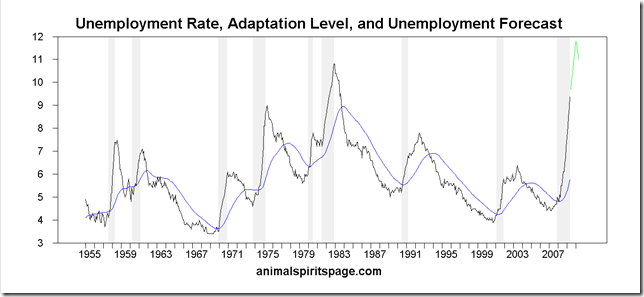
where U is the unemployment rate, UMEAN is an exponential moving average over the past 4 years, and Stdev(U) is a moving standard deviation over the same period.  The forecast for rising '”animal spirits” (in blue above) is based the following conservative unemployment rate forecast:
image

“Animal spirits” are still literally “negative” as unemployment is above its adaptation level.  In addition to their manifest financial losses of wealth, Americans have suffered a loss of psychological “wealth” in their confidence levels.  If “animal spirits” follow a track similar to recent 8-10 year-long cycles, they will go positive in second half 2010, peak in about 2013, with the next recession in about 2017.  We don’t think the cycle will last that long, but our forecasts don’t try to go out more than a year; and there is no “recession,” in the historical NBER sense, in the next year:

image

We expect the economy to at least stabilize and exhibit nonnegative growth.  The opposing forces of debt deflation and simultaneous massive monetary and fiscal stimuli cloud the picture of growth rate, which we don’t forecast in any event.  Note that the unemployment rate rose following the last two recessions, as we expect this time.

What are the implications for the stock market?  As pointed out here, the recent upturn of the granddaddy of long-term momentum oscillators in May comes after the first false signal in the postwar period in 2001-2002; and with the P/E on the S&P 500 over 100, and given the ferocity of the recent run-up and seasonal weakness going into summer, we side with Peter Eliades’ expectation of a pull-back in the near term.  However, “animal spirits” are rising, there’s lots of money still on the sidelines, and we know from prospect theory that people have a tendency to gamble when they feel they’re losing—so a blow-off is possible.  Be careful!

image

Is this investing?  NO!  This is gambling and speculation on the national level, aided and abetted by the clowns who are making up policy as they go along (they’re riverboat gamblers all in Washington D.C.).  Whether the market goes straight up, pulls back for a retest of the lows and then goes up—or the Coppock curve signal is false, and the market waffles while going to new lows—the surest bet would seem to be on volatility. 

Personally, we are waiting for single digit P/Es on the S&P, but even that may not happen in this strange environment.  As Marc Faber says, the Dow could go 50,000 in a hyperinflation while losing value against every other currency or commodity in the world.  We expect that as CPI inflation rises north of Fed targets and above 3 percent, short rates will have to adjust, and the consequent flattening of the yield curve will spell the beginning of the end.  But this could be several years away.  If the next downturn takes us all the way into depression, as we expect, single digit P/Es should be on offer.  Conservative investors will wait for that buy point.

This is research, not investment advice.  You invest at your own risk.

Conclusion

Our judgmental view is for the economy to enter into a full-blown depression over the next five or so years (see this and references).  This will occur after the cyclical expansion we appear to be entering, which we expect to be weak because of debt overhang.  Our judgmental view is informed by historical patterns of what happens to nations who acquire too much debt while the income and wealth distributions become highly unequal:  effective demand collapses because most households simply don’t have enough money to keep the circular flow going at a healthy rate.  The money largely gets diverted to rich households that don’t spend as high a proportion of income; and who today are probably more likely to send their savings abroad for investment in the high-growth, non-dollar economies of the world, reducing funding for American capital formation.  Most Americans probably have some understanding of this at a gut level and are saving more and moving into a generally more precautionary mindset as a result.  But the national propensity for risk-taking has always been high.  Americans are a bunch of self-selected risk takers.  We may witness a national “doubling-down” in the near term as folks try to make themselves whole in the stock market.  Moreover, our relatively robust economic health internationally may fuel yet another dollar rally and inflows into American paper assets. 

jmotb060409image001

Ultimately, we expect the entire Bretton Woods system to go supernova, with a burst of worldwide inflation that will make paper assets anywhere of limited investment value.  This will be the result of the “globally coordinated policy response” resulting from the Panic of 2008.  A new monetary system will be called for. 

Optimally the current upturn in “animal spirits” might facilitate an honest reappraisal of the state of the nation and a truly grassroots democratic (small “d”) demand for reform, beginning with an audit of the Fed and a reappraisal of the fairness of the payroll and personal income tax system.  Barring significant reform, Americans should be prepared for even rougher times in the next slump.  Put your house in order!

Thursday, May 28, 2009

Slope of yield curve and growth

With all the hoopla about rising Treasury yields, it is worth remembering that the slope of the yield curve has been a pretty good predictor of future real growth.  Click on graph for larger image.

image

Growth might accelerate into 2011 and then level off or decline.  If “inflation” of the traditional wage-price variety accelerates, while not likely given the state of the labor market, that would pose a danger in that the Fed would presumably have to tighten to control it.  (The Fed doesn’t tighten to control asset inflations.)  The current steepening of the yield curve is entirely consistent with our last “animal spirits” update forecast of “no recession [in the NBER sense] in sight”; the next update comes in June after the May unemployment release.  Real growth will accelerate to maybe 2 percent.

The higher yields at the long end and increasing risk aversion among foreign debt buyers (but not the Fed!) should push Treasury sales further into the short end, so short run, Treasury wins, perhaps.  But if there are indications of accelerating inflation at all, a classical rush to the short end and inversion of the yield curve might presage Obama becoming a one-term president.  Hence, it is in the Democrats’ interest, regardless of their rhetoric, to keep the labor market down.  The President’s continuing appeasement of the ruling class would seem to guarantee this; he hasn’t breathed a word about doing away with George Bush’s tax cuts for the rich in ages (see this for my take on the big picture, if you haven’t already).  So much for shared sacrifice.

At some point either the labor market will kick back and inflation happen, or the economy will implode again as bad debts transferred onto the taxpayers’ tab cause demand to fail—the dollar will collapse—and foreign investors will demand even higher rates.  If the current social contract remains in place, this will be the coup de grace for the American middle class—there won’t be one anymore.  There will be a rich elite (the top ten percent of Americans now take half of all national income) and a captive working class, still better off than the poor in the less developed countries, but without access to the educational opportunities and social connections required to jump to the upper class except in rare instances.  The rich will grumble about paying the lion’s share of taxes, as they do now, while taking a pig’s share of all income.

Hence, we stick to our adherence to the Strauss and Howe hypothesis of a renegotiation of the American social contract culminating in a massive crisis over the next dozen years or so (see this and this).