Showing posts with label obama. Show all posts

Thursday, April 24, 2014

The West breaks faith

With a country on the brink of civil war, crying out for a diplomatic solution--and actually with a diplomatic solution in place crying out for organized referendums to plot a sane course of action--the USA has fallen back to its default option--"bomb bomb bomb"--having sent first the CIA director on a secret mission that did not stay secret, then the Secretary of State, then the Vice President to Kiev to egg the quite possibly illegitimate Ukrainian government on to military action. The Russians are apparently sending a column of "peacekeeping" military in from the east.

This morning's first reports are here.

One of the Rothschilds once said, "Buy on the smell of gunpowder." The stock market seems to like it. More on this below.

We will see if Putin's position is as strong as he seems to think it is. I think he is counting on being the leader of a global wave of blow-back against the US from the G20 - USA - UK to support his action.

This is clearly not the time to "unite" the Ukraine by military means. Those Ukrainians in the east who were "neutral" or merely desiring a peaceful resolution will never forgive the US and its puppets in Kiev for this, I think.

Our CIA-puppet president is proving to be stupider than he looks. Of course the underlying plan is to bankrupt the Ukraine--and possibly the EU--and swoop in and gather up the assets. We'll see how that works out.

America is doing what it does best to defend its currency, sowing chaos abroad. According to Martin Armstrong, the US stock market will benefit as well, as hot money pours in from China (collapsing) and Europe. He thinks the Dow will double by the end of 2015. This is not investment advice, but reportage. You invest at your own risk, unlike the Wall Street banks, who also invest at your risk.

Thursday, April 17, 2014

How stupid is our CIA-appointed president?

Washington has already lost the war in the Ukraine. The BRICs are accelerating their arrangements to avoid the petro-dollar. Russia and China have accelerated their plans to form a pan-Asian trade alliance. Russia is building an independent settlement system so that the US cannot impose economic sanctions through the banking system. The BRICs are forming their own development bank and have expressed a desire to avoid contact with the IMF.

First the CIA stage a coup after Yanukovych cancels an agreement to join the EU in favor of closer relations with Russia. RT (note source) interviewed the former security chief of the Ukraine who described in detail how the coup was run out of the American embassy in Kiev. The director of the CIA, John Brennan, recently visited Kiev to follow up. This was reported on RT and in the American alternative press, but nowhere in the MSM. The White House confirmed the visit.

The ever-stupid American public is being told the Russians fomented the coup; that it is the Russians destabilizing the Ukraine; and they are buying it.

The German “60 Minutes” has just investigated the sniper shootings at the Maidan and found that they were perpetrated by the protesters, not pro-Russian agents. This is typical false flag chaos-creation by the CIA.

Putin has been consistent in his demands: he wants the Ukraine to be a buffer state, not aligned with NATO; and given the demonstrably split demographics and east-west hostilities, for referendums to be held in the east to establish more autonomy for the eastern provinces, who large dislike Kiev. The statistics I’ve seen on eastern Ukrainian sentiment on secession and joining Russia are about a third for, a third against, a third just want peace and don’t care.

Putin is correct that the primary danger now is civil war. Military action by Kiev in the east virtually guarantees it. If Putin is smart, he will not engage militarily; and the West will lose the hearts and minds of Ukrainians for generations to come. As the EU goes bust they will look to the east. They will likely default on debts to the IMF under such conditions.

What is is disturbing this morning is that our CIA-appointed president is on TV looking very gray and exhausted saying that under no conditions will America take military action, that our only course will be tightening sanctions.

In contrast, Michael Hudson, who is better connected than I, is on RealNews saying that under the table the Americans are threatening Russia with military action, including nuclear, and that Europe and the rest of the world are terrified by this.

The neocon-neoliberal Washington Consensus is on its last legs. Their program for world domination has already failed; they’ve hollowed out the US economy and turned the rest of the world against us. The plutocrats who are pulling the strings everywhere have no national allegiances. They park their money beyond national tax jurisdictions; and they will make themselves at home in Europe or Asia and encourage the EU to join the pan-Asian trade zone if that suits them; and where would that leave the US?

It is time for Russia and America to work together to let the Ukraine develop a federalized structure; and to jointly support this impoverished, ransacked region so that it may support itself. America via the IMF wrecked the Russian economy when the Soviet Union fell (by “free market shock treatment” that destroyed the social fabric, fostered anti-Semitism and created pronounced inequality and government by a plutocracy that Putin is trying to ride herd on).

Destroying the Ukraine in the name of freedom helps no one except Blackwater, or Xi, or Academi and the rest of their military-industrial-financial complex ilk. And of course the plutocrats on both sides who would like to buy up Ukrainian assets at bargain prices.

But this is what Washington does best, destroying countries in the name of freedom.

But starting World War III would guarantee that the rest of world would turn on us.

Time to throw the psychopathic bums out, America. Wake up!

Friday, November 16, 2012

Winds of war

I will confess that I sometimes read the updates of Benjamin Fulford, a former Forbes financial journalist and self-described insider to the true power structure of the world.  He indicates that there has been an attempted putsch by the military against President Obama, in planning for years, by the right-wing “Christian” faction associated with George W. Bush and Mitt Romney.  He credits the election of Obama of at least postponing the start of World War III.

Fulford often sounds crazy, but he points out that there have been a lot of military brass who have lost their jobs recently.  With the events unfolding in Gaza the atmosphere is ripe for a false flag attack, any spark.  America is severely cracking.  Make sure to read to the bottom of the attached—it was written by a senior editor of “Veterans Today".”

Hence, a quick search turned up the following:

Via:  presstv.com

US military planned mutiny on the Bounty to topple Obama

By Gordon Duff

Mon Oct 29, 2012 4:41PM GMT

The Obama administration has had American military, both on domestic and foreign bases on high alert since October 1. However, there has been no known terrorist enemy threatening the US. The enemy is called “domestic” but its origins are far from American.

Today, Rear Admiral Charles M. Gaouette was “fired” from his command of one of the three carrier battle groups back to Bremerton, Washington to face an investigation.


It is impossible to adequately state how unusual this is and how serious.


The Navy was clear that the charges had nothing to do with his personal conduct, no rape or sexual misconduct, no stolen money, no drug use, the things that usually bring down careers in the Navy, that and crashing ships into each other.


Gaouette was sent back because the Secretary of Defense found him unfit for command, sent him across the world in the middle of one of the largest combat exercises in history, one both timed prior to an election and one at a critical location, near the Straits of Hormuz in the Persian
Gulf.


Gaouette commanded nearly one third of the Naval and air combat forces in the region.


The decision was made based on a conversation with the Secretary of Defense who, at the end of the talk, believed Gaouette was part of a group of military officers who have been under suspicion for planning a “Seven Days in May” type overthrow of the US government if President Obama is re-elected.


This is not conjecture, dozens of key officers face firing, hundreds are under investigation, all with direct ties to extremist elements in the Republican Party and the Israeli lobby.


Reports received are sourced at the highest levels of the Pentagon and indicate that the administration has been aware of these plans for months.


It is not just the Obama administration. This happened before.


The Air Force moved against the Bush administration in 2007 when it loaded up to nine nuclear weapons on a B 52 aircraft at Minot Air Force Base. We know now that up to three of those nuclear weapons are listed as “missing,” the military expression for this is “Broken Arrow.”


From Veterans Today:
Minot-Barksdale, The forgotten mutiny
In August 2007, at least six nuclear warheads were stolen from Minot Air Force Base in North Dakota. The moment they were loaded, they disappeared from America’s nuclear inventory, “location unknown,” something that is not supposed to happen. There is no possible “misinterpretation” of orders, no mistake, no “wrong label” issue. These weapons were stolen, pure and simple. Discussions of individual commanders having authority to deploy weapons, stories of accidents, confusion or political alignments within the Air Force are “red herrings.”

Nothing is more controlled, more secure, more restricted, more classified, more protected than the nuclear arsenal of the United States. However, on that fateful day in 2007, a half dozen or more, hydrogen bombs, were plucked out of a secure bunker with no paperwork, no orders, nothing.


This is the military. People are jailed for losing flashlight batteries.


They were loaded into the weapons bay of a B-52 long-range bomber for transport to places unknown, for purposes unknown. The plane had no orders, was part of no mission, operated under no legal command structure, in fact, the moment the weapons were loaded, was no longer an American plane at all. A mission, even under the most innocent possible circumstances, that would have required the knowledge of the President and his staff, certainly the Joint Chiefs of Staff and likely the National Security Council as well, seem to have authorized itself, out of “thin air.”


Though the plane later landed at Barksdale Air Force Base in Louisiana, there is no evidence supporting this as the intended destination, far from it.


The theft, hijacking, you pick the term, these are the best two so far, happened outside the command authority of the United States government, contravening all protocols for the storage, handling and deployment of nuclear weapons. The incident was also a violation of treaties requiring America to safeguard her stockpile of nuclear weapons, not just from environmental disasters but also, as with this incident, from a mutiny by members of the military and civilian branches of our government, acting outside authority, acting as civilians, an act of piracy, mutiny, an act of insurrection.


Today’s “relief of command” is a response to a similar threat.


The “Barksdale Nukes” were believed to be heading to Diego Garcia for use against Iran as part of a false flag war, one started by a naval admiral who was tasked by an extra-governmental agenda to start a war.


This was the Air Force part of a joint operation that is said to have involved 5th Fleet commander, Admiral Cosgriff who as reported to the Secretary of State by Gwyneth Todd, then Chief Political Advisor to the fleet. Todd, who has recently retold her story to the Washington Post and other media outlets, received a death threat this morning after a stalking incident against her by an FBI agent stationed at the US embassy in Canberra, Australia.


Similarly, top defense consultant John Wheeler III, who knew of these issues quite well was mysteriously murdered and his body found in a garbage heap in Delaware in late 2010. No suspects have been arrested; no real investigation has ever been made.


That was then.


Today, key members of the military more loyal to Israel and Wall Street than the United States are said to be planning a mutiny to take place after the presidential election.


Their task, upon seizing power, is to facilitate a massive terror attack inside the United States, possibly using a stolen nuclear weapon, declare martial law, move troops into Iraq and to attack Iran with aid from Saudi Arabia and the Gulf States.


Turkey is to attack Syria with aid from Israel and civil war between the Kurdish regional government and the national government in Baghdad is to begin with the US brokering a peace and re-establishing what “newly appointed President Romney” would describe as the “Status of Forces Agreement” he mentioned during the debates.


His real intent is to occupy Iraq and attack Iran. In the process, America intends on “neutralizing” the nuclear capability of Pakistan.


This is the plan, it is known, not just in the Department of Defense, but by all intelligence agencies, the plotters have all been recognized, are all under surveillance and they have not been very careful.
All information here has more than one official source.


Step one, Benghazi


Those involved in the plot, those outside the military, are those who are spreading “conspiracy theory” rumors about US complicity or malfeasance in the handling of the murder of the US ambassador to Libya, Chris Stephens.
Today, CIA Director, General Petraeus clearly stated that the CIA had received no requests for help. A month ago, the State Department also made it clear, the attack was military, well coordinated and that no forces were available capable of making a difference.


In fact, the “conspiracy theorists,” those attempting to use their wild theories in order to implement an “October Surprise” are directly aligned with those who planned and executed the attack.


This is one of the advantages of a “false flag” attack on an American diplomat by America’s own friends and allies, or those mistaken for being such, any attempt to characterize those known to be guilty, prior to an election, would be used to discredit anyone giving out actual accurate information.


This is the role of the controlled press in terror operations, providing “deception and cover.”


Thus, it was necessary to invent a non-existent “Al Qaeda cell” in Libya and to hunt down minor third party assets while the real killers, well trained special operations military from the Gulf States and “other nations” were able to escape and will remain unaccountable.


Security services of both Britain and France had reported the presence of a special operations team well in advance of 9/11 but the target was a mystery.


The Benghazi attack required incredible coordination. What debunks conspiracy theories is that even the most amateur attacks use radio frequency jammers. They are common even to the Taliban much less to groups this sophisticated, a force now said to number at least 120 with 50 or more being trained special operations forces.
This backs up General Petraeus’ statement that no messages were received.


One incredible inconsistency in the “conspiracy media” came from Fox News. They reported that the US compound in Benghazi was relieved by a large force of friendly militia at 3am, a full hour before the lethal mortar attack is said, by Fox News, to have begun. Jennifer Griffin wrote this exclusive account for Fox News:


“They were killed by a mortar shell at 4 a.m. Libyan time, nearly seven hours after the attack on the consulate began - a window that represented more than enough time for the U.S. military to send back-up from nearby bases in Europe, according to sources familiar with Special Operations. Four mortars were fired at the annex. The first one struck outside the annex. Three more hit the annex.


A motorcade of dozens of Libyan vehicles, some mounted with 50 caliber machine guns, belonging to the February 17th Brigades, a Libyan militia which is friendly to the U.S., finally showed up at the CIA annex at approximately 3 a.m.”


Fox was so busy gloating over their misdirection that they totally missed how thoroughly they discredited themselves. Nothing written in any of the recent versions remotely depicts eyewitness reports. They made the whole thing up.


All of those who report a “hodge-podge” of conflicting calls for help through jammed communications, reminiscent of the jamming during the attack on the USS Liberty, are now potential suspects in the planning and execution of the attack itself.
Additionally, there is little possibility the attack in Benghazi could have been carried out without the presence of foreign agents within the State Department and the well-timed distraction of the Terry Jones telethon financed and supported by the CATO Institute and Republican National Committee, of which I am, sadly, a longtime member.


Israel rule

The planned overthrow and subsequent declaration of martial law is a massively financed operation with billions of dollars available. The primary impetus for this action is a belief by members of the “dispensationalist” pseudo-Christian heresy that pervades America’s military service academies that the United States should be subservient to the State of Israel.


Over the past three decades, religious extremists have taken over the Air Force Academy, Annapolis and West Point, teaching mandatory classes in obscure religious beliefs, hatred of Islam and stressing obedience to an “Apocalypse Cult” that stresses pre-emptive nuclear war in order to bring on the “end times” and destroy all life on earth.


Some find these beliefs inconsistent with oaths sworn by all members of the military:


“I, _____, having been appointed an officer in the Army of the United States, as indicated above in the grade of _____ do solemnly swear (or affirm) that I will support and defend the Constitution of the United States against all enemies, foreign or domestic, that I will bear true faith and allegiance to the same; that I take this obligation freely, without any mental reservations or purpose of evasion; and that I will well and faithfully discharge the duties of the office upon which I am about to enter; So help me God." (DA Form 71, 1 August 1959, for officers.)”


Oaths, so easy to take, so convenient to break, and so it goes…


GD/MA


Gordon Duff is a Marine Vietnam veteran, a combat infantryman, and Senior Editor at Veterans Today. His career has included extensive experience in international banking along with such diverse areas as consulting on counter insurgency, defense technologies or acting as diplomatic representative for UN humanitarian and economic development efforts. Gordon Duff has traveled to over 80 nations. His articles are published around the world and translated into a number of languages. He is regularly on TV and radio, a popular and sometimes controversial guest. More Press TV articles by Gordon Duff

Sunday, November 11, 2012

Almost every issue is a wedge issue

Sometimes you have a great notion.  Today I’m having one about how we think about things.  It’s that almost every issue in the modern discourse is a wedge issue, or can profitably be used as one.  That “profitably” is a hint as to the exception, by the way.  And then if you can link issues in voters’ minds, you can create a web of divisive issues.

Let’s start with “economics.”  Every school of economics is bullshit being used by some interest group to further their own advantage.

How about “freedom”?  Same thing.  I’m rich, I want to be free.

How about “socialism”?  We already have socialism for Wall Street.  The government redistributes the money from hard working folks to Wall Street when their big derivative bets don’t pay off the way they hoped.  The government rewrites rules and regulations that even people like me with a Ph.D. in economics have trouble understanding, but which rewrites almost universally have the effect of letting the financial institutions skim a heftier slice out of our hides.

How about “capitalism”?  Sure, we got capitalism, crony capitalism.  See the last point.

I’m not going to belabor the point.  I could dredge up more buzzwords (“abortion,” “family values,” “gun rights,” “welfare,” and so on) but I won’t.  I won’t even touch “democracy,” which has gotten to be a big joke.

The one issue that really matters now is the distribution of wealth, and derivatively, the distribution of income.  America is still a rich country but the rich always seem to have an excuse for letting the poor get poorer.  “You can’t fix that because [raising taxes is linked to being pro-abortion] [raising taxes is not freedom] [that’s socialism]!” 

We may not have free markets—they are horribly concentrated and monopolistic in too many cases—but we do have enough capitalism that those who own stuff (or act as if they did by manipulating the stock price to their own advantage—I’m referring to our non-owner, stock option loaded American management gangsta class) largely get to call the shots for those who don’t own the means of production or get to act as if they did, i.e., labor, working folks.

Until this imbalance is righted the situation is not going to get better.  The greatest danger lying ahead is a global neofeudalism.

Will “socialism” destroy us?  Hardly.  I have pointed to the Scandinavian countries as working models of how a greater degree of social justice can produce a more prosperous nation.  And anyway, it’s not socialism because the state doesn’t own the means of production.

So long as Americans are so easily divided the raw economics of the ownership class’s interests and its power over the politicians will determine our course.

The first tiny step toward equity is a more progressive tax system. 

So if Obama has any backbone he will let us go over the fiscal cliff, and then cut taxes for the 98 percent. 

If not, if he compromises without effecting any significant increase in the progressivity of the tax system, then will in truth be a Manchurian candidate, a total sycophant, good little Barry whose mother worked for the Foundation and knew how to be nice around rich people.

He who oppresses the poor shows contempt for their Maker,
but whoever is kind to the needy honors God.

When calamity comes, the wicked are brought down,
but even in death the righteous have a refuge.

Wisdom reposes in the heart of the discerning
and even among fools she lets herself be known.

Righteousness exalts a nation,
but sin is a disgrace to any people.

--Proverbs

Reference:  Michael Hudson, Obama Wins for whom?

A couple of recent article from Der Spiegel about how Germans see America now (the Germans, having some history of their own to deal with, don’t mince words):

Americans Don't Want The Truth In US Election, He Who Lies Wins

Destroyed by Total Capitalism America Has Already Lost Tuesday's Election

P.S.  Mish has declared that California will fail because they’ve enacted tax reform.  I’ll take the other side of that bet.  California is a very dynamic state; and being a state, and not a country with the ability to print money, they have to balance their budget over the long term.  Is it an accident that so much technological innovation has come out of California, with its (formerly?) great educational system? 

I still expect the global fiat money debt dilemma to be “resolved” in some sort of monetary catastrophe, with possibly multiple “bang points,” including deflation and (possibly hyper-) inflation. 

Thursday, November 8, 2012

Today’s most depressing blog posts

We are doomed.  The historical dynamic will not be reversed.

Via:  www.nakedcapitalism.com

Obama Wins, the System is Broken

[…] There is a reluctance to recognize how large the gap between Obama’s persona and his mode of operation is, and there is a similar failure to appreciate what most of his compromises are about. Like Br’er Rabbit’s pleas not to be thrown in the briar patch, concessions for Obama are typically a vehicle to get him where he wanted to go anyhow.

More at The Real News

This is the money quote from this interview:

JAY: So what does the U.S. economy look like in four years? Whoever is the presidential nominee for the Democrats, it seems the plate gets set for a far-right candidate of the Republican Party to say, look, you had eight years and couldn’t do it.

JOHNSON: It looks like Brazil before Lula. It looks like it’s heading in that direction—in other words, favelas. You know, Lula’s made some strides in reversing—Lula and his successor, excuse me, have made some strides in reversing the inequality and alleviating poverty and invigorating education there. They were in a deep ditch of violent inequality of income and wealth, and they’ve made some positive strides. We’re going in the other direction as—faster than they turned things around.

Read more at http://www.nakedcapitalism.com/2012/11/obama-wins-the-system-is-broken.html#SqueqEfJmSuPzADS.99

See also:

Obama and progressives: what will liberals do with their big election victory? – Glenn Greenwald in The Guardian

Wednesday, November 7, 2012

Obama’s political economic calculus

One of the best pieces of advice anyone can give a new President or reelected President in an economy that experiences a recession on average once every four or five years—keeping in mind that the long cycles of recent decades plausibly represent a period doubling characteristic of a phase transition to chaos—is, “Take your recession early in your term.”

Ronald Reagan did this, taking credit for Jimmy Carter’s ending the ‘Seventies inflation by appointing Paul Volcker in 1978.  Jimmy’s problem was that he didn’t understand how our monetary system works until after bringing a bunch experts to Camp David and learning about it midterm.  He followed his principles, ultimately whipped inflation, and lost the election.  Paul Volcker was a monetarist who did what he said he was going to do, and tightened credit, the source of credit-money in a fiat fractional reserve monetary system.

Obama won the election by brilliant data mining and positioning in swing states, and because Romney was such an unappealing personality.

Obama was lucky.

Like Carter, he didn’t understand the problems that confronted him in his first term—a corrupt and fraudulent Wall Street, excessively leveraged and coddled by the Treasury and the Fed when their bad derivative bets blew up.  Franklin Roosevelt had a better understanding and a stiffer backbone in his dealings with the bankers.  Heads rolled.  Obama let hundreds of billions of dollars of bad debt be piled onto the Treasury’s sovereign debt.

Obama does understand that America’s middle class is being hollowed out.  His solution is to raise marginal tax rates on high income people, in part.  In my view, this is a terribly important part, as I believe a sickness of self-regard (“we are gods”) has entered the American elites and nothing would benefit the polity more than taking some of the starch out of their shirts and bringing them back down to Earth with the rest of us working folk. 

I would love to see the payroll tax rate lowered and the ceiling removed, for example.  Imagine that!  Or the Bush-Obama tax cuts on the over-250 thousand dollars brackets removed.  Or better, those rates increased to Reagan levels around 50 percent.

There should be a wealth tax, and a financial transactions tax (the high frequency traders are already imposing such a tax and pocketing the proceeds).

But the larger problem is the debt that was largely created because it was so easy to do so after Nixon removed the dollar’s tether to gold 41 years ago.  Only monetary reform will address some of the root causes of American inequality at this point, a preponderance of which originates in the financial sector.

Glass-Steagall needs to be reinstated.  Was it an accident that America went from the ‘Thirties to the Oh-Oh decade without a major financial crisis?  The derivatives markets need to be made transparent and regulated (such a move is likely to reveal a house or horrors, however, showing many big banks to be effectively insolvent).  The big banks need to be downsized “by fiat” or required to maintain capital ratios such that they do it by themselves.  Perpetrators of fraud need to be prosecuted. 

And perhaps the Fed needs to buy up a bunch of federal debt and forgive it before the Fed itself is shut down.  The failure of fiat, fractional reserve banking is writ large across the entire Western world.  It will be a miracle if the BRICs don’t also emulate us in this regard.  But they may benefit by leapfrogging in this area as in others.

What to replace the Fed?  Something not owned by the banks at a minimum, something owned by the American people.  Ron Paul and Andrew Jackson get this right.  The American people accurately perceived the self-dealing of Wall Street via the Fed in the crisis.  Those with the expertise and access to see and understand it up close have been nauseated by the level of corruption that Obama did not “begrudge.”  This has been his major failing.  There was a moment when he could have marshaled support from both the far right and the far left and explained to the American people why reform was needed.  He sold out.  (He may have considered health care a more important priority in a nation about to collapse, a point of view I have sympathy with.  See the Wilkinson video below.)

If gridlock wins in Obama’s second term—because Obama is a consummate politician and may not attempt anything that he deems impossible—or may he, in a second term?—it will be because our system is broken, and the absolute failure and gut-wrenching Crisis apparently required in America to forge a new national identity and social contract (and this is per The Fourth Turning, which has been so durably prophetic lo these past couple of decades)—it will be because that Crisis has not yet come to a head, and Americans remain divided and willing to go down with their parties “on principle” instead of compromising.

I’d also like to see “economic policy” replaced with “social policy.”  What I mean by that is democratic capitalism within the following constraints: 

First, workfare and health benefits for the economically displaced (i.e., unemployed; health care is available for everyone). 

Second, a tax system sufficiently progressive to produce a more “optimal” after-tax distribution of income, consumption and wealth.  Here I am relying of the results of Wilkinson et al. that I take to be the most sweeping condemnation of the narrow, money-based approach to welfare adopted by economists.  Can we pull off an enlightened Scandinavian-type democratic capitalism (not really socialist, because the state doesn’t own the means of production, just influences the distribution of product)?  I hope so.  The Scandinavian countries have recently been ranked as the most prosperous in the world.

It may take the next generation to get us there.  It was nice to see youth breaking for Obama.

Capitalism is great, but it needs to function within a moral framework providing social justice while not encouraging dependency.  Libertarianism and traditional Republicanism leave that to the market, and markets fail to provide it.  Ultimately increasing inequality will cause aggregate demand to collapse as most people simply don’t have enough money.  We’re halfway there.  We may have to go all the way for everyone to get the point.  We may not have to wait that long to get there.  And then we will see as well to what purpose the President puts all the sinister powers he and George W. Bush accrued that have so eroded the Constitutional rights of the American people.  To what means, and to what ends? 

It may all be determined in the Crisis to come.

Monday, November 5, 2012

W socialist, O capitalist in first term

via:  www.businessinsider.com

The left side of the chart shows the first Bush years. The right is Obama's.

The red line represents the trajectory of private sector jobs, while the blue and green lines represent the trajectory of state and local government jobs. All are set at 100 to the beginning, just for the sake of normalizing each number to the same point.

As you can see, under Bush's first term, private sector jobs never got to their start point, while public sector jobs soared.

Under Obama private sector jobs have now easily surpassed the level they were when he started, while public sector employment is way down, with no comeback having yet commenced.

image

Read more: http://www.businessinsider.com/jobs-bushs-first-term-vs-obamas-first-term-2012-11#ixzz2BMSMbeCb

Friday, November 2, 2012

The Obama record

Yes, I know the principled arguments for voting for a third party candidate if you live in a non-swing state (and I already have, writing in for Ron Paul, the only candidate who got the gestalt of decaying overweening military-industrial crony capitalist country-hollowing empire, or was brave enough to say it), but if you live in a swing state and vote for Romney, the blood of the next American civil war will be on your hands.  Romney is not a conservative, he is a vampire, ready to to suck the blood out America for the benefit of his capitalist class.

Via:

Whitney TOOLSON - Why I Am Voting for Obama

Wednesday, October 24, 2012

The definition of insanity

Insanity: doing the same thing over and over again and expecting different results.
Albert Einstein

Obama missed the opportunity to make the point that doing what George W. Bush did—cutting taxes, mostly for the rich, and increasing military spending—is exactly what busted the budget in the last decade and started down the path of trillion dollar deficits.

“The last president cut taxes for the rich and increased military spending, and did we get jobs?  Where are the jobs?  NO, we got financial crisis and a mini-depression that I inherited.  So why would doing the same thing again work this time?”

Oh, he tried to make the point, but he lacked the emotional force required to counter an attack dog like Romney.

The national spirit level has sunk to new depths in recent weeks.  The Republicans appear to have successfully scapegoated Obama. 

The American social contract is broken.

Wednesday, August 15, 2012

Friday, April 23, 2010

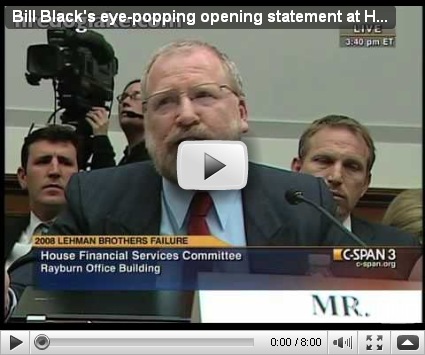
William Black on our corrupt regulators

This is much-watch, especially if you’ve been seduced into drinking some of Obama’s financial reform Kool-Aid.  Obomba has proven himself a spineless cut-out for the military-industrial-financial Establishment many times over.  He may have good intentions, he may face a fecally-impacted Washington, he may face death threats every day, he may be doing all he thinks he can do given the cards he’s been dealt, but the fact remains that no significant reform of a broken America is taking place. 

Bill Black lays the blame where it belongs, on the industry-captive (industry-whore) regulators who had the power to preclude and then to clean up the mess all along:  Alan Greenspan, Ben Bernanke, Tim Geithner, Larry Summers, and so on ad nauseum. 

Friday, December 18, 2009

Dennis Kucinich: a truth teller in Congress

Via:  RawStory.com

Kucinich: ‘Class war is over, working people lost’

By Sahil Kapur
Thursday, December 17th, 2009 -- 3:05 pm

denniskucinich20090616b Kucinich: Class war is over, working people lostWASHINGTON -- Reflecting on the growing divide between Wall Street and Main Street, Rep. Dennis Kucinich (D-OH) on Wednesday offered a powerful critique on the state of the economy in an open committee hearing.

"The class warfare is over -- we lost," Kucinich said before the Committee on Oversight and Government Reform. "I want to make that announcement today. Working people lost.  The middle class lost."

The harrowing comments from Kucinich, who is Chairman of the Domestic Policy Subcommittee, come amidst a national unemployment rate of 10 percent, one year and several months after the economic collapse of 2008 has marred the livelihoods of many.

"Don't tell me about class warfare," he continued. "Come to my neighborhoods in Cleveland.  I will show you class warfare.  I’ll show you hollowed out areas. I’ll show you businesses that went down because they don’t have access to capital.  And on Wall Street it is fat city.  Don’t tell me about class warfare."

Kucinich, a former presidential candidate who is viewed across the nation as a progressive champion on many issues, said that despite the recent uptick in economic figures, many regular Americans continue to struggle.

"All across this country people are starved for capital," Kucinich said. "Small businesses are failing, you have shopping centers that are becoming vacant because people can’t afford the rents anymore because the people who own the malls the developers are getting cash calls and credit is tightening."

"The separation between the finance economy and the real economy is real. This is not some fake idea. You can’t call that class warfare. That’s a fact."

Kucinich, who voted against the Emergency Economic Stabilization Act of 2008 (also known as the Wall Street bailout), lamented it as a catalyzing force for the rising inequality of income in the United States.

"The wealth of this nation is being accelerated upward," Kucinich said. "That’s one of the problems that I had with the bailout."

"You could say that it helped stabilize the American economy, but what I see is the separation between the real economy and Wall Street. Wall Street is stabilizing, markets are a lot better, banks are doing well -- they parked their money at the Fed for a while so they could get higher interest rates."

With income and wealth inequality at levels greater than in 1929, Kucinich’s statement is not an exaggeration.  Presidents George W. Bush and Barack W. Obama, along with Hank Paulson, Ben Bernanke, Timothy Geithner, Larry Summers and the rest of the Whole Sick Economic Policy Crew, will go down in history as the puppets of the plutocracy who drove the nail into the coffin of the American middle class for a generation or more.  Just wait until they start raising taxes to pay for the bank bailouts!  You never hear these shysters ever talk about raising taxes on the rich (see previous post).  They are good lackeys of the plutocracy, all.

Combined with his sickening Nobel Prize acceptance speech, which displays a stunning ignorance of the realities of terrorism, social justice and proportionality (see Global Guerillas for up-to-speed discussion of asymmetric conflict) President Obama, with his soaring yesteryear rhetoric and good-little-boy conformism to his masters’ wishes, may go down as our most fey, quixotic president ever.

Wednesday, September 16, 2009

What the doctors prescribe: a public option

Via:  Huffington Post  This is amazing.  The AMA doesn’t even represent the doctors!  Who the hell can you believe anymore? 

The Obama presidency is failing.  If the President doesn’t take this study in his hand and demand a public option he is even more of a wimp than he appears.  For a few weeks last fall, I suspended disbelief and gave him time to prove that his political instincts were better than mine, that he was going to clean up Wall Street and get health reform by waiting for the parade before jumping in front of it.  But now it is clear that he is simply cowed, afraid to go up against the oligarchs in finance and health insurance.  Any and all opposition to Beltway business-as-usual is being painted as lunatic fringe (and I wonder how much of it is staged by fifth column agents).  The body politic is very cagily being quartered, using the same old fake polarities of “Republican” and “Democrat,” “liberal” and “conservative,” when the real party in power, the Money Party, is pulling the strings and the people are still dancing to Ronnie Reagan’s Hollywood dream-song, thinking that they will be the ones to win the lottery, and that government is always their enemy…. The American people let this government happen, the American people will have to unseat it.

Majority Of Doctors Back Public Option: New England Journal Of Medicine Study

A new study finds that a majority of physicians support the creation of a public health care option.

A Robert Wood Johnson Foundation (RWJF) study published in Monday's New England Journal of Medicine shows that 63 percent of physicians support a health reform proposal that includes both a public option and traditional private insurance. If the additional 10 percent of doctors who support an entirely public health system are included, then approximately three out of four physicians nationwide support inclusion of a public option. Only 27 percent support a private-only reform that would provide subsidies for low-income individuals to purchase private insurance.

Surveying a nationally representative sample of 2,130 physicians across America, researchers Salomeh Keyhani, M.D., M.P.H., and Alex Federman, M.D., M.P.H., from Mount Sinai School of Medicine in New York City queried physicians about a range of options for expanding health insurance coverage.

"There should be no confusion about where doctors stand in the debate over expanding health insurance coverage: they want reform," said Risa Lavizzo-Mourey, president and CEO of the Robert Wood Johnson Foundation. "This survey reveals important information about the perspective of physicians on issues central to the health reform debate. Policy makers should listen to their doctors."

"We found that no matter how you sliced the data, physicians demonstrated majority support for a public health insurance option, regardless of their type of practice or where they live," said Keyhani.

Among those physicians who identified themselves as members of the American Medical Association, 62.2 percent favored both the public and private options. The AMA has opposed a public option, saying that it "threatens to restrict patient choice by driving out private insurers."

A majority of physicians surveyed (58 percent) also supported expanding Medicare eligibility to those between the ages of 55 and 64.

"These results give voice to individual physicians in the national discussion about health reform," said Federman. "Most often we hear the opinions of special interest groups rather than doctors themselves, but we know that Americans want to hear the opinions of doctors like those who treat them. This study lets us hear the unfiltered views of physicians on key elements of health reform and should be useful for lawmakers."

Read the full study here.

Read more at: http://www.huffingtonpost.com/2009/09/14/majority-of-doctors-back_n_286352.html?view=print

Tuesday, September 1, 2009

The bubble at the end of the age

Before commenting on the stock market, which everyone cares about, I must indulge a small obsession with the way that mainstream economists are able to ignore relevant research in psychology even when they are doing inherently psychological work themselves, and even when the relevant work in psychology was actually published by an economist—but in a journal with “psychology” in the title. 

I refer of course to the article by Robert Shiller in Sunday’s New York Times, “An Echo Chamber of Boom and Bust,” which apparently resulted from Shiller talking to himself in his office.  In their book on “animal spirits” Shiller and Akerlof ignore a seminal article in the Journal of Economic Psychology relating “animal spirits” to the first law of psychology, the Wundt Curve describing sensitivity to adaptation level. (see this and this).  The obscure economist who wrote these papers might reasonably be really pissed off at the arrogance of Shiller and Akerlof.  I have it on good authority that Shiller declined to respond to correspondence on the subject.

Paul Samuelson once said words to the effect that, "As economists, we don’t care what other people think of our work—we write for ourselves.”

I’m just a blogger, as Calculated Risk likes to say (and CR is someone who does respond to emails, BTW). 

As August has come to a close and a lot of folks are looking for a stock market pullback (and yours truly is slightly bloody from a small –2 beta position on the NDX), I thought it would be appropriate to update the Coppock Guide and my own “animal spirits” of the stock market oscillator that are both monthly models. 

The picture is pretty astoundingly bullish on a pure emotion basis.  Of course, it would require a veritable tsunami of liquidity to float the market on top of an economy that is in a depression.  But that’s what we have a Federal Reserve and Goldman Sachs for! 

Here’s the picture:

image

Click on graph to see bigger image in new window.

Now, I am as blown away as anyone to think that the U.S. stock market would have the unmitigated chutzpah to complete a gigantic head-and-shoulders pattern by climbing another ~50 percent from today’s levels, but this is what the emotional nature of the market wants, and it’s what Ben Bernanke would most like to deliver.  It might happen after the current pull back, as more economic indicators stabilize, and the dollar rallies on weakness in foreign economies.

It could be the bubble at the end of the age for America.  The way things are going the next collapse, due by my reckoning in 2013 or 2014, will be worse than this one.  The stock market will see new lows, in real terms if not in nominal terms.  If, as many expect, the government responds to fiscal bankruptcy by starting a big hot war and getting an inflation or hyper-inflation going, the stock market could continue to go up.

Next “animal spirits” update will be after the unemployment rate data is released on Friday.

Monday, August 10, 2009

Obama’s deal with big pharma

image

The United States government has agreed not to negotiate prices with Big Pharma in exchange for support of a health bill.

Here’s what Robert Reich, a Democratic team player, has to say about that.

We’ve got a liberal friend from Minnesota visiting who is still arguing that it’s going to be better under Obama because he’s not a Republican.  And I do agree that Bill Clinton and a Republican Congress did the best job in recent memory of managing the economy.

I keep trying to tell her there’s only one party in American politics, the Money Party, and it always wins because it owns the government. 

Sadly, it wasn’t enough that Obama could beat the system (and he really did, and beat the Clintons, too) by raising his own money over the Internet.  What must the man be feeling, if he actually believes anything like his campaign rhetoric?  He’s gone back on what he represented as his basic values, ramping up a stupid war and providing massive welfare for the rich and now caving in to Big Pharma.  Or was it all an act?  I don’t think so.

Head’s up people:  you got to support Congressional candidates with money who will honor your will.  

First, we have to figure out how to get them on the ballot…. I still like the idea of voting out all incumbents until they get the idea….

Wednesday, July 29, 2009

Break up the Fed (then abolish it)

An op-ed in the WSJ of all places is saying pretty much what I wrote to my elected representatives in Fire Bernanke, Audit and Abolish the Fed.  Take actual banking regulation away from the eggheads and away from New York City.  Set up a bank examination agency somewhere in fly-over land and staff it with people who actually know banking.  The loans that were booked during the real estate bubble were laughable.   “Purchase money seconds”?  “Zero down”?  “Negative am”?  Please!  Any responsible banker of a generation or two ago would—and many did—gag on this crap.  It is encouraging that the article below appeared in the Wall Street Journal. 

The next step is to demolish B of A, Citi, JP Morgan, HSBC and Wells, all of whose balance sheets are probably jokes.  See Regulatory reports show 5 big banks face huge loss risk.  The “fortress balance sheet” of JPM is riddled with worthless derivatives, probably.  Time for a new sheriff who will take on the oligarchs and knock down their houses of cards.  These banks have been run like hedge funds and deserve to be dismantled and put under new leadership.  This is the kind of banking that Glass-Steagall and the other reform legislation of the early thirties sought to abolish, and that Larry Summers et al. brought back because “markets are self-regulating.”   

The sooner the President understands that the pitchforks aren’t just for the bankers, and gets rid of the Wall Street players who have ripped off the American public (Summers, Geithner, Bernanke for starters)—and embraces really radical financial reform and some pay-back of the banking bailouts, the better the President’s chances of political survival are.  Because asset values probably haven’t hit bottom, and the public won’t stomach any more bailouts, so more big losses are probably coming for the banks with lots of derivatives.

Via:  WSJ

Let’s Break up the Fed

The Federal Reserve has done a terrible job at financial regulation. Why give it more power?

By AMAR BHIDé

The Obama administration’s plan to increase the powers of the Federal Reserve, says one critic, is like giving a teenager “a bigger, faster car right after he crashed the family station wagon.” Treasury Secretary Timothy Geithner disagrees. He argues that the Fed is “best positioned” to oversee key financial companies, and that the Obama plan would give the Fed only “modest additional authority.”

Mr. Geithner is right about one thing: The Fed’s power is already vast.But it wasn’t even well-positioned to supervise the likes of Citicorp. Broadening the Fed’s responsibilities won’t help. Instead, we should think of how best to dismantle an overextended Fed.

Though advanced economies like ours require organizations capable of taking on a wide range of activities, there are limits. As Frank Knight, the great Chicago economist, pointed out in his 1921 classic “Risk, Uncertainty, and Profit,” individuals who control large organizations have to delegate many decisions to subordinates. Entities like hedge funds, where individuals such as George Soros make most of the consequential choices, are exceptions.

Therefore, good judgments about people—picking the right subordinates, refereeing staff conflicts, evaluating performance, and so on—are crucial.

Good judgment requires experience, not just exceptional intelligence or raw ability. Although many lessons about managing people can be applied to different fields, good judgment also requires some specific expertise. You can’t manage plumbers without knowing something about plumbing.

Unfortunately no one can learn everything about everything. Yes, Lou Gerstner turned around IBM without any prior experience in the computer business. But he had decades of general management experience, was an exceptionally quick study, and had to come up to speed in just one industry. Individuals who can learn how to effectively lead conglomerates, especially during periods of transition, are exceedingly rare.

This mismatch between what even the most talented minds can learn and the challenges of controlling widely disparate businesses has helped bring our financial system to the brink of collapse. The great names in finance once had distinctive identities and capabilities: Salomon Brothers was the champion in bond trading; Merrill Lynch’s thundering herd was tops in retail brokerage; Morgan Stanley and J.P. Morgan’s white-shoe bankers built formidable blue-chip client lists; and Bear Stearns’s PSDs—poor, smart and driven staff—cultivated scrappy entrepreneurs. Willy-nilly diversification turned these focused outfits into highly leveraged, unwieldy agglomerations of unrelated fiefdoms.

Likewise, the Fed has been incapacitated by its transformation into an omnibus enterprise with responsibilities ranging from boots-on-the-ground regulation to high-level monetary policy. The Federal Reserve Act of 1913, which created the Federal Reserve System, did so to forestall financial panics rather than pursue macroeconomic policies. The gold standard defined monetary policy. The Fed was merely meant to “provide an elastic currency” by serving as lender of last resort in times of crisis. The Act also assigned the Fed routine responsibilities for maintaining and improving the financial system—examining banks, issuing currency notes, and helping clear checks.

The adoption of Keynesian and monetarist ideas by central bankers and elected officials subsequently cast the Fed in a proactive macroeconomic role. William McChesney Martin, who served as chairman from 1951 to 1970, said that the job of the Fed was “to take away the punch bowl just as the party gets going.” This might have been wise in theory, but it wasn’t mandated by the law. In 1977, an amendment to the 1913 Act explicitly charged the Fed with promoting “maximum” employment and “stable” prices. The Humphrey-Hawkins Full Employment Act that followed in 1978 mandated the Fed to promote “full” employment and while maintaining “reasonable” price stability.

Legislation also has increased the Fed’s responsibilities for overseeing the mechanics of the financial system. The Bank Holding Company Act of 1956 gave the Fed responsibility over holding companies designed to circumvent restrictions placed on individual banks. It was tasked with regulating the formation and acquisition of such companies.

Congress further tasked the Fed with enforcing consumer-protection and fair-lending rules. The Fed was made the primary regulator of the 1968 Truth in Lending Act that required proper disclosure of interest rates and terms. Similarly, the Community Reinvestment Act of 1977 forced the Fed to address discrimination against borrowers from poor neighborhoods.

The expansion of bank holding companies into activities such as investment banking and off-balance-sheet exposures to complex instruments such as credit-default swaps also required the Fed to increase the scope of its supervisory capabilities.

In principle, an exceptionally talented theorist might capably run a Fed focused just on monetary policy. Setting the discount rate and regulating the money supply are centralized, top-down activities that do not require much administrative capacity. But without deep managerial experience and considerable industry knowledge, effective chairmanship of a Fed that relies on far-flung staff to regulate financial institutions and practices is almost unimaginable. The vast territory the Fed covers would challenge the most exceptional and experienced executives.

As it happens, the Fed has been led for more than 20 years by chairmen who had no senior management experience. Prior to running the Fed, Alan Greenspan started a small consulting firm and Ben Bernanke was head of Princeton’s economics department. Given their understandable preoccupation with monetary and macroeconomic matters, how much attention could they be expected to devote to mastering and managing the plumbing side of the Fed? While the record of the Fed’s monetary policy has been mixed, its supervision of financial institutions has been a predictable and comprehensive failure.

The Fed’s excessively broad mandate also has thwarted accountability. The CEOs of Citibank, AIG, Bear Stearns, Lehman and Countrywide are all gone—albeit with too much delay and with no clawback of unmerited compensation. At the Fed, no high-level heads have rolled. Mr. Geithner was promoted to treasury secretary. Mr. Bernanke is treated with great deference as he solemnly testifies that if it weren’t for the Fed, the crisis would have been much worse. But then, how can anyone be held responsible for failing at a job no human could do?

At the very least we should split the monetary policy and regulatory functions of the Fed, as was done through the Maastricht Treaty that established the European Central Bank. What we need now is a debate about how to break up the Fed—and some of the sprawling financial institutions it supervises—in order to make both the regulator and the regulated more manageable and accountable.

Mr. Bhidé, a visiting scholar at Harvard, is the author of “The Venturesome Economy” (Princeton University Press, 2008). He is currently writing a book about the financial crisis.

Thursday, July 9, 2009

Screw the stimulus, shoot the macroeconomists

Let’s establish a few facts. 

Modern macroeconomics as administered by the American government has brought us continuous inflation since World War II until this year, skyrocketing national and private debt, unemployment that rises after recessions in jobless recoveries, blatantly fraudulent financial practices blessed by Larry Summers under President Clinton (the same Larry Summers who is largely tasked with cleaning up the mess he created between multi-million dollar gigs with Wall Street firms), banking and investment firm bailouts of their bad debts (bad bets) that amount to the greatest expropriation of wealth by the richest Americans from working Americans in the form of future taxpayer burdens, and now exploding deficits—beyond WW II shares of GDP—that will wreck American society and culture for generations to come if not addressed quickly.

So screw the stimulus and modern macroeconomics.  Shoot the macroeconomists, or at least waterboard them.  The pointy heads who are advising the President (Blinder, Krugman, et al.) are tenured professors who have never had a real job and prima facie are not in touch with reality.  The other advisors, Summers, Geithner et al., sold out to Wall Street (mostly Goldman Sachs) long ago.  They have taken care of their own under Obama very well in the past year.

So screw the stimulus and modern macroeconomics. 

Let’s focus on the American people.

For those with jobs, a moderate deflation has actually been beneficial.  At least 84 percent of the American labor force is fully employed (84 = 100 – 16 = labor force – U6 unemployment, the more accurate measure of under- and unemployment).  One-third of homeowners have paid off houses, and probably 90 percent or more of home mortgages will not go to charge off. 

So what should the government do? 

The government should provide universal health care (props to the Big O for making that first priority), so that those whose lives are being torn apart by an economic calamity not of their own making will at least have access to health care.  Severe recessions have documented adverse health impacts.

The government should also provide a poverty level stream of support payments to the unemployed so that they can survive unemployment even if long-term.  This is what the European nations do, and their unemployment rates are now actually lower than ours.  The rationale for these payments is to allow people to find new jobs, move if necessary, retrain if necessary, and to prevent them from becoming totally alienated from America.  Stalin said that dictatorships only last so long as the dictators keep their people well-fed.  The authorities would do well to remember that.

The American economy is going through a massive transformation.  The debt-fueled consumption binge of the current decade spawned consumption and investment patterns far from optimality.  Americans spent more than they earned, spending debt taken against their rapidly inflating home values, which in turn spawned excessive investment in real estate.  All that is over.  It will take years for displaced Americans in aggregate to find their places in the reconfigured economy.  America is still the greatest industrial power in the world, the most innovative economy and culture, filled with self-selected risk-takers and self-starters. 

Betting on the people is our best bet.

Betting on the government is our worst bet.  Main Street Americans (listen up, oh ye ruling elites) view Washington and New York at a den of vipers greedily sucking the blood out of the dying economy. 

Main Street knows that America is broke, even if the idiots in the Beltway bubble cannot admit it.  Main Street knows that the Democrats are every bit as bought and paid for as the infinitely corrupt Republicans were.  Americans are sick of both parties.  The Republicans hold a slight edge in this regard in that Main Street Americans think the stimulus is a crock of shite, pork on a nation-destroying scale that will spell the end of any notion of voluntary cooperation with the government in the future.  Main Street is right.  Since Reagan, politicians have been playing the game of “tax cutting is more fun,” and avoiding facing the facts, “kicking the can down the road,” letting the blow-up fall on some future guy’s watch.

Tax increases and spending cuts are coming.  SCREAM at your elected representatives that YOU DON’T WANT NO STINKING STIMULUS!  Tell them to take care of the people who are hurting!  They’re the most effective stimulus spending possible—they’ll spend every buck they get.  Let the economy self-organize.  Minimize the additions to the mountain of national debt—shrink the deficits.  Let the people spend the money.  They will spend it wisely.  Wall Street won’t.  The Soviet Union showed us central planning doesn’t work—why would the Obama administration think they can do it?  No one on Main Street believes the contracting process will be anything other than corrupt.

And “use it or lose it”?  How stupid is that?  When we’re flat broke to start throwing money around as if we had too much of it?  This is the kind of thinking modern macroeconomics produces, and that its exponents like Paul Krugman like to trumpet in their arrogant obtuseness. 

We need to move slowly.  We need triage.  If the feds won’t bail out California’s government, they should be ready to help its people.  We are probably going to witness mass migrations as the economy reconfigures, much as during the Great Depression.  We need to make sure our educational system doesn’t do damage to a generation of Americans because of the greed of the elites, the way a generation of Chinese was damaged by the madness of Mao Zedong during the Cultural Revolution.

If the American government does not clean up its fiscal act, because the dollar is the international reserve currency it risks creating an international crisis of unprecedented proportions, that will damage an entire generation worldwide, more so than it has already been damaged, and that may well lead to world war.

Screw the stimulus.  Give the money to the people.  Let the states and localities put their houses in order.

Let’s get real, Americans.  The stimulus is a crock.  Scream your heads off now, so that maybe you won’t be sending your sons and daughters or grandsons and granddaughters off to war in ten years.

Watch Charlie Rose talking with Roger Altman to see what’s coming on the fiscal front.

Thursday, June 18, 2009

How to compound systemic risk—the Obama plan

The Obama plan is exactly backwards in its approach to systemic risk.  It will increase systemic risk.

As pointed out by one of the leaders of econophysics, Eugene Stanley (here), one of the prime results in the exploding field of network theory is that densely connected networks are chaotic and unstable compared to sparsely connected networks.

This only makes sense.  If every part of a network affects every other part of a network it becomes very easy for large perturbations to propagate through the network, and rebound, and so on. 

The Obama-Summers-Geithner solution to our problem of systemic risk is evidence of an intellectual obtuseness that is breathtaking.

The Fed created or permitted by neglect of its duties the systemic risk that caused this crash, and the Great Depression before it.  Mish got this right. 

The obvious solution given that systemic risk is a characteristic of the structure of the financial system is to change the structure of the system to reduce systemic risk.  Break up investment banks and commercial banks.  Eliminate financial institutions that are big enough to create systemic risk all by themselves (no more “too big to fail”).  Make it impossible for the system to become densely connected by limiting leverage.  The plan does increase capital requirements but not enough.  And it leaves the trading of CDSs, the densely-linked network of derivatives that largely caused the supposed near melt-down of the system last fall, lightly regulated and less than transparent. 

You can’t leave the TBTF institutions in place, or they will capture the regulators again.  Or perhaps it’s better to say they’re not letting them go at this time.

Glass-Steagall and the other laws that the neocons undid over the past thirty years worked.  They kept the system stable for sixty years.

Let’s bring them back. 

Here is Simon Johnson’s take:

Too Big To Fail, Politically

What is the essence of the problem with our financial system – what brought us into deep crisis, what scared us most in September/October of last year, and what was the toughest problem in the early days of the Obama administration?

The issue was definitely not that banks and nonbanks could fail in general.  We’re good at handling some kinds of financial failure.  The problem was: a relatively small number of troubled banks were so large that their failure could imperil both our financial system and the world economy.  And – at least in the view of Treasury – these banks were so large that they couldn’t be taken over in a normal FDIC-type receivership.  (The notion that the government lacked legal authority to act is smokescreen; please tell me which statute authorized the removal of Rick Waggoner from GM.)

But instead of defining this core problem, explaining its origins, emphasizing the dangers, and addressing it directly, what do we get in yesterday’s 101 pages of regulatory reform proposals?

  1. A passive voice throughout the explanation of what happened (e.g., this preamble).  No one did anything wrong and banks, in particular, are absolved from all responsibility for what has transpired.
  2. A Financial Services Oversight Council, which sounds like a recipe for interagency feuding, with the Treasury as the referee and – most important – provider of the staff.  The bureaucratic principle is: if you hold the pen, you have the power.
  3. Some of the largest banks (”Tier 1 Financial Holding Companies”, or Tier 1 FHCs) will now be subject to supervision by the Federal Reserve Board – although under the confusing jurisdiction also of the Financial Services Oversight Council in many regards (e.g., in the key setting of material prudential standards) and subsidiaries can have other regulators.
  4. Tier 1 FHC should have higher prudential standards (capital, liquidity and risk management), but “given the important role of Tier 1 FHCs in the financial system and the economy, setting their prudential standards too high could constrain long-term financial and economic development.”  Sounds like a banker drafted that sentence.  None of the important details/numbers are specified, although the Fed should use “severe stress scenarios” to assess capital adequacy.  Is that the same kind of actually-quite-mild stress scenario they used earlier this year?
  5. In terms of risk management, “Tier 1 FHCs must be able to identify aggregate exposures quickly on a firm-wide basis.”  There is no notion here that risk management at these big banks has failed completely and repeatedly over the past two years.  How exactly will FHCs be able to identify such risks and how will the Fed (or anyone else) assess such identification?
  6. In case you weren’t sufficiently confused by the overlapping regulatory authorities in this plan, we’ll also get a National Bank Supervisor (NBS) within Treasury.  Regulatory arbitrage is not gone, just relabeled (slightly).
  7. There is no greater transparency or public accountability in the regulatory process.  We still will not know exactly what regulators decided and on what basis.  Such secrecy, at this stage in our financial history, clearly prevents proper governance of our supervisory system.
  8. There appears to be no mention that corporate governance within these large banks failed totally.  How on earth can you expect these banks to operate in a responsible manner unless and until you address the reckless manner in which they (a) compensate themselves, (b) destroy shareholder value, (c) treat boards of directors as toothless wonders?  The profound silence on this point from the administration – including some of our finest economic, financial, and legal thinkers – is breathtaking.

There’s of course more in these proposals, which I review elsewhere and Secretary Geithner’s appearances on Capitol Hill today may be informative – although only if his definition of the underlying “too big to fail” issue uses much stronger language than yesterday’s written proposals.

But based on what we see so far, there is little reason to be encouraged.   The reform process appears to be have been captured at an early stage – by design the lobbyists were let into the executive branch’s working, so we don’t even get to have a transparent debate or to hear specious arguments about why we really need big banks.

Writing in the New York Times today, Joe Nocera sums up, “If Mr. Obama hopes to create a regulatory environment that stands for another six decades, he is going to have to do what Roosevelt did once upon a time. He is going to have make some bankers mad.”

Good point – but Nocera is thinking about the wrong Roosevelt (FDR).  In order to get to the point where you can reform like FDR, you first have to break the political power of the big banks, and that requires substantially reducing their economic power - the moment calls more for Teddy Roosevelt-type trustbusting, and it appears that is exactly what we will not get.

By Simon Johnson

Wednesday, June 17, 2009

On the coming neo-feudalism

It does seem as if the vast majority of people in the United State of America are going to become like medieval serfs, living at what feels in the post-gilded-age new realities like subsistence, watching a small slice of society from a distance as they jet in and out of the country, monopolize the ski resorts, continue to live in big houses with two or three thousand square per person, and so on.

The Baby Boom doesn’t have enough money to retire (quaint notion) and will be working till they drop, which will actually extend their lives.  The Gen X’ers will continue to live on scraps.  The Millennials are idealistically waiting their turn to be heroes while trying to find a way to support themselves in a workforce that is top-heavy with whining Boomers and cagey Gen X’ers.  Most of us will work for large or small corporations at a wage that is enough to support a modest lifestyle, but holidays will be spent close to home.  We will worry that we may be next to join the ranks of the unemployed, many of whom and whose stories we know—stories of lost jobs, houses, children’s sense of security in forced moves to strange communities.  The health consequences of the current crisis are no doubt predictable.  In a PBS special on other countries’ health programs, a German was asked if unemployed people lose their health benefits there.  Of course not, he said.  They are under great stress and risk to their health.  They need health benefits more than anyone. 

For a developed nation, America is a barbaric place.

Demand will not recover.  The Stimulus, piling upon preexisting terrifying trillions in deficits courtesy of Bush, will not work.  Spending will be cut to satisfy our external creditors.  The sheer weight of the debt will slow the economy.  The narrow U3 unemployment rate will rise into the double digits and stay there through the president’s term.  The “real” under- and unemployment rate U6 will hit twenty percent, and stay in the high teens. 

The poor and disenfranchised may even take to the streets at some point.  Americans are pretty timid now, worried that they’ll be called terrorists and disappear in the night or be put on the no-fly list.  Habeas corpus is gone.  Last September Hank Paulson said we may need martial law.  The government has been preparing for it.  There are empty prison camps standing ready, according to reliable reports.  (Many were built by Halliburton, allegedly.)  The Katrina experience showed us what to expect:  mercenaries will disarm the public; impose martial law; tell you to stay in your house or get shot.  FEMA’s National Level Exercise scheduled for late July is supposedly a counter-terrorism drill, but I would bet it involves practicing how to impose martial law.  Some believe the true purpose of the exercise itself will be to disarm the public.  Lots of luck with that.  That might provoke the first shots of a revolution.  But perhaps that is the intent, to show force and discourage any further dissent.  Like Iran now.  Like China twenty years ago.

Will President Obama be able to prevent this?  I don’t think so.  His government has thrown trillions at financial institutions, but we don’t even have workfare or income support for the long-term unemployed, and not everyone is even covered by unemployment insurance.  There are 25 million people in the U6 category today.  What happens when there are 50 million?  Will the government help them, or try to lock them all up?  We have a higher percentage of our population behind bars than any other developed country.  Will the fortunate just sit in their houses and hope that the Xe guys (formerly Blackwater—great name for a mercenary outfit) will protect them and their property from roving gangs? 

Americans have lost confidence in their government and themselves.  Their elected representatives do not listen to them.  The President is an agent of the status quo.  He has enabled the largest wealth transfer to a privileged elite in American history during the financial crisis, at the expense of the American taxpayer for years to come.  Does any American believe the new financial regulations will break the grip of the rich upon the resources of the nation?  Will we all come together all can-do, gung-ho style and pitch in together and the income distribution suddenly become more equal as it did in World War II and pull ourselves out of this? 

It ain’t happening.

These problems, of course, are replicated in many other countries, including our ostensible long-term rival and enemy, China.  Which is why the next ten years are a breeding ground for fascism around the world, and for the seeds of war.  We went into Iraq to build military bases to protect “our” oil, if push comes to shove.  But our military policies are backward-looking to the last war, as John Robb and others point out.  We will look pretty stupid when someone pulls off what Robb calls a systempunkt right here at home while we’re blowing billions in Afghanistan.  We don’t require our kids to get educated well.  Obama is backing off a single-payer health insurance plan, the one preferred by the American people and the one that makes the most sense from an insurance point of view.  The American social contract is broken.

People say Europe will be a museum in a decade, a lot of pretty castles and tourist attractions and mamoni hanging around at cafes.  America might be like a ski resort, with some beautiful neighborhoods in the cities and trailer parks outside where the workers and retired people live.  The Chinese will buy up real estate and companies and immigrate in large numbers, as they did to Vancouver from Hong Kong, having bought enough members of Congress to get their way.  They won the financial war, fair and square.  They might even teach us how to make state capitalism work, as the Japanese taught us how to make quality automobiles.

Or we could try democracy, for a change.

Saturday, June 6, 2009

D-Day for Barack Obama: who are you?

Even the President’s oh-so-careful consideration of horrific “solutions” like the one described below and “prolonged detention” of American citizens merely suspected of “terrorism” (see this and this) raise the gravest concerns about his integrity and judgment.  Yes, he is slick, we all know that.  But who is Barack Obama really?  Where is the Constitution and the rule of law in all this?  Where is the prosecution of torturers?  History provides plenty of examples of fascism taking root and flowering in dismal economic times.  Sound off to your Congress people!  There is strength in numbers.  Choose not to live in fear.  What made America great and will keep America great is the rule of law for all. 

Via: New York Times

    June 6, 2009

U.S. May Permit 9/11 Guilty Pleas in Capital Cases

By WILLIAM GLABERSON

The Obama administration is considering a change in the law for the military commissions at the prison at Guantánamo Bay, Cuba, that would clear the way for detainees facing the death penalty to plead guilty without a full trial.

The provision could permit military prosecutors to avoid airing the details of brutal interrogation techniques. It could also allow the five detainees who have been charged with the Sept. 11 attacks to achieve their stated goal of pleading guilty to gain what they have called martyrdom.

The proposal, in a draft of legislation that would be submitted to Congress, has not been publicly disclosed. It was circulated to officials under restrictions requiring secrecy. People who have read or been briefed on it said it had been presented to Defense Secretary Robert M. Gates by an administration task force on detention.

The proposal would ease what has come to be recognized as the government’s difficult task of prosecuting men who have confessed to terrorism but whose cases present challenges. Much of the evidence against the men accused in the Sept. 11 case, as well as against other detainees, is believed to have come from confessions they gave during intense interrogations at secret C.I.A. prisons. In any proceeding, the reliability of those statements would be challenged, making trials difficult and drawing new political pressure over detainee treatment.

Some experts on the commissions said such a proposal would raise new questions about the fairness of a system that has been criticized as permitting shortcuts to assure convictions.

David Glazier, an associate professor at Loyola Law School in Los Angeles who has written about the commission system, said: “This unfortunately strikes me as an effort to get rid of the problem in the easiest way possible, which is to have those people plead guilty and presumably be executed. But I think it’s going to lack international credibility.”

The draft legislation includes other changes administration officials disclosed last month when President Obama said he would continue the controversial military commission system with changes that would increase detainees’ rights. It is not known whether the White House has approved the proposed death penalty provision. A White House spokesman declined to comment.

The provision would follow a recommendation of military prosecutors to clarify what they view as an oversight in the 2006 law that created the commissions. The law did not make clear if guilty pleas would be permitted in capital cases. Federal civilian courts and courts in most states with capital-punishment laws permit such pleas.

But American military justice law, which is the model for the military commission rules, bars members of the armed services who are facing capital charges from pleading guilty. Partly to assure fairness when execution is possible, court-martial prosecutors are required to prove guilt in a trial even against service members who want to plead guilty.

During a December tribunal proceeding in Guantánamo, the five detainees charged with coordinating the Sept. 11 attacks said they wanted to plead guilty. Military prosecutors argued that they should be permitted to do so. Defense lawyers argued that tribunals should follow American military law and bar the guilty pleas. The military judge has not yet made a decision.

Lawyers who were asked about the administration’s proposed change in recent days said it appeared to be intended for the Sept. 11 case.

“They are trying to give the 9/11 guys what they want: let them plead guilty and get the death penalty and not have to have a trial,” said Maj. David J. R. Frakt of the Air Force, a Guantánamo defense lawyer.

The military commission system has been effectively halted since January while the administration considers its options. The only death penalty case now before a military judge is the case against the five detainees charged as the planners of the Sept. 11 attack, including the self-proclaimed mastermind, Khalid Shaikh Mohammed.

Cmdr. Suzanne M. Lachelier, a Navy lawyer for one of the detainees in the Sept. 11 case, Ramzi Bin al-Shibh, said of the Obama administration, “They’re encouraging martyrdom.”

The administration has not announced whether it will continue with the Sept. 11 case in the military commissions or charge some of the men in federal court. Officials involved in the process said that lawyers reviewing the case have said that federal-court charges against four of the men might be possible, but that the evidence might be too weak for a federal court case against one of the five, Walid Bin Attash, a veteran jihad fighter who was known as Khallad.

Dean Boyd, a Justice Department spokesman, said no decisions had been made about where the men would be prosecuted. Mr. Boyd said it was premature to discuss any legislative proposals. But, he said, “As the president has said, the administration is working diligently to identify possible legislative amendments to the current military commission system.”

A bill presented to Congress seeking changes in the commissions could open a new debate about the system for trying terrorism suspects. The administration is already in a standoff with Congress over financing for Mr. Obama’s plan to close the Guantánamo prison by January.

In the Sept. 11 case, the five detainees have seemed to be daring the United States to put them to death, expressing pride in their acts of what they call jihad against America, which they described as “the terrorist country,” and its allies, “the filthy Jews.”

In December, the military judge, Col. Stephen R. Henley, ordered written arguments from lawyers. “Can an accused plead guilty,” Colonel Henley asked, “to a capital offense at a military commission?”

The military prosecutors argued that Congress had a “clear intent” to permit guilty pleas in death penalty cases at Guantánamo. They note that a detainee could be sentenced to death only after a unanimous vote by a panel of military officers.

Critics of the military commission system say that the battles over its fairness show that any execution would bring new scrutiny around the world. They say the prosecutors should be required to present evidence proving that anyone who is to be executed was actually guilty of the crimes charged.

Requiring prosecutors to reveal what they know about detainees and how they know it would cast light both on the interrogation techniques used against the men and the acts of terrorism for which they are facing death, said Denny LeBoeuf, an American Civil Liberties Union lawyer who works on Guantánamo death penalty issues.

“Don’t we have an interest as a society,” Ms. LeBoeuf asked, “in a trial that examines the evidence and provides some reliable picture of what went on?”

Via:  The Mass Psychology of Fascism, by Willhelm Reich.  New York:  Orgone Institute Press, 1946.  (Downloadable here.)  Observations of an astute psychologist in refreshingly direct terms from the immediate aftermath of World War II.  Note that the conclusion is that fascism must be resisted organically.  This chapter does not get into Reich’s interesting ideas about sexuality, not do its conclusions depend on them.  Click on pages for larger image.  Or better:  download the book, go to Contents, and click on chapter 7 hyperlink.  It will be a lot easier to read.

image 

image

image

image