Wednesday, January 20, 2010

Social contract broken

Scott Brown’s victory in Massachusetts was a cruel irony from the point of view of anyone wishing that barbaric America might actually provide its citizens with universal health care.  The irony is that Massachusetts already did it, and didn’t want a Washington plan that would have cost them more money.  Ted Kennedy must be rolling over in his grave.

That, and according to Democratic pollsters, a pervading dissatisfaction with the President’s lack of backbone in standing up to the oligarchs of Wall Street.  The memory of Franklin Delano Roosevelt may run strong in Massachusetts.  The health insurance stocks rallied.  Given the fiscal woes of the states now it is unlikely that any will be in a position to emulate Massachusetts’ plan.

Dysfunction at a national government level is just what the top 1 percent of the income and wealth distribution want.  They’d be happy to see an independent candidate run for president in 2012.   The more the merrier!  Nothing will get done!  Marginal tax rates on super-high incomes will remain at multi-generational lows!  The rich can continue to hollow out America, to create serfs where there once was a middle class.

It is important to see the big picture.  Follow the money.

Can you say, “banana republic”?

Wednesday, January 13, 2010

Interfluidity post on inequality

Steve Waldman on interfluidity.com, linked to at nakedcapitalism.com, has referenced some of my reference rants on inequality in a nice list of references on inequality.  Before starting The Animal Spirits Page I contributed frequently to interfluidity.com.  Today I was happy to thank Steve.

Benign writes:

Steve,

We discussed this back in June 2008 (oh so long ago!) on Interfluidity, and at the time I did a Google search on inequality and productivity and came up with this:

http://www.interfluidity.com/v2/125.html#comment-790

Richard B. Freeman, Alexander M. Gelber

NBER Working Paper No. 12588

Issued in October 2006

NBER Program(s): LS POL

—- Abstract —–

This paper examines performance in a tournament setting with different levels of inequality in rewards and different provision of information about individual's skill at the task prior to the tournament. We find that that total tournament output depends on inequality according to an inverse U shaped function: We reward subjects based on the number of mazes they can solve, and the number of solved mazes is lowest when payments are independent of the participants' performance; rises to a maximum at a medium level of inequality; then falls at the highest level of inequality. These results are strongest when participants know the number of mazes they solved relative to others in a pre-tournament round and thus can judge their likely success in the tournament. Finally, we find that cheating/fudging on the experiment responds to the level of inequality and information about relative positions. Our results support a model of optimal allocation of prizes in tournaments that postulate convex cost of effort functions.

This seems plausible to me. The question for Americans going forward is whether we descend into neo-feudalism–which implies long-term economic decline if the above is true–or whether our income and wealth distributions can be returned to something that most Americans find to be fair. Simon Johnson is correct in saying that the country is currently being run like a banana republic ("with nukes"). But the inequality has been long in the making and extends across virtually all occupations.

Most Americans today believe in some way or another that the social contract is broken. The most compelling historical theory of this that I've found is Strauss and Howe's The Fourth Turning, which suggests that we're heading into a crisis over the next decade or more that will require a rewrite of the American social contract. It's going to be interesting.

Thanks.

January 13th, 2010 at 2:47 pm

Tuesday, January 12, 2010

Princeton economics department merits an “F”

Keep these idiots in the ivory tower. Here is an entertaining and damning video featuring Bernanke and Krugman trumpeting their total ignorance of the real world in the mid 2000’s. And the Fed is going to be our “systemic risk regulator”? It’s our systemic risk creator! h/t patrick.net

Keynsians vs. Austrians video from eclipptov

Saturday, January 9, 2010

Reinhart & Rogoff score again

They are out with a new paper, good solid descriptive statistics of what has happened in the past when countries have gotten into a debt position like the US is in now. Here’s a link to the paper:

“Growth in a Time of Debt”

T or F: Debt-financed fiscal stimulus will create faster than average growth in this situation.

Bonus question: Future credit crises are (more) (less) likely given the government’s current tack.

zerohedge.com has a summary here. The WSJ’s comment:

In a new paper presented Monday at the annual meeting of the American Economic Association, Carmen Reinhart of the University of Maryland and Kenneth Rogoff of Harvard study the link between different levels of debt and countries’ economic growth over the last two centuries. One finding: Countries with a gross public debt exceeding about 90% of annual economic output tended to grow a lot more slowly. For advanced countries above the 90% threshold, average annual growth was about two percentage points lower than for countries with public debt of less than 30% of GDP.

The results are particularly relevant at a time when debt levels in the U.S. and other countries at the center of the financial crisis are rapidly approaching the 90% threshold. Gross government debt in the U.S., for example, stood at 85% of GDP in 2009 and will reach 108% of GDP by 2014, according to IMF projections. The U.K.’s gross government debt stood at 69% of GDP in 2009 and is expected to reach 98% of GDP by 2013.

“If history is any guide,” the rising government debt “is very troubling for the U.S. and other advanced economies,” says Ms. Reinhart.

Tax cuts for the rich! Let the poor eat cake!

As I showed in a recent post not only is the income distribution at record levels of inequality, but the rich aren’t pulling their oar the way they used to in the gung-ho, we’re-all-in-this-together postwar era that began during World War II.  It is that social contract that is broken.

It is well-known that the bulk of tax revenues come from upper income earners, and that approximately the bottom 40 percent of the income distribution pay no explicit federal income tax (but we do apply the highly regressive “payroll tax” for Social Security to them).

So when I read stuff like the quote below from John Mauldin (or Mish Shedlock, or Peter Schiffer or any number of other pseudo-libertarians shills who advocate tax cuts for the rich to stimulate the economy)—well, insert your own synonym for “gag me”:

The Great Experiment

So this is the backdrop as we look into the future. Unemployment is rising and is likely to remain stubbornly high (over 10%) for some time, except for the few months this coming summer when the Labor Department will hire hundreds of thousands of temporary census workers. The savings rate is rising, and consumer spending is at the very least challenged. The stimulus starts to drop sharply in the latter half of the year. States, counties, and cities are short about $260 billion and will either have to cut services (and thus jobs) or increase taxes. Housing is likely to get weaker, as there are large numbers of defaults coming because of mortgage-rate resets this year and next (more on that in a few weeks). Valuations on stocks are in the high range, and do not portend well for long-term returns.

Further - and this is the most important item to me - Congress is likely to allow the Bush tax cuts to expire and to add insult to injury with some form of large tax increase for heath care. Between the local, state, and federal tax increases, we could see a massive increase in taxes of perhaps $500 billion in a $13-trillion economy, or about 4% of GDP.

Think about that for a moment. It is likely we will begin 2011 with close to 10% unemployment, if not higher. Christina Romer's work shows that tax cuts have a three-times benefit to GDP. Tax increases presumably have a similar negative effect. (Ms. Romer, by the way, is President Obama's Chairwoman of the Council of Economic Advisors. This is not a partisan idea.)

This is the great experiment to which we are going to be subjected. There are those who agree with Art Laffer and company that tax cuts are a positive for the economy (that would include your humble analyst). And there are those who contend that the economy did just fine in the Clinton years before the Bush tax cuts and that we will do just as well if we take them away. And further, taxing the rich a little more is not really going to change their behavior.

My contention is that if such a tax increase is enacted all at once, the economy will at a minimum dip back into a nasty recession. If I am wrong, then I will have to abandon one of my long-cherished beliefs. I will have to stop arguing that tax cuts are as important as I think. Right now, when I read the data and studies, they confirm my tax-cutting bias. But I have to be willing to change my mind if The Great Experiment proves me wrong.

But if you think unemployment is high now, you will really not like what happens if we dip back into recession. It could go a lot higher. They are truly risking a great deal if they decide to pursue this experiment.

When the problem is the distribution, not the level, focusing on aggregates (like the economy is probably “out of recession” now according to GDP and Industrial Production, dude) is wrong.  We need to rebalance aggregate demand, not stimulate it with tax cuts for the people who already have all the money. 

It is important to remember that in this analyst’s opinion one of the “authorities” cited in the article, Arthur Laffer, is one of the great intellectual frauds of the past couple of generations in America, providing, as the story goes, the intellectual justification for Ronald Reagan’s tax cuts for the rich on the back of a cocktail napkin (there is poetic truth in the urban legend). 

We know that supply side economics failed miserably.  The tax cuts were not “self-financing,” and the federal government led the country down the primrose path of living on plastic.  From this point of view Bill Clinton and his foes in the Republican Congress were the best thing to happen to American fiscal policy in the past fifty years.  Reagan inflamed the brass-ring dreams of Americans cut taxes for his “base.” 

At the same time, in virtually every line of work in America, those at the top decided that they deserved a bigger share and went ahead and took it, because they could (as Ronnie had sufficiently bamboozled everyone else with his gub’ment-and-taxes-are-evil, you-too-can-be-rich Irish charm).  Until we can get income multiples from CEO to average worker back into a range that most people consider fair (possibly through some sort of incomes policy), it is fair to say the top 1 percent will not be significantly damaged if their taxes went up to levels that have been acceptable to the American people for most of the last two generations. 

It is the greedy manipulation of the American economy and government by the rich that is different today.  Their tax burden is in fact a lot less than historical averages.

image

Tax cuts in the current environment will accelerate the transformation of America into a neo-feudal state.  We need to raise marginal tax rates on the top 1 percent, in part to dispel the notion that they are “sovereign individuals.”  As John Dunne put it, no man is an island.  Or to quote another source (which I have recently been enjoying in an illustrated version by R. Crumb), the answer to the question, “Am I my brother’s keeper?” is, “Yes.” 

From an economic point of view, the American productivity miracle of the postwar period was based on more than technology, but on a spirit of teamwork that may very quickly be lost if American turns into a society of moneyed gentry and neo-serfs.

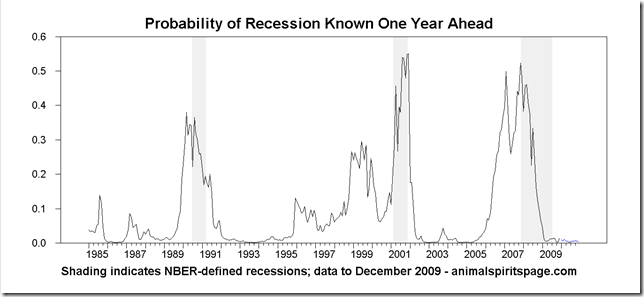
I forgot in the update yesterday to include the updated “recession probability” chart.  No NBER-type recession in sight.  
image

But American society and its economy continue to be very sick.  At at time when the have-nots most need work it appears to harder to get than any time in the past thirty years.

image

Here’s query that produces a plethora of references on the adverse impact of highly unequal socioeconomic status on health.

It’s my view that there are innate standards of fairness in the human breast that must be satisfied if pathologies are not to become severe.  Whether the corporate state can ever overcome its bias toward greed is unclear.  But I will speculate, optimistically, that corporations with flatter corporate income distributions will at some point gain a productivity advantage, that may lead to social change.  “Pension fund socialism,” as Peter Drucker called it, has failed—even if American workers technically own American companies through their pension funds and 401(k)’s the money managers have insulated company managements from any meaningful shareholder action by voting the “Wall Street rule” (for management) routinely.

Let’s see the leaders of American corporations take the lead in reestablishing a sense of fairness by taking less out of their companies for themselves.  Economists can quibble endlessly about whether inequality has in fact increased or whether it has any effect on productivity (see a realclearmarkets.com summary of a recent study by Robert J. Gordon indicating that it’s all an illusion…) but the perception of gross unfairness is out there.

Social change is coming, but not from Barack Obama.  It my fellow (exceedingly hard working) blogger George Washington is fond of saying, change springs up from the grass roots.

Enjoy your Saturday!

Friday, January 8, 2010

Animal spirits update: fiscal stimulus high!

To begin with I’d like to cite some excellent digging that zerohedge.com has done with published Treasury data that indicate an awareness on the part of the administration that the income distribution is indeed hosed and the best way, ceteris paribus, to cure what ails us is to channel more money to those without:

Treasury Flooded Consumers With Money In December, Just In Time To Unleash Holiday Shopping "Animal Spirits"


My preference would be for a livable dole for the unemployed based on workfare but getting that through the obstructionists (Republicans, in this term) in Congress is apparently not possible.  The administration doesn’t know how to attack the root causes of our problems, or doesn’t feel strong enough to do it, but they know how to print money and throw it at problems (kind of like chimps throwing something else at attackers…).

As Simon Johnson has commented recently, “We now have a system that is completely based on moral hazard.”

Unemployment in December remained constant at 10.0 percent on a fall in the labor force that pushed the participation rate to it lowest level in five years.  The U-6 unemployment of all unemployed and involutarily employed part-time and discouraged workers rose to 17.3 percent.

So what will happen to “animal spirits”?  They will continue to rise as forecast, sluggishly, as Americans adapt to the current situation, to peak about late 2012, to be followed by another deflationary collapse as all the bad debt the government refuses to deal with implodes on the economy, and we crash from the ultimate debt-financed binge at the end of the age, so to speak.

Here is the big picture on “animal spirits”:

image

And for good measure, a close-up:

image

I have assumed the the track of unemployment, after a little more on the upside, will track the slope of previous recent declines in the business cycle “expansion” (I put expansion in quotes because only the top few percentiles of the income distribution have participated in the past several expansions).

The increase in “animal spirits” or general confidence levels is mirrored in a decline in other financial market based measures of risk aversion, namely the Baa-Aaa spread that shows the degree of risk aversion in the corporate bond market.  We made a great call on the topping of this spread early in the year that has some ways to run:

image

From a social psychology point of view the problem is that we’re entering another false dawn, kind of like “morning in America,” where the federal debt binge really got started, by the way, and since, as mentioned, our leaders are doing nothing to right the fundamental wrongs, we’re headed for another collapse similar to the last one.  The politicians can be counted on to do absolutely nothing unless hit over the head by economic conditions, and disenchantment with the current administration may lead to a gridlocked Congress.

America will enter an eerie calm over the next couple of years.  The rich will pretend that everything is all right and go with their lives as usual.  The middle class will lay in their beds at night wondering if they will be next, as they watch friends and neighbors grind into destitution and depression with long-term job loss, loss of house, loss of any shred of middle class socioeconomic status.  It will be an America profoundly divided beneath the surface, not by political lines, but by what are effectively entitlements bestowed upon the “haves” by a system that (except for some hidden indications, like the anomalous Treasury spending noted above, and perhaps by the tax increase on the rich that is allegedly part of the health insurance expansion bill) increasingly turns a blind eye to the those at the bottom of the socioeconomic heap.

America is not becoming a banana republic, a hollowed-out state.  It is one.  The ruling junta is the Greed Party, also known as the the Money Party.  The postwar American social contract based on shared sacrifice and working together is broken, and must be restored.

Tuesday, January 5, 2010

Krugman (probably) wrong again; Hussman scores

Krugman Sees 30-40% Chance of U.S. Recession in 2010 – Proving once again that he knows nothing about business conditions or how the real economy actually operates, Paul Krugman is forecasting a significant chance of “recession” in 2010.  Now, the definition of “recession” is political, made by the National Bureau for Economic Research, usually well after the event; and Krugman is an Establishment insider, so he may know something I don’t, namely that the NBER is planning on changing their “definition,” which usually tracks the slope of Industrial Production and a few other primary economic series pretty well.  My recession forecasting model, which forecast the 2001 and 2007-? recessions from a year or more in advance, says “no recession in sight” (in the traditional NBER sense), but rather, a basically L-shaped chugging ahead at some finite positive slope.  Here’s the chart from the last update:

image

Sometimes I just want to grab Krugman by the neck and yell, “The economy doesn’t go into recession with the yield curve as steeply sloped as it is now, Paul!”

My best-guess is still that we’ll limp along for a couple of years, weathering the next waves of rate-reset defaults on exotic mortgages, until the next debt-deflationary collapse around 2013.  That is when the fiat money hits the fan.

The best way to get an inflation (or hyperinflation) going, historically, has been to be at war.  It is my working hypothesis that all the idiotic fiat monetary authorities of the world are conspiring to inflate their way out of their unmanageable debt loads, so we should see all the monetary Wizards gathering with all the Daddy Warbucks by mid-decade to expand our endless wars.

That is, unless a new government is put in place.

Timothy Geithner Meets Vladimir Lenin - John Hussman on the Fed and Treasury’s overstepping their legal authorities and the likely consequences for taxes paid by the American people.  Must reading.  Remember, Tim Geithner “forgot” to pay $35,000 in federal taxes.  Raise marginal rates on incomes over $1 million to 90 percent!  Bring the ruling class back down to earth!  Let them know that they are not gods!