Showing posts with label confidence. Show all posts

Thursday, March 20, 2014

Fiat money = funny money => Fed must screw labor

h/t Mish for pointing out an article by Adair Turner, former Chairman of the United Kingdom’s Financial Services Authority, a member of the UK’s Financial Policy Committee and the House of Lords, suggesting that the Fed or any fiat money central bank might accept conversion of assets on its balance sheet, i.e., Treasuries, into zero coupon perpetuities, and so create "helicopter money" and permanent monetization of the sovereign debt.

I suggested just this strategy as a joke some time ago (here).

However, we all knew that the Fed can and does print money. But stating it as baldly as this brings me back to the problem this causes in the labor market.

As I have said repeatedly, inflation (a sustained wage price spiral inflation) is always and everywhere a labor market phenomenon accommodated by monetary policy.

Thus, with the vast overhang of base the Fed must worry about inflation in the long run, even if not so much right now. Why not now? Because prosumers are overburdened with debt and inflation is nowhere raising its ugly head. Looking more deflationary now, it is.

But should actual deleveraging take place by some other means than a few bad debts actually being charged off (imagine that!), such as bad debts being recognized as such (FAS 157 thrown out, good riddance) and debtors finding relief as the (unpaid) debts hit statute of limitation dates with no more recourse--then the Fed would have to worry about a wage-price spiral getting going.

In other words, the Fed is intrinsically anti-labor and always will be. What did Paul Volcker teach us, if not that? You got to recruit some cannon fodder, some inflation fighters to win the war on inflation.

There's an interesting wrinkle in here in that Janet Yellen has allegedly stated her desire to see the labor force participation rate improve, while at the same time worrying that it will adversely impact the unemployment rate (duh!) and hence, confidence. (My readership is small but highly intelligent and knows that if discouraged workers are included the unemployment rate is well above 10 percent by the governement's own questionable figures.)

I do believe the Fed economists are aware of the psychological importance of the unemployment rate that the unknown economist whose work I channel has established, and which the econophysicists seem to appreciate far more than the professional economist (i.e., generally establishment cheerleaders) community does.

Sometime within the next few years the unemployment rate will meet its falling adaptation level and rise above it. That is when we will see the next collapse of confidence. So the model predicts.

In passing I note that MMT does not really offer a way out of the wage price spiral problem. They just seem to be willing to inflate the debt out, disco style. However, the danger of hyperinflation may be greater this time, given the size of the base, and they seem oblivious (to me) to the Austrian distributional implications that those who get new money first can increase their wealth at rates much faster than those depending on increasing real wages can expect.

To bing this discussion full circle, let's ask what comes next for the international monetary system? Does an IMF ADR basket currency make the central banks love labor any more? I think not. Unless they're playing competitive devaluation games, they still can't afford too much inflation ("a little inflation is a good thing, but not too much"--this is the mainstream cant).

Given the plutocratic distribution in the world today, it seems to me that any fiat money system broadly adopted is going to result in labor continually getting screwed, absent really aggressive incomes policies (guaranteed basic income and health care, for example; or even better, enforced limits on wage contours, now being challenged even in Sweden, such is the prevalence of greed in the current historical moment).

History shows that a metal based system achieves stable prices over long periods. Sorry, "Rich Dad, Poor Dad," you're not a genius for investing in real estate. To paraphrase Paul Samuelson, during an inflation every fool is a great financier. It takes no brains to load up on debt when inflation is guaranteed.

Are there financial crises under a metal standard? Yes, just like under fiat banking as it rides into its sunset. The answer to cyclical variations is always to let them happen, to concentrate on stabilizing people and not "the business cycle," to take care of displaced persons during the adjustment. And to keep banks out of the business of speculation with other people's money.


Friday, March 7, 2014

‘Animal spirits’ update

The approach taken to confidence determination here stipulates that, for the most part, confidence levels are determined by whether unemployment is above or below what people are used to, an adaptation level modeled as an exponential moving average over the past four years. When unemployment is below the adaptation level, we feel good; and conversely. Thus, in the 1980s, when unemployment came down from double digit levels to 9 percent, that level produced gains in confidence. Currently the adaptation level is at 7.8 percent and unemployment is at 6.7, so in theory we are “confident” (as I have mentioned, I don’t quite know why the median income household—really everyone below about the 90th percentile—has not lost confidence completely; we know the top 10 percent are confident, and for the most part completely out of touch with what is happening in the country.)

What is remarkable about this simple theory is that it is very sensitive to identifying the beginnings of the downward cascade of economic activity—and upward shooting of the unemployment rate—that occur at the outset of recessions.

image

The forecast in blue assumes the following judgmental forecast for unemployment:

image

Now it is possible that unemployment will bounce along a bottom at about current levels for longer than I have assumed, but in this theory of the business cycle confidence will always fail when the adaptation level comes down to the current unemployment rate. Note in the graph above that the crossover point is almost always exactly when the NBER defined recession begins, and when unemployment accelerates upward.

The negative skewedness of the first differences seen here is also seen in stock prices, which arguably follow a very similar type of adaptation-level theoretic dynamic, at least in part.

The current period is morphologically similar to the early 1970s, before the recession began, with the Michigan Consumer Sentiment series lagging (green in “animal spirits” chart). If we follow that pattern the collapse will be sudden.

My judgmental forecast puts the start of the collapse a year from now, in February 2015, but my forecast includes increases of 0.1 percentage points a month starting in about six months. I cannot comment on the calculation of the unemployment rate authoritatively, but many have found the sharp decreases in the labor force participation rate to be anomalous. (It was amusing and sickening to hear that Janet Yellen is worried that the labor force participation rate might increase from its generation low and cause the unemployment rate to go up. She and the Fed are apparently aware of the underlying model referenced here even if here book-writing husband’s book on “animal spirits” doesn’t reference it.)

If we are at something like “peak false consciousness” (again) it won’t take much to prick the bubble, especially as the unemployment rate and adaptation level converge.

Friday, January 10, 2014

Honey, I shrunk the labor force!

With the adaptation level at 8.1 and the “current unemployment rate” at 6.7, the confidence cushion has widened a bit, but I view this as a holding action. I don’t know why people pay attention to the unemployment rate any more, but then, I am a professional. Most people are not obsessed with the increasingly flaky economic data as I and other readers of Zero Hedge et alia are.

With continued weakness in the Michigan series, and a topping formation in the A metric, the collapse, when it comes, will be sudden, as it always it.

image

Thursday, October 31, 2013

Median household incomes at 1996 levels

From an adaptation-level theoretic perspective, I don’t understand why confidence hasn’t collapsed already.

image

Source: Census via FRED. Annual data through 2012.

Saturday, September 14, 2013

‘Animal spirits’ and the natural unemployment rate

The San Francisco Fed reports median estimate of the natural rate of unemployment in 2013 is 6.6 percent (source). Other estimates put the rate at 7.9 percent (source). Assume the current unemployment rate is the current natural rate, at 7.3 percent. How long until confidence collapses if the rate remains fixed at that level? Obviously it will take infinitely long for the adaptation level to converge to the current level, but when does it get within 0.1 of the adaptation level? That actually doesn’t occur until March 2016. But this is not a realistic path.

The crossover from “unemployment rate below adaptation level” to “unemployment rate above adaptation level”—the signal of collapsing confidence—is always preceded by a leveling out of the smoothed (12-month MA) unemployment rate, which has not yet happened. This is a necessary but not sufficient condition for a collapse of confidence to be imminent.

image

We will monitor developments for this occurrence.

Wednesday, June 26, 2013

Will consumption collapse?

Running at about 70 percent of GDP, consumption has been above long-term averages for a while, with much of it financed by debt.  Households are deleveraging where they can.  Where will consumption go?

image

Of course, for the majority of consumers, the weakness in real disposable income has been greater than depicted because of the great degree of inequality in the income distribution.  Government spending won’t pick up the slack, and neither will investment, from all appearances:

Graph of Shares of gross domestic product: Gross private domestic investment: Fixed investment: Nonresidential

Friday, February 1, 2013

‘Animal spirits’ update

N.B. This is research, not investment advice.  You invest at your own risk, unlike the Wall Street banks, who also invest at your risk. 

The uptick of the unemployment rate from 7.8 to 7.9 has caused our ‘animal spirits’ indicator to put in a top.  Continued increases or merely stability of the unemployment rate will cause further losses of confidence.

image

The underlying judgmental unemployment rate forecast is this:

image

My forecast is still that the US economy enters recession in the second half of 2013.  The two big proximate drivers:  the continuing assault on consumption from higher taxes and medical costs; a precautionary demand for liquidity (increased saving rate); the sequester—to any degree—of federal government spending; and to the extent that it impacts the small segment of the population current salivating over stock market gains induced by QEternity, a diminished wealth effect (yes, the implicit stock market forecast is that we’re at a major top—I called it a year ago but the presidential election year got in the way—this cycle is very reminiscent of the early 1970s, and we’re at about the turn from 1972 to 1973).  Throw in Europe in various states of severe recession and depression, and the likelihood of some slowdown in China, and we have the potential for a coordinated global contraction, almost as if the signs all say we are at the end of the [high?] growth age….

Here is the whole history:

image

Note how depressed the Michigan Consumer Sentiment index is, just as it was in the early ‘Seventies.  The drop-off from here could be precipitous from here.  Even somewhat proven indicators such as the “Rule of 20” show the market looking toppy (yellow line is where the blue S&P line is supposed to be):

Source:  News-to-Use

Thursday, April 19, 2012

‘Animal spirits’ update: contraflation?

The adaptation level theoretic measure of confidence that I track continues to be positive, slightly, based on the relationship of the unemployment rate to an exponential moving average of recent rates.  When you’re coming down from over ten percent, 8.1 percent seems great (and nobody really pays close attention to the high U measures of unemployment, in this view).  The configuration of my confidence metric and the Michigan sentiment measure most closely resembles that in 1973, when Michigan confidence was low, but the A metric was positive.

image

The period after the election to the inauguration is what someone has called the mother of all lame ducks if Romney wins.  Any tax relief the Congress might enact—whether a “temporary” payroll tax cut or further postponement of the Bush-Obama tax cuts’ expiration—will be political suicide.  It might well be even if Obama wins.

That implies that fiscal drag equivalent to 3-4 percent of GDP could kick in January 1, 2013.  The underlying unemployment rate forecast is as follows:

image

Notice that confidence turns up even as the unemployment rate continues to rise!  This is one of the interesting nonlinearities of the A metric.  In terms of my confidence metric, the next recession may not be that bad, ending in about the middle of 2014, probably as the Fed pumps even more credit into the economy, and as inflation probably infects the wage price spiral, gunned on by war in the Middle East, if Charles Nenner’s forecast is true.

In the final supernova end game of the global credit bubble there is a tremendous first-mover advantage to she who inflates first.  And historically, war is a quick way to get a “hot” inflation going—even as some sectors (like housing and some commodities) continue to deflate!

We need a new term for this phenomenon of inflation and deflation occurring simultaneously. 

Contraflation?

Friday, January 13, 2012

Secular exhilaration confirmed

My forecast of bettering “animal spirits” is confirmed in the pop of the Michigan sentiment series today.  With the bally-hooed unemployment rate—still the headline variable, even though just about everyone knows U6 and what’s going on with the labor force matter much more—now below its adaptation level, “animal spirits” are positive for the first time in the current “recovery.”  I am showing my freehand forecast of the unemployment rate and its implications for “animal spirits” below.   As I mentioned a couple of posts ago, the situation today most resembles early 1973, at right about the time of a stock market peak and about a year before the onset of recession.  [This is research, not investment advice.  You invest at your own risk, unlike the Wall Street banks, who also invest at your risk.]

image

image

Technically, my model shows “animal spirits” going negative, and the next “recession” (collapse of confidence accompanied by accelerating losses of income and product) beginning in mid-year 2013.

However, Europe’s recession and deceleration of Chinese growth may quicken things a bit.

It’s 1973 all over again, the year before a major social and economic crisis.  Watch my brother Marvin sing about it.

Wednesday, September 7, 2011

‘It’s the debt, stupid,’ redux

Watch for unprecedented manipulation of the unemployment rate, as the administration comes to terms with the fact it is the relationship of the unemployment rate to its adaptation level that is the strongest single determinant of confidence in the United States of America.  The general public, including unsophisticated investors and even types like yours truly with a Ph.D. in economics, distrust the stock market and look at any manufactured gains there as simply more evidence of the expropriation of the public by the kleptocracy.

We learned in macro thirty-five years ago that when effective demand collapses in the depression, increased monetary “stimulus” is like “pushing on a string”—the public and businesses don’t want to borrow in a collapsing economy.  The only lesson Bernanke seems to have taken from his studies of the Depression (and from his current crop of colleagues) is that banks can’t be permitted to lose any money.

Three links by sources I trust sum it up pretty well:

It's A Long Hard Road – www.contraryinvestor.com (may be in the archives after September 2011)

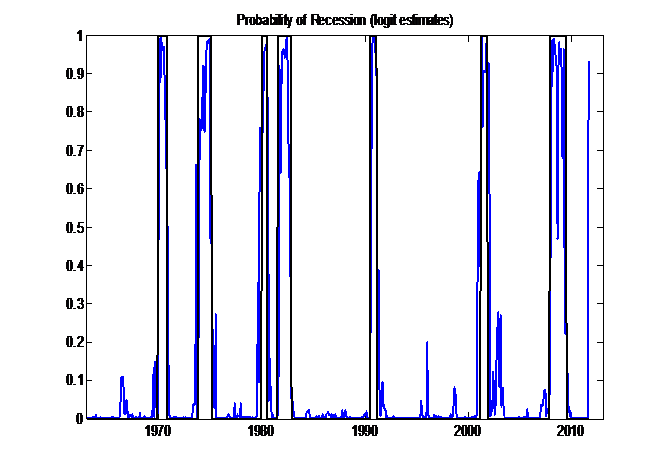
An Imminent Downturn: Whom Will Our Leaders Defend? – John Hussman.  Hussman has developed a robust logistic model on more than just the yield curve, something I would do if I were paid to to do.

‘Helicopter Ben’ risks destroying credit creation – Bill Gross.  An almost comical whine seemingly on behalf of the banks by Bill Gross, who points out that the proposed contortionist “Operation Twist” will not help the banks to create credit, of course missing the main point that in a multi-generational deflationary collapse of effective demand very few want to borrow except the carry trade operators who are having fun blowing bubbles right and left to sucker the poor forcibly “risk on” public in to parting with more of their money.

By the way, I may have been the first to coin the phrase, “It’s the debt, stupid,” but I welcome any contributions to substantiating that claim.  Here’s the earliest reference I can find on the site:


The Animal Spirits Page: It's the debt, stupid