Showing posts with label japan. Show all posts

Saturday, January 19, 2013

Multiple occupancy

I made a crack recently about how the Japanese will solve their overcommitted entitlements problem, given their increasingly top-heavy dependency ratio, and given that 95 percent of their sovereign debt is held domestically, namely, that they will solve it by the old Boomers hunkering down and taking whatever the kids toss to them, just to keep the kids on the islands.

Now, American sovereign debt is significantly held by foreigners, so the prescription applies doubly to American Boomers. Almost a third of the young adult kids are already at home, since the Boomers already blew the national wad and let the political system get sold to the highest bidder, the multi-nationals and the corporate gangstas who sit atop that pile, who promptly shipped the jobs overseas and in the name of free markets screwed everyone who wasn't a member of their club, i.e., labor, anyone working for a wage or salary who wasn't participating in the ridiculously rigged stock market as a major part of their comp, and established oligopolies in as many industries as possible, and Wall Street decided to get into the action by pulling a magnificent bait and switch on the American homeowner, a classic pump and dump, so that their friends the hedgies could become the landlords of America... yada yada yada, you know the story by now.

The point being that multiple occupancy, whether in the extended family way or otherwise, is probably the future of real estate in America, especially for the Boomers.


Monday, November 12, 2012

Swedish vs. Japanese models

Via:  Trust Your Instincts  h/t Jesse

In imposing even “balanced austerity” and not confronting the load of bad debt that has been made to be an obligation of the US taxpayers, Obama is engaging in what Bill Black calls a “great betrayal” of progressive principles.  Here’s a nice collection of simple explanations of the Swedish vs. Japanese (and US in the 1980s) approaches to a crisis of solvency due to bad debt clogging up the banking system.  We may wait a very long time for it to be cleared by natural attrition.  Iceland is the poster child of how clearing the debt by requiring banks to mark to something like market and take their losses can liberate the private economy to start up again. 

Swedish versus Japanese Model

There are two basic models for how to deal with a bank solvency driven financial crisis.


Under the Japanese model, losses on the excesses in the financial system are only recognized as banks generate the capital to absorb them.  This is good for banks, particularly their book capital, because the model involves hiding their true condition and pursuing policies designed to boost bank earnings.  It is bad for the economy because it distorts asset prices and access to capital (for proof, look at the performance of Japan's economy).

The alternative is a Swedish model that is bad for banks and good for the economy.  It is bad for banks, particularly their book capital, because they are required to recognize the losses on the excesses in the financial system today.  It is good for the economy because it avoids the distortion in asset prices and access to funding associated with hiding the losses under the Japanese model (for proof, look at the performance of Sweden's economy).

The following are a series of posts which examine these models and their implications:

Confirmation that Japanese Model being used and losses are being hidden
RBS's Stephen Hester's confession that bank hiding losses with regulators' blessing
Just how sizable are the losses being hidden by banks?

Choosing between Japanese and Swedish models
Its not to late to adopt the Swedish model and stop the financial crisis
Response to solvency crisis:  Swedish vs Japanese model
Liam Halligan:  EU policy choice is between Swedish and Japanese models
Europe's banks are addicted to ECB's money

Proof Swedish Model Works
Iceland confirms that Swedish model for bank solvency works

Iceland shows that forcing banks to take losses works to end financial crisis

Toxic Side-Effects from Implementing Japanese Model
Repealing Disclosure Laws seems Reasonable
Greece is Heading for Hell

Problem with the Japanese model is that there is no easy exit

Background
Is there any truth to bank earning presentations under Japanese model?
Hiding losses does not restore confidence in banking system
The policy of 'what is good for banks is good for the economy' has failed
Do nations exist for capitalism or their citizens?
What interest rate would central bank policy be set at if the Swedish model had been used?

Thursday, August 11, 2011

This is not investment advice

The first chart is from www.angrybear.com, the second from www.stockcharts.com.

This is research, not investment advice.  You trade at your own risk, unlike the Wall Street banks, who also trade at your risk.

image

The S&P 500 is about to make a “death cross” when the 50 day moving average crosses below the 200 day moving average.  Downward momentum could easily build.

Sunday, May 29, 2011

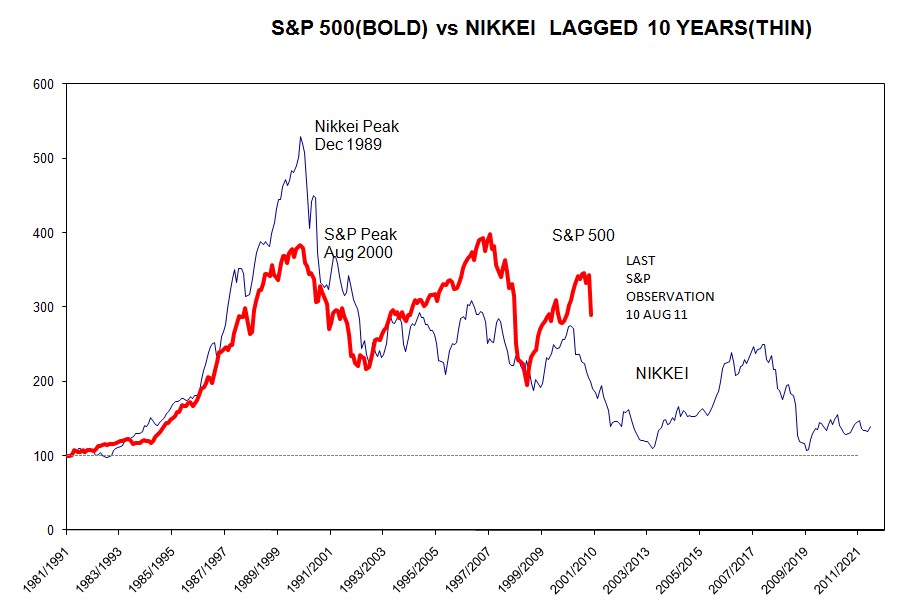
Japan’s “lost” decades and America’s

Philip Pilkington: Beyond growth – are we entering a new phase of economic maturity? argues that Japan’s lost decades were not so bad when you look at social welfare, a dimension that eludes Paul Krugman.  Japanese aggregate debt to GDP climbed to levels far beyond where America is now, and mirabile dictu, life expectancy increased and in general social welfare remained very high relative to barbaric American standards.  Pilkington is citing work by Modern Monetary Theory proponent Bill Mitchell.  I have been hard on MMT because it shares all the weaknesses of fiat money systems—and in fact exploits them to advance social welfare.  In Japan’s case, they were able to assume staggering amounts of debt because they are a high saving society and largely owed it to themselves.  Their currency remained strong, there was no hyperinflation, and people hung together.  (There is a larger question:  the societies with very high kinship coefficients across the population such as Japan and the Scandinavian countries seem to be satisfied with government services requiring much higher levels of taxation than Americans put up with; are content with much flatter income and wealth distributions; and also score happier on many measures of general happiness.)  This is not to say that Japan shouldn’t have shut down their zombie banks and purged the bad debt from the books—they would have been even better off if they had; but powerful interests being what they are, they didn’t.  Just as America is proving incapable of writing off its bad debts, instead pursuing the illusion that the banking system will recapitalize over time if interest rates are held low enough for long enough.  The pin that pricks this bubble, I believe, is the off-balance-sheet derivatives exposure to the housing market that has not yet cleared.  If the housing market continues downward, how many CDSs will be triggered?  And how will the Fed attempt to bury those bailouts from the public?  And will they be able to?

The difference between Japan and America, of course, is the level of social cohesion and shared sacrifice.  The Japanese pull together.  America is being pulled apart.  I applaud the agenda that proponents of MMT seek to achieve by printing money, I just doubt that those objectives would be achieved in the United States by printing money.  So far, the evidence suggests most stimulus monetary or fiscal goes into the pockets of the well-heeled.

Hence Steve Keen’s fairly obvious but nicely presented views on debt-financed aggregate demand:  when the debt growth stops, unless the lost aggregate demand is replaced, there is a multiplier-magnified contraction of the economy.  Much of the growth of aggregate demand in the United States in the past decade or more has been debt-financed. 

This is why I subscribe to Strauss and Howe’s prophesy of a profound national crisis in the United States, culminating about 2020 and concluding about 2026.  As the big mouths at PIMCO like to say, what we have now financial repression.  All indications—renewal of the “Patriot” Act, and dark intimations about how the government is actually interpreting it—point to more direct forms of repression being readied.

Americans need to forge a new social contract soon or descend into decades or centuries of grinding neo-feudalism, by which I mean banana republic-style inequality and its attendant inefficiency.  America’s greatest resource is her people, and if the people lose heart, they become wage slaves on the plantation.  History teaches that vast inequalities always fuel revolutions, sooner or later.  If we lack genetic ties, we need to cling to the classic American ideals of fairness and freedom and equality before the law.  Adam Smith maintained that capitalism without a moral context—think of the medieval doctrine of “fair price”—cannot succeed in anything but crass exploitation.

I have to believe we can live up to our ideals.