Showing posts with label geithner. Show all posts

Wednesday, August 4, 2010

Geithner gets it right for once

Via:  AP

Geithner: Extending tax cuts for wealthy a mistake

Geithner says extending tax cuts for the wealthiest Americans would be a $700 billion mistake

Martin Crutsinger, AP Economics Writer, On Wednesday August 4, 2010, 7:29 pm EDT

WASHINGTON (AP) -- Treasury Secretary Timothy Geithner said Wednesday that extending the Bush-era tax cuts for the wealthy would be a $700 billion mistake. He also rejected a compromise proposal that would extend the cuts for one or two years.

Geithner said cuts for families making more than $250,000 annually should be allowed to expire on schedule at the end of the year. But the administration believes tax cuts for the 95 percent of taxpayers making less than $250,000 should be extended, he said.

Geithner's comments came during a speech at the Center for American Progress and focused on what is likely to be a key economic battle leading up to the November midterm elections. Unless Congress acts, all of the tax cuts approved in 2001 and 2003 will expire at the end of December.

Republicans have argued that all of the tax cuts should be extended. They contend that raising taxes on any group at the current moment would be harmful to the economy.

Geithner said extending the tax cuts for the top 2 percent of taxpayers would cost $700 billion over a decade and $30 billion for a single year. He said wealthy families are more likely to save the money, which doesn't help the economy in the short run.

Geithner said allowing the tax cuts on the wealthy to expire would also help get the soaring deficits under control.

"Borrowing to finance tax cuts for the top 2 percent would be a $700 billion fiscal mistake," Geithner said. "It's not the prescription that the economy needs right now and the country can't afford it."

As I showed in this post, there are lots of tax cuts for the middle class in the Bush tax cuts that should not be repealed.

This a great wedge issue for the Democrats.  They can once again accuse the Republicans of standing for little more than keeping taxes low on rich people and make the accusation stick. 

This good PR move hardly exonerates Geithner, Summers, Bernanke et al. for effecting the most massive wealth redistribution from working taxpayers to the wealthy in the history of the world, as Barry Ritholtz terms the bailouts of the past couple of years.

The tax increases on the rich the Geithner advocates are mild in the context of American postwar history.  This chart due to Paul Krugman shows the top marginal tax rate (red) and median family income (blue): 

If the take-home pay of the CEOs and corporate board members and senior executives and Wall Street traders were brought down to Earth by a marginal tax rate in the 75-90 percent range, I think it would do much to sober those people up, who have been looting the treasure of American corporations by manipulation of their governance and related capital markets for too long.

It is heartening to see that forty billionaires have heeded Bill Gates call to give away half of their fortunes to charity.  Such moves as these might be the seeds of a new social contract.

Let’s see if they actually do it.  One of the oldest tricks in the book in Hollywood is for a star or starlet to hold a press conference announcing that their giving X million dollars to charity, and then to never do it. 

Tuesday, January 5, 2010

Krugman (probably) wrong again; Hussman scores

Krugman Sees 30-40% Chance of U.S. Recession in 2010 – Proving once again that he knows nothing about business conditions or how the real economy actually operates, Paul Krugman is forecasting a significant chance of “recession” in 2010.  Now, the definition of “recession” is political, made by the National Bureau for Economic Research, usually well after the event; and Krugman is an Establishment insider, so he may know something I don’t, namely that the NBER is planning on changing their “definition,” which usually tracks the slope of Industrial Production and a few other primary economic series pretty well.  My recession forecasting model, which forecast the 2001 and 2007-? recessions from a year or more in advance, says “no recession in sight” (in the traditional NBER sense), but rather, a basically L-shaped chugging ahead at some finite positive slope.  Here’s the chart from the last update:

image

Sometimes I just want to grab Krugman by the neck and yell, “The economy doesn’t go into recession with the yield curve as steeply sloped as it is now, Paul!”

My best-guess is still that we’ll limp along for a couple of years, weathering the next waves of rate-reset defaults on exotic mortgages, until the next debt-deflationary collapse around 2013.  That is when the fiat money hits the fan.

The best way to get an inflation (or hyperinflation) going, historically, has been to be at war.  It is my working hypothesis that all the idiotic fiat monetary authorities of the world are conspiring to inflate their way out of their unmanageable debt loads, so we should see all the monetary Wizards gathering with all the Daddy Warbucks by mid-decade to expand our endless wars.

That is, unless a new government is put in place.

Timothy Geithner Meets Vladimir Lenin - John Hussman on the Fed and Treasury’s overstepping their legal authorities and the likely consequences for taxes paid by the American people.  Must reading.  Remember, Tim Geithner “forgot” to pay $35,000 in federal taxes.  Raise marginal rates on incomes over $1 million to 90 percent!  Bring the ruling class back down to earth!  Let them know that they are not gods!

Wednesday, August 12, 2009

The FDIC is in trouble

Via:  The Daily Reckoning   Nothing succeeds like failure in disciplining a financial system, an inconvenient fact that we’ve forgotten in our age of unlimited moral hazard or financial fascism.  The current administration could be called “The Dukes of Moral Hazard…,” with Tim Geithner as their poster boy.

As we all know, the Federal Deposit Insurance Corporation (FDIC) guarantees depositors that they'll get their money back if a bank fails, at least up to a certain amount. To fund its operations, the FDIC collects small fees from the banks that are held in reserve for the purpose of taking over troubled banks and paying off depositors.

Since the Great Depression, a period marked by widespread runs on banks, the FDIC has done a good job of fulfilling its mandate. So how are they doing in this crisis?

In a nutshell, they are in trouble.

The FDIC insures 8,246 institutions, with $13.5 trillion in assets. Not all of them are going bankrupt, of course. Yet as of late July, a disturbing 64 banks had gone belly up this year - the most since 1992 - costing the FDIC $12.5 billion. At the end of Q1, the agency was already asking for emergency funding.

And worse, much worse, is likely yet to come. The following chart shows the total assets on the books of the FDIC's list of 305 troubled banks. The list doesn't include the biggest banks that are considered too big to fail, as they are being separately supported with bailouts. By contrast, if the banks on this list fail, the FDIC is on the hook to have to step in and take them over and, of course, make depositors whole.

Other measures of how serious the losses at banks are becoming can be seen in the chart below, which shows charge-offs and non-current loans at all banks. You can see that the Net Charge-offs remain stubbornly high, with banks charging off almost $40 billion in bad loans in the last two quarters alone. And the number of non-current loans - loans where payments are not being kept up - is soaring.

Together, these measures indicate the potential for more big failures and more big bailouts coming down the pike.

Into the battle against bank insolvency the Fed brings a level of reserves that can best be described as paper-thin. From almost $60 billion last fall, the FDIC's reserves have been drawn down to only about $13 billion today, a 16-year low. A quick look at the FDIC's own data shows us how inadequate those reserves are compared to the deposits they are now insuring.

The chart below says it all:

As you can see, the Federal Deposit Insurance Corporation currently covers each dollar on deposit with a trivial 2/10ths of a penny.

And even that understates the seriousness of the situation: the $4.8 trillion in deposits the FDIC is providing coverage on doesn't include the expansion that now extends insurance coverage from $100,000 to $250,000 for normal bank accounts. That likely brings the exposure of the FDIC closer to $6 trillion. But that's pretty inconsequential at this point: using any reasonable accounting method, the FDIC is already bankrupt and will require hundreds of billions of dollars in government bailouts just to keep the doors open.

So, given the dire shape of its finances, what measures is the FDIC taking, you know, to batten down the hatches and all that?

For starters, they are expanding their mandate by guaranteeing bank loans - $350 billion and counting at this point. And the government has tapped the FDIC to play a pivotal role in guaranteeing the loans issued to buy toxic waste through the government's highly problematic and fraud-prone new Private Public Investment Partnership (PPIP). The FDIC's commitment to the PPIP is and may become limited based on its resources.

It is hard to draw any other conclusion but that hundreds of billions in new funding will be required to keep the FDIC operating. Given the catastrophic consequences of the FDIC failing, starting with a bank run of biblical proportions, there's no question it will get whatever funding it needs. By loading the new loan guarantee responsibilities and the PPIP onto the FDIC's back, the administration will go back to Congress and ask for the next large bailout.

Of course, in the end, all of this falls on the taxpayer, either directly in the form of more taxes or indirectly via the destruction of the dollar's purchasing power. Another bale of straw on the camel's back, and another reason to be concerned about holding paper dollars for the long term.

Wednesday, July 29, 2009

Break up the Fed (then abolish it)

An op-ed in the WSJ of all places is saying pretty much what I wrote to my elected representatives in Fire Bernanke, Audit and Abolish the Fed.  Take actual banking regulation away from the eggheads and away from New York City.  Set up a bank examination agency somewhere in fly-over land and staff it with people who actually know banking.  The loans that were booked during the real estate bubble were laughable.   “Purchase money seconds”?  “Zero down”?  “Negative am”?  Please!  Any responsible banker of a generation or two ago would—and many did—gag on this crap.  It is encouraging that the article below appeared in the Wall Street Journal. 

The next step is to demolish B of A, Citi, JP Morgan, HSBC and Wells, all of whose balance sheets are probably jokes.  See Regulatory reports show 5 big banks face huge loss risk.  The “fortress balance sheet” of JPM is riddled with worthless derivatives, probably.  Time for a new sheriff who will take on the oligarchs and knock down their houses of cards.  These banks have been run like hedge funds and deserve to be dismantled and put under new leadership.  This is the kind of banking that Glass-Steagall and the other reform legislation of the early thirties sought to abolish, and that Larry Summers et al. brought back because “markets are self-regulating.”   

The sooner the President understands that the pitchforks aren’t just for the bankers, and gets rid of the Wall Street players who have ripped off the American public (Summers, Geithner, Bernanke for starters)—and embraces really radical financial reform and some pay-back of the banking bailouts, the better the President’s chances of political survival are.  Because asset values probably haven’t hit bottom, and the public won’t stomach any more bailouts, so more big losses are probably coming for the banks with lots of derivatives.

Via:  WSJ

Let’s Break up the Fed

The Federal Reserve has done a terrible job at financial regulation. Why give it more power?

By AMAR BHIDé

The Obama administration’s plan to increase the powers of the Federal Reserve, says one critic, is like giving a teenager “a bigger, faster car right after he crashed the family station wagon.” Treasury Secretary Timothy Geithner disagrees. He argues that the Fed is “best positioned” to oversee key financial companies, and that the Obama plan would give the Fed only “modest additional authority.”

Mr. Geithner is right about one thing: The Fed’s power is already vast.But it wasn’t even well-positioned to supervise the likes of Citicorp. Broadening the Fed’s responsibilities won’t help. Instead, we should think of how best to dismantle an overextended Fed.

Though advanced economies like ours require organizations capable of taking on a wide range of activities, there are limits. As Frank Knight, the great Chicago economist, pointed out in his 1921 classic “Risk, Uncertainty, and Profit,” individuals who control large organizations have to delegate many decisions to subordinates. Entities like hedge funds, where individuals such as George Soros make most of the consequential choices, are exceptions.

Therefore, good judgments about people—picking the right subordinates, refereeing staff conflicts, evaluating performance, and so on—are crucial.

Good judgment requires experience, not just exceptional intelligence or raw ability. Although many lessons about managing people can be applied to different fields, good judgment also requires some specific expertise. You can’t manage plumbers without knowing something about plumbing.

Unfortunately no one can learn everything about everything. Yes, Lou Gerstner turned around IBM without any prior experience in the computer business. But he had decades of general management experience, was an exceptionally quick study, and had to come up to speed in just one industry. Individuals who can learn how to effectively lead conglomerates, especially during periods of transition, are exceedingly rare.

This mismatch between what even the most talented minds can learn and the challenges of controlling widely disparate businesses has helped bring our financial system to the brink of collapse. The great names in finance once had distinctive identities and capabilities: Salomon Brothers was the champion in bond trading; Merrill Lynch’s thundering herd was tops in retail brokerage; Morgan Stanley and J.P. Morgan’s white-shoe bankers built formidable blue-chip client lists; and Bear Stearns’s PSDs—poor, smart and driven staff—cultivated scrappy entrepreneurs. Willy-nilly diversification turned these focused outfits into highly leveraged, unwieldy agglomerations of unrelated fiefdoms.

Likewise, the Fed has been incapacitated by its transformation into an omnibus enterprise with responsibilities ranging from boots-on-the-ground regulation to high-level monetary policy. The Federal Reserve Act of 1913, which created the Federal Reserve System, did so to forestall financial panics rather than pursue macroeconomic policies. The gold standard defined monetary policy. The Fed was merely meant to “provide an elastic currency” by serving as lender of last resort in times of crisis. The Act also assigned the Fed routine responsibilities for maintaining and improving the financial system—examining banks, issuing currency notes, and helping clear checks.

The adoption of Keynesian and monetarist ideas by central bankers and elected officials subsequently cast the Fed in a proactive macroeconomic role. William McChesney Martin, who served as chairman from 1951 to 1970, said that the job of the Fed was “to take away the punch bowl just as the party gets going.” This might have been wise in theory, but it wasn’t mandated by the law. In 1977, an amendment to the 1913 Act explicitly charged the Fed with promoting “maximum” employment and “stable” prices. The Humphrey-Hawkins Full Employment Act that followed in 1978 mandated the Fed to promote “full” employment and while maintaining “reasonable” price stability.

Legislation also has increased the Fed’s responsibilities for overseeing the mechanics of the financial system. The Bank Holding Company Act of 1956 gave the Fed responsibility over holding companies designed to circumvent restrictions placed on individual banks. It was tasked with regulating the formation and acquisition of such companies.

Congress further tasked the Fed with enforcing consumer-protection and fair-lending rules. The Fed was made the primary regulator of the 1968 Truth in Lending Act that required proper disclosure of interest rates and terms. Similarly, the Community Reinvestment Act of 1977 forced the Fed to address discrimination against borrowers from poor neighborhoods.

The expansion of bank holding companies into activities such as investment banking and off-balance-sheet exposures to complex instruments such as credit-default swaps also required the Fed to increase the scope of its supervisory capabilities.

In principle, an exceptionally talented theorist might capably run a Fed focused just on monetary policy. Setting the discount rate and regulating the money supply are centralized, top-down activities that do not require much administrative capacity. But without deep managerial experience and considerable industry knowledge, effective chairmanship of a Fed that relies on far-flung staff to regulate financial institutions and practices is almost unimaginable. The vast territory the Fed covers would challenge the most exceptional and experienced executives.

As it happens, the Fed has been led for more than 20 years by chairmen who had no senior management experience. Prior to running the Fed, Alan Greenspan started a small consulting firm and Ben Bernanke was head of Princeton’s economics department. Given their understandable preoccupation with monetary and macroeconomic matters, how much attention could they be expected to devote to mastering and managing the plumbing side of the Fed? While the record of the Fed’s monetary policy has been mixed, its supervision of financial institutions has been a predictable and comprehensive failure.

The Fed’s excessively broad mandate also has thwarted accountability. The CEOs of Citibank, AIG, Bear Stearns, Lehman and Countrywide are all gone—albeit with too much delay and with no clawback of unmerited compensation. At the Fed, no high-level heads have rolled. Mr. Geithner was promoted to treasury secretary. Mr. Bernanke is treated with great deference as he solemnly testifies that if it weren’t for the Fed, the crisis would have been much worse. But then, how can anyone be held responsible for failing at a job no human could do?

At the very least we should split the monetary policy and regulatory functions of the Fed, as was done through the Maastricht Treaty that established the European Central Bank. What we need now is a debate about how to break up the Fed—and some of the sprawling financial institutions it supervises—in order to make both the regulator and the regulated more manageable and accountable.

Mr. Bhidé, a visiting scholar at Harvard, is the author of “The Venturesome Economy” (Princeton University Press, 2008). He is currently writing a book about the financial crisis.

Thursday, June 18, 2009

How to compound systemic risk—the Obama plan

The Obama plan is exactly backwards in its approach to systemic risk.  It will increase systemic risk.

As pointed out by one of the leaders of econophysics, Eugene Stanley (here), one of the prime results in the exploding field of network theory is that densely connected networks are chaotic and unstable compared to sparsely connected networks.

This only makes sense.  If every part of a network affects every other part of a network it becomes very easy for large perturbations to propagate through the network, and rebound, and so on. 

The Obama-Summers-Geithner solution to our problem of systemic risk is evidence of an intellectual obtuseness that is breathtaking.

The Fed created or permitted by neglect of its duties the systemic risk that caused this crash, and the Great Depression before it.  Mish got this right. 

The obvious solution given that systemic risk is a characteristic of the structure of the financial system is to change the structure of the system to reduce systemic risk.  Break up investment banks and commercial banks.  Eliminate financial institutions that are big enough to create systemic risk all by themselves (no more “too big to fail”).  Make it impossible for the system to become densely connected by limiting leverage.  The plan does increase capital requirements but not enough.  And it leaves the trading of CDSs, the densely-linked network of derivatives that largely caused the supposed near melt-down of the system last fall, lightly regulated and less than transparent. 

You can’t leave the TBTF institutions in place, or they will capture the regulators again.  Or perhaps it’s better to say they’re not letting them go at this time.

Glass-Steagall and the other laws that the neocons undid over the past thirty years worked.  They kept the system stable for sixty years.

Let’s bring them back. 

Here is Simon Johnson’s take:

Too Big To Fail, Politically

What is the essence of the problem with our financial system – what brought us into deep crisis, what scared us most in September/October of last year, and what was the toughest problem in the early days of the Obama administration?

The issue was definitely not that banks and nonbanks could fail in general.  We’re good at handling some kinds of financial failure.  The problem was: a relatively small number of troubled banks were so large that their failure could imperil both our financial system and the world economy.  And – at least in the view of Treasury – these banks were so large that they couldn’t be taken over in a normal FDIC-type receivership.  (The notion that the government lacked legal authority to act is smokescreen; please tell me which statute authorized the removal of Rick Waggoner from GM.)

But instead of defining this core problem, explaining its origins, emphasizing the dangers, and addressing it directly, what do we get in yesterday’s 101 pages of regulatory reform proposals?

  1. A passive voice throughout the explanation of what happened (e.g., this preamble).  No one did anything wrong and banks, in particular, are absolved from all responsibility for what has transpired.
  2. A Financial Services Oversight Council, which sounds like a recipe for interagency feuding, with the Treasury as the referee and – most important – provider of the staff.  The bureaucratic principle is: if you hold the pen, you have the power.
  3. Some of the largest banks (”Tier 1 Financial Holding Companies”, or Tier 1 FHCs) will now be subject to supervision by the Federal Reserve Board – although under the confusing jurisdiction also of the Financial Services Oversight Council in many regards (e.g., in the key setting of material prudential standards) and subsidiaries can have other regulators.
  4. Tier 1 FHC should have higher prudential standards (capital, liquidity and risk management), but “given the important role of Tier 1 FHCs in the financial system and the economy, setting their prudential standards too high could constrain long-term financial and economic development.”  Sounds like a banker drafted that sentence.  None of the important details/numbers are specified, although the Fed should use “severe stress scenarios” to assess capital adequacy.  Is that the same kind of actually-quite-mild stress scenario they used earlier this year?
  5. In terms of risk management, “Tier 1 FHCs must be able to identify aggregate exposures quickly on a firm-wide basis.”  There is no notion here that risk management at these big banks has failed completely and repeatedly over the past two years.  How exactly will FHCs be able to identify such risks and how will the Fed (or anyone else) assess such identification?
  6. In case you weren’t sufficiently confused by the overlapping regulatory authorities in this plan, we’ll also get a National Bank Supervisor (NBS) within Treasury.  Regulatory arbitrage is not gone, just relabeled (slightly).
  7. There is no greater transparency or public accountability in the regulatory process.  We still will not know exactly what regulators decided and on what basis.  Such secrecy, at this stage in our financial history, clearly prevents proper governance of our supervisory system.
  8. There appears to be no mention that corporate governance within these large banks failed totally.  How on earth can you expect these banks to operate in a responsible manner unless and until you address the reckless manner in which they (a) compensate themselves, (b) destroy shareholder value, (c) treat boards of directors as toothless wonders?  The profound silence on this point from the administration – including some of our finest economic, financial, and legal thinkers – is breathtaking.

There’s of course more in these proposals, which I review elsewhere and Secretary Geithner’s appearances on Capitol Hill today may be informative – although only if his definition of the underlying “too big to fail” issue uses much stronger language than yesterday’s written proposals.

But based on what we see so far, there is little reason to be encouraged.   The reform process appears to be have been captured at an early stage – by design the lobbyists were let into the executive branch’s working, so we don’t even get to have a transparent debate or to hear specious arguments about why we really need big banks.

Writing in the New York Times today, Joe Nocera sums up, “If Mr. Obama hopes to create a regulatory environment that stands for another six decades, he is going to have to do what Roosevelt did once upon a time. He is going to have make some bankers mad.”

Good point – but Nocera is thinking about the wrong Roosevelt (FDR).  In order to get to the point where you can reform like FDR, you first have to break the political power of the big banks, and that requires substantially reducing their economic power - the moment calls more for Teddy Roosevelt-type trustbusting, and it appears that is exactly what we will not get.

By Simon Johnson

Monday, June 1, 2009

Reagan [and Greenspan, Clinton, Rubin, Summers, Obama, Bernanke and Geithner] did it

Comments on the ever-irascible Paul Krugman’s column, “Reagan Did It,” which blames the 1982 Garn-St. Germain Depository Institutions Act for all our current problems. 

Here Paul lets his deep hatred of Republicans cloud his judgment, as usual.

I was teaching macroeconomics in 1982 and joked with my students that Reagan was going to ruin the economy for decades to come.  All of us junior faculty saw “supply side economics” for what it was—a ruse to lower taxes on rich people—and we knew that once supply side economics failed that Congress would fail to have the discipline to balance the budget.  Cutting taxes wins elections, raising taxes loses them.  So Walter Mondale’s campaign in 1984 was proof of concept.  The poor man at least managed to carry one state, his home state of Minnesota, the exemplar of northern European style socialism in North America.  So the fiscal disaster was easy to see coming even back then. 

The insolvency of the S&Ls was not as easy to spot from the vantage point of academia (something I know very well now, as a practitioner), but wiser heads like William Seidman did indeed sound the alarm before the sector went bankrupt.

But Paul Krugman turns a blind eye to the very manifest sins of the liberal mafia currently making policy, especially Robert Rubin and his colleagues Larry Summers and Tim Geithner.  It is widely agreed that it was the deregulation of the Gramm-Leach-Bliley Act in 1999 that repealed the parts of the Glass-Steagall Act which had not already been repealed, that in large part produced the greatest and most fraud-riddled asset bubble in history, the American real estate bubble of the Oh-Oh Decade that is currently unwinding.

Unfortunately, the pursuit of economic policy seems to have become somewhat “personal,” as the monetary and fiscal authorities, acting well beyond their knowledge or statutory authority, seem to have adopted an underworld style of enforcement.  Although I find Independent Accountant’s frequent bigotry offensive and wrong, I do credit his (and Yves Smith’s and Zero Hedge’s) coverage of the backstories of the current chaos, our drift toward financial fascism.  Here is his take on recent events:

Via:  Stress Test Kabuki Dance

"The [Fed] directed at least seven of the nation's biggest banks to bolster their capital levels by $65 billion while effectively blessing the stability of six others, marking for the first time a bold line between some of the nation's stronger and weaker banks. ... By contrast, regulators have told Bank of America Corp. it must take steps to address a roughly $34 billion capital shortfall, the biggest gap among its peers. Wells Fargo & Co. needs to find $13 billion to $15 billion; GMAC LLC, $11.5 billion; Citigroup Inc., $5 billion; and Morgan Stanley, $1.5 billion. ... Financial markets seemed to shrug off news of the capital shortfalls. ... Some investors said the news was less negative than many had feared. Others held out the idea that many banks would be able to boost their capital without having to seek fresh government funds. The stress tests--designed to examine individual banks' ability to withstand future losses--helped alleviate the near-panic that investors felt at the beginning of the year as many worried some banks might have to be nationalized. ... 'I think this will be a confidence-instilling announcement,' [FDIC] Chairman Shelia Bair told a Senate panel Wednesday. 'There will be additional needs for capital buffers for some institutions, but I think there will be mechanism to do that within the next six months.' ... Now, some of the stronger banks will be permitted to repay funds borrowed from the government under its [TARP] and escape the related restrictions on compensation and dividend payments. ... Banks are being told to boost their capital not because they are in trouble, but because regulators think they don't have a big enough buffer to continue lending if the economy worsens in the coming months", my emphasis, Deborah Solomon, David Enrich and Damian Paletta (SE&P) at the WSJ, 7 May 2009.

"For nearly three months, more than 150 federal employees have been scrutinizing bank books, questioning bankers' projections and comparing each bank's expectations. The government now knows more about the 19 banks, which represent about two-thirds of all US bank assets, than anyone", my emphasis, David Wessel (DW) at the WSJ, 7 May 2009.

"BofA needs to boost common equity by about $35 billion following the tests. Conveniently, it has about $33 billion of private preferred shares. ... True, forcing a conversion solely on private investors could make it hard for banks to sell preferred into private markets for years to come. ... Meanwhile, amid the euphoria, it is important to remember that switching preferred for common is just juggling capital, not raising new money", Peter Eavis at the WSJ, 7 May 2009.

"A shareholder revolt cost Ken Lewis, [BofA's] chief executive, his title as chairman of the board last week, but yesterday's news that BofA will probably need to raise $34bn in new capital could cost him the other part of his job. ... Jeffrey Sonnenfeld of the Yale School of Management said the latest revelations about BofA's financial condition were grounds for Mr. Lewis' dismissal. ... He added that BofA's acquisition of Countrywide Financial and Merrill Lynch in the past year were handled poorly, especially because Mr. Lewis did not inform BofA's shareholders about the size of Merrill's losses prior to the vote on approving the deal: 'Ken Lewis way overpaid on two acquisitions, and failed to inform his true owners of the status of the purchases he was going to make'," my emphasis, Greg Farell at the FT, 7 May 2009.

"The federal government projected that 19 of the nation's largest banks could suffer losses of up to $599 billion through the end of next year if the economy performs worse than expected and ordered 10 of them to raise a combined $74.6 billion in capital to cushion themselves. The much-anticipated stress-test results unleashed a scramble by the weakest banks to find money and a push by the strongest ones to escape the government shadow of taxpayer-funded rescues. ... But questions remain about the stress tests' rigor, in part since the Fed scaled back some projected losses in the face of pressure from banks. ... The information provided by the stress tests will 'make is easier for banks to raise new equity from private sources,' Mr. [Tim] Geithner said. ... Nine of the stress-tested banks--including titans like JP Morgan Chase & Co. and ... [GSG] as well as several regional institutions--have adequate capital. That finding essentially represents a seal of approval from the Fed. ... The test results were vigorously contested by some banks, which argued they were superficial and didn't reflect significant differences in the health of various banks' loan portfolios", my emphasis, David Enrich, Robin Sidel and Deborah Solomon at the WSJ, 9 May 2009.

"Why did the stress tests treat [GSG] better than Morgan Stanley [MS]? ... As a result of Thursday's stress test, [MS] raised $4 billion in common stock. That shareholder dilution mightn't have been needed if the authorities had come up with stronger earnings generation for [MS]. Were the stress tests' assumptions 'stacked in [GSG's] favor?' asks Michael Hecht at JMP Securities. ... The government documents don't give enough detail to explain the gap. ... Few would argue that [GSG] isn't the stronger of the two, and the government may have its [GSG] projections right. But the numbers appear to bake in the idea that [GSG] is savvier at making money from taking risk. The US had better be right", Peter Eavis at the WSJ, 9 May 2009.

"The [Fed] significantly scaled back the size of the capital hole facing some of the nation's biggest banks shortly before concluding its stress tests, following two weeks of bargaining. In addition, according to bank and government officials, the Fed used a different measure of bank-capital levels than analysts and investors had been expecting, resulting in much smaller capital deficits. ... Government officials defended their handling of the stress tests, saying they were responsive to industry feedback while maintaining the tests' rigor. ... [BofA] was 'shocked' when it saw its initial figure, which was more than $50 billion, according to a person familiar with the negotiations. ... At times, frustrations boiled over. Negotiations with Wells Fargo, where Chairman Richard Kovacevich had publicly derided the stress tests as 'asinine,' were particularly heated, according to people familar with the matter. Government officials worried San Francisco-based Wells might file a lawsuit contesting the Fed's findings. ... With the stress tests, government officials were walking a fine line. If the regulators were too tough on banks, they risked angering their constituents and spooking markets. But if they were too soft, the tests could have lost their credibility, defeating their basic confidence-building purpose", my emphasis, David Enrich, Dan Fitzpatrick and Marshall Eckblad (EF&E) at the WSJ, 9 May 2009.

"I've been thinking about stresses. Actually I've been thinking about Treasury Secretary Geithner's stress tests, rosy scenarios, the missing laugh track, the classes of 2009, households, and the automotive giants. ... You see an army of 200 federal examiners had gone over the books and calculated the impact of growing unemployment, asset (particularly real estate portfolio lending) deterioration, potential exposure on other investments, and various personal-credit/ loan write-offs. The unstated goal was to re-assure the general public that our banking behemoths were on solid ground and that there was no reason to fear any 1930's type meltdown. ... It was set up from the get go to advance all of them to the next grade level in the spirit of 'no child (or mega bank) left behind.' Well, guess what? THAT is exactly what happened! ... The worst case scenarios (of what can go wrong, will go wrong) for the coming two years suggested a 'further potential exposure' of a mere $599 BILLION in losses (roughly 5.1% of total assets)", Fred Cederholm (FC) Financial Sense, 11 May 2009, link: http://www.financialsense.com/editorials/cederholm/2009/0511.html.

"Are America's banks: a) healthy, b) insolvent, or c) being kept alive by the government but delighted to pretend otherwise? ... That any bank can sell equity is one big benefit of the stress test. By producing a credible estimate of losses over the next two years--$600 billion--officials have restored some confidence in the banks' word. ... But investors can now buy a bank's shares and be confident that its books are not being cooked flagrantly and that it is not about to be nationalised", my emphasis, Economist, 14 May 2009, link: http://www.economist.com/finance/PrinterFriendly.cfm?story_id=13665327.

"Finally, a stimulus plan Wall Street can get behind. ... But thanks to the government's stress tests, Wall Street is being flooded with fees. A number of the stress-tested 19 financial institutions, whether told by the [Fed] to raise money or to boost their capital cushions or not, are rushing to sell new shares. The 10 that have been told to plug a capital hole have a month to submit a capital-raising plan and than six months to raise the cash. ... What does that mean for Wall Street? Plenty of underwriting fees. ... Add to those offerings [GSG's] sale of $5 billion in common stock last month, and the fees that were generated from TARP bank follow-on deals in the past two months stand at more than $670 million. The big winners? The investment banks of [GSG], [MS], JPMorgan Chase, Barclays, and Wells Fargo and its Wachovia unit, which will share in this fee party, according to Dealogic", Stephen Grocer at the WSJ, 14 May 2009.

"Federal officials have pressured [BofA] to revamp its board by bringing in directors with more banking experience, as regulators place the bank under increasingly heavy government scrutiny. The move represents unusual influence by the federal government over the workings of a financial institution in which it doesn't own a stake. It's particularly significant because many of the bank's woes stem from its purchase of Merrill Lynch & Co.--an acquisition that was completed after heavy prodding by federal regulators. The Merrill deliberations were the beginning of regulators' deepening involvement in the Charlotte, NC, lender's day-to-day operations. ... Prior to those moves, federal banking regulators--the [Fed] and the Office of the Comptroller of the Currency--had signalled to the bank's leadership that such steps would be well received by the federal government. Government officials also suggested that the task of reshuffling the board be led by independent directors, and that the board needed more members with banking expertise", my emphasis, Dan Fitzpatrick and Damian Paletta at the WSJ, 15 May 2009.

Come on SE&P, you can do better than this. How do you know what Zimbabwe Ben (ZB) thinks? Would ZB make a confidence shattering announcement? What do we learn from this? Ken Lewis "rats out" ZB and Hank Paulson, the BofA gets dinged for $34 billion. GSG wants to return its TARP funds, it's fine. How can anyone take these tests seriously? Is the BofA worse off than Citigroup? I have no idea what these tests consisted of. ZB said on television they were not solvency tests. What then?

DW, are you serious? I'll "audit" you comment. Assume 175 of ZB's "finest" worked 50 hours a week for 11 weeks. Further, if they were Big 87654 drones, they would be billed at a $325 per hour weighted average. By the magic of multiplication I get: 175 x 11 x 50 x $325 = $31.3 million. This is my "shadow" Big 87654 stress test price. Last year KPMG billed Citi $98 million, PWC billed BofA $83 million, that's $181 million already! What did the "stress testers" do? My surmise: a whole lotta nuttin'. The Big 87654 should be furious with DW for suggesting ZB & Co. know more about these banks than the Big 87654. On the other hand ...

Has Eavis ever got this right.

Is Sonnenfeld working for ZB?

Beware round numbers. I surmise ZB decided the stress tests' minimum future losses were $600 billion to still have "market cred". Starting with $600 billion, the stress testers job was: allocate losses to favored and disfavored banks, like GSG and BofA respectively. If a bank's losses exceed ZB's projections, can its stockholders sue the Fed as if it was a CPA firm rendering an opinion? Seal of approval? Is the Fed now an underwriter?

Quoted without comment.

Did EF&E read their article? Who wants a Fed which is "responsive to industry feedback"? Isn't that partially responsible for "the crisis"? I'd welcome Wells Fargo's lawsuit. Who knows what discovery might reveal? Regulators "risked angering their constituents". Who are? TBTF bank managements, or the members of Pat Buchanan's pitchfork brigade? The tests were a "confidence-building" measure. The Fed could have saved plenty. It could have asked the DOJ to let Bernie Madoiff run the stress tests in return for a reduced sentence. How about it ZB and Eric Holder? Bernie needs something to do with his time.

Well said FC. FC is an Illinois CPA who is an S&L crisis veteran.

Does the Economist realize it indicted the: Big 87654, SEC, OCC and PCAOB all at once? Ye who favor more regulation, think about this.

It's good to see GSG will get something out of this.

Who does the Fed want added to BofA's board? Vikram Pandit? Lloyd Blankfein? That this is retaliation for Ken Lewis violating the Fed's "omerta" becomes more obvious every day.

Monday, May 11, 2009

‘Animal spirits’ update, May 11, 2009

Even if the unemployment rate goes to 11.9 percent over the coming year, the “animal spirits” or confidence levels of Americans are forecast to improve.  The bottoming of confidence levels is also seen in the Michigan Consumer Sentiment series.

image

Our yield-curve-plus-“animal spirits” recession forecasting model shows the recession coming to an end (keep in mind that this model has correctly predicted in real time the beginning and end of the last recession and the onset of this one, and performs similarly on every recession since 1957 in backtesting).  The “probability” of negative real growth continuing is nil by these lights.

image

Note that the model does not foresee a “double dip” within the next 12 months, while it clearly signaled the 1982 relapse.  The very severity of the declines of many output variables makes it more likely that they will be able to find a bottom.

image

More detail on the model is available here.

Discussion:  It is very common at the extreme points of economic and stock market cycles to assert that “it is different this time.”  The recession forecasting model is a single equation model with parameters estimated on data available before 1990, so for its parameters to change the world would in fact need to be very different in this cycle.  That is possible, and we shall soon have the answer.  What distinguishes this cycle is its global debt-deflationary aspect, which has exacerbated the downturn everywhere.  Countering this, however, is the stated and demonstrated willingness of monetary authorities to provide credit.  Commercial and industrial lending slowed after the last two recessions (as I showed here) as businesses and lenders alike become more risk averse.  Given the debt load on consumers, businesses and government, the recovery can be expected to be slow.  Much of the “real” GDP growth of this decade was financed by a huge and unsustainable run-up in consumer debt, so the country appears to be dropping back to a “pay-go” level of consumer spending (as they say within the Beltway) with some saving.

My personal opinion on the financial sector:  the lunatics are running the asylum in Washington.  Perhaps because he isn’t a financial person, President Obama brought on board the very actors who opened the Pandora’s box of deregulation, Larry Summers and Tim Geithner.  The greatest danger now is that the government throws more good taxpayer money after bad private debts; I subscribe to the IMF view that America is close to a tipping point of debt-deflationary implosion with respect to government spending.  It is better to do nothing than to bail out more banks.  There are plenty of healthy banks that can meet needs of business as recovery unfolds.  It is clear that the big money institutions control this administration, and the people are up in arms about throwing good money after bad, so Congress is letting it all happen under the table, through the Fed and the FDIC.  The problem with activist cries like Paul Krugman’s to clean up the mess is who would be doing the clean up.  Bad private debts need to charge off, not be added to the public debt at par or something close to it, and private investors need to take the hit.  It is these very same private investors who “own” Congress, however.

Long term, it is my surmise that the inequality of the income distribution will continue to cause “failures of effective demand” like the current one.  (See this.)  A disproportionate amount of money gets sucked out of the economy by the rich, who control the financial system, manipulate the markets, and tell the government what to do.  In a society in which personal assets are required for access to education and opportunity, the majority of the population can be kept in a pseudo-meritocratic servitude.  Already one third of American students do not complete high school, a characteristic of a feudal society or a banana republic.  Nothing President Obama is doing will reverse this, in my opinion; nor will anything less than a total breakdown and renegotiation of the social contract make fundamental change possible.  The rich have their hooks too far into the economy and the government for that to happen.  Hence I subscribe to the thesis of Strauss and Howe that we’re heading toward a national crisis in about ten years that will define a new America, with a new social contract.  The present one is broken.  (See here and here for background on Strauss and Howe’s historical long wave theory.)  In the meanwhile, over the next decade we can expect to see failures of effective demand like the one we’re in now, over and over again, until we reach the crisis point.

Tuesday, April 28, 2009

Items of interest 4/28

Via:  Baseline Scenario 

Pierre Bourdieu, Tim Geithner, and Cultural Capital 

France in the 1960s and 1970s was the source of a tremendous amount of new philosophical, literary, and critical thinking - Foucault, Derrida, Lévi-Strauss, Baudrillard, Barthes, etc. But in my opinion, the most important member of that intellectual generation was the sociologist Pierre Bourdieu. In Distinction, Bourdieu’s best-known work, he described how economic class is reinforced by cultural capital: economic elites create cultural distinctions, and pass on to their children the ability to make those distinctions, in order to use cultural sophistication as a means of perpetuating class dominance. This may sound abstract, but think about the example that is the subject of Bourdieu’s The Love of Art: museums. Upper-class parents take their children to fine art museums and teach them how to talk about Rembrandt, Monet, and Picasso; later in college, job interviews, and cocktail parties, the ability to talk about Rembrandt, Monet, and Picasso is one of the markers that people use, consciously or unconsciously, to identify people as being from their own tribe. (Note that democratizing museums - making them open to anyone - doesn’t undermine cultural capital, because the key is not looking at paintings, but learning how to talk about them.)

We used the term “cultural capital” in our Atlantic article as a way of describing the influence of Wall Street over Washington. By this, we meant that one of the primary means by which Wall Street got its way in Washington was by creating and propagating the understanding - among sophisticated, educated, cultured people, as opposed to “populists” or the “rabble” that showed up at anti-globalization protests - that what was good for Wall Street was good for the country as a whole. We didn’t mean to say that old-fashioned campaign contributions and lobbying did not play an important role. (We did, however, say that we thought out-and-out corruption of the Jack Abramoff variety was probably a minor factor - not because we have any insider knowledge one way or the other, but simply because such criminal behavior was simply unnecessary given the other levers available.) But I don’t think that implicit quid pro quo bargaining is a sufficient explanation, because I believe it entirely possible that there are honest politicians and civil servants who really, truly believe that they are acting in the public interest when they come to the aid of the largest banks.

Tim Geithner may very well be such a man. […]

Can you say, “sense of entitlement”?  This sort of astute social observation, coming from someone inside the Eastern Establishment, but with experience observing the social structures of many countries, carries immense weight.  Thank you James Kwak.  The social contract in America needs to be reconstituted.  President Obama’s great promise to bring this about is not off to a good start.  It is well to remember that Obama’s mother worked for the Ford Foundation, as did Geithner’s father.  Obama’s primary loyalties may be to his socioeconomic class.

Via:  Zero Hedge

Sam Zell: "Very Few CRE Financings In 2003-2007 Are Above Water"

Posted by Tyler Durden at 9:09 AM

Following up on the theme Zero Hedge discussed that the vast majority of commercial real estate backed loans have negative equity, real estate tycoon Sam Zell yesterday, in a presentation to the Milken Institute, said that "you have a scenario today where you have very few '03 to '07 financings that are above water. You have more debt than you have value." As owners of these properties have more debt than value, sales of properties over the next two to three years will be minimal as none of them would result in a deleveraging. Instead Sam Zell says "investors will buy distressed debt as these properties go into foreclosure." […]


This goes to the heart of the CRE problem: as no owners of negative equity properties are motivated to sell (why contribute equity to force a sale), existing properties will merely see continuing declining cash flows with no underlying property ownership exchanges, until either the loan defaults or the borrower (REIT xyz) files for bankruptcy as interest costs overwhelm cashflows. The last fact is the reason why Scott Minerd, CEO of Guggenheim partners said "Equity players have every reason to keep playing for time." That explains all the recent REIT dilution actions, who, together with any investors who "dollar cost average down" on their REIT positions, are merely hoping the U.S. government will be successful in reinflating the housing and rent bubbles yet again and property values rise above loan values, resulting in at least nominal equity value. For investors who like betting on those kinds of odds, Craps or even Black Jacks may be a better expression of risk appetite.

Deflationary pressures continue in CRE, and residential awaits the next round of rate resets.  It’s going to take a while for any inflation to get going.

Sunday, April 19, 2009

America close to the tipping point

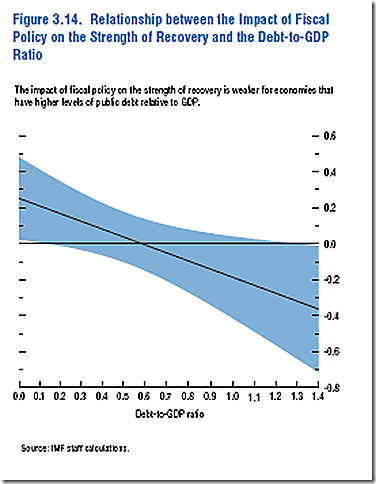
Recently released IMF analysis (via Telegraph)  indicates that federal debt/GDP ratios in excess of 60 percent tend to become deflationary black holes.

"The impact becomes negative for debt levels that exceed 60pc of GDP," said the Fund.

While no countries were named, this would raise questions about Japan, Germany, France, Italy and ultimately Britain and the US after their bank rescues.

The IMF said the US is at the epicentre of this crisis just as it was in the Depression, setting the two episodes apart from normal downturns. However, the risks are greater this time. "While the credit boom in the 1920s was largely spec­ific to the US, the boom during 2004-2007 was global, with increased leverage and risk-taking in advanced economies and many emerging economies. Levels of integration are now much higher than during the inter-war period, so US financial shocks have a larger impact," it said.

The IMF said the global financial system is still under acute stress, with output tumbling and inflation falling towards zero in key nations. "The risks of debt deflation have increased," it said.

Abrupt halts in capital flows can have "dire consequences" for emerging economies, it said. Eastern Europe has already suffered the effects, with a 17.6pc fall in industrial production in February. The region is highly vulnerable to the credit crunch since it owes more than 50pc of its GDP to Western banks.

image

The U.S. nominal GDP is about $14 trillion, the gross federal debt is $10 trillion, or 71 percent (the ratio is 46 percent if debt held by the public is used.  (I am not going to go into the issue of which number is “correct,” but the latter is most commonly used.)  Neither of these debt figures, both from fourth quarter 2008, include any of the multifarious bailout commitments.  Just adding a projected $2 trillion fiscal deficit for 2009 to the debt and assuming no growth in GDP takes the ratio using debt held by the public squarely to 60 percent.

Obama’s budget will tip America into a debt-deflationary downward spiral if the IMF is right.  No wonder the American public is slow to warm up to the stimulus plan—and why the public views the banking bailouts as throwing good money after bad.

The American people have a low opinion of government spending and contracting programs.  We read creditable stories about missing billions in Iraq and missing trillions throughout the federal budget.  We have seen how this administration has furthered Wall Street’s class warfare on the American people in its handling of the banking “bailout.”  President Obama looks more and more like a fiscal Manchurian candidate.

So, again, I propose a “middle way”:  let the objective be to take care of the American people, not to achieve some figment of “potential output.”  The Democrats may have good intentions, but they’re listening to the wrong economists, Keynesians who have been out of power for too long and who now are listening to a scribbler of 70 years ago (that they read in their halcyon graduate school days), a Keynes, most of them seem not to realize, who was preaching to an America that was the largest creditor nation in the world, not the greatest debtor.

Let the economists go yell at China, today’s great creditor nation.  China seems to be listening.


IMF links via Econbrowser:

MF World Economic Outlook

Saturday, April 18, 2009

Wall St spin grows over stress test results

Even the Financial Times fell for the spin in this article, when they let go unchallenged the following statement by a “senior banker” (Jamie, don’t be bashful):

“The government is torn,” said a senior banker. “They have an unpalatable choice between declaring that the banking system is uniformly healthy, which would cause laughter in the market, and saying that some banks need further capital injections, which at this stage can only come from Uncle Sam.”

What’s wrong with this statement?  The way corporate capitalism works is like this:

The government doesn’t recapitalize anyone until all private party claimants have been wiped out, or in the case of preferred or common equity, wiped out and debt converted to equity.  And let the bad banks fail, and their business go to banks that are not “too big to fail.” [corrected 4/20]

Scream your head off to your elected representatives if those pirates Summers and Geithner try to take any more of your and your children’s money with more taxpayer bailout!

Via:  Financial Times

Wall St fears grow over stress test results

By Francesco Guerrera and Edward Luce

Published: April 17 2009 22:00 | Last updated: April 17 2009 22:00

With less than three weeks to go before Washington releases the results of its “stress tests” of the nation’s 19 largest banks, most of Wall Street appears to be in need of Prozac.

Rising panic over how the results will be released has raised fears the results could lead to another collapse of confidence in the battered financial sector. Among other concerns, there is uncertainty over how the federal government will release the results, whether it will publish one aggregate number, or a bank-by-bank breakdown.

In addition, there are concerns as to whether Washington will have the capital to plug any hole it reveals. Wall Street executives believe that some banks will almost certainly require a capital injection, even though Washington is thought unlikely to brand any bank as “failed”.

Although the rules would give banks six months to raise capital from the market before turning to Washington, few believe troubled institutions will have that much time. As one banker said this week: “Once it is known that an institution needs money following the stress tests, they will have about six minutes, rather than six months, to raise the money.”

Banking stocks have performed well in recent weeks as good first-quarter results and some positive signs on the economic front allayed investors’ worst fears over the future of the industry.

However, executives fear that the release of the stress test results, scheduled for early May, could make it apparent the US banking system is split between a small group of relatively healthy companies, such as Goldman Sachs and JPMorgan Chase, and a large cohort of weaker ones.

In addition, if the stress tests force the government to inject capital into ailing institutions such as Citigroup and Bank of America, the move could spook investors and reawaken worries over the nationalisation of some of the nation’s largest banks.

“The government is torn,” said a senior banker. “They have an unpalatable choice between declaring that the banking system is uniformly healthy, which would cause laughter in the market, and saying that some banks need further capital injections, which at this stage can only come from Uncle Sam.”

Bankers who have been involved in the stress tests say the authorities are leaning towards publishing fairly detailed results in early May, possibly as early as May 4. In addition, the Fed plans to release a “white paper” next week setting out the methodology behind the tests.

However, bankers say that over the next fortnight the Federal Reserve, which is carrying out the tests, is likely to tell the banks of its conclusions and give them time to respond – a process that could lead to further adjustments to the actions to be taken as a result of the tests. It could also intensify lobbying by the banks for differential treatment.

The picture is complicated by pressure that stronger institutions, such as Goldman Sachs and JPMorgan, are applying to the Treasury to permit them to repay the troubled asset relief funds they received from the government – not least to escape the conditions Congress has attached to them.

The Treasury appears to be split about the best way forward with some arguing for early repayment, which would showcase the success of the programme, and others arguing it would risk an embarrassment down the line if the economy deteriorated and the banks had to return for further assistance.

In addition, by repaying early, the banks would have escaped the strings imposed by Congress on Tarp recipients, while still benefiting from other government assistance, including debt guarantees. “These are legitimate concerns,” said Douglas Elliott of the Brookings Institution. “One way round them would be to get Goldman Sachs and JPMorgan to agree to continue to adhere to the conditions that apply to Tarp recipients.”

Thursday, April 2, 2009

Geithner Plan DOA

It wasn’t going to work anyway, as I pointed out here. The reason banks aren’t lending aggressively is that the economy is in the dumps.  C&I lending declined in aggregate after the last two recessions and will likely to do after this one.  But the relaxation of mark-to-market is the final nail in the coffin of the PPIP monstrosity.

Via Zero Hedge:

Mark to Market, Time of Death, 8:45AM, April 2, 2009

April 2 (Bloomberg) -- The Financial Accounting Standards Board, pressured by U.S. lawmakers and financial companies,voted to relax fair-value rules that Citigroup Inc. and Wells Fargo & Co. say don’t work when markets are inactive.


The changes approved today to fair-value, also known as mark-to-market, allow companies to use “significant” judgment in valuing assets to reduce writedowns on certain investments, including mortgage-backed securities. Accounting analysts say the measure, which can be applied to first-quarter results, may boost banks’ net income by 20 percent or more.

****

Well, now that banks are all good in perpetuity, there goes the need for the PPIP. Hopefully this at least means that Bill Gross and Larry Fink won't make billions compliments of U.S. taxpayers. But don't take my word for it: the head of the world's largest hedge fund voices these very concerns. In fact, Dalio is so disgusted by the insanity in equity markets, rumor is he has moved out of trading equities entirely.

Via Contrary Investor: Foreigners have virtually stopped buying American paper, so guess who’s going to be buying?  Hint:  initials “FR” (hyperinflation alert; see this).