Showing posts with label deficits. Show all posts

Sunday, March 23, 2014

“Pushing on a string”—because the status quo

When I learned my macro, it was accepted that increasing reserves of the banking system when it was already in a substantial excess reserves position would have no effect on real output; hence it was called “pushing on a string,” an expression that I believe was coined in the Great Depression with respect to the excess reserves of the day.

In the Liquidity Trap, monetary policy was considered to be useless.

Now we have the trickle up theory of asset inflation, openly acknowledged by the Fed. Janet Yellen says the trickle down happens after the trickle up. But of course, the Fed does not acknowledge that asset inflation is inflation; it’s just wealth effect. John Hussman has pointed out that even the wealth effect is caused by an illusion, that the banking system is solvent, courtesy of FAS 157. Nevertheless, the Fed feels compelled to sweep the bad assets under the carpet before they can be audited. In the end we’ll have Good Bank, Bad Bank, with the Bad Bank being the Fed.

The non-economists readers of this blog need to be aware that current Fed policy, QE, goes against everything the entire mainstream macroeconomics canon says, but you won’t find an academic economist to admit it. If they’re conservative, like the Establishment Blowhard Gregory Mankiw, they like it because it lines the pockets of their clientele, the 1 percent (the “because capitalism (the banks want it) otherwise martial law” argument). If they’re liberal, like Paul Krugman, they like it because liberals always like accommodative monetary policy; it always serves their clientele, government, through monetization of the debt.

So mainstream academic economics has aligned itself with the status quo, and established its lack of intellectual integrity beyond any doubt.

The two political parties and their mainstream economist cheerleaders both support the status quo, while the structural rot continues. You just need to know they’ve abandoned everything the discipline has been saying for over thirty years in doing so.

Thursday, March 20, 2014

Janet Yellen interview

I have just watched the Janet Yellen interview (available here) from forthcoming movie, Money for Nothing: Inside the Federal Reserve, and I must say I found Ms. Yellen's Brooklyn folksy I'm-your-friendly-Berkeley-macro-teacher persona absolutely nauseating.

Questioned aboat the steps taken to resolve the financial crisis in 2008 she presents the same tired "we had to do something of the system was gonna collapse" without the slightest seeming awareness that when FDR, one of her putative heroes, I would guess, attacked the same structural problem in the 'Thirties he took structural actions to remedy them.

She certainly has never made a loan and has no understanding of what bad debt is, debts that will never be repaid and should be charged off by the bank with the bank taking the loss.

It's the same old Hank Paulson, either/or, bail Wall Street out, ignore the fraud, let them increase their bonuses in coming years on the backs of the taxpayers--or it's martial law.

And these macro people still think the Phillips Curve works!

I could go on, but I can't. It was just sickening.

Janet Yellen will do Wall Street's bidding and like Bernanke cash in afterwards.

I hope I outlive the Fed. It will be great day for America when the Fed is abolished.

Tuesday, September 24, 2013

Was full employment a debt-illusion?

http://research.stlouisfed.org/fred2/graph/?s%5B1%5D%5Bid%5D=EMRATIO

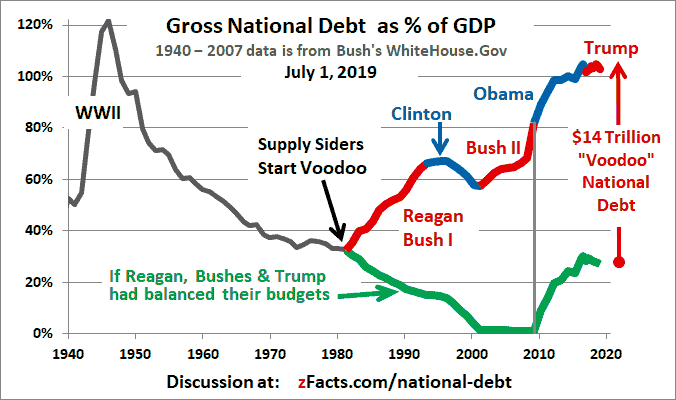
The Great Debt Illusion began with "Supply Side Economics" in Reagan I, a con game that provided definitive proof that tax cuts for the rich do not provide growth that "trickles down" to everyone else. Here's the picture of federal debt:

http://research.stlouisfed.org/fred2/series/GFDEGDQ188S

Notice where the take-off occurs. Add to this insight that it was a Republican, Nixon, who took us off the gold standard in 1971, setting the stage for massive monetization of federal debt, and it is hard not to conclude that the modern-era Republicans are the most fiscally-irresponsible party in American history. All their talk of austerity is in fact mere mean-spiritedness. This is the distinguishing characteristic of the Republican Party today.

Today, the House Republicans take pride in being the most hard-hearted folks in the country, proving it by taking their greedy frustration out on women and children by cutting funding for food stamps.

This is a party without a future.

On the employment issue: in the Sixties, it was possible to support a family on one (male) income. Not so today except for the top few percent. Multi-generational living is a growing trend, and maybe not such a bad one if it brings families closer together.

Shalom.

Monday, August 26, 2013

Fourth turning update

The entertaining Jim Quinn has put up the third in his series of "Trying to Stay Sane in an Insane World." Quinn works at Wharton and his website is either one of the cleverest honeypots around, or Wharton — a bastion of, let's face it, Wall Street think — actually allows some free speech.

However, here's my response to the Austrians who say — who chant — "Government bad! Government bad!" — and, "Free markets good! Free markets good!"

Feudalism bad! The Middle Ages were based on a system of highly concentrated ownership of the means of production, which at that time was mostly land. You had your lords and your serfs. With the assistance of rapidly improving technology are getting closer and closer to a new age of feudalism.

The Crisis still looks to peak after 2020. Buckle up.

Tuesday, July 9, 2013

The signature of incipient depression (take 2)

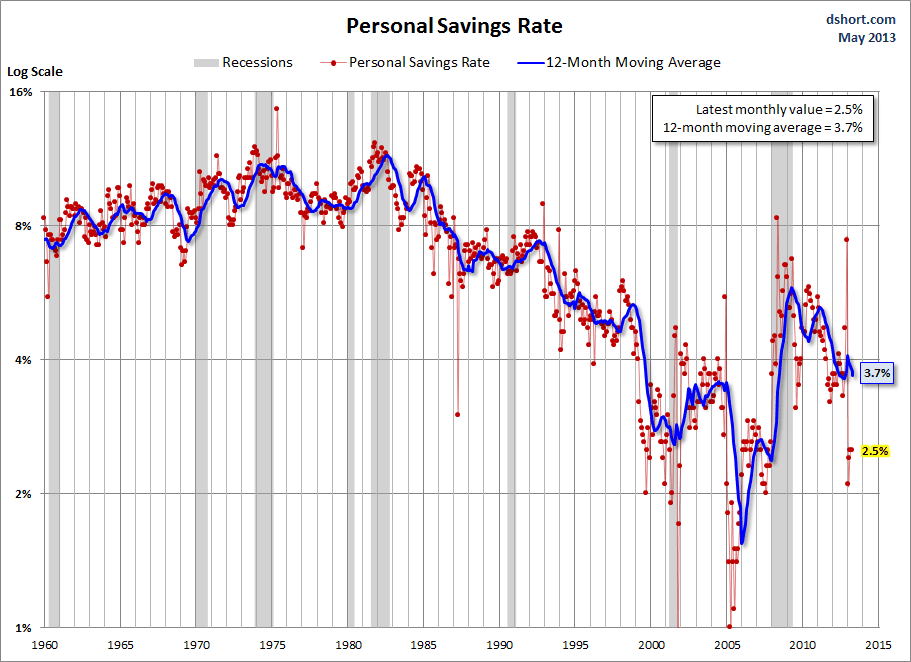
I almost titled this, “It’s the distribution, stupid,” but there’s more to it than that.  A while ago I published a piece called The signature of incipient depression that pointed out the similarity of the current period (still applies, two years later) to 1929, pre-The Great Depression:  namely, the very high total nonfinancial debt to GDP, and the extreme inequality of the income and wealth distributions.  Today I can add declining real incomes for the ~90+ percent as the third leg of the stool.

In a consumer-based economy, effective demand collapses when most people’s real incomes are falling, as they are now.  I’m putting up graphs of the three main elements of this signature of incipient depression, mostly in response to a stupid piece in Quartz from someone “refuting” Reinhart and Rogoff (here).  Not that they’re wrong, or that the No Exit situation that the fiscal authorities are in won’t prevent them from blowing the biggest debt bubble in world history over the next six years as posited in When will the financial singularity occur? ~2020.  Another six years might seem like a long time to kick the can down the road, but it would make this episode of ZIRP approximately as long as the previous one (1934-1946).

It is always possible for an economist—an ideological cheerleader—to miss the forest for the trees.  The most powerful fiscal remedies available to us now are steeply progressive income and wealth taxes, and a program of food and shelter and basic medical care in exchange for work for the dispossessed, who may be expected to become numerous if present trends continue.  Or perhaps a negative income tax with the elimination of the minimum wage.  And put health insurance on a hybrid single payer system so that everyone gets at least some coverage.

The point being:  The US economy still sports the signature of incipient depression.  As the focus ostensibly turns to fiscal policy for the remainder of the decade I suppose the best advice is to try to get on the gravy train if you can.  The next decade will be the Depression 2.0 decade, in all likelihood, the true test of democracy vs. fascism—we’re not there yet.  And given how piggy the 1 percent are world-wide we might not see much inflation until about 2020 either—except of course that rolling through asset markets.  My best guess is that the Feds will tase the labor market with a little more monetary tough love (also part of the “wash and rinse” cycle in the stock and metal markets, one for the Gipper, so to speak) so that the big boys can get nice and levered up for the big ramping up in asset markets to come in the second half of the decade.  Ordinary working people are hosed pretty much everywhere, it seems.  Just my guess.

The debt situation is worse if you look at all nonfinancial debt:

Here’s a longer-term picture of household income:

And that’s using the government’s phony hedonically adjusted inflation measure.

Tuesday, November 13, 2012

Throwing the baby out with the bathwater

Via. ft.com 

Richard Koo doesn’t address the problem of bad debts being carried in the banking system by “extend and pretend” or by having been bought by the Fed and subsequently disappearing into that black hole of unreported charge offs.  I have taken a fair use chunk of Koo’s article but encourage readers to read the whole thing. 

I have this inkling that because all the derivative bets are off the books, the capital class, those holding financial assets, is not really aware of the risks of a general deflation, and can only see the “problem” of fiscal spending supporting “deadbeats” (the 47 percent) who are dependent on the government for basic needs.  We shall see.

Explain the disease to help US citizens

By Richard Koo

In 2008, Barack Obama told the US people the nation’s economic crisis would take a long time to overcome. In 2012, many of those voters are losing patience, because they have not been told why this recession has lasted so long or why his policies were the correct response. Here is the missing explanation – based on not only the US experience, but also that of Japan and Europe.

Today, the US private sector is saving a staggering 8 per cent of gross domestic product – at zero interest rates, when households and businesses would ordinarily be borrowing and spending money. But the US is not alone: in Ireland and Japan, the private sector is saving 9 per cent of GDP; in Spain it is saving 7 per cent of GDP; and in the UK, 5 per cent. Interest rates are at record lows in all these countries.

This is the result of the bursting of debt-financed housing bubbles, which left the private sector with huge debt overhangs – notably the underwater mortgages – giving it no choice but to pay down debt or increase savings, even at zero interest rates.

However, if someone is saving money or paying down debt, someone else must be borrowing and spending that money to keep the economy going. In a normal world, it is the role of interest rates to ensure all saved funds are borrowed and spent, with interest rates rising when there are too many borrowers and falling when there are too few.

[continues here]

Wednesday, October 3, 2012

Solution to the debt problem

See American Dream Has Become a Myth – Stiglitz in Der Spiegel.

Given that we are in QEternity and ZIRP Into Perpetuity, and that the infrastructure of the US is crumbling, our schools are a mess, our teachers so abused that hardly anyone with half a brain would ever consider becoming one, and given the self-evident truth of Modern Monetary Theory that if you put slack to work in productive ways that exceed the cost of printing the money to do so, then it is obvious what Timmy and Ben should put their empty crania together to do--

Let the Treasury issue Zero Coupon Perpetuities!  Let the Fed buy them!

Problem solved!

Women pose for photos near a homeless man during New York Fashion Week this month.

Tuesday, June 19, 2012

When ‘capitalism’ fails

Capitalism fails when capital, or the control of capital, as currently in our corporatist system, becomes too concentrated.

When the majority of real incomes are falling, aggregate demand fails.  Duh!  And when people have already borrowed too much, trying to keep up or make a quick buck like the rich folk do, increasing the monetary base and encouraging people to borrow more is a fool’s errand.

Private property is great, and encourages people to work, except when ownership becomes too concentrated, when they feel locked out.

For capitalism to survive, its leaders—the owner class—will have to adopt an ethos that, “For everyone to whom much is given, of him shall much shall be required.”

Otherwise the owner class invites revolution of one form or another. 

Before that happens their greed causes a massive deflation that may very well expropriate themselves (see Comstock’s excellent deflation overview, which inspired these comments).

Democracy exists to allow people to make laws to fix broken systems.

Our democracy is also now broken.

Lot of work to do.

Tuesday, November 22, 2011

Thank God for Bruce Bartlett

Here’s some tax truth from a Republican:

The truth is that the federal surpluses resulted from specific legislation enacted in 1990 and 1993 that virtually every Republican opposed. In particular, taxes were increased and tight budget controls were put in place that prevented taxes from being cut or spending increased unless offset by tax increases or spending cuts. These budget controls are commonly referred to as “paygo,” for pay-as-you-go.

What happened can be seen in Congressional Budget Office data. When the 1990 budget deal took effect in fiscal year 1991, federal spending was 22.3 percent of G.D.P. and revenue was 17.8 percent. The deficit was 4.5 percent of G.D.P. Revenue rose steadily to 19.9 percent of G.D.P. by fiscal year 1998 and spending fell to 19.1 percent, yielding a budget surplus of almost 1 percent of G.D.P.

Revenue continued to rise to 20.6 percent of G.D.P. in fiscal year 2000, and spending fell to 18.2 percent. The surplus reached 2.4 percent of G.D.P.

These results run 100 percent contrary to Republican dogma, which is that tax increases, especially on the rich, do not yield additional revenue because people will cease working and investing, and the economy will stagnate. Yet the hallmarks of the 1990 and 1993 budget deals were an increase in the top income tax rate; first to 31 percent from 28 percent, and then to 39.6 percent. Revenue clearly rose, as did the economy.

This is a must-read article: 

Balancing the Budget, for Real – New York Times

Wednesday, August 10, 2011

Just to be perfectly clear

Another two or more years of ZIRP (zero interest rate policy) is a subsidy to banks carrying bad debt at inflated “extend and pretend” values permitted by today’s phony accounting.

The Fed is willing to bleed the rest of the American economy to subsidize the banks.

The “bad banks” will not “grow solvent” as a result of this policy.  The enormity of the bad debt is simply too great.

ZIRP hasn’t helped the economy yet, so why should it going forward? 

However, those who fear inflation in the intermediate term are premature.  Bad debts don’t get repaid, they only get papered over until their failure is so absolutely plain to see it can’t be covered up any more….  Deflation lies between now and the future Great Inflation.

Which is why we’re probably in for another round of “quantitative easing” in which the Fed buys bad debt from weak banks and hides it away where bad debts never see the light of day.

At this point, some of the Modern Monetary Theory solutions to our problems seem actually attractive.  Why shouldn’t the Fed write off (i.e., charge off, write down to a zero value) the U.S. Treasury debt it holds.  That’s not a default, it’s more like the kind of favor rich people do for each other (as when the board of a Colorado savings and loan “charged off” a $100,000 loan to a son of George H.W. Bush).

We’ve been here before.  The Fed pursued a ZIRP in the 1930s.  It didn’t end well.

image

See also the estimable Joseph Stiglitz’s four-part solution to our problems here.

Saturday, August 6, 2011

Comment on the S&P downgrade

Could we have a more obvious example of a rating agency serving its oligarchic Wall Street masters more servilely? 

S&P participated in the massive frauds of the real estate boom, certifying junk as AAA, and enabling Wall Street to dispossess many Americans of their homes at taxpayer expense after having profited from the pump-and-dump (and short, in some vile cases), so why shouldn’t they enable their masters to further enhance their relative social and financial position by sending the remains of the American middle class into old-age serfdom?  www.angrybear.com has the best data on Social Security, and it says the system if funded for decades to come if Treasury obligations are honored.  Moreover, relatively small changes to the payroll tax, like taking the ceiling off, would render the system solvent indefinitely, if I am not mistaken.

Obama should strike back, and take S&P to court for fraudulent activities during the real estate fraud boom.  It’s time to put the rating agencies completely out of business.

S&P should have downgraded the entire Bretton Woods II monetary system.

Friday, July 29, 2011

US debt breakdown (pun intended)

Via:  New York Times

Click through for an excellent graphic showing which administrations accrued the debt and who holds it.  Note that China holds less than ten percent of the debt, and that the lion’s share of the debt was accumulated under  George W. Bush.

Via:  Foreign Affairs – How Scary Is the Deficit – Setser and Roubini.  Very, in their view.

Sunday, May 29, 2011

Japan’s “lost” decades and America’s

Philip Pilkington: Beyond growth – are we entering a new phase of economic maturity? argues that Japan’s lost decades were not so bad when you look at social welfare, a dimension that eludes Paul Krugman.  Japanese aggregate debt to GDP climbed to levels far beyond where America is now, and mirabile dictu, life expectancy increased and in general social welfare remained very high relative to barbaric American standards.  Pilkington is citing work by Modern Monetary Theory proponent Bill Mitchell.  I have been hard on MMT because it shares all the weaknesses of fiat money systems—and in fact exploits them to advance social welfare.  In Japan’s case, they were able to assume staggering amounts of debt because they are a high saving society and largely owed it to themselves.  Their currency remained strong, there was no hyperinflation, and people hung together.  (There is a larger question:  the societies with very high kinship coefficients across the population such as Japan and the Scandinavian countries seem to be satisfied with government services requiring much higher levels of taxation than Americans put up with; are content with much flatter income and wealth distributions; and also score happier on many measures of general happiness.)  This is not to say that Japan shouldn’t have shut down their zombie banks and purged the bad debt from the books—they would have been even better off if they had; but powerful interests being what they are, they didn’t.  Just as America is proving incapable of writing off its bad debts, instead pursuing the illusion that the banking system will recapitalize over time if interest rates are held low enough for long enough.  The pin that pricks this bubble, I believe, is the off-balance-sheet derivatives exposure to the housing market that has not yet cleared.  If the housing market continues downward, how many CDSs will be triggered?  And how will the Fed attempt to bury those bailouts from the public?  And will they be able to?

The difference between Japan and America, of course, is the level of social cohesion and shared sacrifice.  The Japanese pull together.  America is being pulled apart.  I applaud the agenda that proponents of MMT seek to achieve by printing money, I just doubt that those objectives would be achieved in the United States by printing money.  So far, the evidence suggests most stimulus monetary or fiscal goes into the pockets of the well-heeled.

Hence Steve Keen’s fairly obvious but nicely presented views on debt-financed aggregate demand:  when the debt growth stops, unless the lost aggregate demand is replaced, there is a multiplier-magnified contraction of the economy.  Much of the growth of aggregate demand in the United States in the past decade or more has been debt-financed. 

This is why I subscribe to Strauss and Howe’s prophesy of a profound national crisis in the United States, culminating about 2020 and concluding about 2026.  As the big mouths at PIMCO like to say, what we have now financial repression.  All indications—renewal of the “Patriot” Act, and dark intimations about how the government is actually interpreting it—point to more direct forms of repression being readied.

Americans need to forge a new social contract soon or descend into decades or centuries of grinding neo-feudalism, by which I mean banana republic-style inequality and its attendant inefficiency.  America’s greatest resource is her people, and if the people lose heart, they become wage slaves on the plantation.  History teaches that vast inequalities always fuel revolutions, sooner or later.  If we lack genetic ties, we need to cling to the classic American ideals of fairness and freedom and equality before the law.  Adam Smith maintained that capitalism without a moral context—think of the medieval doctrine of “fair price”—cannot succeed in anything but crass exploitation.

I have to believe we can live up to our ideals. 

Tuesday, March 22, 2011

Links 3/22/2011

Obama is as much of a budget-buster as GWB, from whom he inherited the worst deficit in the nation’s history.  Washington is totally out of control.

My thoughts recently, watching disasters unfold on two sides of the world, have been toward historical parallels with the ‘Thirties.  If Washington decides to take the first steps toward restoring a landed aristocracy by further smashing labor, virtually precluding the higher education of any children but those of the rich, and slashing government budgets across the land—what will we do with the tens of millions of unemployed families that will fill our streets?  This is essentially the problem FDR faced in the ‘Thirties.  Acting in loco parentis as if the market had failed miserably (it had, due to unbalanced aggregate demand due to unbalanced income and wealth distributions, IMHO), he put people to work, mostly to give them hope, as his programs did not get the nation out of the Depression.  World War II equalized the income distribution as “the Pearl Harbor of the 21st Century” failed miserably to do, and set the stage for renewed growth….

image

(click chart to go to source)

What will America do in the deflationary collapse probably just over the horizon?

Monday, February 14, 2011

Comment on “modern monetary theory”

Inspired by Lincoln’s printing of fiat money to finance the Civil War, “modern monetary theory” posits that deficits don’t matter, that money is as money does, and that we should just print more money to get out of our present debt hole.  I haven’t addressed MMT before (except to dismiss it once, as I recall, as just another ruse to inflate our way out of our debt) because I considered it beneath the level of serious discourse, but Jesse has a nice demolition of it here, that I would like to add to.

Indeed, MMT is just another ruse to inflate our way out of our debt, which in the context of a fiat money world, Bretton Woods II, requires that our currency depreciate against others, but not so much that people refuse to accept it any more.  Money is what people accept as money, and if folks stop accepting the dollar—whether as reserve currency or not—then the U.S. is hosed.  Our banana republic status becomes official.

What I would like to add to Jesse’s analysis is the hidden truculent aspect of MMT.  In the context of a declining, bankrupt empire whose denarius is still widely accepted, an empire threatened by “barbarians” at its borders and dissent within, the best way to keep your denarius viable is to sow chaos across the rest of the world.

The Bretton Woods II super-nova, as I have called it, is just beginning to flame out.  The world-wide housing bubble was not created by Wall Street but by Washington forty years ago when the world went on Bretton Woods II.  Sure, Wall Street piled on and sold the rest of the world a bunch of toxic assets, to do their part to support the empire.

But should democratic reform spread—should the Europeans work out their problems, should China successfully reign in its bubble—should there become a viable alternative to the dollar, and the oil price rise sharply in dollars—there will continue to be strong incentive for the U.S. empire to defend its currency by sowing chaos throughout the world.

Wars have always been the best way to stimulate inflation.  And “modern monetary theory,” which disingenuously offers the old ruse of inflating one’s way out of debt, implicitly invites inflation and war.

Monday, August 2, 2010

The Great Accommodator strikes again

Alan Greenspan’s face says it all:  “I am a servant of the ruling class, I will accommodate the ruling class, whether as a Fed chief or as an ex-Fed chief.”  BTW, I find a certain similarity between the faces of Greenspan and the President.  These are not strong men.

Greenspan correctly diagnoses the split between the economy of the ruling class and that of everyone else.  Here is Barry Ritholtz at The Big Picture:

“Our problem, basically, is that we have a very distorted economy in the sense that there has been a significant recovery in a limited area of the economy amongst high-income individuals who have just had $800 billion added to their 401(k)s and are spending it and are carrying what consumption there is. Large banks, who are doing much better, and large corporations, whom you point out and the–and everyone’s pointing out, are in excellent shape.

The rest of the economy, small business, small banks, and a very significant amount of the labor force, which is in tragic unemployment, long-term unemployment, that is pulling the economy apart. The average of those two is what we are looking at, but they are fundamentally two separate types of economy.”

-former Fed Chair Alan Greenspan, Meet the Press

Fascinating quote from Easy Al on Meet the Press via Bloomberg. It has 3 subtexts that might not be readily apparent — until we break it down:

1) Extend the Bush tax cuts on highest bracket earners: Since its the 401(k) crowd that are carrying the recovery, Greenspan suggests, then we best not crimp the income of these big spenders

2) Two Americas: Greenspan seems to be channeling John Edwards when he discusses two economies. The bailouts reduced competition. They extended the life of badly structured financial firms, and forced smaller firms to scramble.

3) Greenspan’s Legacy: It seems that Easy Al can figure out precisely what he has wrought. The secret to getting such candor out of the former Fed chief is to trick him into discussing the broader economy.  That way, he does not realize that he is discussing the effects of his tenure as FOMC chair.

Of course, Greenspan is still wrong on Housing. Recall that he failed to recognize the impending housing correction (collapse more accurately) and made claims that the worst was behind us — just as housing was accelerating downwards:

“If home prices stay stable, then I think we will skirt the worst of the housing problem.  But right under this current price level, maybe 5, 7 or 8 percent below is a very large block of mortgages which are underwater, so to speak, or could be underwater, and that would induce a major increase in foreclosures.  Foreclosures would feed on the weakness in prices, and it would create a problem.  So that–it’s touch and go.”

One last thing: I have to give Greenspan credit for this touch of tax cut honesty:

“Look, I’m very much in favor of tax cuts, but not with borrowed money.  And the problem that we’ve gotten into in recent years is spending programs with borrowed money, tax cuts with borrowed money, and at the end of the day, that proves disastrous.”

For once, I agree with him . . .

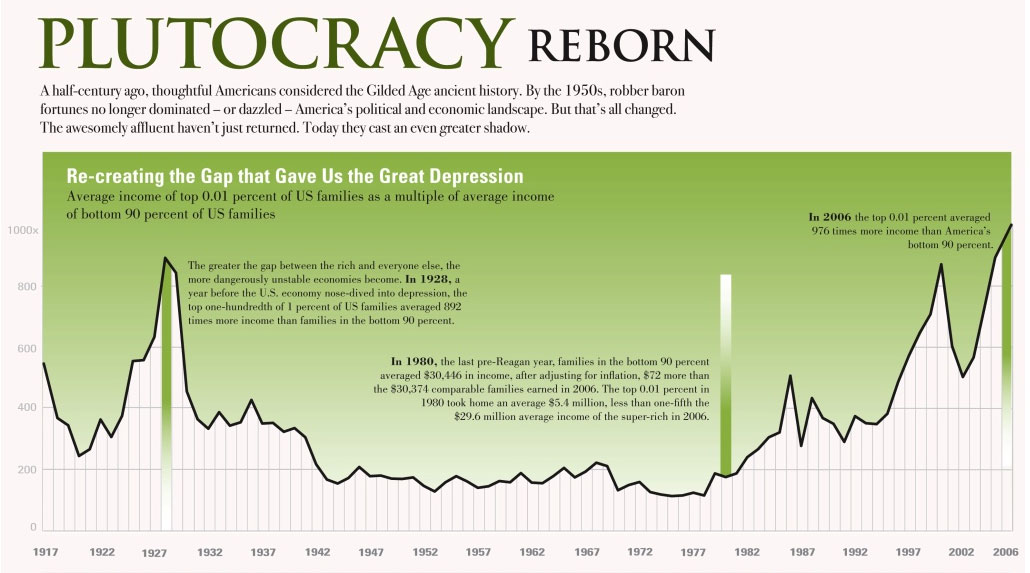
Ah, Barry, you are usually so reasonable.  Why don’t we raise marginal tax rates on the ruling class who have manipulated the tax system and the governance of big corporations so much in their favor?  Are CEOs really worth 400 times the average workers salary today when the multiple was a tenth of that thirty years ago?  In other times of fiscal distress marginal tax rates on super-high incomes were higher, almost as if there were a sense that “shared sacrifice” was a good thing.  Are you and Alan the Mess-Meister suggesting that we should leave marginal tax rates on high incomes alone and raise them on the middle class?

Let’s get real.  Here’s the picture that tells the story of how America has moved from “we’re all in this together” to “you first, after me—it’s the free market way!":

Until Americans start to function as a nation again, we descend into deeper banana republicdom.  Is it the end of the nation-state?  Is the only path to survival to join a strong corporation (i.e., “gang”)?  Will corporations that perpetuate stark inequality survive, if there is truly an “optimal” degree of income inequality that American corporations have clearly exceeded?  Will more egalitarian corporations benefit from higher productivity and resiliency, if the nation-state dies, and prove the template for the next major form of social organization?  (Unfortunately, the immediate associations that come to mind are of the perpetually-warring native American tribes prior to European overrun; and the incredibly funny scenes of warring office buildings in Monty Python’s “The Meaning of Life.”…)

Big changes coming.  The old order is falling apart.  Do unto others as you would have them do unto you.

Monday, July 19, 2010

Krugman vs. Galbraith: my deficit is bigger than yours

Oh, wow.  The NYT discovers that we have too much debt, even as James Galbraith and Paul Krugman engage in a bitter bout of “my deficit is bigger than yours.”  What the plutocracy-controlled mainstream hasn’t yet acknowledged and what Main Street has already figured out is that bailouts and stimulus go to the rich, not to them, or as I like to put it, the income distribution in the United States is like a car engine running on one cylinder—no matter how much Stimulus pours in, most of it goes to the already-rich.  And heaven forbid we raise marginal tax rates.

The Europeans, who still have a social contract (and I’m talking about wage differentials in companies, not just government policy), even if burqua-strained, will kill the US in the dealing with the problem of excessive debt. 

And from a consumer point of view, with near-zero interest rates and a stock market that looks like a falling knife more and more, the best rate of return one can get is paying off debt.

The US seems to need sado-masochistic crisis with real blood in the streets before it deals with its historical preference for opportunistic greed as the primary element of its social contract.  Large damage is done to human capital by this means.

July 12, 2010

Paralyzed by Debt

By ROGER LOWENSTEIN

Last month, my wife and I refinanced our mortgage. Though the rate was lower and we could have afforded more debt, we paid down a chunk of the balance. Don’t ask me why — it just felt better to owe less money. Time was, such thrift would have been hailed as patriotic. Now it threatens the economic recovery. Less borrowing means less to spend.

Suppose everybody did this? Well, it turns out, everybody has. Eschewing trips to the mall, Americans are paying off credit-card balances and home-equity lines. Despite low rates, mortgage demand has plummeted.

Some people have no choice but to pare their debts (indeed, some are being foreclosed on). For others, call it morning-after sobriety or late-blooming prudence. Losing income tends to bring on a case of the nerves, and half of American workers have suffered a job loss or a cut in hours or wages over the past 30 months. And, need we add, people’s stock portfolios are not what they were.

The economic term is “deleveraging”; it means that, as opposed to the normal state of affairs, in which, each quarter, people borrow more money and banks issue more loans, credit in the economy is shrinking. Remarkably, this deleveraging has been going on for nearly two years. Ordinary Americans are behaving just as the banks they love to excoriate — having, formerly, assumed too much risk, they are going into hibernation. If credit, in the words of the writer James Grant, is money of the mind, people have become psychologically indisposed to minting it.

Such restraint, even if sensible individually, does not augur well for the gross domestic product. Total household credit has contracted for seven straight quarters. Mortgage debt is down $462 billion from the peak, which it reached in November 2008. Bank-card borrowings, which peaked two months later, are off $126 billion. Auto loans have fallen $122 billion; home-equity lines, $77 billion.

To peruse such figures is to get a whole new sense of America’s economic crisis. The bank failures and bailouts of the fall of ’08 called to mind a great and terrible battle. The drone of falling credit numbers since then suggests a ponderous army in drawn-out retreat. As Stephanie Pomboy, publisher of the newsletter Macro­Mavens, has pointed out, government transfers like stimulus spending and tax credits masked the effects of diminishing credit for a while. That is to say, even if people were unwilling to borrow, they were happy to spend money they got from the government. Now that government supports are being pulled away, the effects of deleveraging are in plain view. Home and car sales are plummeting again. Job growth has shrunk to a sliver. Personal bankruptcies are soaring. Deflation, a dangerous state of economic dead air, when prices fall from lack of demand, is a distinct possibility.

Credit and inflation are really two sides of the same coin. When credit expands, people have more money to pay for goods, and prices go up. The Federal Reserve Board has kept short-term interest rates at nearly zero, effectively jamming the credit-creation pedal through the floor. But it hasn’t persuaded people to take out their wallets or their credit cards, stoking fears of a Japan-like deflation. Core inflation (which measures price increases of everything but energy and food) has fallen to its lowest level in 44 years. As people pay back loans rather than take out new ones, they exert a drag on business. As Pomboy writes, “The U.S. economy is in the grips of a powerful but silent undertow.”

Some of the deleveraging is being forced by banks. Underwriting standards have toughened, making it harder for people to get loans. (This is a good thing, by the way. The reason we got into trouble is that banks were too easy.)

Indeed, the underlying cause of deleveraging is that Americans got too leveraged. This excess was decades in the making. In the aftermath of World War II, the average family earned far more, each year, than the total of its borrowings. But beginning in the 1970s or so, the culture relaxed. Credit cards and mortgage options proliferated. By 2001, household debt reached a par with annual after-tax household income. (The average family owed what it earned.) By the peak of the bubble, in 2008, borrowings had surged to 36 percent more than income.

Which raises the issue: how much of that debt will have to be repaid before people return to their customary, and stimulative, profligacy? Thus far, we have undone only a portion of the excess. Household debt now stands at 26 percent more than income — still very high by historical standards. “There is no magical level where it should be,” says David Resler, an economist with ­Nomura Securities. “There is no clear equilibrium.”

Absent a massive federal stimulus (and maybe even with one), the economy is not likely to show much life until deleveraging ends. The conventional view is that we are almost there. That assumes that the average American will resume borrowing and spending before the prior excesses are fully washed out. To return to the status quo of before the housing boom — say, back to debt to income ratios prevailing in 2000 — it would take five more years of deleveraging at the current rate. Deleveraging cycles are rare, notes David Rosenberg, an economist with the Toronto firm Gluskin Sheff, but five to seven years is typically what they take. The Conference Board, which asks consumers every month whether they anticipate buying a home, a car or an appliance within the next six months, reported plummeting numbers in June. Consumers used to get their kicks from new Sub-Zero refrigerators; now they chip away at their balances. The turn is yet to come.

Roger Lowenstein, an outside director of the Sequoia Fund, is a contributing writer and author of “The End of Wall Street.”

Sunday, July 18, 2010

Why marginal tax rates need to go up

Via:  www.ataxingmater.com  I have been saying for some time that marginal tax rates on income over a million dollars or so should be at 75-90 percent for no other reason than to bring the members of the ruling klepto-plutocracy back down to Earth.  And do away with the special loopholes the rich drive through.

Overpaying CEOs

The Wall Street Journal reports today on a study by three academics on CEO pay.  They are Streedhari Desai (Harvard), Jennifer George (Rice) and Arthur Brief (Utah), and their study is "When Executives Rake in Millions: Meanness in Organizations" (available on SSRN).  Here's the abstract:

The topic of executive compensation has received tremendous attention over the years from both the research community and popular media. In this paper, we examine a heretofore ignored consequence of rising executive compensation. Specifically, we claim that higher income inequality between executives and ordinary workers results in executives perceiving themselves as being all-powerful and this perception of power leads them to maltreat rank and file workers. We present findings from two studies - an archival study and a laboratory experiment – that show that increasing executive compensation results in executives behaving meanly toward those lower down the hierarchy. We discuss the implications of our findings for organizations and offer some solutions to the problem.

Trends in this country are ominous. 

  • Wages for the middle class have stagnated, especially with the waning power of labor unions to demand an adequate share of corporate revenues (a result of the decades-long effort of neocons and multinational corporations to kill labor unions and make new unionization efforts in previously nonunionized industries very difficult through generous provisions for employer control and significant hurdles for union approval). 
  • The middle class has therefore depended more on debt than it should, a dependency that has been encouraged by the financialization of the economy and the hunger of the financial institutions and shadow banking system for "product" from which it can reap multiple layers of fees and excess profits.  That easy flow of credit led directly to the financial crisis that caused the Great Recession.
  • Meanwhile, those at the top have done well and those at the very top--the ultra rich in the top tier of corporate status and in the finance (and shadow finance) industry and its related hangers-on--have done exceedingly well by being able to keep a much larger share of the business profits for themselves.
  • That inequality then has created a feedback cycle of disrespect for ordinary workers and greed for more profits and status and power that also led directly to the financial crisis that caused the Great Recession.
  • And now we learn the capping blow (which common sense tells us anyway, given what we know about human nature and its frequent inability to handle the struggle between self-interest and altruism in ways that benefit all) those at the top who have been paying themselves exceedingly well (and their buddies when they serve on their boards of directors) are likely to treat their employees exceedingly poorly.  Greed at the top goes along with meanness towards those considered "beneath" them.

From my perspective this is just one more reason (i) to ensure that ALL compensation income is subject to payroll taxes (removing the Social Security cap) and (ii) to increase the tax rates on the income of the top by adding more rate brackets.  We should go back to the type of system we had before Reagan, when there were many more "rate brackets" under the income tax.  It's really not reasonable in a progressive tax system to fail to distinguish between incomes of a quarter million and incomes of $10 million--they should not be taxed at the same marginal rate.  And the hedge or equity fund or real estate partnership manager who makes more than a million a day as his compensation for managing (paid, of course, part as fee and part as "carried interest") should be taxed at a rate considerably higher than the CEO who makes "only" 10 million a year.  The wacky system we have right now lets that equity fund manager pay the preferential capital gains rate under a realization system--meaning with deferral as well as lower rates! 

So why is it that Congress--even in a period of high deficits and lots of talk about having to change the benefits under Social Security because of the GOP and blue-dog Dems' worries about the deficits (even though Social Security has actually been running a surplus) --couldn't bring itself to pass a bill that would treat carried interest as the ordinary compensation income that it is, so that fund managers would pay tax the same way that their firm's janitor does?   Talk about meanness.

Monday, July 12, 2010

President’s men: debt disaster coming

Via:  www.washingtonpost.com

Obama's debt commission warns of fiscal 'cancer'

By Dan Balz
Washington Post Staff Writer
Monday, July 12, 2010; A02

BOSTON -- The co-chairmen of President Obama's debt and deficit commission offered an ominous assessment of the nation's fiscal future here Sunday, calling current budgetary trends a cancer "that will destroy the country from within" unless checked by tough action in Washington.

The two leaders -- former Republican senator Alan Simpson of Wyoming and Erskine Bowles, White House chief of staff under President Bill Clinton -- sought to build support for the work of the commission, whose recommendations due later this year are likely to spark a fierce debate in Congress.

"There are many who hope we fail," Simpson said at the closing session of the National Governors Association annual meeting. He called the 18-member commission "good people with deep, deep differences" who know the odds of success "are rather harrowing."

(Graphic: President Obama's proposed 2011budget explained)

Bowles said that unlike the current economic crisis, which was largely unforeseen before it hit in fall 2008, the coming fiscal calamity is staring the country in the face. "This one is as clear as a bell," he said. "This debt is like a cancer."

The commission leaders said that, at present, federal revenue is fully consumed by three programs: Social Security, Medicare and Medicaid. "The rest of the federal government, including fighting two wars, homeland security, education, art, culture, you name it, veterans -- the whole rest of the discretionary budget is being financed by China and other countries," Simpson said.

"We can't grow our way out of this," Bowles said. "We could have decades of double-digit growth and not grow our way out of this enormous debt problem. We can't tax our way out. . . . The reality is we've got to do exactly what you all do every day as governors. We've got to cut spending or increase revenues or do some combination of that."

Bowles pointed to steps taken recently by the new coalition government in Britain, which also faces an acute budgetary problem, as a guide to what the commission might use in its recommendations. That would mean about three-quarters of the deficit reduction would be accomplished through spending cuts, and the remainder with additional revenue.

Most Republicans in Congress are opposed to any tax increases, which has made the work of the commission far more difficult. Bowles and Simpson appealed for support to the governors, who have been forced by their states' constitutions to balance their budgets with deep spending cuts and, in many cases, tax increases.

Bowles and Simpson said the commission would have had a stronger hand politically had it been created by Congress, rather than through an executive order. Simpson was pointed in his criticism of seven Republicans who once co-sponsored such a measure but who helped block it in the Senate.

"As far as I can discern, it was to stick it to the president," Simpson said. "That's where we are in Washington." He later added that all seven "have now come to us to say, 'We're ready to help.' "

The presentation by Simpson and Bowles, which included repeated statements of determination to produce a bipartisan set of recommendations, drew praise from the governors.

"I don't know that I've every heard a gloomier picture painted that created more hope for me," said Arkansas Gov. Mike Beebe (D).

Washington Gov. Chris Gregoire (D) said that many governors fear that the commission's recommendations will result in more demands on the states.

Bowles, who noted that the 1997 balanced-budget agreement between the Clinton White House and the Republican-controlled Congress included many provisions that put more burdens on the states, said that wasn't likely.

"I don't think you're going to see a lot of devolution coming from us because the states are all broke," he said.

Simpson also warned that the November elections could add another wild card to the work of the commission. "I have no idea what's going to happen on Election Day but it's going to be disruptive . . .," he said. "It's going to be a big wake-up call around the whole United States. I have no idea where it's going, but thank heaven we have a month then to work through the wreckage."

See also:  Niall Ferguson's Complete And Definitive Guide To The Sovereign Debt Crisis