Showing posts with label unemployment. Show all posts

Sunday, October 20, 2013

My favorite blog posts from the week

Tax Rates, Inequality, and US Deficits – Barry Ritholtz.  Sometimes no one nails it like Barry.

Its Friday, after what was for me a long and annoying 17 days. But the shutdown is over, US markets are at all time highs, and Bob Shiller got his Nobel (more on this tomorrow).

You might think that I would be at peace with the current state of the world, but life is never that simple. You see, I have assumed the task of explaining things which require explaining. By some quirk of fate and an odd academic background, I find myself with skills in simplifying complex matters. Whether OCD or over-compensation for some other defect, this is my lot in life. (I made peace with it long ago).

As we discussed yesterday, amongst all of the background nonsense since October 1, the noise about the deficits was not really about budget deficits at all. Rather, it was about a decidedly narrow ideology held by a small percentage of Americans. Their belief is that government should be much smaller. This is a legitimate political ideology, one that has persisted over the centuries.

Their approach to this philosophy, however, is far less intellectually honest. Rather than having a full on debate on that subject — a debate they are likely to lose — they have chosen a very different approach. This time around, they made the deficit a proxy.

Because of what I do for a living, I found this offensive. Deficits impact fixed income, an important part of portfolio planning. They impact available credit, capital for investment, in a broad and varied way. Hence, the deficit is a genuine issue, a real problem that should be addressed in a mature and responsible way. It can be easily solved using intelligent solutions, but for the ideologues in Washington DC (and elsewhere) who refuse to treat it as the basic mathematics and accounting problem it actually is. The way the Tea Party and others have treated the deficit reminds me of the approach Meredith Whitney took to Municipal Debt. Both groups are stunningly ignorant about their subjects, while possessing the skills to allow them to exploit the topic, hog the spotlight for themselves and other tangential pet issues.

The Tea Party, like Whitney, turned an important question of debt and credit and solvency into one giant PR clusterfuck.

Back to our issue of taxes (next week, I will address spending). Amongst Industrialized Nations, the United States has amongst the lowest tax rates in the world, especially for those folks (like myself) who reside at the top of the income scale.

To demonstrate this, I want to point to the IMF’s World Economic and Financial Surveys: Taxing Times. It is chock full f great charts and data and other interesting results of the IMF survey.

The two below caught my eye. They are rather instructive for our discussion of taxes and deficits in the US.

The first looks at major industrial nations, and compares what the IMF calls their Revenue-Maximizing Tax Rates (blue line) versus their actual top rate (red dot).

As you can see, some countries — Denmark and Sweden — are at the top of the revenue maximizing ranges. Other countries — Canada and Germany — are at the bottom of their revenue maximizing ranges.

Then there is the United States, which is simply far off the scale, way below the bottom of its revenue maximizing range.

If your concern is deficits, than you must take notice of how much money the USA is leaving on the table. I am not suggesting that the role of government should be to maximize their tax revenues, but rather to suggest that if you want to close the deficit, you need to at least be in a defendable range. The US is not.

click for ginormous charts
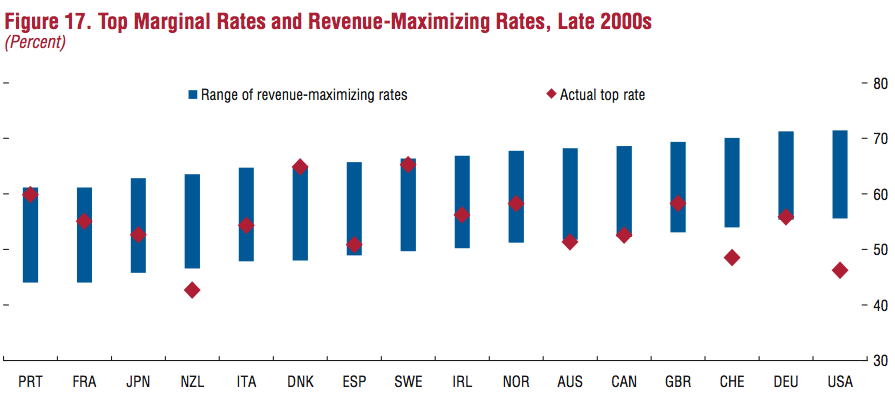
Top Marginal Rates
Source: IMF

Not coincidentally, when we look at shares of Net Wealth held by the bottom 50% of he population versus the top 10%, the United States is off the scale. We are the most unequal nation in the world.
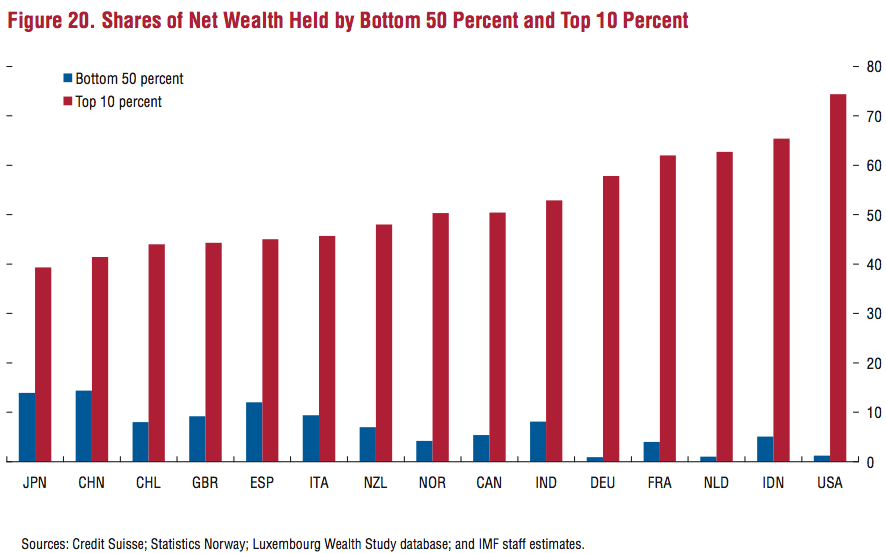
Shares of Net Wealth
Source: IMF

The inescapable conclusion presented to us by this data is that our tax policy is responsible for both the world’s greatest inequality among developed nations, and our ongoing deficits.

If you have a better explanation for our current conditions, or the net results of our tax policies, I would love to hear it.

Source:
Fiscal Monitor Taxing Times
World Economic and Financial Surveys
IMF October 2013
http://www.imf.org/external/pubs/ft/fm/2013/02/fmindex.htm

Did Monetary Policy Cause the Recovery? – John Hussman. A very nice demolition of our monetary policy charade for Janet Yellen to consider. Let’s hope she has the guts to make some heads roll [i.e., to bring back honest accounting].

[…] To address this question, a proper understanding of the credit crisis is essential. Much of the present faith in monetary policy derives from the belief that it was the central factor in ending the banking crisis during what is often called the Great Recession. On careful analysis, however, the clearest and most immediate event that ended the banking crisis was not monetary policy, but the abandonment of mark-to-market accounting by the Financial Accounting Standards Board on March 16, 2009, in response to Congressional pressure by the House Committee on Financial Services onMarch 12, 2009. The change to the accounting rule FAS 157 removed the risk of widespread bank insolvency by eliminating the need for banks to make their losses transparent. No mark-to-market losses, no need for added capital, no need for regulatory intervention, recievership, or even bailouts. Misattributing the recovery to monetary policy has contributed to a faith in its effectiveness that cannot even withstand scrutiny of the 2000-2002 and 2007-2009 recessions, and the accompanying market plunges. This faith is already wavering, but the loss of this faith will be one of the most painful aspects of the completion of the present market cycle. […]

The simple fact is that the belief in direct, reliable links between monetary policy and the economy - and even with the stock market - is contrary to the lessons from a century of history. Among the many things that are demonstrably nottrue - and can be demonstrated to be untrue even with simple scatterplots - are the notions that inflation and unemployment are negatively related over time (the actual correlation is close to zero and slightly positive), that higher inflation results in lower subsequent unemployment (the actual correlation is positive), that higher monetary growth results in subsequent employment gains (the correlation is almost exactly zero), and a wide range of similarly popular variants. Even "expectations augmented" variants turn out to be useless. Examining historical evidence would be a useful exercise for Econ 101 students, who gain an unrealistic sense of cause and effect as the result of studying diagrams instead of data.

Friday, August 2, 2013

‘Animal spirits’ update

In spite of the downtick in the unemployment rate—due to lowered labor force participation—the topping process in “animal spirits” continues; there was no break of the recent high.

image

As the history of the A metric shows, when it crosses the zero line from above a collapse of confidence is virtually guaranteed.

image

When will we get there?  Frequently entry into NBER-defined recession precedes the crossing of the zero line, so my forecast of a collapse of confidence before the end of year may be plausible.  Otherwise it will occur in 2014.  With job growth (especially full-time, “good” job growth) at the pathetic levels it’s at, it’s hard to see how a collapse of confidence before the actually crossing of the zero line won’t take place.

Here’s a close up of my judgmental unemployment rate forecast and its attendant adaptation level forecast:

image

Sooner or later a lot of the unemployed are going to have to start looking for work, and that will push the unemployment rate up, precipitating the collapse of confidence as the published unemployment rate rises.

I have taken a brief look at whether coming within a “just noticeable difference” of the adaptation level is sufficient to cause the collapse, and I don’t think it is.  Confidence is especially sensitive to the A metric actually attaining a negative value.  However, as can be seen from the history, in many cases the NBER-defined recession occurs before that happens.

Friday, May 11, 2012

‘Animal spirits’ update

Based on my judgmental forecast of the unemployment rate, which I expect to break below 8.0 percent just in time for the election, then to shoot up as the global slowdown catches up with the US.  In 2013 and 2014 the US will undeniably be in depression, in this view.  The next slump will be only about a year long (meaning the phase of negative aggregate growth) but will conclude in 2014 with unemployment at depression levels, but nowhere near as bad as it is in some parts of Europe.  The latter part of the decade will present the most fertile breeding ground for fascist extremism in a century, not only in the failed state of Europe but in America.

image

image

I am basing my forecast in part on the purely technical observation that previous “global” peaks in unemployment have come at the end of three local peaks on the way up.

Baby boom retiring?

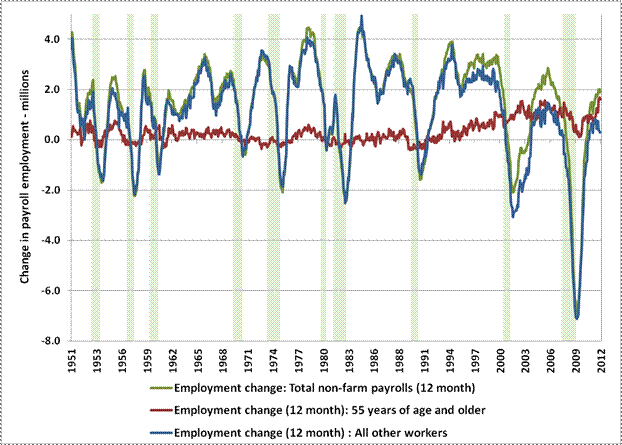
I get annoyed hearing the fallacious statement that labor force participation is declining because the baby boom is retiring.  The baby boom is largely unprepared for retirement, and their participation rates have been increasing since 2000, as can be seen here.

Monday, April 23, 2012

A very fine rant

The main service provided by this site, other than my perspective on “animal spirits,” is to filter the large amount of blog reading I do and forward to my readers the best.  Jim Quinn has a great post that is worth a read in its entirety at

EPIC FAIL – PART ONE

Jim makes some great points about the true state of the labor market that even we cognoscenti can lose sight of in the constant barrage of propaganda from the MSM.

Sunday, April 8, 2012

Desperation behind the unemployment numbers

Via:  www.hussman.net

Beginning first with Alan Greenspan, and then with Ben Bernanke, the Fed has increasingly pursued policies of suppressing interest rates, even driving real interest rates to negative levels after inflation. Combine this with the bursting of two Fed-enabled (if not Fed-induced) bubbles - one in stocks and one in housing, and the over-55 cohort has suffered an assault on its financial security: a difficult trifecta that includes the loss of interest income, the loss of portfolio value, and the loss of home equity. All of these have combined to provoke a delay in retirement plans and a need for these individuals to re-enter the labor force.

In short, what we've observed in the employment figures is not recovery, but desperation. Having starved savers of interest income, and having repeatedly subjected investors to Fed-induced financial bubbles that create volatility without durable returns, the Fed has successfully provoked job growth of the obligatory, low-wage variety. Over the past year, the majority of this growth has been in the 55-and-over cohort, while growth has turned down among other workers. Meanwhile, overall labor force participation continues to fall as discouraged workers leave the labor force entirely, which is the primary reason the unemployment rate has declined. All of this reflects not health, but despair, and explains why real disposable income has grown by only 0.3% over the past year. […]

Regardless of the fact that QE has had no durable economic benefits […], and does little but to repeatedly lay fresh wallpaper over the rotting edifice that is the global banking system, the main effect of QE has been to provide temporary support for the most speculative corners of the financial market after they have been pummeled.

Friday, April 1, 2011

No rate increase in sight

Dent’s unoriginal take is that housing will behave just like Japan’s did after peaking in 1990.  Prices won’t come back for a couple of decades.

If we get a major war in the next three years as Charles Nenner and Gerald Celente expect, we will have what I call “stagflationary deflation”:  sectoral supply-shock price increases that further squeeze nominally unchanging household budgets (at least for the bottom ninety percent).  Consumption at seventy percent of GDP is unsustainable, and what is taken out of consumption would be replaced with war spending.  Consumption would be effectively if not administratively rationed.

“Inflation is always and everywhere a labor market phenomenon accommodated by loose monetary policies.”

Monday, December 13, 2010

America, the barbaric

Here is a cogent exposé of America’s bankrupt value system.  And even America’s poor have been taught to blame themselves (Low incomes make poor more conservative, study finds - physorg).  It is instructive that it is the “liberal”—and often bellicose—Paul Krugman gets the honor of being shredded here.

Via:  Truthout

Reconsidering Japan and Reconsidering Paul Krugman

Sunday 12 December 2010

by: Steven Hill, t r u t h o u t | News Analysis

Reconsidering Japan and Reconsidering Paul Krugman
Shibuya, Tokyo. (Photo: - reuben -)

The New York Times is doing a series on Japan, which the Times describes as an examination of "the effects on Japanese society of two decades of economic stagnation and declining prices." Reading the series is about as cheery a task as rubbernecking at a car wreck on I-95, but, unfortunately, the Times series simply repeats the "conventional wisdom" about Japan put out by the same economic experts who missed an $8 trillion housing bubble in the United States, and, in fact, have been wrong on most of the big economic issues over the past two decades.

Look at it this way: In the midst of the Great Recession, the United States is suffering through nearly 10 percent unemployment and 50 million people without health insurance. A new report has found over 14 percent of Americans living below the poverty line, including 20 percent of children and 23 percent of seniors, the highest numbers since President Lyndon Johnson's War on Poverty. That's in addition to declining prospects for the middle class and a general increase in economic insecurity.

How, then, should we regard a country that has 5 percent unemployment, health care for all of its people, the lowest income inequality and is one of the world's leading exporters? This country also scores high on life expectancy, low on infant mortality, at the top in literacy, and low on crime, incarceration, homicides, mental illness and drug abuse. It also has a low rate of carbon emissions and is doing its part to reduce global warming. In all of these categories, this particular country beats both the US and China by a country mile.

Doesn't that sound like a country from which Americans might learn a thing or two about how to get out of the mud hole in which we are stuck?

Not if that place is Japan. During and before the current economic crisis, few countries have been vilified as an economic basket case as much as the Land of the Rising Sun. Google "Japan and its economy" and you will get numerous hits about Japan's allegedly sclerotic economy, its zombie banks, its deflation and slow economic growth. This malaise has even been called "Japan syndrome," a monicker that sounds like a disease to warn policymakers - as in, "You don't want to end up like Japan."

No one has been more influential in defining this narrative than New York Times columnist and Nobel-Prize-winning economist Paul Krugman. Throughout the 1990s, and still occasionally today, Krugman has skewered Japan's economy and its leaders. In the late 1990s, Krugman wrote a series of gloom-and-doom articles, complete with equations, theories and titles like "Japan's Trap" and "Setting Sun," bluntly stating: "The state of Japan is a scandal, an outrage, a reproach. It is operating far below its productive capacity, simply because its consumers and investors do not spend enough."

Krugman was commenting on Japan's so-called "lost decade" of the 1990s, when the Japanese economy was considered sluggish and underperforming. But let's look at some of the Japanese metrics during that time. Throughout the 1990s, the Japanese unemployment rate was - ready for this? - about three percent. Not 30 percent, that's three percent: about half the US unemployment rate at the time. During that allegedly "lost decade," the Japanese also had universal health care, less inequality, the highest life expectancy and low rates of infant mortality, crime and incarceration. Americans should be so lucky as to experience a Japanese-style lost decade.

Reopening the case of Japan raises some important questions. How do economists such as Krugman decide what to value and prioritize, or what to measure? What is an economy for? To produce the prosperity, security and services that people need? Or to satisfy economists and their equations, theories and models? For too many economic Cassandras, if their spreadsheet columns don't add up, if the surplus nations don't balance the deficit nations and the supply doesn't meet the demand, then disaster surely awaits.

Krugman has gone on the attack again recently, this time in a debate over fiscal stimulus versus deficit reduction as a strategy toward economic recovery. As a stimulus hawk, he has written that the Germans - one of the few economic bright spots in a struggling global economy - "seem to be getting their talking points from the collected speeches of Herbert Hoover." He is criticizing Germany for the same reason he criticizes Japan; he says the country is not spending or consuming enough to stimulate its economy.

But what exactly are the Germans or the Japanese supposed to buy more of? Surely Krugman has visited both countries, and it's plainly evident that neither are lacking in any material goods or modern trinkets to speak of. Americans are the only ones who seem to think they need three refrigerators, four televisions and a car for everyone in the household. Too many economists have yet to figure out that it is this consumer-driven economic model that has crashed and burned.

Japan's economy has been and remains successful. Germany's is thriving as well. Unlike the trickle-down US economy, Japan and Germany have reached an economic steady state in which they don't need roaring growth rates to provide for their people, and here's why: they are better at sharing the wealth produced by their economies to foster a more broadly shared prosperity among their populaces.

But for the economic experts, apparently, it doesn't matter if people's needs are being met; what matters is whether their theories and equations balance. It's no different with media outlets such as The New York Times, which has been getting it wrong for years – they also missed an $8 trillion housing bubble, as well as the lie on weapons of mass destruction in Iraq (prompting the Times to issue an unprecedented mea culpa to their readers). In the same way, the Times and the rest of the media have been missing the real story about what is occurring in Japan and Europe.

As a result, there is a commonsense aspect to this story that gets lost amid the rhetoric and the headlines. Two lessons of our times are that economic bubbles eventually burst, and that the environmental consequences of unbridled growth in this age of global warming are severe. The world needs to figure out how advanced economies can provide for their people without relying on roaring growth rates driven by asset bubbles. If consumer-driven growth was the order of the day in the post-World War II era, going forward it is going to be steady-state economic growth - growing not too fast, but not too slowly - and learning to do more with less. Yet stimulus hawks like Krugman don't seem to get this; they want to crank the "growth machine" into full gear with huge government stimulus spending.

But the real game is no longer strictly about economic growth; it's also about sustainability. The era of US-style trickle-down economies is over for wealthy countries because trickle-down is neither economically sound nor ecologically sustainable. The developed nations must lead the way towards a different path of development. This is not an easy challenge, yet it is the course that Japan and Germany have chosen. If the US didn't have such a trickle-down economy that has produced so much inequality - if it was better at sharing its wealth - perhaps it wouldn't need so much fiscal stimulus and growth.

At the recent G-20 meeting in Seoul, South Korea, German Chancellor Angela Merkel rebuffed President Barack Obama and Treasury Secretary Timothy Geithner's appeals to go back to the toxic economics of Wall Street capitalism. Said Merkel, "It is essential to return to a sustainable growth path." One cause of the crisis, she said, was that "we did not have sustainable growth. In many countries growth was built on debt and [speculative] bubbles."

Her finance minister, Wolfgang Schauble, was even more blunt. He described American policy as "clueless" and said the American growth model is stuck in a deep crisis. "The USA lived off credit for too long, inflated its financial sector massively and neglected its industrial base." Catch the irony: Germany - previously sneered at by US pundits for its "weak and sclerotic" economy - is lecturing America about how to grow our economy. Given Germany's 6.7 percent unemployment (compared to 9.6 percent in the US) and an impressive record at manufacturing things that the rest of the world wants to buy, the Obama administration, as well as Paul Krugman, should be listening attentively.

Creative Commons License
This work by Truthout is licensed under a Creative Commons Attribution-Noncommercial 3.0 United States License.

Monday, October 25, 2010

Inequality links 10/25/2010

Income Inequality Linked to Senate Standoffs – Miller McCune
The United States of Inequality – really nice series from Slate available as a downloadable pdf.
Rich Mom, Poor Mom – Economix
15 Mind-Blowing Facts About Wealth And Inequality In America – businessinsider

Compassion makes for good macroeconomics today, even as the Republicans and Tea Partiers harden their hearts to the damage being done to the poor and unemployed.  Raising marginal tax rates on the rich (top 1 percent) and “stinking rich” (as the Slate author terms the top 0.1 percent)—that is, taxing only the portion of their incomes over, say, $300,000 a year—and using the money to fund humanitarian income assistance to the unemployed and their children would put more money into the spending stream than any other fiscal policy measure, as our economy sinks into depression.

Some would say America is already a hollowed-out state, gutted by money interests, powerless to effect such a social contract.  I hope they are wrong.

Friday, September 3, 2010

Visual interpretation of the unemployment number

If there is any relation between mean duration of unemployment and the subsequent drop in the unemployment rate, we are in for a very slow decline (if any) in the unemployment rate:

image

The following charts show the relationship between mean duration of unemployment and unemployment rate a year later, showing that the relationship has changed in this recession:

image

Using the fitted equation for the period 2007:1 to August 2010, we have a forecasted unemployment rate of 7.5 percent in August 2011.  This depends on a big ceteris paribus (other things equal) assumption about civilian labor force participation rate and other factors behaving the same in the recovery as in the recession.  If we use the line fitted to the whole sample, the forecasted unemployment rate is 10.2 percent, with a looser fit.

So let us assume unemployment remains unchanged for the next year.  What does that do to “animal spirits”?  We are interested because the distinguishing characteristic of an NBER-defined slump or a business slump as understood by any practical person is the associated failure of confidence; which, as Keynes pointed out, is a palpable entity to the practical person that is adequately proxied by survey measures.  And visual examination of the record (below) shows that every recession has been accompanied one-to-one by a failure of confidence as measured by the venerable Michigan sentiment series, and our measure, A.  I have assumed

Regular readers will recall that our proxy for the determinants of confidence is the relation of the unemployment rate to an adaptation level:

A = - (U – UMEAN)/sigma(U)

where A is “animal spirits.”

We are still not close to a failure of confidence; which is not to say the economy isn’t in an over-indebtedness-induced “underemployment equilibrium” exacerbated by a highly unequal distribution of income and wealth.  The next failure of confidence will probably not occur until about 2013.  For this forecast I assume the unemployment rate will fall for a year, stabilize, and begin to rise again:

image

If we assume the unemployment rate remains constant for two years and then begins to rise after the next Presidential election, we have this picture:

image

In the case above confidence never recovers to “positive” levels, but adaptation level effects are evident in that, even as unemployment rises to new highs, the plunge in confidence is not worse than before.  Plus ça change, plus c'est la même chose….

With regard to Hussman’s views on the yield curve noted recently, the 1/10 yield curve is still 2.5+ percent positively sloped, so any logistic yield curve model will still show very low recession probability (ours, of course, also utilizes the A variable; and in any event the effect of ZIRP will not be a distortive on the 1/10 curve as on the 3-month; and changes in the slope are still highly indicative):

image

The shape of the current cycle resembles the 1970-1974 abortive recovery, only worse. 

At some point I will write up some insights on “America on the hedonic treadmill” and the adaptive necessity of resetting adaptation level “set points” to survive what’s coming, but everybody already knows that we’re going to have to get by with less.  The primary contribution today is to put the current cycle in context along the most important dimension, that of “animal spirits” or confidence.  The next collapse is still a ways off.

Saturday, August 7, 2010

Quick comment on double dips

The only time there has been a “double dip” NBER recession in the postwar period was in the 1980-1982 episode, and it was fully signaled by a secondary inversion of the yield curve.  The 1/10 yield curve inverts an average of about a year before NBER recessions begin.  Here is a 12-month smoothed 1/10 yield curve slope over the postwar period:

image

The unsmoothed yield curve did go positive in between the 1980 and 1981-1982 recessions, but only briefly; as Volcker applied more tight money after an election year acceleration of inflation.  The smoothed yield curve remained fully inverted.  (The only time the curve inverted and a technical recession did not occur was in 1966—but a drop in the GDP growth rate from ~8 percent to near zero did occur; a “growth recession” it was termed).

Today the yield curve is steeply sloped, so no double dip is indicated.  Why should the yield curve send such great signals?  That is beyond the scope of this note.  I don’t argue with 60 years of empirical regularity.  The yield curve was also inverted steeply in 1928-1929.

The quickest drop off of the smoothed slope from a level such as we’re at now over 3 was from 2004:6 to 2007:6, as the Fed raised short rates and deflation began its assault on the US economy and long rates.  Thus, if we match that decline rate, the curve might invert in mid-2013 and the next recession begin in mid-2014.

The unemployment story that goes along with this might go something like this:

Unemployment rate rises slightly for a few months, and then a determined effort is made to report declining unemployment rates, which, however, must remain within the realm of credibility with a populace (or least the marginally well informed part of which) has come to rely on the larger U6 unemployment rate measure and the employment-population ratio for indicators of labor market health.  This will prime “animal spirits” for the election year, after which all hell breaks loose.

Here’s the picture:

image

Now a run on the dollar or a failed Treasury auction might cause an inversion to occur quicker, but why would the Chinese do that?  They’re having their own bubble-popping problems.  However, the imperial temptation to drive the world into dollars by starting another war, probably in the Middle East, lingers always.  We probably won’t see unemployment rates under 8 percent for many years.  The best summation of the current labor market is Calculated Risk’s chart here.  Job growth has stalled.

Where will the demand for labor come from?  Americans are an adaptable people, and as they adapt to the “new normal,” business will chug on.  People may exit the measured labor force.  We will continue to be in an underemployment equilibrium because the income distribution is unequal enough that balanced demand is not possible.  Wage concessions to benefit wider employment will be made by Americans on the receiving end of the ruling elite’s diktats, and in this way a new social cohesion among the disenfranchised majority may grow, possibly into a democratic movement with the potential to forge a new social contract through the broken-down apparatus of the American government, or possibly into a new class of post-industrial serfs.

Friday, June 4, 2010

Labor market remains very weak

 image

www.calculatedrisk.com offers the following:

Mean duration of unemployment continues to shoot up.  At this point it is almost irrelevant whether someone is in the labor force or not, as we know that income inequality is at record highs, asset prices have collapsed, so that those at the bottom of the pecking order are likely in need of work whether they’re counted in the labor force or not.  Employment/population is near 25-year lows.

Saturday, April 3, 2010

The state of the labor market

And remember that “employment” counts those involuntarily working part-time jobs and those imputed to be “self-employed.”  See Mish or Tyler Durden for demolition of the current unemployment statistics.

image

The U-6 measure of un- and underemployment hovers around 17 percent.  Given the extreme inequality of the income distribution, this represents a sizeable and growing underclass.  How much fun it will be to live in the United States over the next decade will be largely determined by how the authorities choose to deal with this segment.

The Obama administration is being vilified by some for trying to address a mounting humanitarian crisis here at home, much as Bill and Melinda Gates are being vilified by some on the left for “racist” eugenic ambitions for trying to improve the health of the bottom two billion humans (which, in turn, will predictably lead to lower infant mortality and lower reproduction rates). 

The ruling class loves the current nasty political environment because it keeps their marginal tax rates low.  My read is that the powers that be are aware the economy is collapsing and are making their last greedy grab for wealth to set themselves and their families up during the depression that will unfold in a few years.

Marginal tax rates on incomes over $1 million should be about 75 percent in the current fiscal environment. 

Tuesday, February 23, 2010

Announcement and links

I have taken the ads off the site and gone non-commercial.  I don’t want even the subconscious influence of making money through advertising upon my writing.  I have a day job, and am glad of it.

Let me know if any ads pop up.

I commend to you the writings and links on my recommended blogger sites to the left.  These colleagues provide consistently high quality, linked-to-authoritative-sources copy with an intelligent organizing principle behind it that puts the mainstream propaganda-blathering press to shame.

Everything I read reinforces the impression that American society has ceased to cohere, that not just the government but the social contract is broken.  While “animal spirits” are increasing (because hope springs eternal and humans try to adapt) the potential for very negative social psychology in the next downturn is great—whether it’s outright repression a la Hank Paulson’s dream of martial law implemented by Blackwater/Xe—or simply a loss of long-term “animal spirits” in the context of a rigidified neo-feudalism that kills the dreams in Americans breasts—or sends them deep underground—any of the above is awful to contemplate.  The current repositioning of the Republican party as “libertarian” is the latest in the charade of the do-nothing two-party system and is just another ruse to lower taxes on rich people (a la  Peter Schiff).

Among MSM-sanctioned talking heads, Marc Faber has been most vocal in warning that the hidden powers behind the American throne are clamoring for a big war.  I fear we have some very sick people pulling the strings behind the scenes.  A population in a state of fear is easier to manipulate than otherwise.  Be wary of news of “provocations” from “enemies.”  George Washington has addressed the issues of “false flag” attacks here and here.  Hitler famously used a false flag attack to cement his hold on the German psyche.  Be wary.

As I have suggested many times, the appropriate response to the current maldistribution-induced failure of effective demand to to provide health care and livable workfare to those who need it, funded by progressive increases in marginal tax rates on the super-rich (say, the top 5 percent of the income distribution that receives ~37 percent of income per Saez).  With personal income currently running at $12 trillion and un- and underemployment totaling 25 million, a simple diversion of a trillion dollars, 8.3 percent, from the richest to the most needy would provide $40,000 to each unemployed person and would reignite a healthy circular flow of income and product domestically.  Half that amount would get things going, and the other half could go to health care.

You say this would kill growth, Neocon?  American growth rates were highest in the early postwar period when marginal income tax rates were highest, when we had a sense of shared sacrifice paying off the war debt, when we had a viable social contract.

Here are a few recent links I found interesting or amusing (sorry no hat tips):

The doomsday cycle - Peter Boone, Simon Johnson, VoxEU
US Military Drone pilots will have a front-row seat slaughtering citizens resisting Federal Tyranny
Terrorism Derangement Syndrome
Cheney Confesses to War Crimes
General Petraeus: Torture is Unnecessary, Hurts O...
"Only 21% Say U.S. Government Has Consent of the G...
Yet Another Congressman Questions 9/11

"Of all the enemies to public liberty war is, perhaps, the most to be dreaded, because it comprises and develops the germ of every other. War is the parent of armies; from these proceed debts and taxes; and armies, and debts, and taxes are the known instruments for bringing the many under the domination of the few. In war, too, the discretionary power of the Executive is extended; its influence in dealing out offices, honors, and emoluments is multiplied; and all the means of seducing the minds, are added to those of subduing the force,of the people. The same malignant aspect in republicanism may be traced in the inequality of fortunes, and the opportunities of fraud, growing out of a state of war, and in the degeneracy of manners and of morals engendered by both. No nation could preserve its freedom in the midst of continual warfare."

- “Political Observations” (1795-04-20) and Letters and Other Writings of James Madison (1865), Vol. IV, p. 491

Tuesday, February 9, 2010

Fiscal policy in a classical failure of effective demand

As Professor Saez has shown, the top 1 percent of the income distribution receives 20 percent of income; the top 10 percent 50 percent of income.  This represents a level of inequality greater than that preceding the Great Depression.  Effective demand is failing because most people don’t have enough money, and many people who would like to work can’t get a job.  The current Great Recession is primarily affecting the folks at the bottom.

About half of Americans, the bottom half of the income distribution, pay no federal taxes other than Social Security.  This is where demand is failing.  A tax cut will do them no good.

Now, other things equal, a simple transfer of ten percent of the top 10 percent’s incomes to the bottom 90 percent would contribute greatly to aggregate demand and production.  Or, a tax-financed infrastructure program paid for by the rich would create jobs and incomes for many in the bottom tiers. 

The problem is, no one trusts our government to do anything right.  The Congress is full of pimps representing their Big Money sponsors.  The President is an appeaser.

It is common to say that we’re suffering because wages are converging to global norms.  But what explains the huge increase in income multiples of the people at the top?  Why should the distribution have widened?

Rather, a global ruling class seems to be making its appearance, giving rise to speculation on neo-medievalism, or as I have called it, neo-feudalism, and Dani Rodik’s worry that

democracy, national sovereignty and global economic integration are mutually incompatible: we can combine any two of the three, but never have all three simultaneously and in full. (link)

My belief is that we let the rich have their way out of a delusion that we would be joining them, and that once that dream is over, the scales fall from our eyes, and we begin actively to shame the rich, that the sheer force of human imagination will restore the balance.

If you don’t believe in the power of thought to affect the world directly, read Lynn McTaggart’s books, The Field and The Intention Experiment.  (I’m not linking so you can choose your bookstore.)

I’ve seen the power of thought in an experiment you can try with friends.  Have one person face away from the group, with arms extended horizontally, facing another who puts their fingers on the subject’s wrists, pressing down.  Let the group signal whether it permits the subject to resist the downward pressure—thumbs up—or not—thumbs down.  I’ve seen this done several times, and every time the subject was unable to keep their arms extended when the group signaled thumbs down.

Direct your thoughts to envision social justice in this world.  It will happen if enough of us get beyond the lies.

Saturday, February 6, 2010

The state of the labor market

image

The employment/population ratio has fallen while mean and median duration of unemployment has risen to levels previously unrecorded in the postwar period. 

Monday, November 16, 2009

The worst is yet to come

See:  The worst is yet to come

I agree with Noriel Roubini that the worst is yet to come, but even Roubini falls prey to the figment that a fiscal stimulus involving “shovel-ready” infrastructure spending “creates jobs”:

There's really just one hope for our leaders to turn things around: a bold prescription that increases the fiscal stimulus with another round of labor-intensive, shovel-ready infrastructure projects, helps fiscally strapped state and local governments and provides a temporary tax credit to the private sector to hire more workers. Helping the unemployed just by extending unemployment benefits is necessary not sufficient; it leads to persistent unemployment rather than job creation.

In the past, I have also recommended infrastructure spending or workfare instead of just a livable poverty-level dole.  But upon reflection, and watching the way our government malfunctions, I have become more conservative.  I don’t trust the government to spend my money on anything other than humanitarian aid for my fellow citizens.  And “extending unemployment benefits” is not an adequate answer to the abject lives that Americans confront when they become unemployed long-term (most Americans don’t even qualify for unemployment benefits, to begin with). 

I don’t know any other commentator who is singing my song, which is that the current collapse of effective demand is a distributional problem, to solve which quantitative easing and fiscal stimulus are a fool’s tools.  If the problem is distributional, the solution needs to be as well.

Provide spending power to the disenfranchised and let the system self-organize.  That’s the one thing markets do well.  I never bought John Stuart Mill’s argument that redistributional strategies always ultimately fail.  As I recall it was tied up with that marginal productivity fairy tale.  The rich in America have done very well redistributing income and wealth in their own direction via manipulation of corporate compensation and personal taxes.

The more that government is involved in job creation, the more worthless the resulting jobs will be, generally.  Otherwise, I don’t object to workfare in principle, I just think it will be botched and disagreements (pork-squabbling) over what jobs to create will be used as an excuse for delaying direct humanitarian aid.  People on a livable dole can engage in search for jobs that use their actual skills, rather than just blistering their hands with a shovel.  Or they can engage in training for real jobs.  Government jobs create vast Sargasso Seas of waste in the economy that tend never to go away.

Tax credits for hiring new workers, or as Yves referenced recently, mandatory short work hours per the German solution make a lot of sense (although they don’t have a prayer of being tried here). 

But there will be no excuse for letting our fellow Americans fall into a life on the streets when the next collapse occurs.

Wednesday, September 16, 2009

Industrial production stuck in last century

While industrial production has turned up, and by NBER standards the recession may be over (they’ll decide well after the fact), industrial production will probably remain depressed for several years.  Given the debt drag on the economy, the collapse of consumption and investment, industrial production isn’t likely to achieve 110+ levels for many years if my forecast of another round of deflationary collapse in about four years is correct.

image

Looking at percent changes from a year earlier for industrial production, real consumption spending, and real private fixed investment spending it is tempting to look for an accelerator-type pickup.  Real consumption spending has been far more stable than either of the other series.  But real consumption spending is taking a beating from increased saving, slow-to-no wage growth, and yet-increasing unemployment, and real estate investment spending on construction isn’t coming back soon, so any accelerator effect (derived demand for investment spending) is likely to be muted.

image

Data to August 2009 except for investment which is quarterly to 2009Q2.