Showing posts with label taxes. Show all posts

Friday, April 11, 2014

Krugman on Piketty

Paul Krugman has a beautiful review of Thomas Piketty’s Capital in the Twenty-First Century. I have described Piketty as the hero-economist on a white horse who will finally and I hope irrevocably shut up the neocons and neoliberals who would tell you that the distribution is not a worthy subject of economic analysis. Now, next, if economics would take note of Wilkinson’s epidemiological work on inequality (see this for intro) we might be able to say economics is a noble profession seeking social justice (as some used to think of it) rather than a bunch of whoring cheerleaders for the rich.

Those of us who were young economics professors in 1981 as Ronald Reagan began his program of fraudulent “supply side” tax cuts for the rich (“trickle down economics”)  told our students that America was being duped, that it was time for “mourning in America,” that is was not “morning in America.”

Why We’re in a New Gilded Age

Paul Krugman

MAY 8, 2014 ISSUE

Capital in the Twenty-First Century

by Thomas Piketty, translated from the French by Arthur Goldhammer

Belknap Press/Harvard University Press, 685 pp., $39.95

krugman_1-050814Emmanuelle Marchadour

Thomas Piketty in his office at the Paris School of Economics, 2013

Thomas Piketty, professor at the Paris School of Economics, isn’t a household name, although that may change with the English-language publication of his magnificent, sweeping meditation on inequality, Capital in the Twenty-First Century. Yet his influence runs deep. It has become a commonplace to say that we are living in a second Gilded Age—or, as Piketty likes to put it, a second Belle Époque—defined by the incredible rise of the “one percent.” But it has only become a commonplace thanks to Piketty’s work. In particular, he and a few colleagues (notably Anthony Atkinson at Oxford and Emmanuel Saez at Berkeley) have pioneered statistical techniques that make it possible to track the concentration of income and wealth deep into the past—back to the early twentieth century for America and Britain, and all the way to the late eighteenth century for France.

(continues here)

Tuesday, October 29, 2013

The glorification of greed: America’s greatest export

Two recent items on the major problem facing the world today, the explosion of inequality and the destabilization of society across the globe. The first is a graph showing that inequality has hit the “global upper middle class” the worst in relative terms (e.g., the American middle class and similars).

The great economic reshuffle – Reuters

October 28, 2013 @ 3:43 pm

By Shane Ferro

Branko Milanovic [1], the lead economist at the World Bank’s research department, has a new paper out on global income inequality (the paper was first spotted by John McDermot [2]t). Among other things, Milanovic compares the change in global income from 1988 to 2008:

[3]

He writes:

Global income distribution has thus changed in a remarkable way. It was probably the profoundest global reshuffle of people’s economic positions since the Industrial revolution. Broadly speaking, the bottom third, with the exception of the very poorest, became significantly better-off, and many of people there escaped absolute poverty. The middle third or more became much richer, seeing their real incomes rise by approximately 3% per capita annually.

And yet, those in the 75th to 90th percentile of the income distribution — including “many from former Communist countries and Latin America, as well as those citizens of rich countries whose incomes stagnated” — haven’t seen the sort of gains that the bottom half and the top 1% have. […]

The second article I’m linking to emphasizes the growth of billionaires outside the US and the West. Some might say that America’s greatest export has been its culture, not the least part of which is our glorification of greedy material acquisition. We have seen the shameless tax avoidance of the very rich across the globe—for example, Gerard Depardieu in France emigrating (at last report) to avoid a 75 percent marginal tax rate on income over about two million dollars. In American the highest growth rates occurred when wew had such marginal tax rates and there was a sense of a viable social contract, and when incomes far beyond anything needed for happiness or a good life caused a mild sense of shame among many (I know, I was there and had rich relatives who paid their taxes without complaint).

Billionaires: Decline of the West, Rise of the Rest – triplecrisis.com

Robin Broad and John Cavanagh

With the help of Forbes magazine, we and colleagues at the Institute for Policy Studies have been tracking the world’s billionaires and rising inequality the world over for several decades. Just as a drop of water gives us a clue into the chemical composition of the sea, these billionaires offer fascinating clues into the changing face of global power and inequality.

After our initial gawking at the extravagance of this year’s list of 1,426, we looked closer. This list reveals the major power shift in the world today:the decline of the West and the rise of the rest. Gone are the days when U.S. billionaires accounted for over 40 percent of the list, with Western Europe and Japan making up most of the rest. Today, the Asia-Pacific region hosts 386 billionaires, 20 more than all of Europe and Russia combined.

In 2013, of the 9 countries that are home to over 30 billionaires each, only three are traditional “developed” countries: the United States, Germany, and the United Kingdom.

Next in line after the United States, with its 442 billionaires today? China, with 122 billionaires (up from zero billionaires in 1995), and third place goes to Russia with 110. China’s billionaires have made money from every possible source. Consider the country’s richest man, Zong Qinghou, who made his $11.6 billion through his ownership of the country’s largest beverage maker. Russia’s lengthy billionaire list is led by men who reaped billions from the country’s vast oil, gas and mineral wealth with devastating consequences to the environment. […]

With this kind of concentration of wealth and power the specter of neo-feudalistic global fascism (rule by greedy corporation) is not such a stretch to imagine. Look at Europe, look at the United States.

Labor arbitrage is a game that can be played indefinitely. Until marginal tax rates on very high incomes can be raised substantially global imbalances and instability will probably increase.

Sunday, October 20, 2013

My favorite blog posts from the week

Tax Rates, Inequality, and US Deficits – Barry Ritholtz.  Sometimes no one nails it like Barry.

Its Friday, after what was for me a long and annoying 17 days. But the shutdown is over, US markets are at all time highs, and Bob Shiller got his Nobel (more on this tomorrow).

You might think that I would be at peace with the current state of the world, but life is never that simple. You see, I have assumed the task of explaining things which require explaining. By some quirk of fate and an odd academic background, I find myself with skills in simplifying complex matters. Whether OCD or over-compensation for some other defect, this is my lot in life. (I made peace with it long ago).

As we discussed yesterday, amongst all of the background nonsense since October 1, the noise about the deficits was not really about budget deficits at all. Rather, it was about a decidedly narrow ideology held by a small percentage of Americans. Their belief is that government should be much smaller. This is a legitimate political ideology, one that has persisted over the centuries.

Their approach to this philosophy, however, is far less intellectually honest. Rather than having a full on debate on that subject — a debate they are likely to lose — they have chosen a very different approach. This time around, they made the deficit a proxy.

Because of what I do for a living, I found this offensive. Deficits impact fixed income, an important part of portfolio planning. They impact available credit, capital for investment, in a broad and varied way. Hence, the deficit is a genuine issue, a real problem that should be addressed in a mature and responsible way. It can be easily solved using intelligent solutions, but for the ideologues in Washington DC (and elsewhere) who refuse to treat it as the basic mathematics and accounting problem it actually is. The way the Tea Party and others have treated the deficit reminds me of the approach Meredith Whitney took to Municipal Debt. Both groups are stunningly ignorant about their subjects, while possessing the skills to allow them to exploit the topic, hog the spotlight for themselves and other tangential pet issues.

The Tea Party, like Whitney, turned an important question of debt and credit and solvency into one giant PR clusterfuck.

Back to our issue of taxes (next week, I will address spending). Amongst Industrialized Nations, the United States has amongst the lowest tax rates in the world, especially for those folks (like myself) who reside at the top of the income scale.

To demonstrate this, I want to point to the IMF’s World Economic and Financial Surveys: Taxing Times. It is chock full f great charts and data and other interesting results of the IMF survey.

The two below caught my eye. They are rather instructive for our discussion of taxes and deficits in the US.

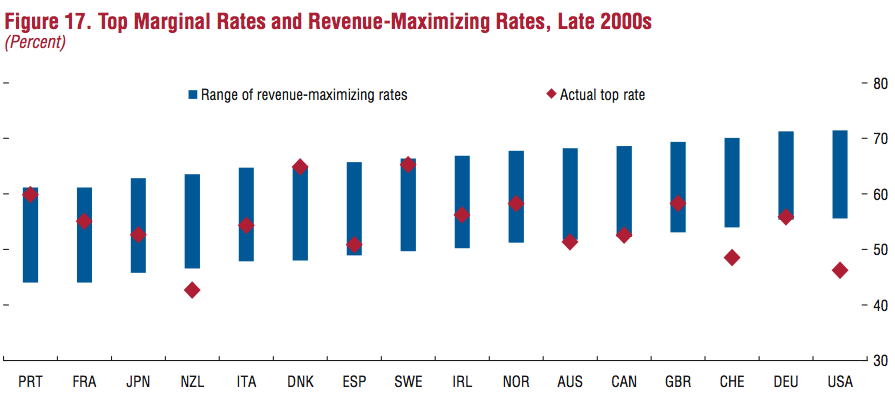
The first looks at major industrial nations, and compares what the IMF calls their Revenue-Maximizing Tax Rates (blue line) versus their actual top rate (red dot).

As you can see, some countries — Denmark and Sweden — are at the top of the revenue maximizing ranges. Other countries — Canada and Germany — are at the bottom of their revenue maximizing ranges.

Then there is the United States, which is simply far off the scale, way below the bottom of its revenue maximizing range.

If your concern is deficits, than you must take notice of how much money the USA is leaving on the table. I am not suggesting that the role of government should be to maximize their tax revenues, but rather to suggest that if you want to close the deficit, you need to at least be in a defendable range. The US is not.

click for ginormous charts
Top Marginal Rates
Source: IMF

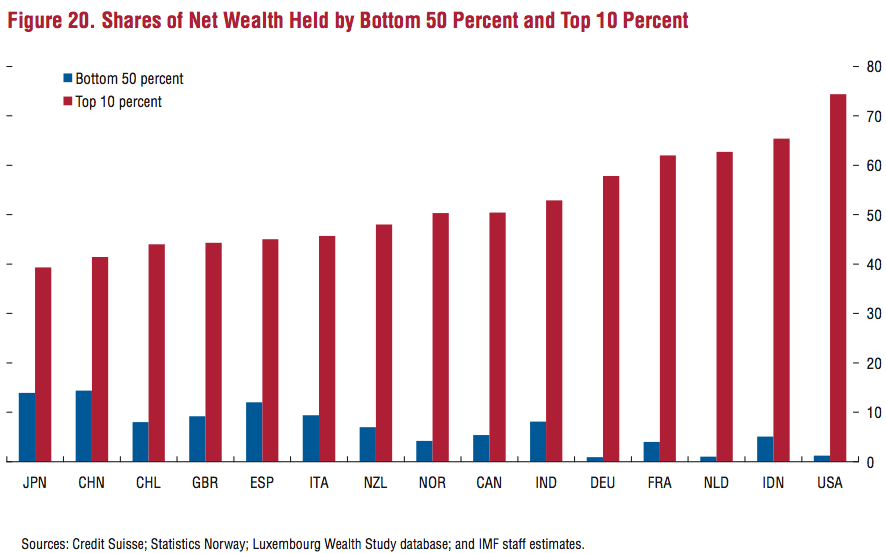
Not coincidentally, when we look at shares of Net Wealth held by the bottom 50% of he population versus the top 10%, the United States is off the scale. We are the most unequal nation in the world.

Shares of Net Wealth
Source: IMF

The inescapable conclusion presented to us by this data is that our tax policy is responsible for both the world’s greatest inequality among developed nations, and our ongoing deficits.

If you have a better explanation for our current conditions, or the net results of our tax policies, I would love to hear it.

Source:
Fiscal Monitor Taxing Times
World Economic and Financial Surveys
IMF October 2013
http://www.imf.org/external/pubs/ft/fm/2013/02/fmindex.htm

Did Monetary Policy Cause the Recovery? – John Hussman. A very nice demolition of our monetary policy charade for Janet Yellen to consider. Let’s hope she has the guts to make some heads roll [i.e., to bring back honest accounting].

[…] To address this question, a proper understanding of the credit crisis is essential. Much of the present faith in monetary policy derives from the belief that it was the central factor in ending the banking crisis during what is often called the Great Recession. On careful analysis, however, the clearest and most immediate event that ended the banking crisis was not monetary policy, but the abandonment of mark-to-market accounting by the Financial Accounting Standards Board on March 16, 2009, in response to Congressional pressure by the House Committee on Financial Services onMarch 12, 2009. The change to the accounting rule FAS 157 removed the risk of widespread bank insolvency by eliminating the need for banks to make their losses transparent. No mark-to-market losses, no need for added capital, no need for regulatory intervention, recievership, or even bailouts. Misattributing the recovery to monetary policy has contributed to a faith in its effectiveness that cannot even withstand scrutiny of the 2000-2002 and 2007-2009 recessions, and the accompanying market plunges. This faith is already wavering, but the loss of this faith will be one of the most painful aspects of the completion of the present market cycle. […]

The simple fact is that the belief in direct, reliable links between monetary policy and the economy - and even with the stock market - is contrary to the lessons from a century of history. Among the many things that are demonstrably nottrue - and can be demonstrated to be untrue even with simple scatterplots - are the notions that inflation and unemployment are negatively related over time (the actual correlation is close to zero and slightly positive), that higher inflation results in lower subsequent unemployment (the actual correlation is positive), that higher monetary growth results in subsequent employment gains (the correlation is almost exactly zero), and a wide range of similarly popular variants. Even "expectations augmented" variants turn out to be useless. Examining historical evidence would be a useful exercise for Econ 101 students, who gain an unrealistic sense of cause and effect as the result of studying diagrams instead of data.

Wednesday, January 9, 2013

Today’s depressing arithmetic

Say you have an income of $96,000, under the payroll tax ceiling.  How much will the 2 percentage point payroll tax increase affect your paycheck?

Your gross monthly income is $8,000.  If your take-home is 65 percent of your gross, a standard assumption, then your take-home pay will be reduced by (0.02*8000)/(0.65*8000) = 0.031 or 3.1 percent.  The dollar reduction in monthly take-home is $160. 

Combine this with a health care premium increasing 6.3 percent (source) and the hit to take-home pay climbs to $200 or more.  Combine this with pay raises that approximately match the actual rate of inflation, and you have a situation where most people’s take home pay is dropping in purchasing power.

I can’t help but believe that when the first pay stubs of the new year arrive, that a considerable amount of belt tightening will ensure.

The 1 percent that runs the country is blissfully unaware of all this, and thinks there is no problem with stiffing the American people year after year.

Tuesday, January 1, 2013

Economic and Distributional Effects of the Senate Tax Bill

Via: taxfoundation.org (links to study page)

House passed it. Can you say, “Slow is beautiful”?  I am sticking with my forecast that the next NBER-defined recession will [be determined to have] begi[u]n in mid-2013, whenever the NBER gets around to determining it.

A few nuggets: 

  • impact on GDP, –1.38 percent;
  • effect on deficit, $37.2 billion reduction (on a ~$1000 billion deficit);
  • $GDP/delta $Tax , –8.0X


image

Note that the table above obviously doesn’t include the effects of the payroll tax cut expiring.  I have emailed the author and asked him to revise it.

Monday, December 31, 2012

Soak the working folks

What no one is talking about in the discussions of the nauseating fiscal cliff negotiations is that the payroll tax holiday, a full 2 percent of individual incomes below about $110,000, is being let expire.  For most households with two parents working, this will be a full 2 percent reduction in take home pay.  Since consumption tends to track disposable income with a correlation >99 percent—combined with some reflexive belt tightening—this tax increase for the majority of households will almost certainly result in a slowing of the economy.  Meanwhile, as the floor for tax increases on the rich will be raised to approximately half a million dollars, the change in rates will likely have little effect.  As a commenter at Daily Kos points out, incomes at that level are largely driven by profits and capital gains and are highly variable, so that the increased tax rate will not even be perceived, at least for a long time.

Happy New Year, everybody!

Wednesday, November 28, 2012

US tax policy: Wild West vs. Sweden

Via:  nytimes.com  Sure a flat tax or VAT is okay *if* it is accompanied by a commitment to good health care and education and social services for *everyone*.  This is the best discussion of the underlying issues I’ve seen, in that it’s clearest about the kind of *social contract* that underlies a tax system. Everyone will have to pay more to get to a good place; lowering taxes will send us into neo-feudalism, which is what the 1 percent would love.  I get very impatient with the ever-so-puerile libertarians about this….  Now if we can just get to a single-payer health care system….

November 27, 2012

Combating Inequality May Require Broader Tax

By EDUARDO PORTER

Rarely have we experienced such a confluence of arguments in favor of raising taxes on the rich. After a hard-won re-election fought mainly over taxes and spending, President Obama arguably has a mandate from voters to tap the wealthy to address our budget woes.

What’s more, raising more money from the wealthy might go a long way toward righting our lopsided economy — which delivered 93 percent of our income growth in the first two years of the economic recovery to the richest 1 percent of families, and only 7 percent to the rest of us.

Yet while raising more taxes from the winners in the globalized economy is a start, and may help us dig out of our immediate fiscal hole, it is unlikely to be enough to address our long-term needs. The experience of many other developed countries suggests that paying for a government that couldhelp the poor and the middle class cope in our brave new globalized world will require more money from the middle class itself.

Many Americans may find this hard to believe, but the United States already has one of the most progressive tax systems in the developed world, according to several studies, raising proportionately more revenue from the wealthy than other advanced countries do. Taxes on American households do more to redistribute resources and reduce inequality than the tax codes of most other rich nations.

But taxation provides only half the picture of public finance. Despite the progressivity of our taxes, according to a study of public finances across the industrial countries in the Organization for Economic Cooperation and Development, we also have one of the least effective governments at combating income inequality. There is one main reason: our tax code does not raise enough money.

This paradox underscores two crucial lessons we could learn from the experience of our peers around the globe. The first is that the government’s success at combating income inequality is determined less by the progressivity of either the tax code or the benefits than by the amount of tax revenue that the government can spend on programs that benefit the middle class and the poor.

The second is that very progressive tax codes are not very effective at raising money. The corollary — suggested by Peter Lindert of the University of California, Davis in his 2004 book “Growing Public” — is that insisting on highly progressive taxes that draw most revenue from the rich may result in more inequality than if we relied on a flatter, more “regressive” tax schedule to raise money from everybody and pay for a government that could help every American family attain a decent standard of living.

Consider government aid for families. According to the O.E.C.D. study, our Temporary Assistance for Needy Families is the most progressive program of cash benefits for families among 22 advanced countries, accurately targeted to serve the poor.

But American family cash benefits are the least effective at reducing inequality. The reason is that they are so meager. The entire budget for cash assistance for families in the United States amounts to one-tenth of 1 percent of the nation’s economic output. The average across the O.E.C.D. nations is 11 times bigger. Even including tax breaks and direct government services, we spend a much smaller share of our economic output on family assistance than almost any other advanced nation.

The same pattern can be found across a range of government programs. The reason is always the same: their relatively small size. Over all, government cash benefits in the United States — including pensions, disability, unemployment insurance and the like — contribute about 10 percent to household income, on average, according to the study. The average across industrial nations is twice that.

Our budget reveals a core philosophical difference with other advanced countries. In the big-government social democracies like those of Western Europe, government is expected to guarantee a set of universal public services — from health care to child care to pensions — that are considered basic rights of citizenry. To pay for this minimum welfare package, everybody is expected to contribute proportionately into the pot.

Government in the United States has a different goal. Benefits are narrower. Social Security and Medicare follow a universal service template, but only for older Americans. Other social spending is aimed carefully to benefit the poor. Financed through a more progressive tax code, it looks more like charity than a universal right. On top of that, our philosophical stance virtually ensures a small government.

Progressive taxes make it hard to raise money because they distort people’s behavior. They encourage taxpayers to reduce their tax liability rather than to increase their pretax income. High corporate taxes encourage companies to avoid them. High taxes on capital income also encourage avoidance and capital flight. High income tax rates on top earners can discourage work and investment, too. So trying to raise a lot of money with our progressive tax code would probably not achieve the goal and could damage economic growth.

Big-government social democracies, by contrast, rely on flatter taxes to finance their public spending, like gas taxes and value-added taxes on consumption. The Nordic countries, for instance, have very low tax rates on capital income relative to income from work. And they have relativelyhigh taxes on consumption. In Denmark, consumption tax revenue amounts to about 11 percent of the nation’s economy. In the United States, sales taxes and excise taxes on cigarettes and other items amount to roughly 4 percent.

Liberal Democrats have long opposed them because they fall much more heavily on the poor, who spend a larger share of their incomes than the rich. But these taxes have one big positive feature: they are difficult to avoid and produce fewer disincentives to work or invest. That means they can be used to raise much more revenue.

Public finances are under strain today on both sides of the Atlantic, as governments struggle to cope with our long global recession and the aging of the baby boom generation. In Southern Europe, the pressure to pare back universal welfare systems is intense. In the United States, political leaders on both sides of the partisan divide have realized that even our relatively meager package of social goods cannot be sustained with our slim tax take.

But the United States has one option that most of Europe’s flailing economies do not. Its tax revenue is so low, comparatively, that it has more space to raise it. A more efficient, flatter tax schedule would allow us to do so without hindering economic activity.

Bruce Bartlett, a tax expert who served in the administrations of Ronald Reagan and George H. W. Bush, told me last week that he thought federal tax revenue could increase to 22 percent of the nation’s economic output, well above its historical average of 18.5 percent, without causing economic harm. If President Obama tries to go down this road, however, he may have to build a flatter tax code.

“We should reform the tax system, no question,” William Gale, a tax policy expert at the Brookings Institution and co-director of the nonpartisan Tax Policy Center, wrote in an e-mail. “We are going to need to move beyond the current set of tax instruments to raise the needed revenues — a VAT and or a carbon tax seem like the obvious ways to go.” And Mr. Bartlett, who writes a column for The New York Times’s Economix blog, also pointed out: “We can’t get all the revenue we need from the rich. Eventually, everyone will have to pay more.”

It’s the distribution, stupid

Infrastructure investment is what we need, let the Treasury print greenbacks to pay for it, or borrow, it doesn’t matter, that’s what we need… yada yada yada.  Gimme that old infrastructure investment.

The problem is, as I pointed out many years ago, the distribution is broken.  As the estimable Emmanuel Saez has shown, 93 percent of the total personal income gain as reported by tax returns in 2010 went to the top 1 percent of the income distribution.  Much of the gain presumably came from the Obama stimulus packages (see here for timeline).

So, the power of capital to dominate labor in capitalism (aptly named) from time to time produces concentrations of wealth and hence (rentier-style, both in terms of property and social advantage) of income generating ability.  The signature of an economy in or going into depression is a huge debt to income ratio and extreme concentration of wealth and income.  And we might add, today, a record high share of national income going to profits.

I am not a socialist, in that I don’t favor the state’s owning of the means of production.  But I am a redistributionist, in that any country, especially any rich country, that abuses its poor, is doomed to collapse.  It’s called a “failure of effective demand.”  When most people don’t have enough money, the economy collapses.

Call it judgment, if you will. 

Sunday, November 11, 2012

Almost every issue is a wedge issue

Sometimes you have a great notion.  Today I’m having one about how we think about things.  It’s that almost every issue in the modern discourse is a wedge issue, or can profitably be used as one.  That “profitably” is a hint as to the exception, by the way.  And then if you can link issues in voters’ minds, you can create a web of divisive issues.

Let’s start with “economics.”  Every school of economics is bullshit being used by some interest group to further their own advantage.

How about “freedom”?  Same thing.  I’m rich, I want to be free.

How about “socialism”?  We already have socialism for Wall Street.  The government redistributes the money from hard working folks to Wall Street when their big derivative bets don’t pay off the way they hoped.  The government rewrites rules and regulations that even people like me with a Ph.D. in economics have trouble understanding, but which rewrites almost universally have the effect of letting the financial institutions skim a heftier slice out of our hides.

How about “capitalism”?  Sure, we got capitalism, crony capitalism.  See the last point.

I’m not going to belabor the point.  I could dredge up more buzzwords (“abortion,” “family values,” “gun rights,” “welfare,” and so on) but I won’t.  I won’t even touch “democracy,” which has gotten to be a big joke.

The one issue that really matters now is the distribution of wealth, and derivatively, the distribution of income.  America is still a rich country but the rich always seem to have an excuse for letting the poor get poorer.  “You can’t fix that because [raising taxes is linked to being pro-abortion] [raising taxes is not freedom] [that’s socialism]!” 

We may not have free markets—they are horribly concentrated and monopolistic in too many cases—but we do have enough capitalism that those who own stuff (or act as if they did by manipulating the stock price to their own advantage—I’m referring to our non-owner, stock option loaded American management gangsta class) largely get to call the shots for those who don’t own the means of production or get to act as if they did, i.e., labor, working folks.

Until this imbalance is righted the situation is not going to get better.  The greatest danger lying ahead is a global neofeudalism.

Will “socialism” destroy us?  Hardly.  I have pointed to the Scandinavian countries as working models of how a greater degree of social justice can produce a more prosperous nation.  And anyway, it’s not socialism because the state doesn’t own the means of production.

So long as Americans are so easily divided the raw economics of the ownership class’s interests and its power over the politicians will determine our course.

The first tiny step toward equity is a more progressive tax system. 

So if Obama has any backbone he will let us go over the fiscal cliff, and then cut taxes for the 98 percent. 

If not, if he compromises without effecting any significant increase in the progressivity of the tax system, then will in truth be a Manchurian candidate, a total sycophant, good little Barry whose mother worked for the Foundation and knew how to be nice around rich people.

He who oppresses the poor shows contempt for their Maker,
but whoever is kind to the needy honors God.

When calamity comes, the wicked are brought down,
but even in death the righteous have a refuge.

Wisdom reposes in the heart of the discerning
and even among fools she lets herself be known.

Righteousness exalts a nation,
but sin is a disgrace to any people.

--Proverbs

Reference:  Michael Hudson, Obama Wins for whom?

A couple of recent article from Der Spiegel about how Germans see America now (the Germans, having some history of their own to deal with, don’t mince words):

Americans Don't Want The Truth In US Election, He Who Lies Wins

Destroyed by Total Capitalism America Has Already Lost Tuesday's Election

P.S.  Mish has declared that California will fail because they’ve enacted tax reform.  I’ll take the other side of that bet.  California is a very dynamic state; and being a state, and not a country with the ability to print money, they have to balance their budget over the long term.  Is it an accident that so much technological innovation has come out of California, with its (formerly?) great educational system? 

I still expect the global fiat money debt dilemma to be “resolved” in some sort of monetary catastrophe, with possibly multiple “bang points,” including deflation and (possibly hyper-) inflation. 

Wednesday, November 7, 2012

Obama’s political economic calculus

One of the best pieces of advice anyone can give a new President or reelected President in an economy that experiences a recession on average once every four or five years—keeping in mind that the long cycles of recent decades plausibly represent a period doubling characteristic of a phase transition to chaos—is, “Take your recession early in your term.”

Ronald Reagan did this, taking credit for Jimmy Carter’s ending the ‘Seventies inflation by appointing Paul Volcker in 1978.  Jimmy’s problem was that he didn’t understand how our monetary system works until after bringing a bunch experts to Camp David and learning about it midterm.  He followed his principles, ultimately whipped inflation, and lost the election.  Paul Volcker was a monetarist who did what he said he was going to do, and tightened credit, the source of credit-money in a fiat fractional reserve monetary system.

Obama won the election by brilliant data mining and positioning in swing states, and because Romney was such an unappealing personality.

Obama was lucky.

Like Carter, he didn’t understand the problems that confronted him in his first term—a corrupt and fraudulent Wall Street, excessively leveraged and coddled by the Treasury and the Fed when their bad derivative bets blew up.  Franklin Roosevelt had a better understanding and a stiffer backbone in his dealings with the bankers.  Heads rolled.  Obama let hundreds of billions of dollars of bad debt be piled onto the Treasury’s sovereign debt.

Obama does understand that America’s middle class is being hollowed out.  His solution is to raise marginal tax rates on high income people, in part.  In my view, this is a terribly important part, as I believe a sickness of self-regard (“we are gods”) has entered the American elites and nothing would benefit the polity more than taking some of the starch out of their shirts and bringing them back down to Earth with the rest of us working folk. 

I would love to see the payroll tax rate lowered and the ceiling removed, for example.  Imagine that!  Or the Bush-Obama tax cuts on the over-250 thousand dollars brackets removed.  Or better, those rates increased to Reagan levels around 50 percent.

There should be a wealth tax, and a financial transactions tax (the high frequency traders are already imposing such a tax and pocketing the proceeds).

But the larger problem is the debt that was largely created because it was so easy to do so after Nixon removed the dollar’s tether to gold 41 years ago.  Only monetary reform will address some of the root causes of American inequality at this point, a preponderance of which originates in the financial sector.

Glass-Steagall needs to be reinstated.  Was it an accident that America went from the ‘Thirties to the Oh-Oh decade without a major financial crisis?  The derivatives markets need to be made transparent and regulated (such a move is likely to reveal a house or horrors, however, showing many big banks to be effectively insolvent).  The big banks need to be downsized “by fiat” or required to maintain capital ratios such that they do it by themselves.  Perpetrators of fraud need to be prosecuted. 

And perhaps the Fed needs to buy up a bunch of federal debt and forgive it before the Fed itself is shut down.  The failure of fiat, fractional reserve banking is writ large across the entire Western world.  It will be a miracle if the BRICs don’t also emulate us in this regard.  But they may benefit by leapfrogging in this area as in others.

What to replace the Fed?  Something not owned by the banks at a minimum, something owned by the American people.  Ron Paul and Andrew Jackson get this right.  The American people accurately perceived the self-dealing of Wall Street via the Fed in the crisis.  Those with the expertise and access to see and understand it up close have been nauseated by the level of corruption that Obama did not “begrudge.”  This has been his major failing.  There was a moment when he could have marshaled support from both the far right and the far left and explained to the American people why reform was needed.  He sold out.  (He may have considered health care a more important priority in a nation about to collapse, a point of view I have sympathy with.  See the Wilkinson video below.)

If gridlock wins in Obama’s second term—because Obama is a consummate politician and may not attempt anything that he deems impossible—or may he, in a second term?—it will be because our system is broken, and the absolute failure and gut-wrenching Crisis apparently required in America to forge a new national identity and social contract (and this is per The Fourth Turning, which has been so durably prophetic lo these past couple of decades)—it will be because that Crisis has not yet come to a head, and Americans remain divided and willing to go down with their parties “on principle” instead of compromising.

I’d also like to see “economic policy” replaced with “social policy.”  What I mean by that is democratic capitalism within the following constraints: 

First, workfare and health benefits for the economically displaced (i.e., unemployed; health care is available for everyone). 

Second, a tax system sufficiently progressive to produce a more “optimal” after-tax distribution of income, consumption and wealth.  Here I am relying of the results of Wilkinson et al. that I take to be the most sweeping condemnation of the narrow, money-based approach to welfare adopted by economists.  Can we pull off an enlightened Scandinavian-type democratic capitalism (not really socialist, because the state doesn’t own the means of production, just influences the distribution of product)?  I hope so.  The Scandinavian countries have recently been ranked as the most prosperous in the world.

It may take the next generation to get us there.  It was nice to see youth breaking for Obama.

Capitalism is great, but it needs to function within a moral framework providing social justice while not encouraging dependency.  Libertarianism and traditional Republicanism leave that to the market, and markets fail to provide it.  Ultimately increasing inequality will cause aggregate demand to collapse as most people simply don’t have enough money.  We’re halfway there.  We may have to go all the way for everyone to get the point.  We may not have to wait that long to get there.  And then we will see as well to what purpose the President puts all the sinister powers he and George W. Bush accrued that have so eroded the Constitutional rights of the American people.  To what means, and to what ends? 

It may all be determined in the Crisis to come.

Thursday, October 18, 2012

Currency wars & monetary policy

Here’s a great explanation of the currency was prevailing now between the US and China.

It’s great up until Rickards throws a 1 percent canard out at the end that tax cuts after WWII was what got us out of the Depression.  Note:

Via:  www.usgovernmentrevenue.com

You just can’t trust a plutocrat anymore, not matter what his seeming political stripes.

Saturday, September 22, 2012

The big lie

“Lower taxes cause higher economic growth.”  It’s making the rounds.

What causes robust economic growth—and a myriad of health and welfare benefits--is social justice, as reflected in a viable social contract that produces a much more equitable distribution of spoils than currently exists in the US, a state of the union where everyone is more or less pulling together rather than pulling apart, as the nation is currently.

Source:  www.washingtonpost.com

Truest statement made by a politician this week:  “You can’t change Washington from the inside.” – Barack Obama.

Mobilize, America!  Vote!  Amend the Constitution!  Clean up the mess!  You’re better off telling the rich to “love it or leave it,” than to fall into the neo-feudalism they would have your and your children and your children’s children live in.  The level of GDP is not the best measure of social welfare.  Most of what they tell you is lies anyway.

Wednesday, August 22, 2012

‘The US labour market doesn’t work’

Via:  FT

If the labour market stick has cracked, the carrot is decaying. The key challenge is low-skilled men, many of whom are not married. But America’s negative income tax is overwhelmingly targeted at parents. The US has spent a generation boosting incentives for high-skilled workers by cutting top marginal tax rates. But payroll taxes have been allowed to take a rising share of low earners’ incomes.

How many times have you heard the outright lie that half of the American workforce doesn’t pay any income taxes?  The payroll tax is an income tax.  Article is here.

Friday, August 10, 2012

Romneycare vs. Obamacare

Via: The Daily Beast

It amazes me that most Americans don’t seem to know this.  Romneycare has resulted in coverage of 98 percent of the citizens of Massachusetts.  Only about one percent of small businesses opt out.  The idea that it’s a states rights thing has been blown away by the Supremes.  That Mitt is running against his own successful health care plan is proof of the moral and intellectual bankruptcy of the Republican platform.  The Republican party stands for nothing other than keeping taxes low on rich people.

Romneycare and Obamacare Differ Only in Inconsequential Ways

by Josh Dzieza Mar 6, 2012 1:16 PM EST

Romney is struggling to distance himself from the health-care law he passed while governor of Massachusetts, and no wonder—the state and federal plans are virtually identical.No other issue--not his wealth, his 15 percent tax rate, or “corporations are people, my friends”--has given Mitt Romney as much trouble as the health care law he passed while governor of Massachusetts. Each of Romney’s opponents has taken a shot at the law Tim Pawlenty dubbed Obamneycare, pointing out again and again that it was the inspiration for President Obama’s reform so loathed by the Republican base. At a town hall rally in Ohio Monday, a Romney supporter pleaded for the candidate to give her something to say to critics. "I understand that Romneycare was good for Massachusetts at the state level, whereas Obamacare is federally mandated," she said. But "I don't know what the fundamental differences between the two [are] and I really would like your assistance with being able to tell others."  [article continues here]

Friday, May 11, 2012

Stimulus—for whom?

As I’ve been saying for years, any fiscal stimulus will go to the 1 percent:  “The American income distribution is like a Detroit V8 firing on one cylinder:  it doesn’t matter how much you step on the gas, only one cylinder going to fire” (source, March 2011). 

In the 2010 recovery, 93 percent of the gains were captured by the top 1 percent. That’s because top incomes grew 11.6 percent in 2010, while the incomes of the 99 percent increased only 0.2 percent. (source)

It when we know facts like this that Larry Summers’ obtuseness in recommending more debt and more fiscal stimulus becomes truly breathtaking.  Well, at least we know Jamie Dimon won’t be becoming Treasury secretary now, after his bank’s trading blooper.

The problem is the distribution, people.  Take away from the military industrial security complex and give to infrastructure workfare and education, and for Christ’s sake, raise taxes on the rich. And make the banks write down or charge off debts that won’t be repaid.

When things go wrong, people get mad, and when people get mad, they make mistakes.

I just watched Bill Moyers on public television.  He showed a bunch of people saying they are mad at corporations, that corporations are looting the common people.

But corporations are just a form of social organization that is very good at raising capital and producing goods and services.

It is the ruling class who are looting the common people, a ruling class of interlocking boards and CEOs and lobbyists and Congressmen and just plain greedy people who have forgotten to reward the people who are doing the work because they along with almost everyone else in America bought into the notion that greed is good and that it’s okay to take more than your share.  I want it all now.  It’s time for you to get into me.

The problem is the ruling class and the American social values that have until recently validated the behavior of our ruling class.  Greed has been good since Ronald Reagan’s presidency, approximately.  We let them get away with it.

The solution is to bring the people in the ruling class down to earth by raising marginal tax rates to at least 75 percent on income over one million dollars.  Take the fun out of expropriating the employees and shareholders of their corporations, let the rich bear their fair share of cleaning up the fiscal mess Wall Street created (whether they’re on Wall Street or not).

If they want to take their money out of the country, they probably can, but the IRS is making it more and more difficult.  If they want to leave, let them go, it’s still a free country, relatively speaking.

The Tea Party movement and the Republican party are sucker’s games, talking about getting government off people’s backs, when all they’re really talking about is protecting the highly unequal status quo and keeping taxes low for rich people. […]  (source)

Monday, May 7, 2012

The Hollande win: tax the rich

American real GDP has actually grown faster when marginal tax rates have been much higher than they are now.  That was back when we had something resembling a viable social contract.

It’s always good to recall how economic inequality correlates with many social pathologies by watching Wilkinson’s ted.org presentation again, with particular attention to his discussion of the Swedish case.

Market capitalism and globalization has fractured societies around the world, separating the global corporate elite from the common people.  In my view, the countries that pull together the fastest will win in the long run because they will be happier and healthier and very possibly more productive.

For an inside view of how Romney views probably inequality, read Adam Davidson’s piece in the New York Times Magazine. “The Purpose of Spectacular Wealth, According to a Spectacularly Wealthy Guy.”

Thursday, April 19, 2012

How Americans pay their taxes

Via: The Atlantic and Center on Budget and Policy Priorities via Taxprofblog  h/t www.angrybear.com

Great big picture review.  Note the big increase in the share of federal taxes coming from the payroll tax.  That’s was Ronnie Reagan’s great sleight of hand, to raise this regressive (because not capped; it would be fine if it were proportional all the way up) tax while lowering top income tax rates across the board so conservatives can crow that “half of Americans don’t pay any [federal] taxes,” a line that is still repeated as if true by journalists and political whores even today.

Tuesday, February 21, 2012

Bruce Bartlett on taxes

Read.  Bartlett is what might be called an apostate Republican.  I’ve been enjoying his articles immensely.  If only I could believe we’ll get honest tax reform out of this Congress…. A perpetuation and deepening of our neo-feudal future seems more likely.

February 21, 2012, 6:00 AM

Tax Code Not Aligned With Basic Principles
By BRUCE BARTLETT

With its relatively heavy taxes on labor, light taxes on unearned income and broad ranges of rates within the same income levels, the American tax code violates fundamental principles of income taxation.

February 14, 2012, 6:00 AM

Why Tax Policy Assumes People Are Richer Than They Think
By BRUCE BARTLETT

Because of the different ways in which income is defined, tax policy often assumes people to be better off than they themselves think they are, an economist writes.February 7, 2012, 6:00 AM

Tilting the Budget Process to the G.O.P.
By BRUCE BARTLETT

Congressional Republicans are trying to tamper with institutions that won’t do their bidding, an economist writes.January 31, 2012, 6:00 AM

How to Avoid Reinventing the Wheel on Tax Reform, Part 2
By BRUCE BARTLETT

It’s hard to overhaul the tax code without an outline upfront of what is intended, which can be used to weigh the impacts of proposed changes against one another, an economist writes.January 24, 2012, 6:00 AM

How to Avoid Reinventing the Wheel on Tax Reform
By BRUCE BARTLETT

An overhaul of the tax code might be possible, because both political parties have reasons to support it — but the debate would be improved if each side understood its own arguments, an economist writes.January 17, 2012, 6:00 AM

The Pros and Cons of Obama’s Reorganization Plan
By BRUCE BARTLETT

Some elements of President Obama’s plan to consolidate government departments make little sense, but abolishing the Small Business Administration is an excellent place to start, an economist writes.

January 10, 2012, 6:00 AM

The ‘Tax Gap’
By BRUCE BARTLETT

About 16 percent of federal income taxes due have not been paid, and the enforcement mechanisms continue to be weakened, an economist writes.January 3, 2012, 6:00 AM

The True Federal Debt
By BRUCE BARTLETT

The overall debts of the federal government are five times as large as the much discussed “national debt,” and can be addressed only through a very long-term approach, an economist writes.December 27, 2011, 6:00 AM

How Politics Came to Dominate Payroll Tax Debate
By BRUCE BARTLETT

Lower payroll taxes were originally a Republican idea, and just why they turned against it is something of a mystery, an economist writes.December 20, 2011, 6:00 AM

Cutting the Corporate Tax Rate Is No Economic Panacea
By BRUCE BARTLETT

Corporate taxes in the United States are not particularly high compared with other nations when they are accurately compared, an economist writes.

Older Entries

Tuesday, November 22, 2011

Thank God for Bruce Bartlett

Here’s some tax truth from a Republican:

The truth is that the federal surpluses resulted from specific legislation enacted in 1990 and 1993 that virtually every Republican opposed. In particular, taxes were increased and tight budget controls were put in place that prevented taxes from being cut or spending increased unless offset by tax increases or spending cuts. These budget controls are commonly referred to as “paygo,” for pay-as-you-go.

What happened can be seen in Congressional Budget Office data. When the 1990 budget deal took effect in fiscal year 1991, federal spending was 22.3 percent of G.D.P. and revenue was 17.8 percent. The deficit was 4.5 percent of G.D.P. Revenue rose steadily to 19.9 percent of G.D.P. by fiscal year 1998 and spending fell to 19.1 percent, yielding a budget surplus of almost 1 percent of G.D.P.

Revenue continued to rise to 20.6 percent of G.D.P. in fiscal year 2000, and spending fell to 18.2 percent. The surplus reached 2.4 percent of G.D.P.

These results run 100 percent contrary to Republican dogma, which is that tax increases, especially on the rich, do not yield additional revenue because people will cease working and investing, and the economy will stagnate. Yet the hallmarks of the 1990 and 1993 budget deals were an increase in the top income tax rate; first to 31 percent from 28 percent, and then to 39.6 percent. Revenue clearly rose, as did the economy.

This is a must-read article: 

Balancing the Budget, for Real – New York Times