Michael Hudson’s masterful exposition of the forces of financial imperialism at play in the Ukraine, from both sides, came out a couple of days ago, but if you haven’t read it—it’s owrth the long read, as it covers the neocon/neoliberal “Great Game” strategy in historical context. Via nakedcapitalism.com
Showing posts with label income distribution. Show all posts
Showing posts with label income distribution. Show all posts
Sunday, May 18, 2014


Wednesday, March 26, 2014
After QE; Piketty and neo-feudalism
There is a lot of nonsense going around about interest rates going up post-QE. Following John Hussman's lead, in a recent post I showed the empirical regularity governing the relationship between central bank balance sheet as a percent of GDP and long-term interest rates proxied by the 10 year T-bond.

Long rates will remain low and the bad debt clogging the banking system will remain impacted, that much seems assured for years to come.
What is a somewhat lower probability outcome is that the dump-the-dollar movement internationally gains sufficient momentum that the Fed has to buy up more and more (perhaps virtually all) new Government debt. This might be called the MMT-by-force-majeure outcome, as there is little chance that such additions to the Fed's balance sheet will ever go away.
In this latter case rates will not go up because of the empirical regularity shown above, but as the dollar falls on the foreign exchange markets due to weak demand to hold or trade in dollars, there will be import inflation domestically in the US. This will cause a further collapse of effective demand--already afflicting the bottom 80 percent or so of Americans--as real purchasing power of consumers is decimated. The US will become an even less attractive place to invest, and capital flight will occur. The US's status as a banana republic will be cemented.
This is the essence of the dreaded global currency reset: the dollar falls on international markets, import inflation slams domestic real demand, but neither short-term nor long-term interest rates rise (short rates exhibit a similar empirical regularity to that shown above). A domestic stagflation occurs. The Fed, ever the servant of Capital, will fight the inflation with modest rises in short rates (this can be done administratively in the short run) sufficient to beat any thought of asking for higher wages out of the heads of workers even though labor cost-push inflation exists only as a curiosity in economic history textbooks.
In the final chapter plutocrats of various "nationalities" (with allegiance to none) will divvy up Plantation America, keeping the best parts of it private, for themselves and their would-be-royal progeny.
Enter the Anti-Mainstream Economist
Certainly Thomas Piketty is the most important economist of the past 80 years, since the last Fourth Turning (Keynes got it that time). I highly recommend The New Yorker's review of his big book (here). A Frenchman, Picketty came to the US at 22 as a young economics superstar and to his great credit, became immediately disenchanted (disgusted is a better word, probably) with the status-quo-supporting mathematical fictions he encountered at MIT. (Disgust afflicted your correspondent upon entering economics at the graduate level in search of "science" after an undergraduate career studying literature.) Son of a leftist French couple, Piketty imbibed the Marxist notion of capital increasingly displacing labor leading to the reserve army of the unemployed and set out to study the issue of the distribution empirically, probably sensing that only real world data could displace the mathematical fictions of the self-congratulating, narcissistic mathematical economist-priests ruling policy in the West.
Piketty's concerns over where the world is going are as dire as mine. He is the Anti-Mainstream economist on the white horse that I thought could never possibly arrive. The New Yorker disappointingly pooh-poohs Piketty's suggestions that we need to raise taxes on the incomes and wealth of the plutocrats as politically infeasible. (But of course The New Yorker’s readership inhabits the status quo, so what else could they say?)
Democracy will have to be reborn to prevent a return to out-and-out feudalism.
It couldn't happen here, of course (although Piketty now has a stateside ally in fellow French-born Berkeley economist Emanuel Saez). Piketty turned tail after a couple of years in the US and returned to Paris, where he has remained since.
[Editor: spelling of Piketty's name corrected 3/27/2014]
Recently Base/GDP has been about 0.22, so we are way out on the right end tail. It would take a reduction of the ratio of about 15 percent of GDP to begin to raise long rates, or about $2.6 trillion at current rates of GDP. The St. Louis base is currently at $3.7 trillion, and has been growing at over 20 percent a year since the last recession.Now, "tapering" is a reduction in the rate of increase of additions to the base, not a reduction of the base. The chart looks to me like a very strong empirical regularity indeed. So the chance that long rates will rise anytime soon is remote in the extreme, as the Fed has no announced plans whatsoever to actually reduce the base.
Long rates will remain low and the bad debt clogging the banking system will remain impacted, that much seems assured for years to come.
What is a somewhat lower probability outcome is that the dump-the-dollar movement internationally gains sufficient momentum that the Fed has to buy up more and more (perhaps virtually all) new Government debt. This might be called the MMT-by-force-majeure outcome, as there is little chance that such additions to the Fed's balance sheet will ever go away.
In this latter case rates will not go up because of the empirical regularity shown above, but as the dollar falls on the foreign exchange markets due to weak demand to hold or trade in dollars, there will be import inflation domestically in the US. This will cause a further collapse of effective demand--already afflicting the bottom 80 percent or so of Americans--as real purchasing power of consumers is decimated. The US will become an even less attractive place to invest, and capital flight will occur. The US's status as a banana republic will be cemented.
This is the essence of the dreaded global currency reset: the dollar falls on international markets, import inflation slams domestic real demand, but neither short-term nor long-term interest rates rise (short rates exhibit a similar empirical regularity to that shown above). A domestic stagflation occurs. The Fed, ever the servant of Capital, will fight the inflation with modest rises in short rates (this can be done administratively in the short run) sufficient to beat any thought of asking for higher wages out of the heads of workers even though labor cost-push inflation exists only as a curiosity in economic history textbooks.
In the final chapter plutocrats of various "nationalities" (with allegiance to none) will divvy up Plantation America, keeping the best parts of it private, for themselves and their would-be-royal progeny.
Enter the Anti-Mainstream Economist
Certainly Thomas Piketty is the most important economist of the past 80 years, since the last Fourth Turning (Keynes got it that time). I highly recommend The New Yorker's review of his big book (here). A Frenchman, Picketty came to the US at 22 as a young economics superstar and to his great credit, became immediately disenchanted (disgusted is a better word, probably) with the status-quo-supporting mathematical fictions he encountered at MIT. (Disgust afflicted your correspondent upon entering economics at the graduate level in search of "science" after an undergraduate career studying literature.) Son of a leftist French couple, Piketty imbibed the Marxist notion of capital increasingly displacing labor leading to the reserve army of the unemployed and set out to study the issue of the distribution empirically, probably sensing that only real world data could displace the mathematical fictions of the self-congratulating, narcissistic mathematical economist-priests ruling policy in the West.
Piketty's concerns over where the world is going are as dire as mine. He is the Anti-Mainstream economist on the white horse that I thought could never possibly arrive. The New Yorker disappointingly pooh-poohs Piketty's suggestions that we need to raise taxes on the incomes and wealth of the plutocrats as politically infeasible. (But of course The New Yorker’s readership inhabits the status quo, so what else could they say?)
Democracy will have to be reborn to prevent a return to out-and-out feudalism.
It couldn't happen here, of course (although Piketty now has a stateside ally in fellow French-born Berkeley economist Emanuel Saez). Piketty turned tail after a couple of years in the US and returned to Paris, where he has remained since.
[Editor: spelling of Piketty's name corrected 3/27/2014]
Sunday, March 16, 2014
First the IMF, now NASA
IMF Urges Redistribution To Tackle Growing Inequality The usual pro-forma self-flagellation, but it can't hurt.
From Guardian:
Natural and social scientists develop new model of how ‘perfect storm’ of crises could unravel global system
A new study sponsored by NASA’s Goddard Space Flight Center has highlighted the prospect that global industrial civilisation could collapse in coming decades due to unsustainable resource exploitation and increasingly unequal wealth distribution.
Noting that warnings of ‘collapse’ are often seen to be fringe or controversial, the study attempts to make sense of compelling historical data showing that “the process of rise-and-collapse is actually a recurrent cycle found throughout history.” Cases of severe civilisational disruption due to “precipitous collapse — often lasting centuries — have been quite common.”
The research project is based on a new cross-disciplinary ‘Human And Nature DYnamical’ (HANDY) model, led by applied mathematician Safa Motesharri of the US National Science Foundation-supported National Socio-Environmental Synthesis Center, in association with a team of natural and social scientists. The study based on the HANDY model has been accepted for publication in the peer reviewed Elsevier journal, Ecological Economics.
It finds that according to the historical record even advanced, complex civilisations are susceptible to collapse, raising questions about the sustainability of modern civilisation:
“The fall of the Roman Empire, and the equally (if not more) advanced Han, Mauryan, and Gupta Empires, as well as so many advanced Mesopotamian Empires, are all testimony to the fact that advanced, sophisticated, complex, and creative civilizations can be both fragile and impermanent.”
By investigating the human-nature dynamics of these past cases of collapse, the project identifies the most salient interrelated factors which explain civilisational decline, and which may help determine the risk of collapse today: namely, Population, Climate, Water, Agriculture, and Energy.
These factors can lead to collapse when they converge to generate two crucial social features: “the stretching of resources due to the strain placed on the ecological carrying capacity”; and “the economic stratification of society into Elites [rich] and Masses (or “Commoners”) [poor]” These social phenomena have played “a central role in the character or in the process of the collapse,” in all such cases over “the last five thousand years.”
Currently, high levels of economic stratification are linked directly to overconsumption of resources, with “Elites” based largely in industrialised countries responsible for both:
“… accumulated surplus is not evenly distributed throughout society, but rather has been controlled by an elite. The mass of the population, while producing the wealth, is only allocated a small portion of it by elites, usually at or just above subsistence levels.”
Sunday, March 9, 2014
How monetary policy drives foreign policy
It should now be evident that America's foreign policy is to an extent being driven by our banking mess. Again and again, we see Washington, including Wall Street's handmaiden, the Fed, exporting monetary chaos implicitely in order to weaken the status of potentially competing reserve currencies:
- Wall Street sent a tsunami of bad AAA-rated mortgage debt to Europe, much to Germany, the locus of power for the Euro (and again, implicit admission of guilt is seen in the apparent fronting of billions of bailout dollars to the European banks by the Fed after the crisis);
- Washington has apparently fomented or supported a coup in the Ukraine that increases the likelihood of war in Europe dramatically therefore sending the gigantic pools of liquid financial assets in the world scurrying into the greenback and US Treasuries, which the Chinese have stopped gobbling up;
- the other factor is that the military-industrial complex needs war to get its funding, and when drone-bombing rag-heads can't provoke a serious attack, destabilizing a former Eastern bloc nation and provoking a somewhat justifiably paranoid Russian leader into military action guarantees at least a shot in the arm of crisis funding.
Russia has repeatedly stated over the past decades that an EU move on the Ukraine crosses a red line. The EU ignored the warning, and with the US's help and the ire of Ukrainians sick of a corrupt government crossed Putin's red line. What the Ukrainians want is democracy and relief from their corrupt plutocrats (see previous post's article by Paul Craig Roberts).
The US has no compelling strategic interest in the Ukraine, or in the Crimea remaining part of the Ukraine. Yes, the Ukraine has been looted by its oligarchs, just as Russia was, and just as the US is being looted by its oligarchs right now; incomes of a majority of American households are falling so the banks can collect on bad debts. It would be nice for people everywhere if they could break the grip of the plutocrats over their livelihoods. In the Ukraine, to substitute debt servitude to Western banks for the domination of the oligarchs would only accelerate the collapse of the EU. And it's not clear the EU, if it offers help, won't be ripped off by the oligarchs as well. The new government in the Ukraine has already increased the power of the oligarchs by giving them provinces to rule, so it's not clear the Western "rescuers" are even able to help solve the fundamental problem at all, and might end up losing their shirts again, as they have in Greece, Portugal, et al.
Until democratic governments around the world become strong enough to counteract the power of the plutocrats by taxing them, both their income and their wealth (as Sweden does) the revolving looting of sovereign governments and demolition of middle classes by the plutocrats and their corporations will continue.
A couple of posts ago I said the scariest thing I've heard recently was Catherine Anne Fitts saying what the world needs now is a global debt for equity swap. I should say I generally like Ms. Fitts' analysis and suspect she may even have misspoken when she made this comment. Such a move would concentrate ownership of the world's assets sufficiently to create even more of a Plantation Earth than we have currently.
She identified the problem, but not the solution. What the world needs now is a global jubilee, debt forgiveness. The debt that the Fed is shoving under the carpet via QE is what is known in banking circles as "bad debt." It is loans that never should have been made because they will never be repaid. In honest not crony capitalism such debts come out of the profits (as losses) of the banks that made them. In crony capitalism, with a central bank controlled by the banks, such debts are "paid back" by being monetized and put on the backs of the taxpayers either directly or through inflation.
The austerity programs Europe has put in place so that Wall Street and European banks can be paid back bad debts have destroyed more than one economy and more are probably yet to fall. (The idea promoted ten plus years ago of "convergence" of interest rates in the EU between periphery and core caused me to gag at the time.) Debt slavery to Western banks is not the answer. (China is apparently making similar mistakes; it will be interesting to see what they do with the bad debt. I suspect their strong central government will tell the bankers to go stuff it.) Ms. Fitts suggests that sooner or later the plutocrats will destroy the banks in order to buy them cheap and collect the rents themselves, canny suggestion indeed.
Chaos in the world = a strong dollar. Until it doesn't. Chaos has a way of being unpredictable.
Capitalism has killed democracy. "Free" markets dominated by monopolies and oligopolies are not what Adam Smith had in mind. It's time for democracy to be reborn. There are degrees of economic inequality that are simply immoral and destructive and humankind has the right to reject them. When the top 85 families own as much as the bottom 3.5 billion people, as recently reported, we have reached such a point.
Tuesday, January 14, 2014
Global currency reset: is it real?
The Intertubes are buzzing with talk of a global currency reset, usually in conjunction with a sale of a DVD that the seller alleges contains secrets that "the elite" have imparted to him that will make the difference between survival and adject ruin in your life. The most cogent of these is by Pastor Lindsey Williams here.
The basic argument is that Christine Lagarde has secured agreement from some 204 nations to enter into a new managed float currency system that, however, will move currencies toward new exchange rates based on national "assets." America, being the premier debtor nation in the world, would be devalued in its new channel, especially relative to the yuan. This of course is what a lot of people would like to see happen to stimulate exports. This system is allegedly to be kicked off by the end of first quarter 2014. There will be some sort of gold-backed or basket-based new international reserve currency introduced.
Obviously America is hit by stagflation as goods from China increase in price by 30 percent or so. Simultaneously the government in 2014 or 2015 will seize 30 to 50 percent of public and private pension funds to pay down government debt.
I have little doubt that the dollar's reserve currency status is weakening. Many significant trade deals have been recast in the past few years out of dollars into other currencies, or in some cases, into commodities. But if such negotiations for a global currency reset have taken place they have been kept very quiet.
The problem I have with this story is that it conflicts with what I see as the most likely outcome, the credit supernova, in which all countries succumb to temptation to beggar the rest of the world to inflate out their debt and depreciate their currency. America's dominance and relative safety (note the negative yields on recent T-bill auctions) would seem to augur a relatively strong dollar in such a supernova scenario.
However, Williams does make a credible case that the American economy will totally collapse in 2015 when the business mandate of Obamacare takes effect. The press has recently given coverage to the profit guarantees that the health insurance companies enjoy under Obamacare. Recent retail sales numbers certainly suggest a collapse of demand (see this).
The good pastor also maintains that the smart meters that have supposedly been put on most American houses are in fact microwave mind control devices that have softened up the population for the imposition of the totalitarian new world order without violent resistence (this seems to entirely based on the allegations of one Barrie Trower, a British physicist).
What economists call "effective" demand collapses when most people's incomes are falling, even if total income (GDP) is ostensibly rising. The rich just don't spend enough or on the right things to keep the circular flow going in a healthy way. And when the most attractive investment opportunities are offshore, anyone with a mutual fund can send their capital abroad. Add to this the bad debts of the banks that they have transferred onto the backs of the American (and Irish, and Spanish, and Portuguese...) people and the stage is indeed set for collapse. The question will be whether the rich will push the poor into a die-off (life expectancies are already declining among the lower classes in America, and probably elsewhere) or whether the population of the world will learn to share in the context of a just society.
In any event, we'll see if there's anything to all the fevered talk about the "global currency reset" within 90 days.
Thursday, October 31, 2013
Median household incomes at 1996 levels
From an adaptation-level theoretic perspective, I don’t understand why confidence hasn’t collapsed already.

Source: Census via FRED. Annual data through 2012.
Tuesday, October 29, 2013
The glorification of greed: America’s greatest export
Two recent items on the major problem facing the world today, the explosion of inequality and the destabilization of society across the globe. The first is a graph showing that inequality has hit the “global upper middle class” the worst in relative terms (e.g., the American middle class and similars).
The great economic reshuffle – Reuters
October 28, 2013 @ 3:43 pm
By Shane Ferro
Branko Milanovic [1], the lead economist at the World Bank’s research department, has a new paper out on global income inequality (the paper was first spotted by John McDermot [2]t). Among other things, Milanovic compares the change in global income from 1988 to 2008:
[3]
He writes:
Global income distribution has thus changed in a remarkable way. It was probably the profoundest global reshuffle of people’s economic positions since the Industrial revolution. Broadly speaking, the bottom third, with the exception of the very poorest, became significantly better-off, and many of people there escaped absolute poverty. The middle third or more became much richer, seeing their real incomes rise by approximately 3% per capita annually.
And yet, those in the 75th to 90th percentile of the income distribution — including “many from former Communist countries and Latin America, as well as those citizens of rich countries whose incomes stagnated” — haven’t seen the sort of gains that the bottom half and the top 1% have. […]
The second article I’m linking to emphasizes the growth of billionaires outside the US and the West. Some might say that America’s greatest export has been its culture, not the least part of which is our glorification of greedy material acquisition. We have seen the shameless tax avoidance of the very rich across the globe—for example, Gerard Depardieu in France emigrating (at last report) to avoid a 75 percent marginal tax rate on income over about two million dollars. In American the highest growth rates occurred when wew had such marginal tax rates and there was a sense of a viable social contract, and when incomes far beyond anything needed for happiness or a good life caused a mild sense of shame among many (I know, I was there and had rich relatives who paid their taxes without complaint).
Billionaires: Decline of the West, Rise of the Rest – triplecrisis.com
Robin Broad and John Cavanagh
With the help of Forbes magazine, we and colleagues at the Institute for Policy Studies have been tracking the world’s billionaires and rising inequality the world over for several decades. Just as a drop of water gives us a clue into the chemical composition of the sea, these billionaires offer fascinating clues into the changing face of global power and inequality.
After our initial gawking at the extravagance of this year’s list of 1,426, we looked closer. This list reveals the major power shift in the world today:the decline of the West and the rise of the rest. Gone are the days when U.S. billionaires accounted for over 40 percent of the list, with Western Europe and Japan making up most of the rest. Today, the Asia-Pacific region hosts 386 billionaires, 20 more than all of Europe and Russia combined.
In 2013, of the 9 countries that are home to over 30 billionaires each, only three are traditional “developed” countries: the United States, Germany, and the United Kingdom.
Next in line after the United States, with its 442 billionaires today? China, with 122 billionaires (up from zero billionaires in 1995), and third place goes to Russia with 110. China’s billionaires have made money from every possible source. Consider the country’s richest man, Zong Qinghou, who made his $11.6 billion through his ownership of the country’s largest beverage maker. Russia’s lengthy billionaire list is led by men who reaped billions from the country’s vast oil, gas and mineral wealth with devastating consequences to the environment. […]
With this kind of concentration of wealth and power the specter of neo-feudalistic global fascism (rule by greedy corporation) is not such a stretch to imagine. Look at Europe, look at the United States.
Labor arbitrage is a game that can be played indefinitely. Until marginal tax rates on very high incomes can be raised substantially global imbalances and instability will probably increase.
Saturday, December 15, 2012
The public players are all fools
How long will our MSM political discourse be limited to witless exchanges between cartoon ideologies? The libertarians are lazy, puerile pikers who want no one to take their toys away. The evangelicals follow like sheep their war-mongering false prophets, funded by greedy rich bastards who laugh at their stupidly. The screeching leftists like Krugman and Bernanke are too brainwashed in fiddle with the dials neoclassical macroeconomics to fully realize that the problem is the distribution, stupid. How long will progressives who sense a fundamental corruption in the military-industrial-financial-fascist complex resulting in the erosion of Constitutional protections, blatant suppression of significantly disruptive opposition (Wikileaks), the lack of a single prosecution of anyone responsible for the massively fraudulent activity that led to the financial crisis and the subsequent bailout of the perpetrators--how long will rationally skeptical progressives be labeled "conspiracy theorists"?
Most of the American people probably would fall into the latter category if they were honest about their views.
At this point They already know all of our political opinions through their surveillance of all our private communications, so what is there to lose in the American people tying up the phone lines to Congress more often with expressions of our disgust with our "representatives"? What other power do we have? Are we going to continue taking this lying down?
Most of the American people probably would fall into the latter category if they were honest about their views.
At this point They already know all of our political opinions through their surveillance of all our private communications, so what is there to lose in the American people tying up the phone lines to Congress more often with expressions of our disgust with our "representatives"? What other power do we have? Are we going to continue taking this lying down?
Wednesday, November 28, 2012
It’s the distribution, stupid
Infrastructure investment is what we need, let the Treasury print greenbacks to pay for it, or borrow, it doesn’t matter, that’s what we need… yada yada yada. Gimme that old infrastructure investment.
The problem is, as I pointed out many years ago, the distribution is broken. As the estimable Emmanuel Saez has shown, 93 percent of the total personal income gain as reported by tax returns in 2010 went to the top 1 percent of the income distribution. Much of the gain presumably came from the Obama stimulus packages (see here for timeline).
So, the power of capital to dominate labor in capitalism (aptly named) from time to time produces concentrations of wealth and hence (rentier-style, both in terms of property and social advantage) of income generating ability. The signature of an economy in or going into depression is a huge debt to income ratio and extreme concentration of wealth and income. And we might add, today, a record high share of national income going to profits.
I am not a socialist, in that I don’t favor the state’s owning of the means of production. But I am a redistributionist, in that any country, especially any rich country, that abuses its poor, is doomed to collapse. It’s called a “failure of effective demand.” When most people don’t have enough money, the economy collapses.
Call it judgment, if you will.
Wednesday, November 7, 2012
Obama’s political economic calculus
One of the best pieces of advice anyone can give a new President or reelected President in an economy that experiences a recession on average once every four or five years—keeping in mind that the long cycles of recent decades plausibly represent a period doubling characteristic of a phase transition to chaos—is, “Take your recession early in your term.”
Ronald Reagan did this, taking credit for Jimmy Carter’s ending the ‘Seventies inflation by appointing Paul Volcker in 1978. Jimmy’s problem was that he didn’t understand how our monetary system works until after bringing a bunch experts to Camp David and learning about it midterm. He followed his principles, ultimately whipped inflation, and lost the election. Paul Volcker was a monetarist who did what he said he was going to do, and tightened credit, the source of credit-money in a fiat fractional reserve monetary system.
Obama won the election by brilliant data mining and positioning in swing states, and because Romney was such an unappealing personality.
Obama was lucky.
Like Carter, he didn’t understand the problems that confronted him in his first term—a corrupt and fraudulent Wall Street, excessively leveraged and coddled by the Treasury and the Fed when their bad derivative bets blew up. Franklin Roosevelt had a better understanding and a stiffer backbone in his dealings with the bankers. Heads rolled. Obama let hundreds of billions of dollars of bad debt be piled onto the Treasury’s sovereign debt.
Obama does understand that America’s middle class is being hollowed out. His solution is to raise marginal tax rates on high income people, in part. In my view, this is a terribly important part, as I believe a sickness of self-regard (“we are gods”) has entered the American elites and nothing would benefit the polity more than taking some of the starch out of their shirts and bringing them back down to Earth with the rest of us working folk.
I would love to see the payroll tax rate lowered and the ceiling removed, for example. Imagine that! Or the Bush-Obama tax cuts on the over-250 thousand dollars brackets removed. Or better, those rates increased to Reagan levels around 50 percent.
There should be a wealth tax, and a financial transactions tax (the high frequency traders are already imposing such a tax and pocketing the proceeds).
But the larger problem is the debt that was largely created because it was so easy to do so after Nixon removed the dollar’s tether to gold 41 years ago. Only monetary reform will address some of the root causes of American inequality at this point, a preponderance of which originates in the financial sector.
Glass-Steagall needs to be reinstated. Was it an accident that America went from the ‘Thirties to the Oh-Oh decade without a major financial crisis? The derivatives markets need to be made transparent and regulated (such a move is likely to reveal a house or horrors, however, showing many big banks to be effectively insolvent). The big banks need to be downsized “by fiat” or required to maintain capital ratios such that they do it by themselves. Perpetrators of fraud need to be prosecuted.
And perhaps the Fed needs to buy up a bunch of federal debt and forgive it before the Fed itself is shut down. The failure of fiat, fractional reserve banking is writ large across the entire Western world. It will be a miracle if the BRICs don’t also emulate us in this regard. But they may benefit by leapfrogging in this area as in others.
What to replace the Fed? Something not owned by the banks at a minimum, something owned by the American people. Ron Paul and Andrew Jackson get this right. The American people accurately perceived the self-dealing of Wall Street via the Fed in the crisis. Those with the expertise and access to see and understand it up close have been nauseated by the level of corruption that Obama did not “begrudge.” This has been his major failing. There was a moment when he could have marshaled support from both the far right and the far left and explained to the American people why reform was needed. He sold out. (He may have considered health care a more important priority in a nation about to collapse, a point of view I have sympathy with. See the Wilkinson video below.)
If gridlock wins in Obama’s second term—because Obama is a consummate politician and may not attempt anything that he deems impossible—or may he, in a second term?—it will be because our system is broken, and the absolute failure and gut-wrenching Crisis apparently required in America to forge a new national identity and social contract (and this is per The Fourth Turning, which has been so durably prophetic lo these past couple of decades)—it will be because that Crisis has not yet come to a head, and Americans remain divided and willing to go down with their parties “on principle” instead of compromising.
I’d also like to see “economic policy” replaced with “social policy.” What I mean by that is democratic capitalism within the following constraints:
First, workfare and health benefits for the economically displaced (i.e., unemployed; health care is available for everyone).
Second, a tax system sufficiently progressive to produce a more “optimal” after-tax distribution of income, consumption and wealth. Here I am relying of the results of Wilkinson et al. that I take to be the most sweeping condemnation of the narrow, money-based approach to welfare adopted by economists. Can we pull off an enlightened Scandinavian-type democratic capitalism (not really socialist, because the state doesn’t own the means of production, just influences the distribution of product)? I hope so. The Scandinavian countries have recently been ranked as the most prosperous in the world.
It may take the next generation to get us there. It was nice to see youth breaking for Obama.
Capitalism is great, but it needs to function within a moral framework providing social justice while not encouraging dependency. Libertarianism and traditional Republicanism leave that to the market, and markets fail to provide it. Ultimately increasing inequality will cause aggregate demand to collapse as most people simply don’t have enough money. We’re halfway there. We may have to go all the way for everyone to get the point. We may not have to wait that long to get there. And then we will see as well to what purpose the President puts all the sinister powers he and George W. Bush accrued that have so eroded the Constitutional rights of the American people. To what means, and to what ends?
It may all be determined in the Crisis to come.
Wednesday, October 3, 2012
Don’t say "class warfare”…
Even if that is what has happened over the past 30 years. Henry Blodget, who has been barred from the securities industry for life, produces a useful set of charts at
Here's What's Wrong With The Economy [CHARTS]
But what’s he’s really saying is that the corporate gansta class that controls capital in this country has screwed labor royally.
Remember that Warren Buffet himself said (paraphrasing): “Yes, there has been class warfare in this country for the past 30 years, and it’s my class that’s winning.”
The current shibboleth of the corporate gangsta class is “austerity.”
Monday, October 1, 2012
Stagtaxflation—the tax increase you can bet on
The most likely tax hike—and the one that will not affect high income Americans, of course—will be the roll back of the Social Security payroll tax cut of two percentage points. This tax break was economically justified in that it provided relief for “the 47 percent,” those that pay no federal “income” tax (the payroll tax is an income tax). It was a bad idea politically, from one point of view, in that it provided a precedent for attacking the revenue stream supporting Social Security payments. The Times article below indicates that most opposition came from conservatives.
In any event, the payroll tax cut will affect about 95 percent of American income earners. Combine this with BLS-measured year-over-year inflation of 2.6 percent over the past 12 months, and you have a close to five percent hit on consumer purchasing power. The consumer is not coming back until corporations start paying living wages. See the rant by Henry Blodget, who has been barred from the securities industry, here. It’s familiar material.
Via: nytimes.com
Payroll Tax Cut Is Unlikely to Survive Into Next Year
By ANNIE LOWREY
WASHINGTON — Regardless of who wins the presidential election in November or what compromises Congress strikes in the lame-duck session to keep the economy from automatic tax increases and spending cuts, 160 million American wage earners will probably see their tax bills jump after Jan. 1.
That is when the temporary payroll tax holiday ends. Its expiration means less income in families’ pocketbooks — the tax increase would be about $95 billion in 2013 alone — at a time when the economy is little better than it was when the White House reached a deal on the tax break last year.
Independent analysts say that the expiration of the tax cut could shave as much as a percentage point off economic output in 2013, and cost the economy as many as one million jobs. That is because the typical American family had $1,000 in additional income from the lower tax.
But there is still little desire to make an extension part of the negotiations that are under way to avert the huge tax increases and across-the-board spending cuts, known as the fiscal cliff, that will start in January without a deal. For example, without any action, the Bush-era tax cuts will expire and the military and other domestic spending programs will be reduced.
“This has to be a temporary tax cut,” said Timothy F. Geithner, the Treasury secretary, testifying before the Senate Budget Committee this year and voicing the view of many in the White House and on Capitol Hill. “I don’t see any reason to consider supporting its extension.”
The White House has not pushed for an extension. “We’ll evaluate the question of whether we need to extend it at the end of the year when we’re looking at a whole range of issues,” Jay Carney, the White House press secretary, told reporters last month.
The original point of the payroll tax holiday was to stimulate consumer spending and aid middle-income households. But now Congress needs the money as it struggles with vast deficits and believes the economy can withstand the expiration.
Many Republicans vehemently opposed its passage last year, as it would divert money from the Social Security program. Many Democrats fervently supported it last year but show no such enthusiasm now. Nancy Pelosi of California, the top House Democrat, has told reporters she thinks it should expire.
Support is lacking for two main reasons. First, both Democrats and Republicans would rather focus on the broader political and economic issue of the fate of the Bush-era income tax cuts. These cuts, too, were initially meant to be temporary, but are now deeply entrenched in the tax code and central to the budget battle.
Second, though the economy has not become significantly stronger over the past year and the tax increases in addition to spending cuts coming next year could push the country into a recession, independent economists say that the economy could shoulder the payroll tax increase without undue harm.
Moody’s Analytics, for instance, estimates that expiration of the payroll tax holiday would shave 0.6 percentage point off economic growth, adjusted for inflation, in 2013 — and that the economy could safely stomach government spending cuts and tax increases totaling up to 1.5 percentage points of economic output.
Still, expiration of the payroll tax cut will increase the taxes of millions of middle-class families.
The fragile state of the recovery and the frustratingly slow growth of the economy have heightened the stakes for the end-of-year negotiations. Economists estimate that if Congress fails to forestall or unwind the spending cuts and tax increases due to take effect next year, the hit could send country back into a recession.
The Federal Reserve currently estimates that the economy will grow 2.5 to 3 percent next year, and that the unemployment rate will be 7.6 to 7.9 percent, still painfully high.
The uncertainty in the United States is “currently a threat,” said Christine Lagarde, the managing director of the International Monetary Fund, pressing Congress last week to avoid the cliff. “It’s not a threat just for the United States of America. It’s a threat for the global economy.”
Some economists have pushed for an extension of the payroll tax holiday to help support the recovery — or for its replacement with other measures to help the millions of low-income working families whose taxes will rise when it expires.
The Economic Policy Institute, a liberal Washington-based research group, for instance, has said that the payroll tax cut has a stronger stimulative effect on the economy than many other tax cuts because the working households that receive it tend to spend the money rather than save it. Thus, it estimates that the tax cut’s expiration could erase 0.9 percent of economic output and put up to a million jobs at risk.
It recommends replacing the payroll tax cut with infrastructure spending or fiscal aid to states, as a form of support for the recovery in the short term that would not have harmful long-term budget effects.
Some conservative economists have pressed for its extension as well, arguing that no Americans should have their taxes go up next year.
“Obama and Congress both need to hear this alarm clock, wake up, and get busy avoiding a payroll tax hike insult to the middle class’s injuries of stagnant wages and high unemployment,” wrote J. D. Foster, a fiscal specialist at the right-of-center Heritage Foundation.
The payroll tax holiday this year has reduced workers’ tax on wages up to $110,100 to 4.2 percent from 6.2 percent. In 2012 that translated into a $700 tax cut for a person making $35,000 a year and a $2,202 tax cut for workers making $110,100 and up.
Monday, May 7, 2012
The Hollande win: tax the rich

American real GDP has actually grown faster when marginal tax rates have been much higher than they are now. That was back when we had something resembling a viable social contract.
It’s always good to recall how economic inequality correlates with many social pathologies by watching Wilkinson’s ted.org presentation again, with particular attention to his discussion of the Swedish case.
Market capitalism and globalization has fractured societies around the world, separating the global corporate elite from the common people. In my view, the countries that pull together the fastest will win in the long run because they will be happier and healthier and very possibly more productive.
For an inside view of how Romney views probably inequality, read Adam Davidson’s piece in the New York Times Magazine. “The Purpose of Spectacular Wealth, According to a Spectacularly Wealthy Guy.”
Friday, February 24, 2012
Global happiness
Via: The Economist The happiest people appear to be in emerging poor or middle income economies with moderate inequality. The worst case appears to occur when you live in a former great power with stagnant incomes and increasing inequality (Russia, Japan, Europe, the future U.S.).
DESPITE global economic gloom, the world is a happier place than it was before the financial crisis began. That is the counterintuitive conclusion of a poll of 19,000 adults in 24 countries by Ipsos, a research company. Some 77% of respondents now describe themselves as happy, up three points on 2007, the last year before the crisis. Fully 22% (up from 20%) describe themselves as very happy—a more important measure, says Ipsos’s John Wright, since whenever three-quarters of people agree on anything, “you need to pay attention to intensity in the results.” […]
But the Ipsos study shows the highest levels of self-reported happiness not in rich countries, as one would expect, but in poor and middle-income ones, notably Indonesia, India and Mexico. In rich countries, happiness scores range from above-average—28% of Australians and Americans say they are very happy—to far below the mean. The figures for Italy and Spain were 13% and 11% (Greece was not in the sample). Most Europeans are gloomier than the world average. So levels of income are, if anything, inversely related to felicity. Perceived happiness depends on a lot more than material welfare.

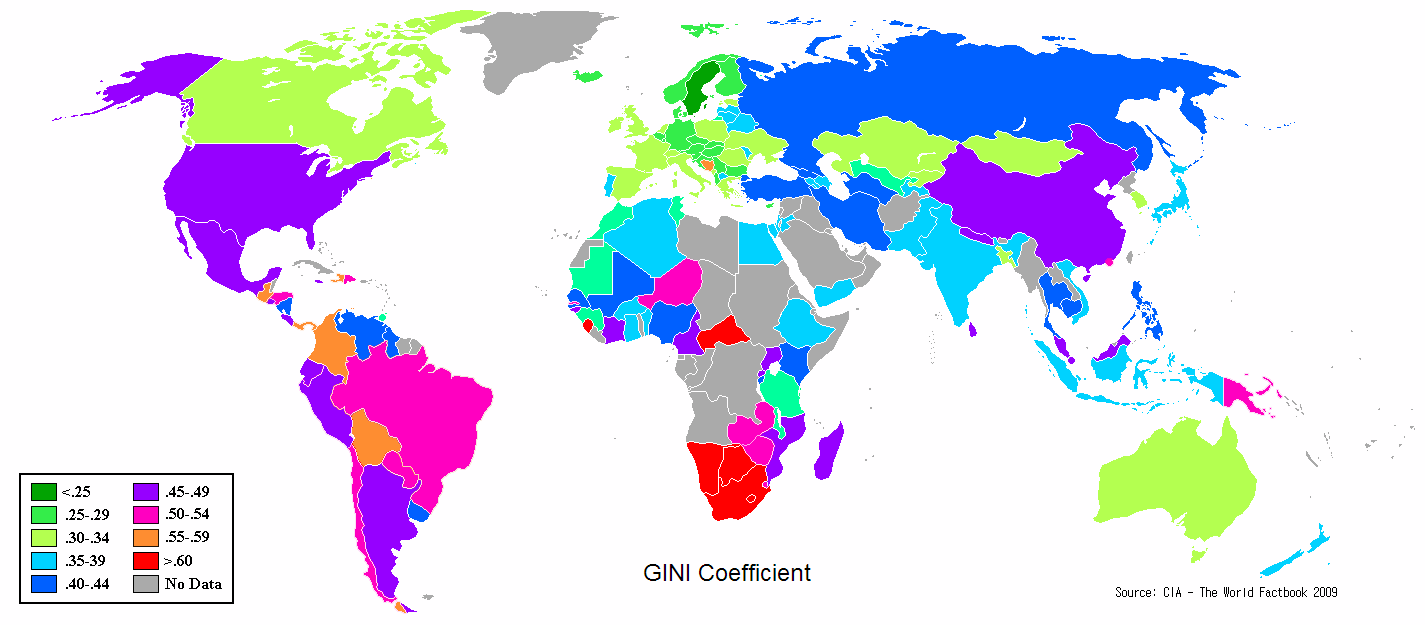
Via: Wikipedia the CIA World Report 2009 (the larger the Gigi coefficient, the greater the inequality)

Monday, March 7, 2011
Dynamic income distribution
Very cool configurable graphic based on Saez’ work that allows you to see which segments of income distribution gained or lost during various time periods. Briefly playing around with it, it appears that during periods of average income loss the distribution of losses is more equal than the typical distribution of income gains. Try it!
http://www.stateofworkingamerica.org/pages/interactive#/?start=2000&end=2008 from the Economic Policy Institute
Subscribe to:
Posts (Atom)