Showing posts with label forecast. Show all posts

Thursday, May 8, 2014

Interest rate reality check

There is a lot of talk about when “the Fed” is going to “raise rates.” Rates are actually determined mostly by supply and demand in the money market. Without getting into an academic fracas, I am going to present some graphs representing very strong empirical regularities that suggest interest rates, long or short, are not going up any time soon.

I’ve presented one of these before, the long term chart; here I’ve added the 3-month T-bill. These graphs show the relationship between interest rates and the ratio of the St. Louis monetary base to GDP. Data is to April or first quarter 2014. The ratio of base to GDP is ~0.23 currently.

image

image

Here is the trajectory of the base/GDP ratio. Can you spot the taper?

image

Here is the trajectory of base:

image

From these empirical regularities I draw the following conclusions:

  • Interest rates aren’t going up any time soon. The “taper” is really a reduction in the rate of addition to base, not a reduction of base.
  • Nor is inflation taking off any time soon, except for stagflationary cost-push. Negative real interest rates will continue. The labor market has no power; the reserve army of the unemployed (whether they are categorized as such or “not in the labor force”) is growing. There is no wherewithal for a wage-price spiral to get started.

This mirrors the experience of the Thirties. ZIRP in that period lasted until near the end of WWII. It took a war to get the inflation started. Federal debt exploded. But America had relatively less sovereign debt going into that war; we are already at comparable levels.

So people who suggest that the Fed “raise interest rates” are really asking the Fed to reduce the size of the monetary base a huge amount. There is no question the Fed would crash the stock market if they did this, purely because of the “optics,” so it won’t happen. Moreover, if the Fed sent all those bad debts back into the banking system they’d be subject to “stress testing” (heaven forbid they were actually marked to market) that I somehow doubt the Fed does on the stuff they hold. (Comment if you know better than I, please.)

Plutocracy World, the Global Casino, rocks on for years to come. The banking system hangs like an albatross around the neck of the world economy. China seems to be making the same mistakes; it will be interesting to see what they do with all their bad debt.

The great economic task of the first half of the twenty-first century will be to reform the world’s monetary system.

Tuesday, August 31, 2010

Scenarios for the future from the Rockefeller Foundation

Actually sort of interesting, although they carefully ignore the problem of concentration of wealth and power (although it is implied; see below).

Via:  Scenarios for the future of technology and international development


image

The scenarios are driven along orthogonal dimensions of “political and economic alignment” and “adaptaive capacity.”  If you believe as many do that extreme inequality leads to social rupture, then we will be somewhere in the bottom half of this matrix, in Hack Attack or Smart Scramble.  For example, many on Tea Party right simply want to get a Congress that won’t bail out California (or any other state).

Thursday, September 10, 2009

‘Bout halfway down

Via:  thoughtofferings.com  h/t zero hedge 

Warning:  This is research, not investment advice.  You invest at your own risk. 

image

Saturday, August 8, 2009

No double-dip recession in sight, risk premia falling

To continue the “animal spirits” update:

There is no double-dip recession in sight.  There is a natural pulse to the economy, and it is stabilizing.  The damage done to effective demand is huge, however, and there is a chance that the natural pulse has been stopped.  However, without an inversion of the yield curve a further pronounced downturn is exceedingly unlikely.  The yield curve was inverted in 1928-1929 and before every postwar slump (and there never failed to be a slump after an inversion; if anyone can provide me with Treasury yield curve data for the 1920s and 1930s I would appreciate it).  Also, before every postwar recession the unemployment rate has risen toward its adaptation level and crossed it almost exactly at the onset of the recession.  Currently, the “animal spirits” variable is forecast to rise even with rising unemployment.  Here is the recession “probability” for the coming year:

image 

As I have been forecasting all year, the RP = Baa – Aaa risk premium has fallen sharply in the past month, so this trade has worked out nicely.  This is research, however, not investment advice.  Risk premia may fall more slowly for several years, until the next slump.

image

From my perspective, the two things that will signal the next collapse will be an inversion of the 1/10 Treasury yield curve, and the unemployment rate rising toward its adaptation level from below.  Currently the adaptation level is 6.1 while the print unemployment rate is 9.4.  This process is forecast to take several years.  See the last “animal spirits” update for details.

Friday, August 7, 2009

Will rising “animal spirits” lead to ruin?

With the decline in the unemployment rate this morning, “animal spirits” improved.  We should see improvement in the Michigan Consumer Sentiment Index going forward, although it has slipped a bit recently.  There is noise in all economic series.

Click on chart for larger image in new window.

image

Even with unemployment climbing to about 11 percent over the next year, confidence will improve until the A metric (reference) actually becomes positive in time for the election, barring a currency crisis or other catastrophe in the meanwhile.  Confidence is one of the primary drivers of the business cycle.  However, given the double-whammy to consumption I noted yesterday from falling wages and salaries and increased saving, and the collapse of investment demand, growth is likely to be very, very slow.

This is bad news, in my view, as it affords the opportunity for the fiscal and monetary authorities to continue to pile up debt on the backs of American taxpayers.  Bernanke and Geithner will continue to bail out the bad debts of some big banks at taxpayer expense, and Congress will continue to rack up world-war-like deficits.

America can not service the debt load it has now.  Credit market debt is about 375 percent of GDP, higher than it was in 1929 according to reliable estimates.  Consumer and business debt is charging off at high rates likely to get worse.  As government crowds out private borrowing, private defaults can be expected to rise even more.  Since a lot of bad private debt of Wall Street firms is being converted into “good,” “risk-free” U.S. Treasury debt, this amounts to a continuation of the greatest expropriation of the ordinary Americans by the rich interests in American history.  Almost none of the high-rolling Wall Street speculators or their institutions have paid any price whatsoever for their trillions of dollars of bad bets.  (There was Lehman, but that was personal, Hank Paulson’s pet revenge project.)  At some point, demand for the dollar will collapse and rising import prices will drive the standard of living of the average American down even further.

We are watching an empire self-destruct in slow motion.  At the end of this process America will truly be a banana republic, with income and wealth inequality far worse than they are now, a hollowed-out state.  As McKinsey notes in a recent study, the human capital of the American labor force is subpar.  How will we climb back out?  The rich are free to invest their money anywhere in the world.

Only a radical reordering of American priorities in the next couple of years will prevent this.  There is no one who believes the Bush-Obama deficits projected over the next ten years are sustainable.  Ron Paul is the only elected politician who is addressing the scope of the change needed.  Everyone else appears to be playing politics as usual, acting as servants to the rich.  Even a five percent surtax on incomes over $1 million to provide health coverage to the poor has been fought tooth-and-nail by our greedy over-class.  The rich in this country have lost all sense of fiscal fairness in the worst crisis in three generations.  Ron Paul is the only politician of any standing who correctly diagnoses the problem, imperial over-reach inevitably leading to ruin.  As a physician, he has even moderated his libertarian positions to support government-sponsored health insurance for the poor, paid for by ending our futile wars.  I would add to that livable workfare for the unemployed to see them through the crisis, which is likely to last a decade or more.

Finally, is the unemployment report real?  Many would say not.  See TrimTabs’ research (here and here) and ShadowStats.  The Labor Department itself shows a decrease in the labor force of over four million in this decade.  Do you believe none of these folks want jobs?  All they have to do, reputedly, is to stop looking for a month and they’re out of the labor force.  The employment-to-population ratio is dropping sharply.  The government is aware of the psychological impact of the unemployment rate number so they manipulate it to keep it down.  The true unemployment rate is already in the teens.  A growing awareness of this reality may undercut the forecasted rise in confidence levels.

Click on chart for larger image in new window.

image

Friday, June 5, 2009

‘Animal spirits’ update and stock market outlook

The confidence levels or “animal spirits” of Americans continued to increase in May as forecast as Americans became more adapted to the new realities of the labor market.  The increase was confirmed by the Michigan Consumer Sentiment Index, a survey measure.

image

Our estimate of confidence levels is given by

                                              A = - (U – UMEAN)/Stdev(U)

where U is the unemployment rate, UMEAN is an exponential moving average over the past 4 years, and Stdev(U) is a moving standard deviation over the same period.  The forecast for rising '”animal spirits” (in blue above) is based the following conservative unemployment rate forecast:
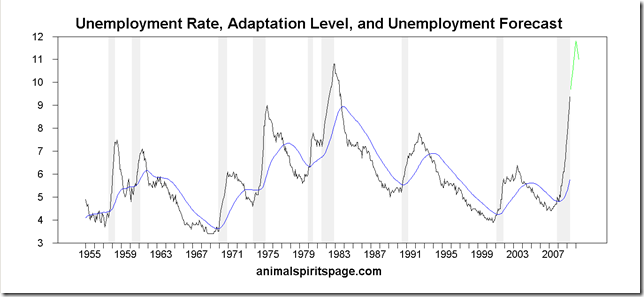
image

“Animal spirits” are still literally “negative” as unemployment is above its adaptation level.  In addition to their manifest financial losses of wealth, Americans have suffered a loss of psychological “wealth” in their confidence levels.  If “animal spirits” follow a track similar to recent 8-10 year-long cycles, they will go positive in second half 2010, peak in about 2013, with the next recession in about 2017.  We don’t think the cycle will last that long, but our forecasts don’t try to go out more than a year; and there is no “recession,” in the historical NBER sense, in the next year:

image

We expect the economy to at least stabilize and exhibit nonnegative growth.  The opposing forces of debt deflation and simultaneous massive monetary and fiscal stimuli cloud the picture of growth rate, which we don’t forecast in any event.  Note that the unemployment rate rose following the last two recessions, as we expect this time.

What are the implications for the stock market?  As pointed out here, the recent upturn of the granddaddy of long-term momentum oscillators in May comes after the first false signal in the postwar period in 2001-2002; and with the P/E on the S&P 500 over 100, and given the ferocity of the recent run-up and seasonal weakness going into summer, we side with Peter Eliades’ expectation of a pull-back in the near term.  However, “animal spirits” are rising, there’s lots of money still on the sidelines, and we know from prospect theory that people have a tendency to gamble when they feel they’re losing—so a blow-off is possible.  Be careful!

image

Is this investing?  NO!  This is gambling and speculation on the national level, aided and abetted by the clowns who are making up policy as they go along (they’re riverboat gamblers all in Washington D.C.).  Whether the market goes straight up, pulls back for a retest of the lows and then goes up—or the Coppock curve signal is false, and the market waffles while going to new lows—the surest bet would seem to be on volatility. 

Personally, we are waiting for single digit P/Es on the S&P, but even that may not happen in this strange environment.  As Marc Faber says, the Dow could go 50,000 in a hyperinflation while losing value against every other currency or commodity in the world.  We expect that as CPI inflation rises north of Fed targets and above 3 percent, short rates will have to adjust, and the consequent flattening of the yield curve will spell the beginning of the end.  But this could be several years away.  If the next downturn takes us all the way into depression, as we expect, single digit P/Es should be on offer.  Conservative investors will wait for that buy point.

This is research, not investment advice.  You invest at your own risk.

Conclusion

Our judgmental view is for the economy to enter into a full-blown depression over the next five or so years (see this and references).  This will occur after the cyclical expansion we appear to be entering, which we expect to be weak because of debt overhang.  Our judgmental view is informed by historical patterns of what happens to nations who acquire too much debt while the income and wealth distributions become highly unequal:  effective demand collapses because most households simply don’t have enough money to keep the circular flow going at a healthy rate.  The money largely gets diverted to rich households that don’t spend as high a proportion of income; and who today are probably more likely to send their savings abroad for investment in the high-growth, non-dollar economies of the world, reducing funding for American capital formation.  Most Americans probably have some understanding of this at a gut level and are saving more and moving into a generally more precautionary mindset as a result.  But the national propensity for risk-taking has always been high.  Americans are a bunch of self-selected risk takers.  We may witness a national “doubling-down” in the near term as folks try to make themselves whole in the stock market.  Moreover, our relatively robust economic health internationally may fuel yet another dollar rally and inflows into American paper assets. 

jmotb060409image001

Ultimately, we expect the entire Bretton Woods system to go supernova, with a burst of worldwide inflation that will make paper assets anywhere of limited investment value.  This will be the result of the “globally coordinated policy response” resulting from the Panic of 2008.  A new monetary system will be called for. 

Optimally the current upturn in “animal spirits” might facilitate an honest reappraisal of the state of the nation and a truly grassroots democratic (small “d”) demand for reform, beginning with an audit of the Fed and a reappraisal of the fairness of the payroll and personal income tax system.  Barring significant reform, Americans should be prepared for even rougher times in the next slump.  Put your house in order!

Wednesday, June 3, 2009

The fate of nations (graphs to contemplate)

Click on graphs for larger image in new window.

 taxesgdp

Sometimes it helps to look at larger patterns from an almost biological perspective.  Note that economic growth accelerates as the tax burden rises over the past 80 years.  We are now in the negative-sum phase in which—following our hypothesis of a broken social contract—the rich classes that control the country manipulate the system (taxes and otherwise) to their advantage.  For reference here are the top marginal tax rates over the same period.

image

Source: Matt Yglesias

And here is Emmanual Saez’s awesome chart of the income distribution.


The forecast is for more bitter fighting over a dwindling pie until growth stalls completely in about five years.  That is when the real crisis begins. 

In the meanwhile the allocation of economic pain will reveal the usually hidden pecking order of American society:  bankers (except some investment bankers, but that was personal) feel no pain, but auto workers do; women and children are some of the first to lose benefits in California; and so on.  In this sense President Obama’s time in office resembles the Hurricane Katrina experience, in which so much of the underbelly of American society was exposed.  

With his focus on maintaining the status quo, the President does not seem to understand the basic problem.  Or perhaps he realizes he is powerless to change it.  It would be nice to see the stimulus reconfigured to concentrate on helping people in dire straits with health care and livable workfare to get them through the crisis. 

So if you think we’ve seen a long-term bottom in the stock market, you’ve got another think coming.  This is research, not investment advice.  You invest at your own risk.

Reference: 
The Animal Spirits Page: Income inequality, debt, crisis and depressions (3 June 2009) http://animalspiritspage.blogspot.com/2009/05/income-inequality-debt-crisis-and.html

Thursday, May 28, 2009

Slope of yield curve and growth

With all the hoopla about rising Treasury yields, it is worth remembering that the slope of the yield curve has been a pretty good predictor of future real growth.  Click on graph for larger image.

image

Growth might accelerate into 2011 and then level off or decline.  If “inflation” of the traditional wage-price variety accelerates, while not likely given the state of the labor market, that would pose a danger in that the Fed would presumably have to tighten to control it.  (The Fed doesn’t tighten to control asset inflations.)  The current steepening of the yield curve is entirely consistent with our last “animal spirits” update forecast of “no recession [in the NBER sense] in sight”; the next update comes in June after the May unemployment release.  Real growth will accelerate to maybe 2 percent.

The higher yields at the long end and increasing risk aversion among foreign debt buyers (but not the Fed!) should push Treasury sales further into the short end, so short run, Treasury wins, perhaps.  But if there are indications of accelerating inflation at all, a classical rush to the short end and inversion of the yield curve might presage Obama becoming a one-term president.  Hence, it is in the Democrats’ interest, regardless of their rhetoric, to keep the labor market down.  The President’s continuing appeasement of the ruling class would seem to guarantee this; he hasn’t breathed a word about doing away with George Bush’s tax cuts for the rich in ages (see this for my take on the big picture, if you haven’t already).  So much for shared sacrifice.

At some point either the labor market will kick back and inflation happen, or the economy will implode again as bad debts transferred onto the taxpayers’ tab cause demand to fail—the dollar will collapse—and foreign investors will demand even higher rates.  If the current social contract remains in place, this will be the coup de grace for the American middle class—there won’t be one anymore.  There will be a rich elite (the top ten percent of Americans now take half of all national income) and a captive working class, still better off than the poor in the less developed countries, but without access to the educational opportunities and social connections required to jump to the upper class except in rare instances.  The rich will grumble about paying the lion’s share of taxes, as they do now, while taking a pig’s share of all income.

Hence, we stick to our adherence to the Strauss and Howe hypothesis of a renegotiation of the American social contract culminating in a massive crisis over the next dozen years or so (see this and this).

Thursday, May 14, 2009

Ben’s first bubble

It is now clear, by our “animal spirits” lights and the granddaddy of all long-term momentum oscillators (see last two posts), that as it concerns Depression II, history is going to repeat as farce.

You cannot have the degree of simultaneous stimulation from monetary and fiscal policy that we have now without it hitting something, sooner of later.  As we sagely commented yesterday, it would appear that Ben’s First Bubble will be in the stock market.

This follows in the Greenspan (modern Fed chief model) tradition.  Old Alan the Appeaser’s first bubble was in the stock market.  As his first official act, Greenspan blew the Stock Market Bubble of 1987 that appears so like a mini-bubble to modern eyes, so quaint and harmless and quickly reflated.  Since the Crash of 1987 occurred at a time of very high, actually peaking, “animal spirits,” (see this) in our view the fabled Plunge Protection Team was entirely unnecessary—but what the hell, Arch, when you got an opportunity to blow up a bubble, you blow.  We’ve had bubbles in stocks, housing and commodities just in this decade.

So here is our view:  A tsunami of liquidity is going hit the stock market in a few months.  Why not housing?  Once burned, twice shy, plus they’ve tightened credit so ordinary folks can’t play the leverage game the rich can play, and the securitization markets are dead and the banks won’t book the trash.  Just when we beginning to have fun!  Why not consumer goods—good old-fashioned inflation?  Too much labor market fear and slack, dummy!  People are taking pay cuts, for crying out loud!  Sure, we’re starting to see stagflationary increases in commodities, like food and energy, but they don’t count, stupid!  They’re not core [inflation]!  Why not commodities?  We’ve got supertankers sitting off Singapore harbor inventorying oil, that’s why!  Glut glut glut!  So what does that leave?  The stock market!

Now, I feel the pain of the investment bankers who’ve lost their world as much as the next guy (not much), but there’s still Goldman and Morgan Stanley, and I know that other at-liberty IBs are joining hedge funds.  Yes, the big money folks are applying their blades to their whetstones in anticipation of extracting further wealth from the American economy.  At some point someone’s going to make a killing shorting the American dollar (not anytime soon, in our view) while blaming the entire thing on the American government.

We urge President Obama and the Congress to consider addressing the needs for food, shelter and health care for the American people, because the next crisis is going to be worse than this one, and you, Mr. President, and your bought-and-paid-for Congress, bless your hearts, do not have the power to stop the big money vandals from gutting our economy again.  And how about raising marginal tax rates on incomes over $1 million to 90 percent to bring these people down to earth?  What do they think they are, gods?  This is getting old.

We hope to be proven wrong. 

Peace.

Wednesday, May 13, 2009

The granddaddy of momentum oscillators

The Coppock indicator is the granddaddy of long-term momentum oscillators.  When it turns up from a negative reading, the stock market usually enters a bull market.  The one false signal in the postwar period was given in this decade, in 2002, but after a stutter, the market recovered and was higher three years later than at the time of the false signal.  The Coppock indicator is at its lowest level of the postwar period, but has not turned up yet.  Given the strength of the recent run-up, I’d kind of expect a stutter-step before we get Ben’s First Bubble continuing in the stock market.  The Coppock curve is below, gratis.  This is another indicator of pent-up yin-yang. Let the panic buying begin!  Just remember:  bulls make money, bears make money, pigs get slaughtered in the next down leg to new lows.

Click to enlarge.  This is research, not investment advice.  Trade at your own risk.

image

‘Animal spirits’ in America and the stock market oscillator

Yesterday we introduced the “animal spirits” stock market oscillator that shocked us with its apparent prediction of a “real” bottom in the stock market.  (Remember that our models are literally models of emotion, not rational decision making.)  Today for your viewing pleasure we offer a graph of the consumer confidence measure together with the stock market oscillator.  What it shows is remarkable:  the current simultaneous apparent bottoming of the confidence indicator and the stock market oscillator is a fairly rare occurrence.  Since 1960 it happened only in 1970, 1974, 1982, 1990, and with the stock market bottom lagging the real economy bottom, in 2001-2002.

Click to enlarge.  This is research, not investment advice.  Invest at your own risk.

image

What would drive this rally?  Sheer liquidity, just like all the other rallies recently.  There are trillions of dollars on the sidelines.  Helicopter Ben is printing money like mad, and there’s a huge carry-trade opportunity for well-heeled borrowers.  If the market makes a massive head-and-shoulders top between now and 2011 or 2012, the next crash will probably be worse than this one—just as the 1973-1974 bear market was worse than the sharp 1970 bear, and was followed by the 1980-1982 double dip, recessions that quenched the ‘Sixties guns-and-butter inflation.  It will take several market crashes and failures of effective demand to wring the bad debt out of the system.  Activist macroeconomic policy, thy name is Volatility.

The current situation is that Americans are tired of being down (“been down so long it looks like up to me”) and their “animal spirits” are rebounding.  This rally is a dangerous bear market rally with the ultimate bottom still years away.  Our long-term view is that we Americans are going further down and must confront and defeat our deepest demons of greedy national identity to emerge safely.

So the next inflation, it seems, will be an asset inflation (“Ladies and gentlemen, place your bets”), a super-suckers’ rally that will probably end up transferring wealth from working people to Wall Street, contributing to the expropriation of the assets of working Americans in the monetary shell game run by the Fed, and leading to the critical distributional inequities that we believe will precipitate the next great American crisis.

Monday, May 11, 2009

‘Animal spirits’ update, May 11, 2009

Even if the unemployment rate goes to 11.9 percent over the coming year, the “animal spirits” or confidence levels of Americans are forecast to improve.  The bottoming of confidence levels is also seen in the Michigan Consumer Sentiment series.

image

Our yield-curve-plus-“animal spirits” recession forecasting model shows the recession coming to an end (keep in mind that this model has correctly predicted in real time the beginning and end of the last recession and the onset of this one, and performs similarly on every recession since 1957 in backtesting).  The “probability” of negative real growth continuing is nil by these lights.

image

Note that the model does not foresee a “double dip” within the next 12 months, while it clearly signaled the 1982 relapse.  The very severity of the declines of many output variables makes it more likely that they will be able to find a bottom.

image

More detail on the model is available here.

Discussion:  It is very common at the extreme points of economic and stock market cycles to assert that “it is different this time.”  The recession forecasting model is a single equation model with parameters estimated on data available before 1990, so for its parameters to change the world would in fact need to be very different in this cycle.  That is possible, and we shall soon have the answer.  What distinguishes this cycle is its global debt-deflationary aspect, which has exacerbated the downturn everywhere.  Countering this, however, is the stated and demonstrated willingness of monetary authorities to provide credit.  Commercial and industrial lending slowed after the last two recessions (as I showed here) as businesses and lenders alike become more risk averse.  Given the debt load on consumers, businesses and government, the recovery can be expected to be slow.  Much of the “real” GDP growth of this decade was financed by a huge and unsustainable run-up in consumer debt, so the country appears to be dropping back to a “pay-go” level of consumer spending (as they say within the Beltway) with some saving.

My personal opinion on the financial sector:  the lunatics are running the asylum in Washington.  Perhaps because he isn’t a financial person, President Obama brought on board the very actors who opened the Pandora’s box of deregulation, Larry Summers and Tim Geithner.  The greatest danger now is that the government throws more good taxpayer money after bad private debts; I subscribe to the IMF view that America is close to a tipping point of debt-deflationary implosion with respect to government spending.  It is better to do nothing than to bail out more banks.  There are plenty of healthy banks that can meet needs of business as recovery unfolds.  It is clear that the big money institutions control this administration, and the people are up in arms about throwing good money after bad, so Congress is letting it all happen under the table, through the Fed and the FDIC.  The problem with activist cries like Paul Krugman’s to clean up the mess is who would be doing the clean up.  Bad private debts need to charge off, not be added to the public debt at par or something close to it, and private investors need to take the hit.  It is these very same private investors who “own” Congress, however.

Long term, it is my surmise that the inequality of the income distribution will continue to cause “failures of effective demand” like the current one.  (See this.)  A disproportionate amount of money gets sucked out of the economy by the rich, who control the financial system, manipulate the markets, and tell the government what to do.  In a society in which personal assets are required for access to education and opportunity, the majority of the population can be kept in a pseudo-meritocratic servitude.  Already one third of American students do not complete high school, a characteristic of a feudal society or a banana republic.  Nothing President Obama is doing will reverse this, in my opinion; nor will anything less than a total breakdown and renegotiation of the social contract make fundamental change possible.  The rich have their hooks too far into the economy and the government for that to happen.  Hence I subscribe to the thesis of Strauss and Howe that we’re heading toward a national crisis in about ten years that will define a new America, with a new social contract.  The present one is broken.  (See here and here for background on Strauss and Howe’s historical long wave theory.)  In the meanwhile, over the next decade we can expect to see failures of effective demand like the one we’re in now, over and over again, until we reach the crisis point.

Wednesday, April 29, 2009

Investment and “animal spirits”

Calculated risk has a nice treatment of The Investment Slump.  We have found that investment as a percentage of GDP tracks very closely with our “animal spirits” measure.  Now, even we are having a little trouble believing our own model’s forecast of a bottom in second quarter, but hope springs eternal.  Anyway, here’s what the history looks like:

The next “animal spirits” forecast will be published after the unemployment rate comes out.  We can only hope that the upticks seen recently in consumer confidence (as we forecast) signal that our forecast of a major turning point in the economy is accurate. 

Monday, April 27, 2009

The business cycle to come

  • Quarterly outlook – Hoisington & Hunt  h/t Mish.  MV=PQ.  We all know the inflation from massive money creation will come, the question is when.  If it picks up before the next election, my guess is the Fed will get to determine whether we get hyperinflation and Obama (wait to tighten after the election), or recession and a return to the Republicans (tighten before the election, yield curve inverts, recession before election).  See also The Age of the Fiat Currency: A 38-year experiment in inflation on why gold and the dollar may fare well in the future.  (See yesterday’s post for why the dollar….)
  • Larry Summers’ New Model – Baseline Scenario.  Maybe if we support the zombie banks the economy will stay sluggish through the next election, and our team will win.

Whatever happens, it is likely that our forecasting model will see it from a year ahead (recent update).  Even though this recession is accompanied by a debt-deflation and a globally synchronized downturn, making it different from other recessions, it was forecast correctly (actually our model showed difficulties beginning in 2006).

However, if “animal spirits” do not improve measurably by the Michigan Sentiment index over the next several months, the implication is that the determinants of “animal spirits” have changed fundamentally.  Basically people will have been too shaken by volatility to get their mojo back.  Under normal circumstances (i.e., the last two recessions) even though unemployment continues to rise, “animal spirits” recover at the bottom of the business cycle, which we are still forecasting to occur in second quarter.

Saturday, April 11, 2009

Saturday stock market strategy

Via:  dshort.com

Every time the 10-year P/E on the S&P 500 has fallen from the first quintile to the fourth, it has ultimately continued to the fifth and bottomed in the single digits.

And recall that the current P/E of the S&P 500 on trailing earnings is ~100:

And don’t forget to review Zero Hedge’s comment on the current market.

This is research, not investment advice. Use at your own risk.

Tuesday, April 7, 2009

Industrial production bottoming?

Industrial production turning points track the animal spirits variable turning points closely, and as animal spirits are forecast to turn up, we are forecasting a turn in industrial production in about midyear (green is forecast).

image