Showing posts with label deflation. Show all posts

Thursday, May 8, 2014

Interest rate reality check

There is a lot of talk about when “the Fed” is going to “raise rates.” Rates are actually determined mostly by supply and demand in the money market. Without getting into an academic fracas, I am going to present some graphs representing very strong empirical regularities that suggest interest rates, long or short, are not going up any time soon.

I’ve presented one of these before, the long term chart; here I’ve added the 3-month T-bill. These graphs show the relationship between interest rates and the ratio of the St. Louis monetary base to GDP. Data is to April or first quarter 2014. The ratio of base to GDP is ~0.23 currently.

image

image

Here is the trajectory of the base/GDP ratio. Can you spot the taper?

image

Here is the trajectory of base:

image

From these empirical regularities I draw the following conclusions:

  • Interest rates aren’t going up any time soon. The “taper” is really a reduction in the rate of addition to base, not a reduction of base.
  • Nor is inflation taking off any time soon, except for stagflationary cost-push. Negative real interest rates will continue. The labor market has no power; the reserve army of the unemployed (whether they are categorized as such or “not in the labor force”) is growing. There is no wherewithal for a wage-price spiral to get started.

This mirrors the experience of the Thirties. ZIRP in that period lasted until near the end of WWII. It took a war to get the inflation started. Federal debt exploded. But America had relatively less sovereign debt going into that war; we are already at comparable levels.

So people who suggest that the Fed “raise interest rates” are really asking the Fed to reduce the size of the monetary base a huge amount. There is no question the Fed would crash the stock market if they did this, purely because of the “optics,” so it won’t happen. Moreover, if the Fed sent all those bad debts back into the banking system they’d be subject to “stress testing” (heaven forbid they were actually marked to market) that I somehow doubt the Fed does on the stuff they hold. (Comment if you know better than I, please.)

Plutocracy World, the Global Casino, rocks on for years to come. The banking system hangs like an albatross around the neck of the world economy. China seems to be making the same mistakes; it will be interesting to see what they do with all their bad debt.

The great economic task of the first half of the twenty-first century will be to reform the world’s monetary system.

Wednesday, March 26, 2014

After QE; Piketty and neo-feudalism

There is a lot of nonsense going around about interest rates going up post-QE. Following John Hussman's lead, in a recent post I showed the empirical regularity governing the relationship between central bank balance sheet as a percent of GDP and long-term interest rates proxied by the 10 year T-bond.

Recently Base/GDP has been about 0.22, so we are way out on the right end tail. It would take a reduction of the ratio of about 15 percent of GDP to begin to raise long rates, or about $2.6 trillion at current rates of GDP. The St. Louis base is currently at $3.7 trillion, and has been growing at over 20 percent a year since the last recession.
Now, "tapering" is a reduction in the rate of increase of additions to the base, not a reduction of the base. The chart looks to me like a very strong empirical regularity indeed. So the chance that long rates will rise anytime soon is remote in the extreme, as the Fed has no announced plans whatsoever to actually reduce the base.
Long rates will remain low and the bad debt clogging the banking system will remain impacted, that much seems assured for years to come.
What is a somewhat lower probability outcome is that the dump-the-dollar movement internationally gains sufficient momentum that the Fed has to buy up more and more (perhaps virtually all) new Government debt. This might be called the MMT-by-force-majeure outcome, as there is little chance that such additions to the Fed's balance sheet will ever go away.

In this latter case rates will not go up because of the empirical regularity shown above, but as the dollar falls on the foreign exchange markets due to weak demand to hold or trade in dollars, there will be import inflation domestically in the US. This will cause a further collapse of effective demand--already afflicting the bottom 80 percent or so of Americans--as real purchasing power of consumers is decimated. The US will become an even less attractive place to invest, and capital flight will occur. The US's status as a banana republic will be cemented.

This is the essence of the dreaded global currency reset: the dollar falls on international markets, import inflation slams domestic real demand, but neither short-term nor long-term interest rates rise (short rates exhibit a similar empirical regularity to that shown above). A domestic stagflation occurs. The Fed, ever the servant of Capital, will fight the inflation with modest rises in short rates (this can be done administratively in the short run) sufficient to beat any thought of asking for higher wages out of the heads of workers even though labor cost-push inflation exists only as a curiosity in economic history textbooks.
In the final chapter plutocrats of various "nationalities" (with allegiance to none) will divvy up Plantation America, keeping the best parts of it private, for themselves and their would-be-royal progeny.

Enter the Anti-Mainstream Economist

Certainly Thomas Piketty is the most important economist of the past 80 years, since the last Fourth Turning (Keynes got it that time). I highly recommend The New Yorker's review of his big book (here). A Frenchman, Picketty came to the US at 22 as a young economics superstar and to his great credit, became immediately disenchanted (disgusted is a better word, probably) with the status-quo-supporting mathematical fictions he encountered at MIT. (Disgust afflicted your correspondent upon entering economics at the graduate level in search of "science" after an undergraduate career studying literature.) Son of a leftist French couple, Piketty imbibed the Marxist notion of capital increasingly displacing labor leading to the reserve army of the unemployed and set out to study the issue of the distribution empirically, probably sensing that only real world data could displace the mathematical fictions of the self-congratulating, narcissistic mathematical economist-priests ruling policy in the West.

Piketty's concerns over where the world is going are as dire as mine. He is the Anti-Mainstream economist on the white horse that I thought could never possibly arrive. The New Yorker disappointingly pooh-poohs Piketty's suggestions that we need to raise taxes on the incomes and wealth of the plutocrats as politically infeasible. (But of course The New Yorker’s readership inhabits the status quo, so what else could they say?)
Democracy will have to be reborn to prevent a return to out-and-out feudalism.
It couldn't happen here, of course (although Piketty now has a stateside ally in fellow French-born Berkeley economist Emanuel Saez). Piketty turned tail after a couple of years in the US and returned to Paris, where he has remained since.

[Editor: spelling of Piketty's name corrected 3/27/2014]

Tuesday, July 2, 2013

When will the financial singularity occur? ~2020

Didier Sornette has some great stuff out now.  See his Ted talk and this white paper, “The Illusion of the Perpetual Money Machine,” in which he he pretty well demolishes the con game that the economics profession—slave to Wall Street—has been playing at the great expense of the people of the world.  I’ve written previously about the faster than exponential growth theory of singularities, financial and otherwise (see here).

image

The bad debt will be cleared.  Sornette indicates that his models show that the anticipated phase transition out of the growth era, originally forecast for 2030-2060 in his work with Johansen, has begun.

Andrew Jackson’s last words before dying were, “I killed the Bank!”

Where is our Andrew Jackson?

Monday, January 21, 2013

Where is the greener grass?

Assume that capital is mobile internationally, and it will seek the highest net rate of return. It is evident that consumption has been overweighted in the composition of American aggregate demand, because it was debt-funded. Increasing income and wealth inequality lower the average propensity to consume. Disposable income is being reduced by tax increases. Investment demand is largely derived from the demand for final goods, for which capital goods are used in production. With stable or decreasing final consumption demand, investment demand is largely put on hold. In this essentially deflationary situation, slack appears in labor and industrial markets. Capital sits on the sidelines, waiting to see what happens next, where the greener pastures may lie. Central bankers lower interest rates to the zero bound and sit around wishing and hoping for an inflation to get the debt under control. Sovereign governments, beholden to the banks, refuse to use the issuance of sovereign currency to put slack assets back to work. This is where we find ourselves.

The conventional wisdom, as given on personal finance websites and in corporate boardrooms, is to wait for the turn of the developing economies, and to put the money where the growth is. America is unattractive.

There is much damage being done to the world economy while playing this waiting game. One by one, developed economies are being sent into severe depression, for example, Portugal, Greece, Spain. These poor countries had unfortunately given away the right to manage their own currencies and were crushed by German creditors. The Japanese, under no such constraints, are gearing up to devalue their currency in an aggressive, mercantilist strategy. Can Brazil, Russia, and India be far behind? China is attempting to balance their domestic demand, and we wish them well. The United States has pushed its interest rates to zero but is frustrated by the status of its currency as the "risk-free" asset. The US has shown that it can blow asset bubbles but because it is intent on the continuing crucifixion of its labor class, it cannot get a sustained domestic inflation going. Pity the poor greenback.

The hidden shoals of the international financial system, the derivatives exposures so conveniently not on the banks' balance sheets, guarantee that the chances of international collapse of the deflationary type are still significant. At that point, should it arrive, some new form of money will almost certainly need to be created. The Fed buying up all Treasury issuance will not be enough.


Monday, January 14, 2013

Links worth clicking

A few from tyillc.com that hit the mark, from my POV:

John Hussman’s remarks on QE are especially trenchant this morning. 

I suspect a deflationary shock is in the cards.

Friday, January 11, 2013

Another comment on Modern Monetary Theory

I continue to believe that the attraction of MMT to modern liberals like Jamie Galbraith and Warren Mosler (I consider myself a classical liberal) is that something like the trillion dollar coin enables an end run around the fecally impacted banking system to get an inflation going, when the debt-deflationary forces in the private economy and banking system—in which, it is true to say, all money is debt—are overwhelming even Helicopter Ben’s attempts to get a nice, mild inflation going.

It might work, especially if accompanied by starting (or expanding) a significant war effort, but of course the fundamental problem is the Fed, especially since that great conservative Richard Nixon took us off the gold standard (he also opened the door for that gi

Source:  Rogoff via businessinsider.com

The fact an establishment economist like Rogoff could present such material at the annual economics meetings, and that Krugman and the White House won’t issue non-denial denials that they are taking this seriously, tells me that we are very close to the unraveling of the Bretton Woods II monetary system, and possibly to some fundamental change in the way the Fed operates.  There are rumors of a new monetary system in the works, and the way this is being sent out suggests to me it’s a trial balloon—so that they can come up with “the better idea.”

I just can’t imagine that the better idea will not involve some attempt to accelerate inflation, given the grip of the creditors on the sovereigns, and aggregate inability to clear bad debt out of the system.

Europe is showing the world what austerity looks like, and it ain’t pretty.

Tuesday, November 13, 2012

Throwing the baby out with the bathwater

Via. ft.com 

Richard Koo doesn’t address the problem of bad debts being carried in the banking system by “extend and pretend” or by having been bought by the Fed and subsequently disappearing into that black hole of unreported charge offs.  I have taken a fair use chunk of Koo’s article but encourage readers to read the whole thing. 

I have this inkling that because all the derivative bets are off the books, the capital class, those holding financial assets, is not really aware of the risks of a general deflation, and can only see the “problem” of fiscal spending supporting “deadbeats” (the 47 percent) who are dependent on the government for basic needs.  We shall see.

Explain the disease to help US citizens

By Richard Koo

In 2008, Barack Obama told the US people the nation’s economic crisis would take a long time to overcome. In 2012, many of those voters are losing patience, because they have not been told why this recession has lasted so long or why his policies were the correct response. Here is the missing explanation – based on not only the US experience, but also that of Japan and Europe.

Today, the US private sector is saving a staggering 8 per cent of gross domestic product – at zero interest rates, when households and businesses would ordinarily be borrowing and spending money. But the US is not alone: in Ireland and Japan, the private sector is saving 9 per cent of GDP; in Spain it is saving 7 per cent of GDP; and in the UK, 5 per cent. Interest rates are at record lows in all these countries.

This is the result of the bursting of debt-financed housing bubbles, which left the private sector with huge debt overhangs – notably the underwater mortgages – giving it no choice but to pay down debt or increase savings, even at zero interest rates.

However, if someone is saving money or paying down debt, someone else must be borrowing and spending that money to keep the economy going. In a normal world, it is the role of interest rates to ensure all saved funds are borrowed and spent, with interest rates rising when there are too many borrowers and falling when there are too few.

[continues here]

Wednesday, August 1, 2012

Pictures of monetary instability

Via:  FT

In line with my thesis that the coming years will feature a degree of monetary instability unprecedented in human history, beginning with ubiquitous negative real rates that are the scourge of banks….

Negative rates as a precursor to the death of banking

Posted by Izabella Kaminska on Jul 31 16:02.

FT Alphaville has presented its case on negative rates and zero deposit rates here andhere (amongst other places).

What we believe is that rather than stimulating the lending market — and the economy along with it — such a rate policy could have a disastrous impact on collateral markets and money market funds, not to mention the net interest income of lending institutions. All of which could unleash a protracted deflationary spiral.

The move could also presage the death of banks and lending institutions completely. […]

Check out the pictures of some major yield curves around the world:

UK:

Australia:

Switzerland:

If you buy the argument that central banks this far gone down the path of excessive accommodation lo this past forty years have only one option left to serve their masters, the fiscal authorities and the creditors, inflate or die, then keep in mind that historically, the quickest way to get an inflation going is to start a big war.

I am beginning to see why Charles Nenner says there is no free will—yet I retain hope that there is.

Tuesday, June 19, 2012

When ‘capitalism’ fails

Capitalism fails when capital, or the control of capital, as currently in our corporatist system, becomes too concentrated.

When the majority of real incomes are falling, aggregate demand fails.  Duh!  And when people have already borrowed too much, trying to keep up or make a quick buck like the rich folk do, increasing the monetary base and encouraging people to borrow more is a fool’s errand.

Private property is great, and encourages people to work, except when ownership becomes too concentrated, when they feel locked out.

For capitalism to survive, its leaders—the owner class—will have to adopt an ethos that, “For everyone to whom much is given, of him shall much shall be required.”

Otherwise the owner class invites revolution of one form or another. 

Before that happens their greed causes a massive deflation that may very well expropriate themselves (see Comstock’s excellent deflation overview, which inspired these comments).

Democracy exists to allow people to make laws to fix broken systems.

Our democracy is also now broken.

Lot of work to do.

Tuesday, March 27, 2012

The debt supernova [metaphor]

I have been reflecting on the metaphor I’ve been using for several years for the massive worldwide credit bubble and its debt-deflationary collapse—still in progress—and the ultimate final flaring of inflation that Bill Gross and I and many others expect.  Because what other way do inept governments have of getting out of having too much debt when their financial sector owners won’t charge bad debts off, to protect their investors?

Inflation, maybe a global hyperinflation.

In the physical version of a (Type I) supernova, a great star undergoes gravitational collapse in upon itself when its energy level falls below a certain point.  The analogue of this is the debt deflation, where credit creation equals nuclear fusion.  However, the release of gravitational potential energy can cause the collapsed star to heat up and expel its outer layers into the cosmos, sometimes leaving a black hole in the center.  The financial analogue of this process would be hyperinflation (stellar supernovas often create a burst of radiation that outshines an entire galaxy), as money is expelled from the financial center, a central bank and its minions, into the larger economy, losing value at every step.

My unapologetically intuitive read of the current situation is that we are still in the gravitational collapse phase. 

The bright white light of accelerating inflation—and many would say, war, though I hope and pray we avoid war—lies on the other side of the last stages of debt deflation.

The black hole or dwarf star left in the center corresponds to the dying ember of the former world economy held by the superrich, as they watch the receding supernova remnant, the refuse swept up by the supernova’s shock wave, flying off into the cold outer reaches of space.  That would be the rest of us.

But seriously, if every over-indebted nation’s central bank decides at the same time that the easiest and best thing to do about its debt is to inflate it away, the result will be something new under the sun, a kind of history none of us has ever lived through (to my knowledge):  total monetary instability.


Comments?

Monday, March 12, 2012

Reinhart on financial repression

Via:  www.bloomberg.com    This is a follow-up to my post on “how long can interest stay low” (or “how long are we ZIRP’ed?”).

As they have before in the aftermath of financial crises or wars, governments and central banks are increasingly resorting to a form of “taxation” that helps liquidate the huge overhang of public and private debt and eases the burden of servicing that debt.

Such policies, known as financial repression, usually involve a strong connection between the government, the central bank and the financial sector. In the U.S., as in Europe, at present, this means consistent negative real interest rates (yielding less than the rate of inflation) that are equivalent to a tax on bondholders and, more generally, savers.

Continues here.  It’s a must read. The extraction of wealth from the lower socioeconomic classes continues.  It was interesting to read Niall Ferguson in one of John Mauldin’s recent blasts saying he feared for America unless a total “reset” of the system takes place.  That I can agree with.

The problem is the distribution, not aggregate demand.  But you can’t expect a mainstream economist to agree to that.

Monday, October 17, 2011

Consumption going down

More Important than Historical Statistics--Private Debt Decline – Comstock

I’ve been saying for years that Consumption at 70% of GDP is unsustainable.  Comstock calls a double dip recession in the works, as Rosenberg does in last post, but the implications of Consumption falling back to its long-term average percent of GDP are secular, not cyclical. 

Wednesday, September 7, 2011

‘It’s the debt, stupid,’ redux

Watch for unprecedented manipulation of the unemployment rate, as the administration comes to terms with the fact it is the relationship of the unemployment rate to its adaptation level that is the strongest single determinant of confidence in the United States of America.  The general public, including unsophisticated investors and even types like yours truly with a Ph.D. in economics, distrust the stock market and look at any manufactured gains there as simply more evidence of the expropriation of the public by the kleptocracy.

We learned in macro thirty-five years ago that when effective demand collapses in the depression, increased monetary “stimulus” is like “pushing on a string”—the public and businesses don’t want to borrow in a collapsing economy.  The only lesson Bernanke seems to have taken from his studies of the Depression (and from his current crop of colleagues) is that banks can’t be permitted to lose any money.

Three links by sources I trust sum it up pretty well:

It's A Long Hard Road – www.contraryinvestor.com (may be in the archives after September 2011)

An Imminent Downturn: Whom Will Our Leaders Defend? – John Hussman.  Hussman has developed a robust logistic model on more than just the yield curve, something I would do if I were paid to to do.

‘Helicopter Ben’ risks destroying credit creation – Bill Gross.  An almost comical whine seemingly on behalf of the banks by Bill Gross, who points out that the proposed contortionist “Operation Twist” will not help the banks to create credit, of course missing the main point that in a multi-generational deflationary collapse of effective demand very few want to borrow except the carry trade operators who are having fun blowing bubbles right and left to sucker the poor forcibly “risk on” public in to parting with more of their money.

By the way, I may have been the first to coin the phrase, “It’s the debt, stupid,” but I welcome any contributions to substantiating that claim.  Here’s the earliest reference I can find on the site:


The Animal Spirits Page: It's the debt, stupid

Wednesday, August 10, 2011

Just to be perfectly clear

Another two or more years of ZIRP (zero interest rate policy) is a subsidy to banks carrying bad debt at inflated “extend and pretend” values permitted by today’s phony accounting.

The Fed is willing to bleed the rest of the American economy to subsidize the banks.

The “bad banks” will not “grow solvent” as a result of this policy.  The enormity of the bad debt is simply too great.

ZIRP hasn’t helped the economy yet, so why should it going forward? 

However, those who fear inflation in the intermediate term are premature.  Bad debts don’t get repaid, they only get papered over until their failure is so absolutely plain to see it can’t be covered up any more….  Deflation lies between now and the future Great Inflation.

Which is why we’re probably in for another round of “quantitative easing” in which the Fed buys bad debt from weak banks and hides it away where bad debts never see the light of day.

At this point, some of the Modern Monetary Theory solutions to our problems seem actually attractive.  Why shouldn’t the Fed write off (i.e., charge off, write down to a zero value) the U.S. Treasury debt it holds.  That’s not a default, it’s more like the kind of favor rich people do for each other (as when the board of a Colorado savings and loan “charged off” a $100,000 loan to a son of George H.W. Bush).

We’ve been here before.  The Fed pursued a ZIRP in the 1930s.  It didn’t end well.

image

See also the estimable Joseph Stiglitz’s four-part solution to our problems here.

Thursday, July 28, 2011

Competitive inflation or deflation?

It has been widely asserted that the only way for the Western world out of its debt problems is competitive inflation.  But it is hard to get an inflation going during a debt deflation.  If we are on the verge of a deflation, what will the competition involve?

Deflation is the reverse of inflation.  Therefore, if winning involved having the fastest inflation rate in competitive inflation, then the country with the slowest fall in prices should win, as, just like inflation, it will relatively reduce the value of its debt the best.

Europe stands a pretty good chance of deflation if the EU fails and debt loads collapse economies (see Simon Johnson’s analysis here).  Europe’s debt problems are worse than America’s.

And, as always in deflations, commodities fall, U.S. Treasury interest rates fall, risk premia rise, stocks fall, and the vastly neglected real economy tanks yet again.  More people lose their jobs, and more children go hungry in the emerging banana republics of the developed world.

Then a bigger war and the big inflation begin, if history rhymes.

Friday, April 1, 2011

No rate increase in sight

Dent’s unoriginal take is that housing will behave just like Japan’s did after peaking in 1990.  Prices won’t come back for a couple of decades.

If we get a major war in the next three years as Charles Nenner and Gerald Celente expect, we will have what I call “stagflationary deflation”:  sectoral supply-shock price increases that further squeeze nominally unchanging household budgets (at least for the bottom ninety percent).  Consumption at seventy percent of GDP is unsustainable, and what is taken out of consumption would be replaced with war spending.  Consumption would be effectively if not administratively rationed.

“Inflation is always and everywhere a labor market phenomenon accommodated by loose monetary policies.”

Tuesday, March 22, 2011

Links 3/22/2011

Obama is as much of a budget-buster as GWB, from whom he inherited the worst deficit in the nation’s history.  Washington is totally out of control.

My thoughts recently, watching disasters unfold on two sides of the world, have been toward historical parallels with the ‘Thirties.  If Washington decides to take the first steps toward restoring a landed aristocracy by further smashing labor, virtually precluding the higher education of any children but those of the rich, and slashing government budgets across the land—what will we do with the tens of millions of unemployed families that will fill our streets?  This is essentially the problem FDR faced in the ‘Thirties.  Acting in loco parentis as if the market had failed miserably (it had, due to unbalanced aggregate demand due to unbalanced income and wealth distributions, IMHO), he put people to work, mostly to give them hope, as his programs did not get the nation out of the Depression.  World War II equalized the income distribution as “the Pearl Harbor of the 21st Century” failed miserably to do, and set the stage for renewed growth….

image

(click chart to go to source)

What will America do in the deflationary collapse probably just over the horizon?

Tuesday, February 22, 2011

Inflation, hyperinflation or deflation next?

By the measure of final sales to domestic purchasers, domestic aggregate demand has not recovered to 2007 levels; the chart shows final sales to domestic purchasers deflated by the personal consumption expenditures deflator:

image

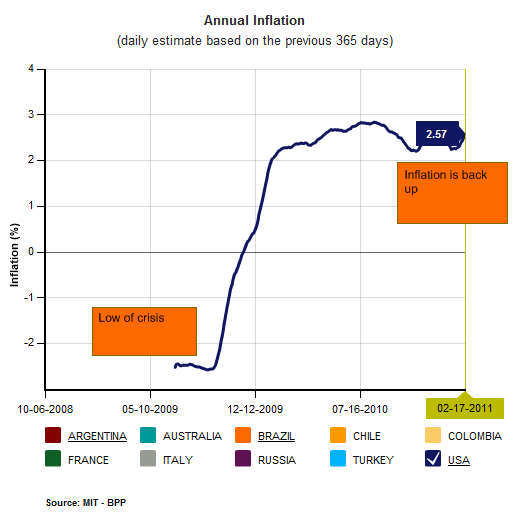
Inflation is running ahead of official estimates, according to credible sources cited here:

What happens next is deflationary stagflation: food and energy prices rise, consumer purchasing power takes a hit, and the constraints on the flow of income contribute to further declines in house prices and other consumable assets.

Overall, the intermediate term—debt deflation, asset price declines, exacerbated by supply shocks to items with relatively inelastic demand.

To get a real wage-price spiral going you have to actually pay people enough to cover inflation and then some, and right now the movement in the labor market is toward bashing labor whenever and wherever possible. This is Bernanke’s and every liberal economist’s wet dream, that we get to inflate our way out of our debt once again, just like the old days.

The difference this time is the debt mountain on our backs. When debts don’t get repaid—because of income insufficiency—asset values fall.

image

The wild card is war. Throughout history, wars have been associated with inflation, and with a larger role for government in the economy. The mainstream parties, Republican and Democrat, have supported all the recent wars slavishly. Only Ron Paul and the Tea Party oppose more war. Whether they really mean it is a mystery to me. There is a lot of unfortunate baggage that goes along with the Tea Party, but at this time, they are the only movement willing to take on the military-industrial complex and provide real change—for which the American public is hungry, as Obama demonstrated. Whether they could actually accomplish anything given the way Congress works is doubtful to me. It would take a sweeping repudiation of the mainstream parties, and the Tea Party so far seems to be traditional Republicanism in sheep’s clothing (financed by the Koch brothers, etc.).

The system is currently dysfunctional. We are entering a crisis episode in which new rules of the game will emerge, one way or another. I believe in peaceful protest. Egypt was inspiring in this regard.

Peace.


See also You Want Inflation? Here's How To Get It

Tuesday, February 1, 2011

Nearly 11 Percent of US Houses Empty

Via:  cnbc.com  That would be 18 million houses.  Slightly more than one per officially unemployed person.

By: Diana Olick

I usually find the quarterly homeowner vacancy and homeownership report from Census pretty lackluster, but the latest one released this morning was anything but.

America's home ownership rate, after holding steady for a while, took a pretty big plunge in Q4, from 66.9 percent to 66.5 percent. That's down from the 2004 peak of 69.2 percent and the lowest level since 1998.

Homeownership is falling at an alarming pace, despite the fact that home prices have fallen, affordability is much improved and inventories of new and existing homes are still running quite high.

Bargains abound, but few are interested or eligible to take advantage.

More concerning than the home ownership rate is the vacancy rate. The Census tables don't tell the entire story, but they tell a lot of it. Of the nearly 131 million housing units in this country, 112.5 million are occupied. 74.8 million are owned, and that's only dropped by about 30 thousand in the past year. 38 million are rented, but that's up by over a million year over year. That means more new households are choosing to rent.

Now to vacancies. There were 18.4 million vacant homes in the U.S. in Q4 '10 (11 percent of all housing units vacant all year round), which is actually an improvement of 427,000 from a year ago, but not for the reasons you'd think.

The number of vacant homes for rent fell by 493 thousand, as rental demand rose. 471,000 homes are listed as "Held off Market" about half for temporary use, but the other half are likely foreclosures. And no, the shadow inventory isn't just 200,000, it's far higher than that.

  • Slideshow: 10 U.S. Cities Where Renting Beats Buying

    So think about it. Eleven percent of the houses in America are empty. This as builders start to get more bullish, and renting apartments becomes ever more popular. Vacancies in the apartment sector have been falling steadily and dramatically, why? Because we're still recovering emotionally from the toll of the housing crash.

    Younger Americans have seen what home ownership has done to their friends and families, and many want no part of it. Credit has become very nearly elitist. Home prices, whatever your particular data provider preference might be, are still falling.

  • Friday, December 3, 2010

    Animal spirits: collapse not imminent

    With the unemployment rate at 9.8 percent, confidence continues to chug upward in what I’m afraid will be a vain attempt to regain positive territory, speaking in terms of the relationship of the unemployment rate to adaptation level.  I continue to expect the next collapse of animal spirits—the defining characteristic of a recession—to occur in about 2013.  This assumes no significant improvement in the unemployment rate.  The hopeless political situation in the United States implies that no matter who wins the next presidential election, it will be considered a defeat by the people.  Continued debt defaults, banking problems and contractionary policy will probably be thrown into the mix.  Here are the charts:

    image

    For confidence to collapse in 2013 it is sufficient that unemployment begin trending up again, regardless of any (negligible) improvement between now and then.

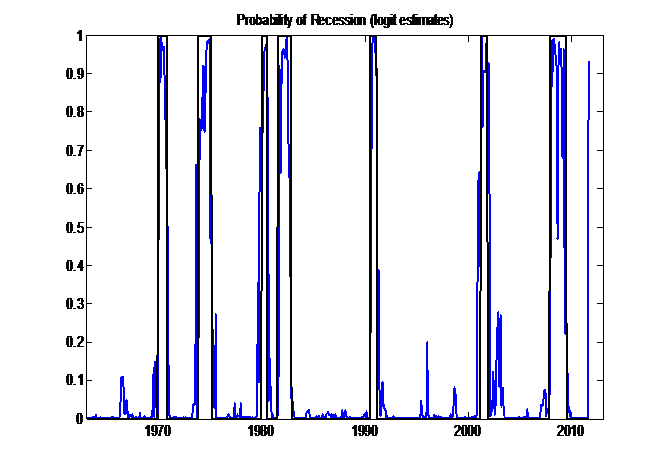
    The yield curve plus animal spirits recession probability forecasting model continues to show no hint of a collapse of confidence in the next year (the NYFRB’s model agrees):

    image

    I have written about effect of ZIRP, Zero Interest Rate Policy, on ability of the yield curve to forecast recession.  It may be true as John Hussman points out that it might be more difficult for the curve to invert, but there is no evidence that the relationship between short and long rates has fundamentally changed in magnitude.  If we see the 10-year yield in the neighborhood of one percent, watch out.  It would take only relatively mild pressure at the short end to tip things over (yes, I am expecting deflation of many asset classes in the intermediate term):

    image