Showing posts with label quantitative easing. Show all posts

Monday, January 14, 2013

Links worth clicking

A few from tyillc.com that hit the mark, from my POV:

John Hussman’s remarks on QE are especially trenchant this morning. 

I suspect a deflationary shock is in the cards.

Wednesday, September 26, 2012

QEternity demolished

Via:  What If the Fed Has It All Wrong 

Hard not to pile on when monetary policy has become such a joke, but here is a thorough demolition of QEternity that addresses where the heads of the consumer, the ruling elite, the central bankers, and the youth of the world are at, and it ain’t pretty.  The whole article is must reading.  From the concluding remarks:

While the Fed waits for the wealth effect to take effect, the European Central Bank is also waiting for its own Godot following Draghi's magic with the ECB rules and regulations. Super Mario's "whatever it takes" promise is powerful, but not without pitfalls:

  • When, if ever, will the Eurozone achieve the necessary banking and fiscal unions?
  • Will Spain and Italy surrender before it is too late?
  • Will ever more austerity finally work?
  • When will the debt spiral stop?
  • How much longer will the Germans put up with the situation, accepting that the ECB ruins its balance sheet taking unlimited risk on behalf of the German taxpayers, risking their fiscal sovereignty to save the "reckless Southerners"?
  • How much longer will the hordes of unemployed young Europeans put up with the situation?

Bankers have indeed delivered. In truth, however, they are merely experimenting with totally unproven ways and means, hoping to gain enough time until more responsible politicians emerge. Given the significant risk still facing us until Godot arrives, investors should await more evidence that either earnings resume their uptrend or some kind of miracle(s) happen.

Equity holdings should be trimmed to conservative levels. Sustainable income should be favored. Cash earns essentially nothing, but is safe for now. Gold remains attractive for many, many obvious reasons.

Tuesday, June 12, 2012

Kindleberger: cutting to the chase

Professors DeLong and Eichengreen have an oh-so-hagiographic foreword to a new edition of Kindleberger’s classic text, which I will admit to not having read.  However, as a believer that financial fundamentals matter, as much as politics, in a political economy, I find their worship and Kindleberger’s analysis strangely obtuse.  Kindleberger’s three main points about financial crises make no mention of leverage.

First, panic. Kindleberger argued that panic, defined as sudden overwhelming fear giving rise to extreme behaviour on the part of the affected, is intrinsic in the operation of financial markets.[…]

Kindleberger’s second key lesson, closely related, is the power of contagion.[…]

[T]he third positive alternative of international institutions with real authority and sovereignty is pressing.”

(source)

Well, doh!  We created a fiat monetary system that confers huge benefits of seigniorage on banks (just as MMT would do for governments) and one thing you can say about human primates is that, historically speaking, they’re as greedy and nasty as chimpanzees.  What group of humans given the ability to print money wouldn’t end up abusing the privilege?

Once the banks capture the regulators, leverage shoots up, and the potential for entirely rational panic, and rationally justifiable contagion, skyrocket. 

Only Acemoglu and Robinson get it, fundamentally.  Mainstream economics is still discussing mechanical models of the economy in the Newtonian mode.

There will be no economic recovery until there is political reform.  And that won’t happen as long as Citizens United vs. US stands as is.

The priests of the status quo always look to the pope for the solution….

As we write, the North Atlantic world appears to have fallen foul to his bad outcome (c), with extraordinary political dysfunction in the US preventing its government from acting as a benevolent hegemon, and the ruling mandarins of Europe, in Germany in particular, unwilling to step up and convince their voters that they must assume the task.

I love that—a “benevolent hegemon”!  If only I could believe that what they don’t mean by that is transferring more bad debt onto the backs of taxpayers, whether overtly or through monetary debasement, aka QE.

Sunday, April 8, 2012

Desperation behind the unemployment numbers

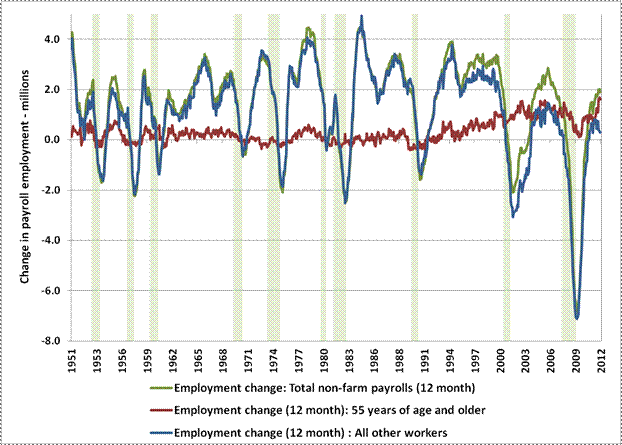
Via:  www.hussman.net

Beginning first with Alan Greenspan, and then with Ben Bernanke, the Fed has increasingly pursued policies of suppressing interest rates, even driving real interest rates to negative levels after inflation. Combine this with the bursting of two Fed-enabled (if not Fed-induced) bubbles - one in stocks and one in housing, and the over-55 cohort has suffered an assault on its financial security: a difficult trifecta that includes the loss of interest income, the loss of portfolio value, and the loss of home equity. All of these have combined to provoke a delay in retirement plans and a need for these individuals to re-enter the labor force.

In short, what we've observed in the employment figures is not recovery, but desperation. Having starved savers of interest income, and having repeatedly subjected investors to Fed-induced financial bubbles that create volatility without durable returns, the Fed has successfully provoked job growth of the obligatory, low-wage variety. Over the past year, the majority of this growth has been in the 55-and-over cohort, while growth has turned down among other workers. Meanwhile, overall labor force participation continues to fall as discouraged workers leave the labor force entirely, which is the primary reason the unemployment rate has declined. All of this reflects not health, but despair, and explains why real disposable income has grown by only 0.3% over the past year. […]

Regardless of the fact that QE has had no durable economic benefits […], and does little but to repeatedly lay fresh wallpaper over the rotting edifice that is the global banking system, the main effect of QE has been to provide temporary support for the most speculative corners of the financial market after they have been pummeled.

Monday, September 14, 2009

Real consumption spending to rise from the dead, briefly

Tim Duy offers some dyspeptic comments on confidence and consumption similar to my own a few days ago.  However, he (and the rest of mainstream economics) continue to ignore research (however obscure) indicating the adaptation level theoretic foundations of confidence determination (reference).  Duy’s nice graph of year-over-year real consumption spending against the University of Michigan sentiment series inspired a similar effort with the “animal spirits” indicator that shows that real consumption spending is about to enter a growth phase.  The contemporaneous correlation of YOY real C and “animal spirits” is about 0.63; the regression with constant has an adjusted R^2 of about 0.33.  But the “animal spirits” indicator has proven extremely sensitive to turning points and trends, more so than the Michigan series.

This is consistent with my general view that the U.S. economy is entering a relatively brief “anti-deflationary” reflationary bubble that will resemble an ordinary business cycle except for the elephant in the room, namely, a growing national debt-to-GDP ratio coming on top of record levels of the ratio.  If I had to bet on whether private sector deleveraging will outrun public sector leveraging, I would bet not.  Not enough private debt is being written off.  The U.S. has more debt than it can service now (see Comstock’s piece).  In 1933 we were the world’s greatest creditor and could borrow easily.  Today our currency is at risk of substantial depreciation.  Our social contract is broken, with extreme inequality in incomes and wealth and a general self-defeating distrust of government by the disenfranchised.  Our deflationary collapse has only stalled.  The tragedy is that the rising “animal spirits” of the next several years will probably guarantee that no meaningful reform takes place—of the financial sector, of the government’s priorities and budget, perhaps even of health care.  In this environment both fiscal stimulus and quantitative easing are fool’s games.  The government should provide health care and livable workfare to the unemployed and limit any increase in spending.  America is a basket case but the government won’t admit it. 

Real consumption should grow 2.0-2.5 percent over the coming year, and may accelerate to about 5 percent YOY growth over the next four years, before the next downturn.  Here’s the chart:

image

Forecasted “animal spirits” in blue, real YOY consumption percentage in red.

Saturday, August 22, 2009

Quantitative easing and fiscal stimulus are both fool’s games

Via:  Daily Finance

It is still the pathetic wet dream of neo-Keynesians and neo-conservatives alike that inflation is going to accomplish the debt jubilee that they think is going to “reflate” our deflationary economies.

PIMCO: Fed needs to 'be irresponsible' if deflation appears
Joseph LazzaroJoseph

To borrow a phrases from the late, great Jimi Hendrix, wrap your mind around this one: would you root for an "irresponsible" Fed?

PIMCO's Managing Director Paul McCulley is doing exactly that. McCulley, in a PIMCO commentary, said that, if the U.S. economic recovery does not begin as expected in Q3/Q4, the Federal Reserve should push inflation above its long-term target to encourage U.S. consumers to spend money.

"The way to make monetary policy effective is for the central bank to promise to be irresponsible," McCulley wrote, citing a 1998 paper written by Nobel Prize-winning Princeton University economist and New York Times (NYT) columnist Paul Krugman.

My primary objection to this line of thinking is that it ignores the primary cause of deflationary depressions, too much debt on a highly unequal income distribution.  Simply put, some people have too much money while everyone else has very little money and too much debt—not enough money to spend to keep the circular flow of income and product going, let alone service their debt.  This is where we are today.  America is a rich country compared to most others and compared to ourselves a generation ago—there’s plenty to go around, but since Reagan the game has been tilted toward capital and rich folks.

But what qualifies Krugman’s remarks as obtuse, in the sense of biting off his own nose to spite his face (and I apologize for getting wonky a bit here, it’s something I’ve sworn off of since leaving academic economics, but every once in a while fall back into) is that the Fed can’t at once be credible in its stated policies of monetary control and at the same time promise to be irresponsible by igniting inflation.  That is incredible, literally.

It’s the debt, stupid, and the income distribution, the fact that the game is rigged by social conventions accepted by—or imposed upon—folks up to now.  Bad debts don’t get repaid by reflation, the cash flow coverage on the loans was never right and won’t be made right by inflation.  And not to get wonkish again, but you introduce all kinds of inefficiencies into the economy when you cause uncertainty about relative prices—because as Hayek pointed out, he who raises his price first wins—and given the state of our social contract, that’s not likely to be the people who need help the most.

What to do?  Follow William Black’s example in the S&L crisis and bust bad bankers, close their banks, write off their crap, break up Goldman Sachs (bring back Glass Steagall—there’s no way Goldman should be getting free money from the Fed), and provide a livable workfare-style dole and health benefits to the unemployed, who are going to be with us for a while. 

Quantitative easing and fiscal stimulus are both fool’s games, blind to the true nature of the problem, the broken distribution.  Fiscal stimulus will be distributed as unequally as the banking bailouts were.  The social contract needs to be renegotiated.

Reference: Income inequality, debt, crisis and depressions

Thursday, July 16, 2009

What a fool believes: who pays for quantitative easing?

A couple of themes today centered on foolishness.

Only a fool could believe our unemployment insurance program is too generous, or could argue against the extension of benefits as the administration has done.  We need a livable dole for all the unemployed.

Via:  Matt Yglesias 

I really just wanted to reproduce this chart showing how relatively stingy unemployment benefits are in the United States:

unemployment-1


N.B.: more than half of unemployed Americans do not receive unemployment insurance payments.

Other references:

Receiving unemployment insurance increases likelihood of re-employment with health insurance – EPI.  Also produces better fit of job with worker skills.

Brookings paper cited by Yglesias – has a great set of charts. 

Here’s one that could be titled, “A fool believes insanely rising asset prices are real wealth”:

image

But what a fool believes he sees
No wise man has the power to reason away
What seems to be
Is always better than nothing
There’s nothing at all
But what a fool believes he sees...

--Michael McDonald, Kenny Loggins

First, the fool saw wealth in debt.  Now, the fool believes in “quantitative easing,” the Fed buying Treasury and other debt and monetizing it to support federal deficit spending by putting high-powered reserves into the banking system.  When the economy has more debt than it can handle, as evidenced now by high default rates and no credit growth and a sky-high debt/GDP ratio (below), this is a way of hiding the losses of the banking system.  Remember, the Fed has refused to tell us what the losses are on the trillions of dollars of debts it has taken from the banking system as assets (and from other types of institutions, what types we don’t know). When these “assets of the Fed” begin to charge off, the Fed should recognize losses and correspondingly reduce the reserves of the banks.  The risk of hyperinflation from quantitative easing is low when consumer and business credit growth is low or negative, as it is now, and high-powered money is eroding.

Via: Comstock Funds

image

But who makes up the losses to the Fed?  The assets were exchanged (say) dollar for dollar for high-powered reserves.  The reduction in the bank’s reserves is a high-powered money-multiplier event if deposit creation against the reserves has taken place.  If they are being held as excess reserves, no calls on loans need occur.  But has the bank recorded a loss as good accounting would require?  Can you see why the banks and other institutions who have unloaded assets on the Fed are nervous about a Congressional audit?  It’s no wonder the level of excess reserves is so high (below).  Will the losses on the Fed’s assets be added to the taxpayers’ burden?  This would just be another way of making the same mistake the feds have wanted since Hank Paulson, which is to make the banks whole by transferring (as near to) the face value of the banks’ bad debts onto the backs of the taxpayers.

Losses on the Fed’s “qualitative easing” (as Willem Buiter calls the taking in of less than Treasury grade assets) need to be properly sent back to the banking system and not borne by the taxpayer.  So far the Fed is still playing games, sweeping the problem under the carpet.

Audit the Fed.  Make the banks charge off bad debts, not put them onto the taxpayers’ backs.  A debt-deflation is assured otherwise.

image