Showing posts with label stimulus. Show all posts

Friday, May 11, 2012

Stimulus—for whom?

As I’ve been saying for years, any fiscal stimulus will go to the 1 percent:  “The American income distribution is like a Detroit V8 firing on one cylinder:  it doesn’t matter how much you step on the gas, only one cylinder going to fire” (source, March 2011). 

In the 2010 recovery, 93 percent of the gains were captured by the top 1 percent. That’s because top incomes grew 11.6 percent in 2010, while the incomes of the 99 percent increased only 0.2 percent. (source)

It when we know facts like this that Larry Summers’ obtuseness in recommending more debt and more fiscal stimulus becomes truly breathtaking.  Well, at least we know Jamie Dimon won’t be becoming Treasury secretary now, after his bank’s trading blooper.

The problem is the distribution, people.  Take away from the military industrial security complex and give to infrastructure workfare and education, and for Christ’s sake, raise taxes on the rich. And make the banks write down or charge off debts that won’t be repaid.

When things go wrong, people get mad, and when people get mad, they make mistakes.

I just watched Bill Moyers on public television.  He showed a bunch of people saying they are mad at corporations, that corporations are looting the common people.

But corporations are just a form of social organization that is very good at raising capital and producing goods and services.

It is the ruling class who are looting the common people, a ruling class of interlocking boards and CEOs and lobbyists and Congressmen and just plain greedy people who have forgotten to reward the people who are doing the work because they along with almost everyone else in America bought into the notion that greed is good and that it’s okay to take more than your share.  I want it all now.  It’s time for you to get into me.

The problem is the ruling class and the American social values that have until recently validated the behavior of our ruling class.  Greed has been good since Ronald Reagan’s presidency, approximately.  We let them get away with it.

The solution is to bring the people in the ruling class down to earth by raising marginal tax rates to at least 75 percent on income over one million dollars.  Take the fun out of expropriating the employees and shareholders of their corporations, let the rich bear their fair share of cleaning up the fiscal mess Wall Street created (whether they’re on Wall Street or not).

If they want to take their money out of the country, they probably can, but the IRS is making it more and more difficult.  If they want to leave, let them go, it’s still a free country, relatively speaking.

The Tea Party movement and the Republican party are sucker’s games, talking about getting government off people’s backs, when all they’re really talking about is protecting the highly unequal status quo and keeping taxes low for rich people. […]  (source)

Tuesday, November 22, 2011

Bernanke serves his Wall Street masters

The Top 0.1% Of The Nation Earn Half Of All Capital Gains – Forbes

Capital gains are the key ingredient of income disparity in the US-- and the force behind the winner takes all mantra of our economic system. If you want  even out earning power in the U.S, you have to raise the 15% capital gains tax.

Income and wealth disparities  become even more  absurd  if we look at the top 0.1% of the nation's earners-- rather than the more common 1%. The top 0.1%--  about 315,000 individuals out of 315 million--  are making about half of all capital gains on the sale of shares or property after 1 year; and these capital gains make up 60% of the income made by the Forbes 400.

It's crystal clear that the Bush  tax reduction on capital gains and dividend income in 2003 was the cutting edge policy that has created the immense increase in  net worth of corporate executives, Wall St. professionals  and other entrepreneurs.

Bernanke Speech Moves Markets: No New Stimulus – ABC News

The effectiveness of first two QEs has been questioned. Critics acknowledge that easing has brought temporary benefits, but they argue those have accrued primarily to the stock market. They question whether flooding the markets with yet more cheap money is a good thing for the economy long-term.

Just so that it’s perfectly clear what’s going on.  The country’s markets are being looted by the central bank to benefit of the ruling class.  I personally, while supposedly a “sophisticated investor,” am terrified of our totally rigged and corrupt stock market.

Have a good day.

Saturday, July 10, 2010

Links 7/10

I am back from visiting a friend who is a top 1-percenter in the Boston-Washington corridor, so I am chockerblot with dismay at the Pollyanna Obama-boosterism of those riding on the Stimulus Gravy Train.  It really took me aback to be asked to contribute to groceries by someone with two homes, including a vacation home on a beautiful island in Maine and annual compensation close to half a million dollars.  The greed and unawareness of how everyone else lives of the top 1 percent is simply astounding.

Saturday, January 9, 2010

Reinhart & Rogoff score again

They are out with a new paper, good solid descriptive statistics of what has happened in the past when countries have gotten into a debt position like the US is in now. Here’s a link to the paper:

“Growth in a Time of Debt”

T or F: Debt-financed fiscal stimulus will create faster than average growth in this situation.

Bonus question: Future credit crises are (more) (less) likely given the government’s current tack.

zerohedge.com has a summary here. The WSJ’s comment:

In a new paper presented Monday at the annual meeting of the American Economic Association, Carmen Reinhart of the University of Maryland and Kenneth Rogoff of Harvard study the link between different levels of debt and countries’ economic growth over the last two centuries. One finding: Countries with a gross public debt exceeding about 90% of annual economic output tended to grow a lot more slowly. For advanced countries above the 90% threshold, average annual growth was about two percentage points lower than for countries with public debt of less than 30% of GDP.

The results are particularly relevant at a time when debt levels in the U.S. and other countries at the center of the financial crisis are rapidly approaching the 90% threshold. Gross government debt in the U.S., for example, stood at 85% of GDP in 2009 and will reach 108% of GDP by 2014, according to IMF projections. The U.K.’s gross government debt stood at 69% of GDP in 2009 and is expected to reach 98% of GDP by 2013.

“If history is any guide,” the rising government debt “is very troubling for the U.S. and other advanced economies,” says Ms. Reinhart.

Tax cuts for the rich! Let the poor eat cake!

As I showed in a recent post not only is the income distribution at record levels of inequality, but the rich aren’t pulling their oar the way they used to in the gung-ho, we’re-all-in-this-together postwar era that began during World War II.  It is that social contract that is broken.

It is well-known that the bulk of tax revenues come from upper income earners, and that approximately the bottom 40 percent of the income distribution pay no explicit federal income tax (but we do apply the highly regressive “payroll tax” for Social Security to them).

So when I read stuff like the quote below from John Mauldin (or Mish Shedlock, or Peter Schiffer or any number of other pseudo-libertarians shills who advocate tax cuts for the rich to stimulate the economy)—well, insert your own synonym for “gag me”:

The Great Experiment

So this is the backdrop as we look into the future. Unemployment is rising and is likely to remain stubbornly high (over 10%) for some time, except for the few months this coming summer when the Labor Department will hire hundreds of thousands of temporary census workers. The savings rate is rising, and consumer spending is at the very least challenged. The stimulus starts to drop sharply in the latter half of the year. States, counties, and cities are short about $260 billion and will either have to cut services (and thus jobs) or increase taxes. Housing is likely to get weaker, as there are large numbers of defaults coming because of mortgage-rate resets this year and next (more on that in a few weeks). Valuations on stocks are in the high range, and do not portend well for long-term returns.

Further - and this is the most important item to me - Congress is likely to allow the Bush tax cuts to expire and to add insult to injury with some form of large tax increase for heath care. Between the local, state, and federal tax increases, we could see a massive increase in taxes of perhaps $500 billion in a $13-trillion economy, or about 4% of GDP.

Think about that for a moment. It is likely we will begin 2011 with close to 10% unemployment, if not higher. Christina Romer's work shows that tax cuts have a three-times benefit to GDP. Tax increases presumably have a similar negative effect. (Ms. Romer, by the way, is President Obama's Chairwoman of the Council of Economic Advisors. This is not a partisan idea.)

This is the great experiment to which we are going to be subjected. There are those who agree with Art Laffer and company that tax cuts are a positive for the economy (that would include your humble analyst). And there are those who contend that the economy did just fine in the Clinton years before the Bush tax cuts and that we will do just as well if we take them away. And further, taxing the rich a little more is not really going to change their behavior.

My contention is that if such a tax increase is enacted all at once, the economy will at a minimum dip back into a nasty recession. If I am wrong, then I will have to abandon one of my long-cherished beliefs. I will have to stop arguing that tax cuts are as important as I think. Right now, when I read the data and studies, they confirm my tax-cutting bias. But I have to be willing to change my mind if The Great Experiment proves me wrong.

But if you think unemployment is high now, you will really not like what happens if we dip back into recession. It could go a lot higher. They are truly risking a great deal if they decide to pursue this experiment.

When the problem is the distribution, not the level, focusing on aggregates (like the economy is probably “out of recession” now according to GDP and Industrial Production, dude) is wrong.  We need to rebalance aggregate demand, not stimulate it with tax cuts for the people who already have all the money. 

It is important to remember that in this analyst’s opinion one of the “authorities” cited in the article, Arthur Laffer, is one of the great intellectual frauds of the past couple of generations in America, providing, as the story goes, the intellectual justification for Ronald Reagan’s tax cuts for the rich on the back of a cocktail napkin (there is poetic truth in the urban legend). 

We know that supply side economics failed miserably.  The tax cuts were not “self-financing,” and the federal government led the country down the primrose path of living on plastic.  From this point of view Bill Clinton and his foes in the Republican Congress were the best thing to happen to American fiscal policy in the past fifty years.  Reagan inflamed the brass-ring dreams of Americans cut taxes for his “base.” 

At the same time, in virtually every line of work in America, those at the top decided that they deserved a bigger share and went ahead and took it, because they could (as Ronnie had sufficiently bamboozled everyone else with his gub’ment-and-taxes-are-evil, you-too-can-be-rich Irish charm).  Until we can get income multiples from CEO to average worker back into a range that most people consider fair (possibly through some sort of incomes policy), it is fair to say the top 1 percent will not be significantly damaged if their taxes went up to levels that have been acceptable to the American people for most of the last two generations. 

It is the greedy manipulation of the American economy and government by the rich that is different today.  Their tax burden is in fact a lot less than historical averages.

image

Tax cuts in the current environment will accelerate the transformation of America into a neo-feudal state.  We need to raise marginal tax rates on the top 1 percent, in part to dispel the notion that they are “sovereign individuals.”  As John Dunne put it, no man is an island.  Or to quote another source (which I have recently been enjoying in an illustrated version by R. Crumb), the answer to the question, “Am I my brother’s keeper?” is, “Yes.” 

From an economic point of view, the American productivity miracle of the postwar period was based on more than technology, but on a spirit of teamwork that may very quickly be lost if American turns into a society of moneyed gentry and neo-serfs.

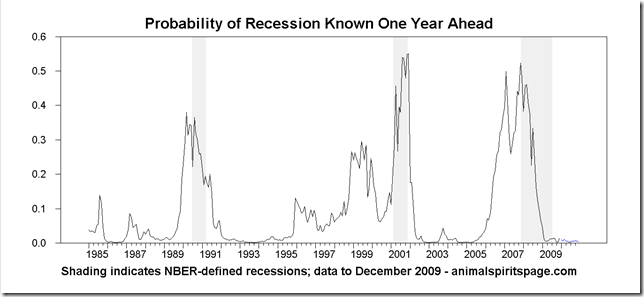
I forgot in the update yesterday to include the updated “recession probability” chart.  No NBER-type recession in sight.  
image

But American society and its economy continue to be very sick.  At at time when the have-nots most need work it appears to harder to get than any time in the past thirty years.

image

Here’s query that produces a plethora of references on the adverse impact of highly unequal socioeconomic status on health.

It’s my view that there are innate standards of fairness in the human breast that must be satisfied if pathologies are not to become severe.  Whether the corporate state can ever overcome its bias toward greed is unclear.  But I will speculate, optimistically, that corporations with flatter corporate income distributions will at some point gain a productivity advantage, that may lead to social change.  “Pension fund socialism,” as Peter Drucker called it, has failed—even if American workers technically own American companies through their pension funds and 401(k)’s the money managers have insulated company managements from any meaningful shareholder action by voting the “Wall Street rule” (for management) routinely.

Let’s see the leaders of American corporations take the lead in reestablishing a sense of fairness by taking less out of their companies for themselves.  Economists can quibble endlessly about whether inequality has in fact increased or whether it has any effect on productivity (see a realclearmarkets.com summary of a recent study by Robert J. Gordon indicating that it’s all an illusion…) but the perception of gross unfairness is out there.

Social change is coming, but not from Barack Obama.  It my fellow (exceedingly hard working) blogger George Washington is fond of saying, change springs up from the grass roots.

Enjoy your Saturday!

Monday, September 14, 2009

Real consumption spending to rise from the dead, briefly

Tim Duy offers some dyspeptic comments on confidence and consumption similar to my own a few days ago.  However, he (and the rest of mainstream economics) continue to ignore research (however obscure) indicating the adaptation level theoretic foundations of confidence determination (reference).  Duy’s nice graph of year-over-year real consumption spending against the University of Michigan sentiment series inspired a similar effort with the “animal spirits” indicator that shows that real consumption spending is about to enter a growth phase.  The contemporaneous correlation of YOY real C and “animal spirits” is about 0.63; the regression with constant has an adjusted R^2 of about 0.33.  But the “animal spirits” indicator has proven extremely sensitive to turning points and trends, more so than the Michigan series.

This is consistent with my general view that the U.S. economy is entering a relatively brief “anti-deflationary” reflationary bubble that will resemble an ordinary business cycle except for the elephant in the room, namely, a growing national debt-to-GDP ratio coming on top of record levels of the ratio.  If I had to bet on whether private sector deleveraging will outrun public sector leveraging, I would bet not.  Not enough private debt is being written off.  The U.S. has more debt than it can service now (see Comstock’s piece).  In 1933 we were the world’s greatest creditor and could borrow easily.  Today our currency is at risk of substantial depreciation.  Our social contract is broken, with extreme inequality in incomes and wealth and a general self-defeating distrust of government by the disenfranchised.  Our deflationary collapse has only stalled.  The tragedy is that the rising “animal spirits” of the next several years will probably guarantee that no meaningful reform takes place—of the financial sector, of the government’s priorities and budget, perhaps even of health care.  In this environment both fiscal stimulus and quantitative easing are fool’s games.  The government should provide health care and livable workfare to the unemployed and limit any increase in spending.  America is a basket case but the government won’t admit it. 

Real consumption should grow 2.0-2.5 percent over the coming year, and may accelerate to about 5 percent YOY growth over the next four years, before the next downturn.  Here’s the chart:

image

Forecasted “animal spirits” in blue, real YOY consumption percentage in red.

Friday, August 28, 2009

It’s the debt *and* the politics, stupid

Paul Krugman has a good liberal heart but his attachment to macroeconomic figments has made him more than a little obtuse.  The bigger the deficit the better, says Paul, if it worked in World War II it will work this time.  But this flies in the face of history.  As Emmanual Saez has shown, WWII produced a miraculous equalization of the income distribution, which did not equalize much as a result of the New Deal.  Some hoped that 9/11 would be the “Pearl Harbor of the twenty-first century” to produce a similar result but it clearly didn’t.  The banking bailouts showed us how the government spends our money:  it distributes it according to the existing income distribution, with most going to the richest Americans.  And America now has a greater aggregate debt load than it did in 1929 (see this). 

As regular readers know, I propose giving a livable workfare and health coverage to the unemployed and involuntarily working part-time, now 25 million people, before spending a nickel on anything else.  They will spend the money wisely; research has shown that the bang for the buck is highest from direct income transfers like this (reference). 

The social contract is broken, Paul.  I’d like to hear your thoughts on how to remedy a broken social contract.  My proposal is hardly revolutionary, as it can be viewed as a way of keeping the people most likely to want wholesale change happy with their lot—but it addresses immediate human need and is better than validating the debt “death spiral” that you seem to be advocating, and that is much more likely to lead to revolutionary change—and war. 

Till Debt Does Its Part

By PAUL KRUGMAN

So new budget projections show a cumulative deficit of $9 trillion over the next decade. According to many commentators, that’s a terrifying number, requiring drastic action — in particular, of course, canceling efforts to boost the economy and calling off health care reform.

The truth is more complicated and less frightening. Right now deficits are actually helping the economy. In fact, deficits here and in other major economies saved the world from a much deeper slump. The longer-term outlook is worrying, but it’s not catastrophic.

The only real reason for concern is political. The United States can deal with its debts if politicians of both parties are, in the end, willing to show at least a bit of maturity. Need I say more?

Let’s start with the effects of this year’s deficit.

There are two main reasons for the surge in red ink. First, the recession has led both to a sharp drop in tax receipts and to increased spending on unemployment insurance and other safety-net programs. Second, there have been large outlays on financial rescues. These are counted as part of the deficit, although the government is acquiring assets in the process and will eventually get at least part of its money back.

What this tells us is that right now it’s good to run a deficit. Consider what would have happened if the U.S. government and its counterparts around the world had tried to balance their budgets as they did in the early 1930s. It’s a scary thought. If governments had raised taxes or slashed spending in the face of the slump, if they had refused to rescue distressed financial institutions, we could all too easily have seen a full replay of the Great Depression.

As I said, deficits saved the world.

In fact, we would be better off if governments were willing to run even larger deficits over the next year or two. The official White House forecast shows a nation stuck in purgatory for a prolonged period, with high unemployment persisting for years. If that’s at all correct — and I fear that it will be — we should be doing more, not less, to support the economy.

But what about all that debt we’re incurring? That’s a bad thing, but it’s important to have some perspective. Economists normally assess the sustainability of debt by looking at the ratio of debt to G.D.P. And while $9 trillion is a huge sum, we also have a huge economy, which means that things aren’t as scary as you might think.

Here’s one way to look at it: We’re looking at a rise in the debt/G.D.P. ratio of about 40 percentage points. The real interest on that additional debt (you want to subtract off inflation) will probably be around 1 percent of G.D.P., or 5 percent of federal revenue. That doesn’t sound like an overwhelming burden.

Now, this assumes that the U.S. government’s credit will remain good so that it’s able to borrow at relatively low interest rates. So far, that’s still true. Despite the prospect of big deficits, the government is able to borrow money long term at an interest rate of less than 3.5 percent, which is low by historical standards. People making bets with real money don’t seem to be worried about U.S. solvency.

The numbers tell you why. According to the White House projections, by 2019, net federal debt will be around 70 percent of G.D.P. That’s not good, but it’s within a range that has historically proved manageable for advanced countries, even those with relatively weak governments. In the early 1990s, Belgium — which is deeply divided along linguistic lines — had a net debt of 118 percent of G.D.P., while Italy — which is, well, Italy — had a net debt of 114 percent of G.D.P. Neither faced a financial crisis.

So is there anything to worry about? Yes, but the dangers are political, not economic.

As I’ve said, those 10-year projections aren’t as bad as you may have heard. Over the really long term, however, the U.S. government will have big problems unless it makes some major changes. In particular, it has to rein in the growth of Medicare and Medicaid spending.

That shouldn’t be hard in the context of overall health care reform. After all, America spends far more on health care than other advanced countries, without better results, so we should be able to make our system more cost-efficient.

But that won’t happen, of course, if even the most modest attempts to improve the system are successfully demagogued — by conservatives! — as efforts to “pull the plug on grandma.”

So don’t fret about this year’s deficit; we actually need to run up federal debt right now and need to keep doing it until the economy is on a solid path to recovery. And the extra debt should be manageable. If we face a potential problem, it’s not because the economy can’t handle the extra debt. Instead, it’s the politics, stupid.

Saturday, August 22, 2009

Quantitative easing and fiscal stimulus are both fool’s games

Via:  Daily Finance

It is still the pathetic wet dream of neo-Keynesians and neo-conservatives alike that inflation is going to accomplish the debt jubilee that they think is going to “reflate” our deflationary economies.

PIMCO: Fed needs to 'be irresponsible' if deflation appears
Joseph LazzaroJoseph

To borrow a phrases from the late, great Jimi Hendrix, wrap your mind around this one: would you root for an "irresponsible" Fed?

PIMCO's Managing Director Paul McCulley is doing exactly that. McCulley, in a PIMCO commentary, said that, if the U.S. economic recovery does not begin as expected in Q3/Q4, the Federal Reserve should push inflation above its long-term target to encourage U.S. consumers to spend money.

"The way to make monetary policy effective is for the central bank to promise to be irresponsible," McCulley wrote, citing a 1998 paper written by Nobel Prize-winning Princeton University economist and New York Times (NYT) columnist Paul Krugman.

My primary objection to this line of thinking is that it ignores the primary cause of deflationary depressions, too much debt on a highly unequal income distribution.  Simply put, some people have too much money while everyone else has very little money and too much debt—not enough money to spend to keep the circular flow of income and product going, let alone service their debt.  This is where we are today.  America is a rich country compared to most others and compared to ourselves a generation ago—there’s plenty to go around, but since Reagan the game has been tilted toward capital and rich folks.

But what qualifies Krugman’s remarks as obtuse, in the sense of biting off his own nose to spite his face (and I apologize for getting wonky a bit here, it’s something I’ve sworn off of since leaving academic economics, but every once in a while fall back into) is that the Fed can’t at once be credible in its stated policies of monetary control and at the same time promise to be irresponsible by igniting inflation.  That is incredible, literally.

It’s the debt, stupid, and the income distribution, the fact that the game is rigged by social conventions accepted by—or imposed upon—folks up to now.  Bad debts don’t get repaid by reflation, the cash flow coverage on the loans was never right and won’t be made right by inflation.  And not to get wonkish again, but you introduce all kinds of inefficiencies into the economy when you cause uncertainty about relative prices—because as Hayek pointed out, he who raises his price first wins—and given the state of our social contract, that’s not likely to be the people who need help the most.

What to do?  Follow William Black’s example in the S&L crisis and bust bad bankers, close their banks, write off their crap, break up Goldman Sachs (bring back Glass Steagall—there’s no way Goldman should be getting free money from the Fed), and provide a livable workfare-style dole and health benefits to the unemployed, who are going to be with us for a while. 

Quantitative easing and fiscal stimulus are both fool’s games, blind to the true nature of the problem, the broken distribution.  Fiscal stimulus will be distributed as unequally as the banking bailouts were.  The social contract needs to be renegotiated.

Reference: Income inequality, debt, crisis and depressions

Thursday, July 23, 2009

On the failure of macroeconomics

There’s a lot of discussion of The Economist’s recent articles on the failure of economics.  I have commented on this previously in Screw the stimulus, shoot the macroeconomists.  Let me try to adopt a more conciliatory tone.  Like many Americans, I am experiencing a lot of frustration watching our dysfunctional government with the perspective of a Boomer’s life experience. So many mistakes, repeated so many times….

The political system is incapable of applying good macroeconomic models even if they exist.  Take for example the slope of the yield curve as a recession indicator, which I used in my model along with my “animal spirits” variable.  Introductory managerial finance texts teach that an inversion of the yield curve is a reliable signal of a recession arriving within about a year.  The Fed knows this, most financially astute people know this. 

The yield curve inverted in 2000 and again in 2006.  What was the policy response?  To pump up the money supply, credit and lending and debt expansion!  Why?  Because Alan Greenspan and Ben Bernanke both saw the potential for deflation.  Was this the right thing to do?  No!  The reason deflation was realistically in the outlook was because we had too much debt already! 

By pumping up credit, our exalted Fed chairmen thought they could save the economy, or perhaps at least not have it collapse on their watch.  Bernanke was publicly quoted many times in 2007 saying the economy was in good shape.

We live in a political economy.

So what should we do?  Take care of the people!  Make policy on moral grounds with minimal reliance on models.  When people become unemployed, help them.  My basic requirements for the stimulus as noted in the reference above are a poverty level dole for the unemployed, and universal health care.  It is truly barbaric that you lose your health care when you lose your job (or it becomes so expensive you can’t afford it).  The government can’t be trusted to spend our money wisely much beyond that.  Too much of the stimulus will be on wasteful projects.

I know this is way too reasonable for the professional economists to buy into.  I am a Ph.D. economist.  The academics are all riding their particular hobby horses, charging their favorite windmills. 

We are living with political economy they’ve helped to create, a mish-mash of broken theories that come in and out of vogue with the amount of money backing their political spokes-clowns.  Remember “supply-side economics”?  How about “real business cycle theory”?  Or “efficient markets theory”?  All these impressively mathematical theories were marshaled to support policies that had major distributional consequences.

Please!  Let’s try looking directly at who gets what out of these policies, and whether a majority of Americans think they’re fair.  It’s our money.

That’s my modest proposal.

Via:  Ritholtz.com  The Jalopy Economy.  What central banking and modern macroeconomics (Keynesian or monetarist) have brought us.

All the fuss about “financial innovation” is largely about the illusory gains due to increasing indebtedness.  The rise in debt has fueled Wall Street’s compensation, asset bubbles, and has brought the U.S. to the brink of bankruptcy (and this doesn’t include the hidden indebtedness arising from social program promises).

image

Tuesday, July 21, 2009

How to spend stimulus dollars: unemployment insurance for all

Via: CNNMoney

Out of work, out of benefits, out of luck

By Julianne Pepitone, CNNMoney.com contributing writer
July 17, 2009: 09:53 AM EDT
The next bubble in the recession is about to burst.

More than 650,000 Americans will have used up all of their unemployment benefits by September, in what experts say could be the start of a looming crisis.

In the early days of the downturn, the government extended unemployment benefits beyond the standard 26 weeks to as many as 79 weeks in hopes of giving the jobless a longer lifeline. Officials predicted the economy worsening and businesses further contracting, resulting in fewer jobs for the newly unemployed to find.

With the recession now 18 months deep and the national unemployment rate standing at 9.5%, it appears that the effort wasn't robust enough for those in the crisis' first wave of layoffs.

"We need to get the issue attention now, because people are running out of benefits and there's just nothing for them," said Andrew Stettner, deputy director of the National Employment Law Project, an advocacy group that has calculated the number of people who will exhaust their unemployment benefits.

In fact, Stettner and the Labor Department are expecting the problem to accelerate. In the next few weeks, the victims of the mass layoffs that happened six months ago -- when the pace of layoffs was at its zenith -- will start running out of their basic benefits. A total of 4.4 million people are expected to face this fate -- or 65% of the entire filing population.

And while they may have up to another year of unemployment insurance benefits -- thanks to the confusing patchwork of extensions that were enacted last summer -- they will be soon be unaccounted for in government unemployment reports.

The Labor Department doesn't track anyone who has moved beyond 26 weeks of unemployment in its weekly data on continuing claims (the number of people who request benefits after their first week). And, said Stella Cromartie, spokeswoman for the Bureau of Labor Statistics, said the agency does not currently have plans to begin tracking this population.

As a result, by late summer the government may begin reporting significant declines in continuing filers. But it won't be cause for celebration. Instead of of indicating that the economy is on the rebound, it could mean that more people are falling off the radar.

"We will see a decline in continuing filers," said the NELP's Stettner. "People are falling out of these numbers, and the pace of more recent layoffs replacing them is not as steep."

"They're not included in these unemployment numbers we hear about every week," said the NELP's Stettner. "They're desperate, asking, 'What's going to happen to me?'"

That's the question facing Jay Ridinger, 54, of Baxter, Tenn. The self-proclaimed "road warrior" once worked for a contract management company, happily bouncing from city to city to complete federal projects.

Ridinger was accustomed to the stop-start schedule of a contractor, so he wasn't worried when his last stint ended in August. But he soon realized this stretch of unemployment was different: "I thought it was the status quo, and instead here I am, applying for food stamps. I just sat in the office and cried and cried."

When he was first laid off, Ridinger received the maximum $250 unemployment check per week -- at the time, Tennessee's standard benefits lasted 13 weeks. Revisions of laws allowed him to get additional weeks of benefits.

"Every time you run out of benefits, you think, 'What the heck am I gonna do?'" Ridinger said. "And then a month later, maybe a check will be in your mailbox -- maybe not. Even if you get one, it's like, 'Ain't that nice, after all that emotion?'"

In most states, the unemployed receive a maximum 26 weeks of state-funded benefits. Two extension programs may also be available for an extra 53 weeks of benefits. (Click here for further detail on unemployment benefits programs.)

The availability and duration of the programs depends on the state's unemployment rates and whether it agreed to participate in part or all of the federal programs. (View the map to see how many weeks of benefits your state offers.)

These extension programs are "difficult to understand, unprecedented and tough to administer," noted Heidi Shierholz, an economist at the Economic Policy Institute, a nonprofit think tank. "It surprised me how difficult it is to get data on this. I study labor markets all the time, and even I didn't know just how much of a behemoth it is."

But just because filers may not be counted in the weekly jobless claims data, it does not mean they don't impact the national unemployment rate. The Labor Department doesn't rely on unemployment-benefit claims to calculate the unemployment rate; instead the agency conducts interviews through a population survey and simply asks people if they have looked for work in the past four weeks. If they have, they're included in the rate.

So, if you have run through all of your benefits and say, "yes," you would still impact the unemployment rate. If you are unemployed and looking for work but aren't claiming benefits, you would be included as well.

Still, the weekly jobless claims number is a good indicator of the health and direction of the economy. And Edward Stuart, an employment economics expert from Northeastern Illinois University, believes the NELP's data may even be "conservative."

"The unemployment rate is going up, and the time spent unemployed is also going up," Stuart said. "Jobs are disappearing, and we aren't replacing them."

In the meantime, Ridinger waits -- checking about 80 Web sites daily and has applied for jobs all over the country in a variety of fields. After almost a year, he's had only one interview.

"This experience has hit me with every possible emotion," he said. "It's humiliating, degrading. I've changed my complete attitude toward the system. I just never expected to be a part of it."

Thursday, July 9, 2009

Screw the stimulus, shoot the macroeconomists

Let’s establish a few facts. 

Modern macroeconomics as administered by the American government has brought us continuous inflation since World War II until this year, skyrocketing national and private debt, unemployment that rises after recessions in jobless recoveries, blatantly fraudulent financial practices blessed by Larry Summers under President Clinton (the same Larry Summers who is largely tasked with cleaning up the mess he created between multi-million dollar gigs with Wall Street firms), banking and investment firm bailouts of their bad debts (bad bets) that amount to the greatest expropriation of wealth by the richest Americans from working Americans in the form of future taxpayer burdens, and now exploding deficits—beyond WW II shares of GDP—that will wreck American society and culture for generations to come if not addressed quickly.

So screw the stimulus and modern macroeconomics.  Shoot the macroeconomists, or at least waterboard them.  The pointy heads who are advising the President (Blinder, Krugman, et al.) are tenured professors who have never had a real job and prima facie are not in touch with reality.  The other advisors, Summers, Geithner et al., sold out to Wall Street (mostly Goldman Sachs) long ago.  They have taken care of their own under Obama very well in the past year.

So screw the stimulus and modern macroeconomics. 

Let’s focus on the American people.

For those with jobs, a moderate deflation has actually been beneficial.  At least 84 percent of the American labor force is fully employed (84 = 100 – 16 = labor force – U6 unemployment, the more accurate measure of under- and unemployment).  One-third of homeowners have paid off houses, and probably 90 percent or more of home mortgages will not go to charge off. 

So what should the government do? 

The government should provide universal health care (props to the Big O for making that first priority), so that those whose lives are being torn apart by an economic calamity not of their own making will at least have access to health care.  Severe recessions have documented adverse health impacts.

The government should also provide a poverty level stream of support payments to the unemployed so that they can survive unemployment even if long-term.  This is what the European nations do, and their unemployment rates are now actually lower than ours.  The rationale for these payments is to allow people to find new jobs, move if necessary, retrain if necessary, and to prevent them from becoming totally alienated from America.  Stalin said that dictatorships only last so long as the dictators keep their people well-fed.  The authorities would do well to remember that.

The American economy is going through a massive transformation.  The debt-fueled consumption binge of the current decade spawned consumption and investment patterns far from optimality.  Americans spent more than they earned, spending debt taken against their rapidly inflating home values, which in turn spawned excessive investment in real estate.  All that is over.  It will take years for displaced Americans in aggregate to find their places in the reconfigured economy.  America is still the greatest industrial power in the world, the most innovative economy and culture, filled with self-selected risk-takers and self-starters. 

Betting on the people is our best bet.

Betting on the government is our worst bet.  Main Street Americans (listen up, oh ye ruling elites) view Washington and New York at a den of vipers greedily sucking the blood out of the dying economy. 

Main Street knows that America is broke, even if the idiots in the Beltway bubble cannot admit it.  Main Street knows that the Democrats are every bit as bought and paid for as the infinitely corrupt Republicans were.  Americans are sick of both parties.  The Republicans hold a slight edge in this regard in that Main Street Americans think the stimulus is a crock of shite, pork on a nation-destroying scale that will spell the end of any notion of voluntary cooperation with the government in the future.  Main Street is right.  Since Reagan, politicians have been playing the game of “tax cutting is more fun,” and avoiding facing the facts, “kicking the can down the road,” letting the blow-up fall on some future guy’s watch.

Tax increases and spending cuts are coming.  SCREAM at your elected representatives that YOU DON’T WANT NO STINKING STIMULUS!  Tell them to take care of the people who are hurting!  They’re the most effective stimulus spending possible—they’ll spend every buck they get.  Let the economy self-organize.  Minimize the additions to the mountain of national debt—shrink the deficits.  Let the people spend the money.  They will spend it wisely.  Wall Street won’t.  The Soviet Union showed us central planning doesn’t work—why would the Obama administration think they can do it?  No one on Main Street believes the contracting process will be anything other than corrupt.

And “use it or lose it”?  How stupid is that?  When we’re flat broke to start throwing money around as if we had too much of it?  This is the kind of thinking modern macroeconomics produces, and that its exponents like Paul Krugman like to trumpet in their arrogant obtuseness. 

We need to move slowly.  We need triage.  If the feds won’t bail out California’s government, they should be ready to help its people.  We are probably going to witness mass migrations as the economy reconfigures, much as during the Great Depression.  We need to make sure our educational system doesn’t do damage to a generation of Americans because of the greed of the elites, the way a generation of Chinese was damaged by the madness of Mao Zedong during the Cultural Revolution.

If the American government does not clean up its fiscal act, because the dollar is the international reserve currency it risks creating an international crisis of unprecedented proportions, that will damage an entire generation worldwide, more so than it has already been damaged, and that may well lead to world war.

Screw the stimulus.  Give the money to the people.  Let the states and localities put their houses in order.

Let’s get real, Americans.  The stimulus is a crock.  Scream your heads off now, so that maybe you won’t be sending your sons and daughters or grandsons and granddaughters off to war in ten years.

Watch Charlie Rose talking with Roger Altman to see what’s coming on the fiscal front.