Showing posts with label animal spirits update. Show all posts

Friday, March 7, 2014

‘Animal spirits’ update

The approach taken to confidence determination here stipulates that, for the most part, confidence levels are determined by whether unemployment is above or below what people are used to, an adaptation level modeled as an exponential moving average over the past four years. When unemployment is below the adaptation level, we feel good; and conversely. Thus, in the 1980s, when unemployment came down from double digit levels to 9 percent, that level produced gains in confidence. Currently the adaptation level is at 7.8 percent and unemployment is at 6.7, so in theory we are “confident” (as I have mentioned, I don’t quite know why the median income household—really everyone below about the 90th percentile—has not lost confidence completely; we know the top 10 percent are confident, and for the most part completely out of touch with what is happening in the country.)

What is remarkable about this simple theory is that it is very sensitive to identifying the beginnings of the downward cascade of economic activity—and upward shooting of the unemployment rate—that occur at the outset of recessions.

image

The forecast in blue assumes the following judgmental forecast for unemployment:

image

Now it is possible that unemployment will bounce along a bottom at about current levels for longer than I have assumed, but in this theory of the business cycle confidence will always fail when the adaptation level comes down to the current unemployment rate. Note in the graph above that the crossover point is almost always exactly when the NBER defined recession begins, and when unemployment accelerates upward.

The negative skewedness of the first differences seen here is also seen in stock prices, which arguably follow a very similar type of adaptation-level theoretic dynamic, at least in part.

The current period is morphologically similar to the early 1970s, before the recession began, with the Michigan Consumer Sentiment series lagging (green in “animal spirits” chart). If we follow that pattern the collapse will be sudden.

My judgmental forecast puts the start of the collapse a year from now, in February 2015, but my forecast includes increases of 0.1 percentage points a month starting in about six months. I cannot comment on the calculation of the unemployment rate authoritatively, but many have found the sharp decreases in the labor force participation rate to be anomalous. (It was amusing and sickening to hear that Janet Yellen is worried that the labor force participation rate might increase from its generation low and cause the unemployment rate to go up. She and the Fed are apparently aware of the underlying model referenced here even if here book-writing husband’s book on “animal spirits” doesn’t reference it.)

If we are at something like “peak false consciousness” (again) it won’t take much to prick the bubble, especially as the unemployment rate and adaptation level converge.

Friday, January 10, 2014

Honey, I shrunk the labor force!

With the adaptation level at 8.1 and the “current unemployment rate” at 6.7, the confidence cushion has widened a bit, but I view this as a holding action. I don’t know why people pay attention to the unemployment rate any more, but then, I am a professional. Most people are not obsessed with the increasingly flaky economic data as I and other readers of Zero Hedge et alia are.

With continued weakness in the Michigan series, and a topping formation in the A metric, the collapse, when it comes, will be sudden, as it always it.

image

Saturday, September 14, 2013

‘Animal spirits’ and the natural unemployment rate

The San Francisco Fed reports median estimate of the natural rate of unemployment in 2013 is 6.6 percent (source). Other estimates put the rate at 7.9 percent (source). Assume the current unemployment rate is the current natural rate, at 7.3 percent. How long until confidence collapses if the rate remains fixed at that level? Obviously it will take infinitely long for the adaptation level to converge to the current level, but when does it get within 0.1 of the adaptation level? That actually doesn’t occur until March 2016. But this is not a realistic path.

The crossover from “unemployment rate below adaptation level” to “unemployment rate above adaptation level”—the signal of collapsing confidence—is always preceded by a leveling out of the smoothed (12-month MA) unemployment rate, which has not yet happened. This is a necessary but not sufficient condition for a collapse of confidence to be imminent.

image

We will monitor developments for this occurrence.

Friday, September 6, 2013

‘Animal spirits’ update: taper off

The downtick in unemployment raised the A metric marginally but its topping formation remains in place. The onset of the next crisis of confidence—the signature characteristic of the business cycle downturn--will probably come in 2014.

image

As I have pointed out before, ZIRP lasted from 1934 to 1946 last time and there’s no indication it will go away soon this time. There has been less banking reform, the debt load is greater, and the distribution is even more skewed. Here is Shiller’s long term bond rate data:

image

Note that from 1936 to 1946 the rate went down. Data is through 2013 YTD. We are still awaiting our 1937-38 analog slump.

Unless, of course, the fools running things manage to get a big war going soon.

The next big thing, especially if Summers gets in, will be crypto-MMT debt explosion as America leaders (ruling class) feather their nests with “infrastructure spending.” Saez and Picketty showed us what happened in to the last such “growth endeavor”: it went 93 percent to the top 1 percent.

Sucks, doesn’t it? Find a faith and practice it, and congregate with like-minded people. Stay away from psychopaths (and that means almost anyone at a senior level in a large corporation, nowadays, as they are shooting the zombies climbing up beneath them in the head to protect their positions).

Peace.

Friday, August 2, 2013

‘Animal spirits’ update

In spite of the downtick in the unemployment rate—due to lowered labor force participation—the topping process in “animal spirits” continues; there was no break of the recent high.

image

As the history of the A metric shows, when it crosses the zero line from above a collapse of confidence is virtually guaranteed.

image

When will we get there?  Frequently entry into NBER-defined recession precedes the crossing of the zero line, so my forecast of a collapse of confidence before the end of year may be plausible.  Otherwise it will occur in 2014.  With job growth (especially full-time, “good” job growth) at the pathetic levels it’s at, it’s hard to see how a collapse of confidence before the actually crossing of the zero line won’t take place.

Here’s a close up of my judgmental unemployment rate forecast and its attendant adaptation level forecast:

image

Sooner or later a lot of the unemployed are going to have to start looking for work, and that will push the unemployment rate up, precipitating the collapse of confidence as the published unemployment rate rises.

I have taken a brief look at whether coming within a “just noticeable difference” of the adaptation level is sufficient to cause the collapse, and I don’t think it is.  Confidence is especially sensitive to the A metric actually attaining a negative value.  However, as can be seen from the history, in many cases the NBER-defined recession occurs before that happens.

Friday, July 5, 2013

‘Animals spirits’ update: The Ben vs. Barack

With U = 7.6, same as last month, the topping process in animal spirits seems to be underway.  The adaptation level of U is 8.5, down 0.1 from last month.  I am assuming that U will stabilize for a few months and then shoot up as self-organized criticality in the labor market kicks in.  The interesting thing about this cycle, like the one in the early Seventies, is that consumer sentiment as measured by the Michigan index seems to be looking through the next slump to the next expansion already.

image

The political economy of the situation, in my read, is as follows:  Obomba would be better off to take his recession now so that the economy is coming back in 2016 for Hillary or whoever.  But the Congressional elections next year could swing radically Republican if the economy is in recession (as I expect it to be).  If Ben continues to taper, he may help the Democrat in 2016, but it may hardly matter, as the Congress will have gone to the Republicans and the people may be convinced that the Democratic (and democratic) agenda has failed, and they will opt for a “strong leader.” 

The one thing Republican administrations are really good at is shutting the economy down (reference).  But would be consistent with their ultimate agenda of bringing feudalism back to the Western world, IMHO. 

And since Ben is a servant of Wall Street, which today favors the Republicans, he will continue with the taper, executing a “wash and rinse” cycle on the stock and bond markets similar to that of the early Seventies.  The inflation gets going in a few years, along with a perhaps MMT-validated increase in deficit spending (see Warren Mosler’s profile in the NYT here), which is all of course consistent with my and others’ hypothesis of a credit super nova yet to come, as the sovereigns, slaves to the banks (at least in the West), compete in a race to debase.  We have Sornette’s forecast of the date for the phase transition in to what can only be a world-wide deflation as about 2020.  And all this is consistent with the very prescient prophecies of Strauss and Howe in the The Fourth Turning.

Interesting times. 

P.S.  I am still unemployed, so anyone knowing of opportunities for a non-derivatives oriented finance geek, please let me know.

Friday, May 10, 2013

‘Animal spirits’ update

I continue to view this period as very similar to 1973, with recession imminent (technically defined; we are actually in a low grade depression).  The blue forecast line in the graph below is judgmental.

image

In A phase space, it is clear that we are turning the corner into the downturn; it is only unclear how much longer the Fed can prop it up.  We are at the point A = 1.5, Delta A (YOY change) = 0.8 on the graph below, which shows four decades of history.  The slide downhill comes next, whether late this year or several years from now, it is hard to tell.  There is no forecasting involved other than assuming the A attractor is relatively stable.  This is really just to say that “the law of the business cycle has not been repealed.”  I just find it hard to believe that with the incomes of roughly 90 percent of the American population falling in real terms, that even with the extraordinary lack of labor force participation recently, that a recession can be avoided in the near term.  Perhaps we’ll have a recession without an increase in unemployment (in the sense of two or more quarters of negative real growth).  Whether the NBER in its wisdom would find that to be a recession is totally irrelevant.  What I am forecasting is the collapse of confidence that always accompanies the business cycle downturn, and I do believe people will be smart enough to smell the coffee at some point regardless of the published unemployment rate.  Times are changing.

image

The adaptation level is now at 8.6 percent unemployment.  Any uptick to within a “just noticeable difference” of that number will probably signal imminence of further decline.  Just rising above 8 percent will probably have psychological significance.

I read the attack on paper gold as a harbinger of things to come.  There is a lot of liquidity looking for a buy point.  TPTB might decide a quick, “controlled” rout is in their interest.

Friday, February 1, 2013

‘Animal spirits’ update

N.B. This is research, not investment advice.  You invest at your own risk, unlike the Wall Street banks, who also invest at your risk. 

The uptick of the unemployment rate from 7.8 to 7.9 has caused our ‘animal spirits’ indicator to put in a top.  Continued increases or merely stability of the unemployment rate will cause further losses of confidence.

image

The underlying judgmental unemployment rate forecast is this:

image

My forecast is still that the US economy enters recession in the second half of 2013.  The two big proximate drivers:  the continuing assault on consumption from higher taxes and medical costs; a precautionary demand for liquidity (increased saving rate); the sequester—to any degree—of federal government spending; and to the extent that it impacts the small segment of the population current salivating over stock market gains induced by QEternity, a diminished wealth effect (yes, the implicit stock market forecast is that we’re at a major top—I called it a year ago but the presidential election year got in the way—this cycle is very reminiscent of the early 1970s, and we’re at about the turn from 1972 to 1973).  Throw in Europe in various states of severe recession and depression, and the likelihood of some slowdown in China, and we have the potential for a coordinated global contraction, almost as if the signs all say we are at the end of the [high?] growth age….

Here is the whole history:

image

Note how depressed the Michigan Consumer Sentiment index is, just as it was in the early ‘Seventies.  The drop-off from here could be precipitous from here.  Even somewhat proven indicators such as the “Rule of 20” show the market looking toppy (yellow line is where the blue S&P line is supposed to be):

Source:  News-to-Use

Saturday, December 29, 2012

’Animal spirits’ update

Industrial Production had a nice bounce in November, putting the probability that we are currently in recession (according to my recently developed model) at about 8 percent.

image

However, the essence of this model is that any six month decline in the exponential moving average adaptation level used is a 100 percent accurate indicator of being in recession.  The average made a new cyclical high in November, at 96.8, which is bullish, while the index was at 97.5.  Subsequent values of Industrial Production falling below 96.8 will increase the likelihood of recession, and a May value falling below that level will be confirmatory.

Thursday, December 20, 2012

Economy at stall speed; recession imminent

I hypothesize that “animal spirits” or confidence levels in the economy are largely a function of how things in the economy are relative to adaptation level.  In the model presented up to now I have used the psychologically sensitive unemployment variable as the basis for the calculation.  Today I am playing around with Industrial Production.  Just as stock market investors become discouraged when a stock’s price slips below a moving average, I hypothesize that much the same pertains to managers of industrial concerns (and throw in an inventory cycle for good measure).

In this case the measure of “animal spirits” would be

A = (IP – IPMEAN) / Sigma (IP)

where A is the “animal spirits” metric, IP is Industrial Production, IPMEAN is its exponential moving average over a the past several years (heavily front-end weighted compared to the unemployment model), and Sigma is its standard deviation over the same period.

image

The picture that emerges suggests we are just at the cusp of a new recession starting.

One of my back burner research projects is to customize a composite contraction measure using several salient macro variables. 

“Animal spirits” matter most in the contraction, when discounting is taking place below an anchor level (we discount losses more than we value gains of same size, in “utility points”).

A simple logistic model using this new “animal spirits” metric and a recent percentage change in Industrial Production produces a quite credible contemporaneous indicator of being in an NBER recession, probability of being in recession now running at about 40 percent:

image

I will update this new model when new data becomes available.  Here is the picture of Industrial Production and its adaptation level, showing that we’re entering the zone of loss discounting:

image

With one false positive in the period leading up to the 1990-1991 recession, if the exponential moving average used here is down over any six month period then the economy is in recession.  It’s not a great leading indicator, but it’s 100 percent accurate coincidentally:

image

As the data here is up to October 2012, we should know by April if the economy is in recession.  The adaptation level is 96.65 of Industrial Production.  An April value falling below that will be confirmatory.

Tuesday, October 9, 2012

‘Animal spirits’ update

Nothing on this web site should be construed as investment advice.  This is pure research and speculation.  You trade at your own risk, unlike the Wall Street banks, who also trade at your risk.

Confidence stalls when things stop getting better than what we’re used to.  Confidence fails when they become worse than what we’re used to.  Defined solely in terms of the unemployment rate, confidence now has a one percentage point cushion between current rate (7.8 percent) and adaptation level (~8.8 percent).  If the unemployment rate stabilizes and climbs a percentage point because the economy falls off some form of fiscal cliff, the actual rate will hit the adaptation level, which historically has almost always precipitated a failure of confidence and a negative jag in output and employment.  The forecast is below.  The remainder of the decade is likely to resemble the ‘Seventies (the 30 year inflation cycle was staggered a year by mini-depression and QE) as cost-push inflation rears its ugly head (see South Africa today) and reserves liquidity feeds into a wage price spiral.

image

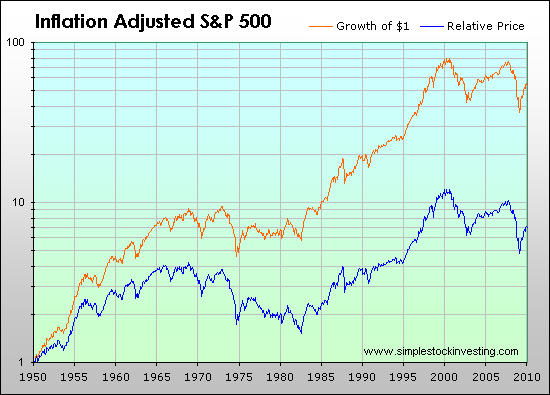
If the American stock market follows the ‘Seventies pattern, there will be a steep bear market bottoming in about first half 2014, and then a “bull market” in which total return to shares is something less than the rate of inflation.

Inflation-adjusted relative price and total return of the S&P 500

Tuesday, September 11, 2012

‘Animal spirits’ update

My judgmental unemployment forecast with adaptation level:

image

Regardless of the fact that the unemployment rate is hardly the best indicator of labor market health, I assume it dominates people’s perception of labor market health, and that when it increases above an adaptation level formed by recent experience, confidence fails.  My best guess as to when the unemployment rate will cross above its adaptation level continues to be about halfway through next year, when America will experience an accelerating collapse of confidence.  Animal sprits will remains depressed until 2016 or so.

The situation continues to resemble the 1973-1974 period, especially with regard to the configuration of the Michigan consumer sentiment series and my imputed confidence measure.  One thing that my measure has done fairly  consistently is to signal the onset of NBER-defined recessions when unemployment rises above adaptation level.

After period doubling in the ‘Eighties, ‘Nineties, and Oh-Oh decades, the American business cycle seems to have reverted to a possibly chaotic shorter pulse more characteristic of the earlier postwar business cycle.

image

Monday, August 6, 2012

When will confidence (‘animal spirits’) collapse?

The theory of confidence that I adhere to says that it is the relationship between the U-3 unemployment rate and its exponential moving average over the past several years that determines the level of confidence (for many practical purposes, such as the timing of recessions):

A = – (U – UMEAN)/Stdev(U) .

Shown below are recent actual values of unemployment and the adaptation level and my judgmental forecast:

image

I continue to believe that confidence will collapse in mid-2013.  Whether the “recession” is declared to begin then or now or somewhere in between is up to the NBER in its ex poste facto wisdom.

Here is what “animal spirits” look like according to the forecast:

image

Green is the Michigan consumer sentiment series.  If the BLS manages to keep reported U-3 unemployment below about 8.8 percent until the election, confidence will remain “positive,”  and, other things equal, the President has some chance of reelection. If unemployment rises above 8.8 percent in the next year, confidence will collapse.

The situation continues to resemble 1972-1973 in the relative configurations of the Michigan measure (depressed but trying to rise) and the A metric (positive, but poised to fall).  By all accounts the current cyclical expansion is the weakest in the postwar period, so a short-lived and fey recovery is to be expected.

image

Friday, June 8, 2012

‘Animal spirits’ update

The President’s reelection chances hinge upon the unemployment rate remaining below 8.8 percent, the current adaptation level.  Any rise above that level will signal the beginning of a recession or negative growth episode, if the pattern that has occurred every other time the unemployment rate rises above its adaptation level persists.

image

I continue to pencil in a rise in the unemployment rate in 2013 as the US falls off the fiscal cliff to one degree or another, with monetary policy impotent to do anything more than goose financial markets hooked on cheap money like heroin junkies.

image

The current situation continues to resemble the year 1973’s setup, with the Michigan survey measure still much lower than the A metric.  Interestingly, then the Michigan measure rose going into the recession as the A metric plunged.  After the cycle bottomed, the A metric shot up and the Michigan measure again became more pessimistic.

The potential for long-term pessimism, or what Keynes called “the state of long-term expectations,” becoming very dismal indeed in America is large, as Americans of even the slowest cognitive abilities wake up to the fact that the plutocracy has bought off the Congress, the President, and the Supreme Court (the justices who ruled for corporations being people in Citizens United were just thinking what they were told to think as good conforming conservatives).  The plutocracy would like to set up their families as the lords and ladies of the new world, ever Anglophiliac in their pretensions, with the rest of us as their wage-serfs.

Here is Joseph Stiglitz trying to say the same things in a way that won’t get him kicked off the MSM media… this is the latest on our continuing feature, “Neofeudalism watch.”

I hope that American creativity will come up with a solution to the problem of the extreme dysfunctionality of the American political economy.  What we have now cannot persist without creating blowback and further dysfunctionality.

Friday, May 11, 2012

‘Animal spirits’ update

Based on my judgmental forecast of the unemployment rate, which I expect to break below 8.0 percent just in time for the election, then to shoot up as the global slowdown catches up with the US.  In 2013 and 2014 the US will undeniably be in depression, in this view.  The next slump will be only about a year long (meaning the phase of negative aggregate growth) but will conclude in 2014 with unemployment at depression levels, but nowhere near as bad as it is in some parts of Europe.  The latter part of the decade will present the most fertile breeding ground for fascist extremism in a century, not only in the failed state of Europe but in America.

image

image

I am basing my forecast in part on the purely technical observation that previous “global” peaks in unemployment have come at the end of three local peaks on the way up.

Thursday, April 19, 2012

‘Animal spirits’ update: contraflation?

The adaptation level theoretic measure of confidence that I track continues to be positive, slightly, based on the relationship of the unemployment rate to an exponential moving average of recent rates.  When you’re coming down from over ten percent, 8.1 percent seems great (and nobody really pays close attention to the high U measures of unemployment, in this view).  The configuration of my confidence metric and the Michigan sentiment measure most closely resembles that in 1973, when Michigan confidence was low, but the A metric was positive.

image

The period after the election to the inauguration is what someone has called the mother of all lame ducks if Romney wins.  Any tax relief the Congress might enact—whether a “temporary” payroll tax cut or further postponement of the Bush-Obama tax cuts’ expiration—will be political suicide.  It might well be even if Obama wins.

That implies that fiscal drag equivalent to 3-4 percent of GDP could kick in January 1, 2013.  The underlying unemployment rate forecast is as follows:

image

Notice that confidence turns up even as the unemployment rate continues to rise!  This is one of the interesting nonlinearities of the A metric.  In terms of my confidence metric, the next recession may not be that bad, ending in about the middle of 2014, probably as the Fed pumps even more credit into the economy, and as inflation probably infects the wage price spiral, gunned on by war in the Middle East, if Charles Nenner’s forecast is true.

In the final supernova end game of the global credit bubble there is a tremendous first-mover advantage to she who inflates first.  And historically, war is a quick way to get a “hot” inflation going—even as some sectors (like housing and some commodities) continue to deflate!

We need a new term for this phenomenon of inflation and deflation occurring simultaneously. 

Contraflation?

Friday, March 9, 2012

‘Animal spirits’ update

I continue to forecast the unemployment rate judgmentally, and by eye, to be consistent with the 1973-1974 pattern relating the “animal spirits” metric and the Michigan sentiment series.  Unemployment can be expected to jolt upward in 2013 as the European recession drags the US down with it, with the US Congress adding its own drag by reducing net fiscal flows into aggregate demand.

image

image

By my estimation the economy will enter recession in the first half of 2013.  From a chaos theory point of view, it looks as if the US entered a period doubling regime in the 1980s, 1990s, and 2000s, as the length of the cycle between recession rose to almost a decade.  Period doubling precedes the transition to chaos in many dynamic systems.  If that is what has occurred, then we can expect a choppy short business “cycle” for some time to come, with perhaps another recession in 2018 or 2019.

We are in an “animal spirits” bubble now, hard as that is to believe.  The next bout of depressed spirits will probably be accompanied by another staggering downward of living standards, health and welfare of the 99%, which may or may not finally motivate the population to force democratic changes that will benefit them. 

Friday, February 10, 2012

‘Animal spirits’ update

image

image

Blue is forecast.  2012 looks much like 1973 in the configuration of both the Michigan series and the “animal spirits” metric.  The sharp deceleration in the economy is expected to be due fiscal austerity, galloping wartime inflation, or a combination of the two.

Friday, January 13, 2012

Secular exhilaration confirmed

My forecast of bettering “animal spirits” is confirmed in the pop of the Michigan sentiment series today.  With the bally-hooed unemployment rate—still the headline variable, even though just about everyone knows U6 and what’s going on with the labor force matter much more—now below its adaptation level, “animal spirits” are positive for the first time in the current “recovery.”  I am showing my freehand forecast of the unemployment rate and its implications for “animal spirits” below.   As I mentioned a couple of posts ago, the situation today most resembles early 1973, at right about the time of a stock market peak and about a year before the onset of recession.  [This is research, not investment advice.  You invest at your own risk, unlike the Wall Street banks, who also invest at your risk.]

image

image

Technically, my model shows “animal spirits” going negative, and the next “recession” (collapse of confidence accompanied by accelerating losses of income and product) beginning in mid-year 2013.

However, Europe’s recession and deceleration of Chinese growth may quicken things a bit.

It’s 1973 all over again, the year before a major social and economic crisis.  Watch my brother Marvin sing about it.

Saturday, December 10, 2011

Secular exhilaration! take 2

So what happened to the stock market in the early ‘Seventies episode, you might ask.

The market peaked right at the New Year of 1973.  By analogy we might expect the same for 2012.  From the previous post note the leading nature of the Michigan Sentiment series, which recently had its own pop to the upside.  Expect some delusional holiday cheer out of Old Europe to keep the fake rally going, but after New Year’s Eve and the first few trading days of 2012, it might be time to say “risk off.”

image

N.B.  This is research, not investment advice.  You invest at your own risk, unlike the Wall Street banks, who also invest at your risk.  Just wait until the Euro sovereign CDSs come home to roost, how the Wall Street bankers come to Uncle Bernie with their hands out (Uncle Sam doesn’t have the cojones to give them any more money, afraid of being tarred and feathered).