Showing posts with label consumption. Show all posts

Wednesday, March 26, 2014

After QE; Piketty and neo-feudalism

There is a lot of nonsense going around about interest rates going up post-QE. Following John Hussman's lead, in a recent post I showed the empirical regularity governing the relationship between central bank balance sheet as a percent of GDP and long-term interest rates proxied by the 10 year T-bond.

Recently Base/GDP has been about 0.22, so we are way out on the right end tail. It would take a reduction of the ratio of about 15 percent of GDP to begin to raise long rates, or about $2.6 trillion at current rates of GDP. The St. Louis base is currently at $3.7 trillion, and has been growing at over 20 percent a year since the last recession.
Now, "tapering" is a reduction in the rate of increase of additions to the base, not a reduction of the base. The chart looks to me like a very strong empirical regularity indeed. So the chance that long rates will rise anytime soon is remote in the extreme, as the Fed has no announced plans whatsoever to actually reduce the base.
Long rates will remain low and the bad debt clogging the banking system will remain impacted, that much seems assured for years to come.
What is a somewhat lower probability outcome is that the dump-the-dollar movement internationally gains sufficient momentum that the Fed has to buy up more and more (perhaps virtually all) new Government debt. This might be called the MMT-by-force-majeure outcome, as there is little chance that such additions to the Fed's balance sheet will ever go away.

In this latter case rates will not go up because of the empirical regularity shown above, but as the dollar falls on the foreign exchange markets due to weak demand to hold or trade in dollars, there will be import inflation domestically in the US. This will cause a further collapse of effective demand--already afflicting the bottom 80 percent or so of Americans--as real purchasing power of consumers is decimated. The US will become an even less attractive place to invest, and capital flight will occur. The US's status as a banana republic will be cemented.

This is the essence of the dreaded global currency reset: the dollar falls on international markets, import inflation slams domestic real demand, but neither short-term nor long-term interest rates rise (short rates exhibit a similar empirical regularity to that shown above). A domestic stagflation occurs. The Fed, ever the servant of Capital, will fight the inflation with modest rises in short rates (this can be done administratively in the short run) sufficient to beat any thought of asking for higher wages out of the heads of workers even though labor cost-push inflation exists only as a curiosity in economic history textbooks.
In the final chapter plutocrats of various "nationalities" (with allegiance to none) will divvy up Plantation America, keeping the best parts of it private, for themselves and their would-be-royal progeny.

Enter the Anti-Mainstream Economist

Certainly Thomas Piketty is the most important economist of the past 80 years, since the last Fourth Turning (Keynes got it that time). I highly recommend The New Yorker's review of his big book (here). A Frenchman, Picketty came to the US at 22 as a young economics superstar and to his great credit, became immediately disenchanted (disgusted is a better word, probably) with the status-quo-supporting mathematical fictions he encountered at MIT. (Disgust afflicted your correspondent upon entering economics at the graduate level in search of "science" after an undergraduate career studying literature.) Son of a leftist French couple, Piketty imbibed the Marxist notion of capital increasingly displacing labor leading to the reserve army of the unemployed and set out to study the issue of the distribution empirically, probably sensing that only real world data could displace the mathematical fictions of the self-congratulating, narcissistic mathematical economist-priests ruling policy in the West.

Piketty's concerns over where the world is going are as dire as mine. He is the Anti-Mainstream economist on the white horse that I thought could never possibly arrive. The New Yorker disappointingly pooh-poohs Piketty's suggestions that we need to raise taxes on the incomes and wealth of the plutocrats as politically infeasible. (But of course The New Yorker’s readership inhabits the status quo, so what else could they say?)
Democracy will have to be reborn to prevent a return to out-and-out feudalism.
It couldn't happen here, of course (although Piketty now has a stateside ally in fellow French-born Berkeley economist Emanuel Saez). Piketty turned tail after a couple of years in the US and returned to Paris, where he has remained since.

[Editor: spelling of Piketty's name corrected 3/27/2014]

Wednesday, June 26, 2013

Will consumption collapse?

Running at about 70 percent of GDP, consumption has been above long-term averages for a while, with much of it financed by debt.  Households are deleveraging where they can.  Where will consumption go?

image

Of course, for the majority of consumers, the weakness in real disposable income has been greater than depicted because of the great degree of inequality in the income distribution.  Government spending won’t pick up the slack, and neither will investment, from all appearances:

Graph of Shares of gross domestic product: Gross private domestic investment: Fixed investment: Nonresidential

Wednesday, February 20, 2013

Economy at stall speed

image

Source:  FRED.  Data to 2012Q4.  The blue line is the value of the most recent observation.  Almost every other time this value has been seen the economy has been either going into recession imminently, or within a year or so.  Only in the 21st century has the economy managed to avoid recession by bouncing off the blue line.

The green line is linear trend over the period from 1950.  The red line is the trend over the past 30 years, which suggests that the US economy is headed for a state of secular stagnation and possible collapse.  

Thursday, October 25, 2012

Debt, the big picture

Via: Felix Salmon

CEOs’ self-serving deficit manifesto

Felix Salmon

OCT 25, 2012 13:26 UTC

TECHNOCRATS

The WSJ has what it calls “CEOs Deficit Manifesto ” — a copy of the letter, signed by 80-something US CEOs, urging action on the debt and deficit. It’s not a particularly impressive document. It starts like this:

Policy makers should acknowledge that our growing debt is a serious threat to the economic well-being and security of the United States.

It is urgent and essential that we put in place a plan to fix America’s debt.

MW-AR995_debt_f_20120607165649_ME.jpg

This is ridiculous. There are lots of serious threats out there to the economic well-being and security of the United States, and the national debt is simply not one of them. Nor is it growing. The chart on the right, from Rex Nutting, shows what’s actually going on: total US debt to GDP was rising alarmingly until the crisis, but it has been falling impressively since then. In fact, this is the first time in over half a century that US debt to GDP has been going down rather than up.

So when the CEOs talk about “our growing debt”, what they mean is just the debt owed by the Federal government. And when the Federal government borrows money, that doesn’t even come close to making up for the fact that the CEOs themselves are not borrowing money.

In fairness, here is the picture of *federal* debt to GDP:

image

I am in favor of redistributive social policy in an era when the market system fails to provide a living for people who desire work and can’t find it.  The Benign Brodwicz program has always been, “poverty level workfare and health care for the unemployed.”  The conservatives will say such government spending doesn’t “produce” anything, but in first round of spending after the transfer all that money goes into the spending stream for consumer goods that are some business’s revenue.  My story is that with sufficient redistribution (requiring work in exchange for benefits; to some extent as FDR recognized the government will have to act in loco parentis) the constipation of aggregate demand we now face—falling incomes for the majority, exploding incomes for those at the top of the socioeconomic pecking order—can be unblocked.

The rich, however, seem to be willing to create a separate country for themselves within a South American-style society in which the people in the barrios are simply ignored. 

But this is self-serving only in the narrowest sense, and in the short run.  See the recent post on the evidence for the societal benefits of greater equality.

The current mantra is, “You first, after me.”  Social Darwinism is back.  The self-regarding CEOs don’t like freeloaders, and want to cut them off, but their CAPEX spending plans reveal what they think that will do to the economy.

If Mitt wins, one hopes the old “moderate Mitt” will come out and move slowly. 

There’s no better welfare state than the Mormon church, with its income guarantee for unemployed members.  Perhaps Mitt’s secret plan is to get everyone to convert to Mormonism….

Monday, October 17, 2011

Consumption going down

More Important than Historical Statistics--Private Debt Decline – Comstock

I’ve been saying for years that Consumption at 70% of GDP is unsustainable.  Comstock calls a double dip recession in the works, as Rosenberg does in last post, but the implications of Consumption falling back to its long-term average percent of GDP are secular, not cyclical. 

Wednesday, March 2, 2011

A propaganda blast from Morgan Stanley

Via:  Mish  Download “USA, Inc.” here.

Here is a trenchant, cutting analysis (not) of what ails America, looking at the USA as if it were a private company, not a nation—and we all know how American companies deal with excessive costs.  They take it out of labor’s hide.

Of course, the recommendations are to cut the entitlements of everyone, including “those for whom there are few alternatives” (paraphrase).  And naturally, we should tax consumption (make the tax system more regressive)—because everyone else does.  (In Euroland they get a lot more for their money, but that isn’t mentioned.)  I will credit them with showing that we could basically solve the fiscal problem by raising the marginal tax rate on the highest two tiers of income to around 75 percent, something I’ve been advocating for a while.

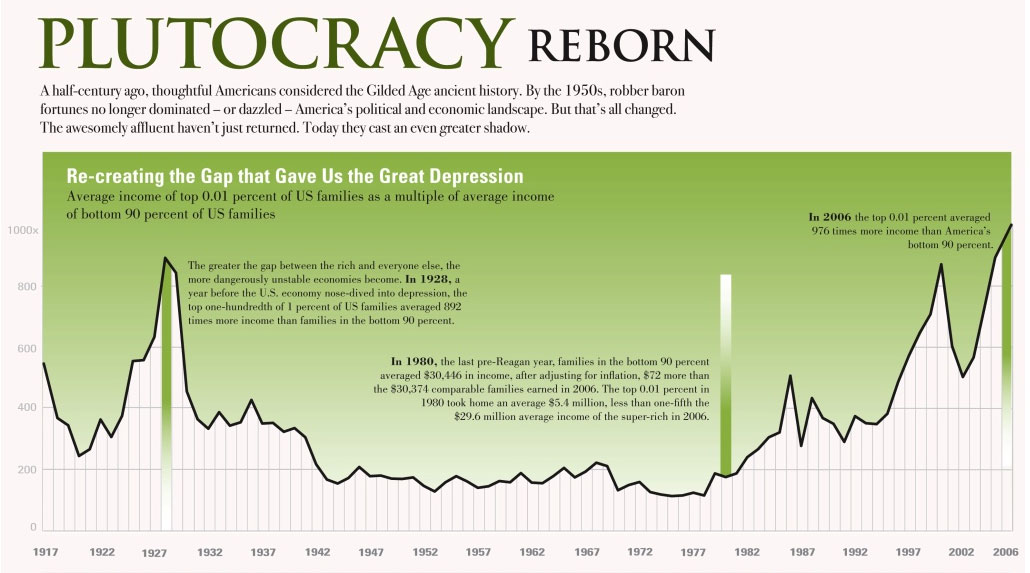
The basic flaw of the report—other than treating a nation as a private corporation, which carries a frightening amount of pernicious subliminal baggage—is its excessive reliance on arithmetic, scenarios and other corporate finance style BS that has nothing to do with what ails us (IMHO), namely, that our social contract no longer works.  Prima facie evidence of which is the prevailing kleptocracy that has replaced democracy in the United States.  The rules of corporate governance, the interlocking boards and CEOs, the tax system, the bought-and-paid-for Congress and its major client, the military-industrial complex, the massively messed up health insurance system—everything today conspires to make the USA, our nation, a banana republic.  Yes, we have no democracy.  The rich get richer, the poor get poorer.

How do you address a massively unequal rigged economic system, according to Morgan Stanley?  By cutting the entitlements of those at the bottom.  To make us more competitive, so the rich can get richer on the backs of American serfs.

The American social contract is broken.  It will take more than arithmetic to solve this problem.  It will take a massing of social will to reinstitute democracy in America. 


See also:  Fix Congress First!

Saturday, January 22, 2011

On taxing consumption, the rich, and other matters

I read The Atlantic’s colorful piece on The Rise of the New Global Elite with appreciation.  Upon reflection, it makes me wonder if Marx’s historical vision wasn’t right after all.  We’ve been saying for several generations that capitalism won because a rising tide lifts all boats and the immiseration of the proletariat never happened.

While shopping for a vendor to do some analytical work recently, I heard from the Indian firm’s young American sales rep, “Why don’t you play the labor arbitrage?”  Does playing the labor arbitrage justify Jeffrey Immelt’s huge compensation at GE?  How much intelligence does it take to do that?

For every genuine innovator who becomes a billionaire there are a hundred twenty hedge fund managers who take their money out of the markets by trading, often manipulatively, if Jim Cramer can be believed on anything (maybe just this).  One hedge fund manager of my acquaintance said in a moment of weakness that he really didn’t believe (the neoclassical economics-finance line) that what he did contributed in any way to “efficient allocation of resources.”

So, we have a class of ultra-rich folks who control the government and its labor and tax laws, and the markets, who think they are smart enough to deserve everything they get.  It’s private property, right? 

And now that the bottom 90 percent in America have been expropriated of much of their share of the nation’s wealth, the conventional wisdom says, “Tax consumption, all the other developed nations do.”

Why?  To provide funds for investment?  And where will that investment be?  Not in America, in all likelihood.  The rich will invest in the high-growth areas (as anyone can do through a mutual fund).  With the wealth lost in the housing bust and household deleveraging, consumption is already going to take a hit. 

How is this not going to further the descent into serfdom of the majority of Americans?  The last thirty years have proven that trickle down economics doesn’t work.  How to kill domestic demand.  Anything to avoid having the rich pay their fair share of taxes.

But The Atlantic’s article makes clear that the global elite sees themselves as world shape-shifters:  if a deal can lift three Indian families into the middle class at the expense of one American family, they call it a win.  They are blithely unconcerned with the rising gulf of inequality between their class and everyone else.

The big money has no national allegiances.  They see themselves “doing God’s work.” 

The moneychangers rule the world.  National governments take their orders.

+    +    +

U.S. aggregate demand, not adjusted for inflation:

image

To show how in-your-face the don’t-tax-the-rich movement has become, see this article from the Heritage Foundation (bold added—or read The Economist’s special report on the global elite):

Slow-Growth U.S. Now Ripe for Consumption Tax: Kevin Hassett

Kevin Hassett, On Sunday January 23, 2011, 9:00 pm EST

The prospect of meaningful tax reform has become the hot topic in the hearing rooms and, just as important, the back rooms of Washington.

House Ways and Means Committee Chairman David Camp, Republican of Michigan, devoted his first hearing to the topic, and President Barack Obama’s team is talking up the subject in private and in public.

“We’re examining whether we can find the political support for a comprehensive tax reform,” U.S. Treasury Secretary Timothy Geithner said on Jan. 12. Two days later, he met with financial officers from major companies, including Microsoft and Cisco Systems, to discuss the corporate tax rate.

The last overhaul of the tax code was in 1986, when President Ronald Reagan and congressional Democrats including Representative Dan Rostenkowski and Senator Bill Bradley crafted legislation that should be in the Tax Policy Hall of Fame, if there was one. In pairing lower marginal rates with an assault on exemptions and other loopholes, the Tax Reform Act of 1986 proved the benefit of broadening the tax base.

Now it’s time to take that one step further.

In 1651, the English philosopher Thomas Hobbes became the patron saint of tax geeks when he called for government to switch to a consumption tax -- one based on the money people spend, not what they earn. Such a tax, he argued in his book, “Leviathan,” was morally preferable:

“For what reason is there that he which laboureth much and, sparing the fruits of his labour, consumeth little should be more charged than he that living idly, getteth little and spendeth all he gets; seeing the one hath no more protection from the Commonwealth than the other?”

Passing Favors

Like Hobbes, those who today decry the irrationality of the tax code and advocate fundamental reform are ignored by elected officials. Rather than a simple-to-understand code, politicians prefer the current mess, a tangle of exceptions that makes it easy to pass out favors without being noticed.

Just figuring out what you owe is so complicated that few Americans dare do their own taxes. Talk about busywork: In her annual report, the Internal Revenue Service’s national taxpayer advocate, Nina Olson, estimated that American taxpayers and their hired preparers spend 6.1 billion hours annually complying with the law. That’s equivalent to the hours of 3 million full- time workers.

What might we accomplish by dedicating the work of these hypothetical 3 million people to something more productive?

Big Idea

Persistently slow growth has become the kind of problem that calls out for a big idea, one that can produce steady improvement, not just a short-term jolt. Moving toward a consumption tax would encourage investment in capital, potentially increasing future growth.

Lawrence Summers, writing in 1981 -- more than 25 years before he would serve as Obama’s chief economic adviser -- estimated that “a complete shift to consumption taxation might raise steady-state output by as much as 18 percent.”

Harvard University economist Dale Jorgenson, in a 2003 article, said a U.S. move to a true consumption tax is unlikely because it “would shift the burden of taxation from the rich to the poor.”

Instead, he proposed redrawing the existing income-based system so that that earned income is taxed at 10 percent, investment income is taxed at 30 percent, and every dollar of a business’s income generates a credit against its taxes. Jorgenson estimated that such a system would produce gains “equivalent to 19 cents for every dollar of U.S. national wealth.”

Boosting Output

For a book on fundamental tax reform that I edited in 2005 with Alan Auerbach of the University of California-Berkeley, we looked at literature on different models and concluded that switching to an ideal system might eventually increase economic output by 5 to 10 percent.

Our glaring need for economic growth is why, after so many years of talk, there seems to be a growing consensus behind real improvement to our tax code.

The groundwork for this consensus was established by President Obama’s National Commission on Fiscal Responsibility and Reform, which recommended reducing individual tax rates to three tiers of 8 percent, 14 percent and 23 percent, and reducing corporate taxation to a single rate between 23 percent and 29 percent, down from today’s top rate of 35 percent.

Political realities also argue for progress. House Republicans need to give their animated base a win, of course, and Obama needs a big reform as he approaches his 2012 reelection bid.

It’s been 360 years since Hobbes first called for the elimination of income taxation and wholesale adoption of a consumption tax. Its time may finally have come.

Kevin Hassett, director of economic-policy studies at the American Enterprise Institute, is a Bloomberg News columnist. The opinions expressed are his own.)

Sunday, August 15, 2010

Further evidence no double dip, just continued depression

When I say the economy is depressed, I mean it psychologically and in the sense that high unemployment appears to be here for a while.  One definition of a depression is a 10 percent decline in real output from peak to trough.  I expect the next collapse of “animal spirits” to complete that. 

Here is more evidence from Michael Panzer of www.financialarmageddon.com that we can expect consumers to slog on through for a couple of years, producing barely positive real growth (see previous post).

Via:  Daily Finance

Monday, August 2, 2010

The Great Accommodator strikes again

Alan Greenspan’s face says it all:  “I am a servant of the ruling class, I will accommodate the ruling class, whether as a Fed chief or as an ex-Fed chief.”  BTW, I find a certain similarity between the faces of Greenspan and the President.  These are not strong men.

Greenspan correctly diagnoses the split between the economy of the ruling class and that of everyone else.  Here is Barry Ritholtz at The Big Picture:

“Our problem, basically, is that we have a very distorted economy in the sense that there has been a significant recovery in a limited area of the economy amongst high-income individuals who have just had $800 billion added to their 401(k)s and are spending it and are carrying what consumption there is. Large banks, who are doing much better, and large corporations, whom you point out and the–and everyone’s pointing out, are in excellent shape.

The rest of the economy, small business, small banks, and a very significant amount of the labor force, which is in tragic unemployment, long-term unemployment, that is pulling the economy apart. The average of those two is what we are looking at, but they are fundamentally two separate types of economy.”

-former Fed Chair Alan Greenspan, Meet the Press

Fascinating quote from Easy Al on Meet the Press via Bloomberg. It has 3 subtexts that might not be readily apparent — until we break it down:

1) Extend the Bush tax cuts on highest bracket earners: Since its the 401(k) crowd that are carrying the recovery, Greenspan suggests, then we best not crimp the income of these big spenders

2) Two Americas: Greenspan seems to be channeling John Edwards when he discusses two economies. The bailouts reduced competition. They extended the life of badly structured financial firms, and forced smaller firms to scramble.

3) Greenspan’s Legacy: It seems that Easy Al can figure out precisely what he has wrought. The secret to getting such candor out of the former Fed chief is to trick him into discussing the broader economy.  That way, he does not realize that he is discussing the effects of his tenure as FOMC chair.

Of course, Greenspan is still wrong on Housing. Recall that he failed to recognize the impending housing correction (collapse more accurately) and made claims that the worst was behind us — just as housing was accelerating downwards:

“If home prices stay stable, then I think we will skirt the worst of the housing problem.  But right under this current price level, maybe 5, 7 or 8 percent below is a very large block of mortgages which are underwater, so to speak, or could be underwater, and that would induce a major increase in foreclosures.  Foreclosures would feed on the weakness in prices, and it would create a problem.  So that–it’s touch and go.”

One last thing: I have to give Greenspan credit for this touch of tax cut honesty:

“Look, I’m very much in favor of tax cuts, but not with borrowed money.  And the problem that we’ve gotten into in recent years is spending programs with borrowed money, tax cuts with borrowed money, and at the end of the day, that proves disastrous.”

For once, I agree with him . . .

Ah, Barry, you are usually so reasonable.  Why don’t we raise marginal tax rates on the ruling class who have manipulated the tax system and the governance of big corporations so much in their favor?  Are CEOs really worth 400 times the average workers salary today when the multiple was a tenth of that thirty years ago?  In other times of fiscal distress marginal tax rates on super-high incomes were higher, almost as if there were a sense that “shared sacrifice” was a good thing.  Are you and Alan the Mess-Meister suggesting that we should leave marginal tax rates on high incomes alone and raise them on the middle class?

Let’s get real.  Here’s the picture that tells the story of how America has moved from “we’re all in this together” to “you first, after me—it’s the free market way!":

Until Americans start to function as a nation again, we descend into deeper banana republicdom.  Is it the end of the nation-state?  Is the only path to survival to join a strong corporation (i.e., “gang”)?  Will corporations that perpetuate stark inequality survive, if there is truly an “optimal” degree of income inequality that American corporations have clearly exceeded?  Will more egalitarian corporations benefit from higher productivity and resiliency, if the nation-state dies, and prove the template for the next major form of social organization?  (Unfortunately, the immediate associations that come to mind are of the perpetually-warring native American tribes prior to European overrun; and the incredibly funny scenes of warring office buildings in Monty Python’s “The Meaning of Life.”…)

Big changes coming.  The old order is falling apart.  Do unto others as you would have them do unto you.

Friday, July 9, 2010

Consumption will continue to fall

As I have pointed out in the past, Consumption reached unsustainable percentages of GDP over the past 30 years as median wages stagnated, the rich manipulated the tax system and corporate compensation to their advantage, and consumers financed consumption spending out of illusory bubble profits on their houses, or simply out of increased debt.  Note that wages and salaries began their decline in 1971.while the federal government led the way toward greater indebtedness for all.  The conversion of billions of dollars of compensation into “capital gains” hides the trend toward increasing top-drawer incomes when looking at the NIPA numbers for wages and accrued salaries.  See Saez for what the tax returns showed.

image

Investment is at record postwar lows as a percentage of GDP, and as everyone knows, Government spending (not pictured) is rising as a share of GDP. 

Inevitably, Consumption must fall—unless there is a dramatic increase in wage and salary income (that would also fuel derived domestic investment demand, presumably).  But will (domestic) Investment step up to the plate to fuel aggregate demand without Consumption being supported by incomes?  Not likely, when there are so many solvent, rapidly growing countries in the world to invest in without the specter of the IRS hanging over them.  See Global Guerillas for an argument that the US is becoming a "hollow state,”  and The Global Political Awakening and the New World Order for a high-toned prediction that seems to say that the New World Order will be toast pretty soon.  The prescient Gerald Celente seems to think we’ll be hearing a lot of “power to the people” soon.

Wednesday, May 12, 2010

The collapse of effective demand (cont.)

First quarter 2010 data on the components of nominal aggregate demand show only consumption and government spending above pre-recession levels.  Investment spending is at early 2003 levels in dollars and would be lower in real terms. 

image

The uptrend in consumption is not supported by “real” personal income growth as pointed out by contraryinvestor.com in their May note—it’s mostly coming from government transfer payments.


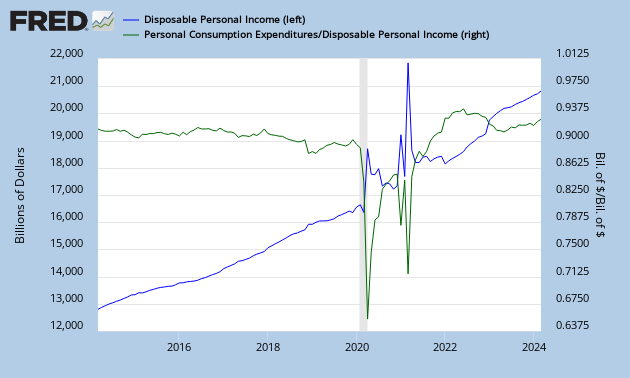
Consumption out of disposable income is soaring again as consumers get tired of saving.

image

The picture of final sales to domestic purchasers shows domestic nominal demand at 2007 levels.

image

Employment/population has improved slightly, it is still at early 1980s levels, and the labor market continues to be very slack, with the unemployed experiencing extreme difficulties in finding a new job.

image

If the government experiences any trouble at all in floating its debt, the transfers to the lower income brackets will probably be diminished, causing a collapse of consumption spending.  The lifting of the “emergency” extensions of unemployment benefits would fall into this category.

The government could kill the economy more quickly in a number of ways, including requiring 1099s to be filed for all expenses over $600 paid by any business that would kill small business; by the imposition of a VAT that would kill small business; by a tax increase on any middle- or lower-income bracket.

The rich have conspired to suck a disproportionate amount of the income from corporate America to themselves, while keeping marginal tax rates on that income at historically low levels.  There is not organic personal income growth to support a recovery.  A “classic Keynesian” prescription would be for government to debt-finance a massive government investment injection to aggregate demand, but the bond market probably won’t like that.  Keynesianism as practiced by the mainstream has ignored debt/GDP, now at record levels. 

In the coming collapse of aggregate demand, the rich will have to answer the question, “Am I my brother’s keeper?”

Friday, April 2, 2010

The calm between storms

The stability of a 9.7 percent unemployment rate repeated three times can be expected to enhance consumer and business confidence or “animal spirits” in the coming months.  Recall that the measure of “animal spirits” of the obscure economist that I channel is

A = - (U – UMEAN)/Sigma(U)

where A is “animal spirits,” U is the unemployment rate and UMEAN is a 48-month exponential moving average of U, and Sigma(U) is its standard deviation over that period.  The idea is that that people make normalized judgments of current conditions based on what they’re used to, as suggested by adaptation level theory, and that the thing that most influences confidence levels is folks’ perceived job insecurity.

image

Making a freehand forecast of unemployment suggests that “animal spirits” will rise to about the zero level in time for the next Presidential election, and that the next collapse of confidence (which we believe is the signature of a serious business slump) will not occur until about 2013-2015. 

Our recession probability model forecasts virtually no chance of a slump in the next 12 months.

image

This is not to suggest the economy is healthy.  As regular readers know, I subscribe to the hypothesis of The Fourth Turning that we are heading toward a period of extreme change characterized by a complete collapse in the social contract and the legitimacy of the current government.  See this post and links for more.  From an economic perspective, the extreme inequality of income and wealth we have now is the strongest indicator that the system no longer works for most folks the way it used to.  In short, the ruling class—led by Wall Street—is now bleeding America to death.  There will be no lasting recovery without equalization of pay scales across corporate America, and fundamental reform of the financial sector to prevent the Fed from simply being a money machine for an elite few.

I’m including a chart on labor market volatility to underscore the dynamics of why confidence will increase in the next secular exhilaration.  The labor market’s volatility as measured by Sigma(U) will peak soon and begin to decline; labor market volatility tends to peak before “animal spirits.” Once unemployment falls below its adaptation level in about 2012, and A rises above zero the diminished labor market volatility will boost confidence sharply.

image

Without a rebalancing of aggregate demand through greater equality of incomes and more progressive taxation, America may sink into a neo-feudal state in which its worst authoritarian qualities will come to the fore, and in all likelihood extinguish the best of what America has been. 

What will the quality of the current expansion phase be?  I have to believe it will be characterized by muted growth.  Investment has collapsed, and “Knightian” or fundamental uncertainty has entered the picture with regard to the fiscal future of America.  Americans are still over-consuming; consumption must fall.  Government is tapped out—so where will the demand come from?

Instead of foolishly insulting them Krugman-style (although this could be part of the political cover game, Krugman just being a tool) we should be offering the Chinese opportunities to spend their trillions of reserve dollars on American businesses and real estate.  Make them offers now and we’re better off than we will be after the dollar collapses.  How unhappy are they in Montgomery, Alabama, that Hyundai decided to build a plant there?  Not very.  And we might remain friends and avoid World War III or IV or whatever your number is by promoting Chimerican symbiosis.  When was the last time we were at war with Great Britain?

My judgment is that the next downturn is likely to be worse than the last one.  Gird yourselves.

Friday, March 26, 2010

The “shop till you drop” economy

With the collapse of Investment, Consumption has roared to record highs as a percentage of GDP.  Data to 2009Q4.  Who would want to invest in the United States when there are fiscally solvent, rapidly growing emerging economies to invest in? 

image

GDPI = Gross Domestic Private Investment; PCEC = Personal Consumption Expenditures.  Both in current dollar terms.

Monday, March 15, 2010

The collapse of effective demand (cont.)

“Effective demand” is the dollars flowing into actual demand.  In a collapse of effective demand most people simply don’t have or spend enough money, and aggregate demand collapses.  This is where I think we are heading. 

Final dollar sales to domestic purchasers are on a downward trend…this the flow of money in dollar terms from Americans into the spending stream….

…even as dollar disposable income staggers upward with help from occasional fiscal injections with the rate of consumption spending out of disposable income returning to a long-term trend rate of 93 percent…

…while the components of nominal (dollar) aggregate demand, Y = C + I + G + (X – M), show chronic weakness in investment and net exports, with consumption growing fastest and government spending chugging ahead….


Of components contributing demand, only consumption has risen to pre-Great Recession levels in dollar terms.  Any whiff of inflation is translated immediately into lower real purchasing power. Private domestic investment is at 2002 levels in dollar terms; it is at 1998 levels inflation-adjusted.  Consumption depends on the household sector that depends on jobs and income to spend.  Wisely, Congress extended unemployment benefits through 2010.  But a second round of exotic mortgage rate resets is due later in 2010 and 2011, and it is more difficult than any time in the past 30 years to get a job in America…

…while a strong dollar, so necessary to our continued successful Treasury auctions, hurts us in exporting manufactured goods, the United States still having the largest industrial output of any nation, and the developing world growing much faster than we are and in need of manufactured capital goods. Our net exports are solidly negative and cannot be counted on to pull up aggregate demand in the near future, though they may drag it down less.

Thus a rebalancing of domestic demand would seem to be required to forestall a potential humanitarian disaster in the United States, namely entrance into a depression as domestic effective demand collapses. As I have maintained all along, the government needs to provide poverty level workfare to the unemployed and health care to all Americans.  The next recession is likely to be even more severe than the recent one.  Those to whom much has been given (as all products are joint) need to step up to the plate.

However, it may be that Americans’ collective distrust of government, and the power of entrenched interests, will prevent any rebalancing.  The trash talk about the Democrat’s health bill is illustrative.  The bill applies tax surcharges only to small business owners making more than $1 million a year, affecting only about 1 percent of small business owners.  If the health bill goes down, I would guess that the odds of an equitable rebalancing of demand diminish radically.

America may fracture in this case, with state and local governance becoming much more important.  

The last great leveling of the income distribution, that “corrected” the imbalances of the 1920s and the Great Depression (the New Deal didn’t do it) occurred in a few short years in the early 1940s, as the United States entered into a world war.

Can the income distribution become more equitable without another world war?  Or do we collapse into neo-feudalism and a rigid class system for generations to come?

Sunday, November 29, 2009

Is global warming unstoppable?

Via:  Science Daily

ScienceDaily (Nov. 24, 2009) — In a provocative new study, a University of Utah scientist argues that rising carbon dioxide emissions -- the major cause of global warming -- cannot be stabilized unless the world's economy collapses or society builds the equivalent of one new nuclear power plant each day.

"It looks unlikely that there will be any substantial near-term departure from recently observed acceleration in carbon dioxide emission rates," says the new paper by Tim Garrett, an associate professor of atmospheric sciences.

Garrett's study was panned by some economists and rejected by several journals before acceptance by Climatic Change, a journal edited by Stanford University climate scientist Stephen Schneider. The study will be published online the week of November 23.

The study -- which is based on the concept that physics can be used to characterize the evolution of civilization -- indicates:

  • Energy conservation or efficiency doesn't really save energy, but instead spurs economic growth and accelerated energy consumption.
  • Throughout history, a simple physical "constant" -- an unchanging mathematical value -- links global energy use to the world's accumulated economic productivity, adjusted for inflation. So it isn't necessary to consider population growth and standard of living in predicting society's future energy consumption and resulting carbon dioxide emissions.
  • "Stabilization of carbon dioxide emissions at current rates will require approximately 300 gigawatts of new non-carbon-dioxide-emitting power production capacity annually -- approximately one new nuclear power plant (or equivalent) per day," Garrett says. "Physically, there are no other options without killing the economy."

Getting Heat for Viewing Civilization as a "Heat Engine"

Garrett says colleagues generally support his theory, while some economists are critical. One economist, who reviewed the study, wrote: "I am afraid the author will need to study harder before he can contribute."

"I'm not an economist, and I am approaching the economy as a physics problem," Garrett says. "I end up with a global economic growth model different than they have."

Article continues here.

Read the paper at arXiv.org here.  Should be read in conjunction with that oldie-but goodie, “Finite-time singularity in the dynamics of the world population, economic and financial indices” found here.

Moral: Prepare for a lower standard of living.

Tuesday, November 10, 2009

A picture of the collapse of effective demand

image

Aggregate Demand  = Consumption + Investment + Government + Net Exports

I’ve included all series in nominal dollar terms because that’s what matters in the end, whether the dollars are flowing or not.  All series are relative to an index equal to 100 in 1990:1.  Net exports was more volatile so it got its own scaling on the right axis (note that the index is positive, even as we ran a negative trade balance).

Investment and net exports have collapsed the most.  Consumption is bravely trying to get back to where it was in early 2008, but will probably not get there.  At the risk of a busy graph I’ve included wage and salary compensation of employees; it has tanked more than consumption.  So there is some question what’s going on with the consumption numbers, as Contrary Investor points out, possibly transfer payments.  The (ridiculously named) Permanent Income Hypothesis tells us consumers may just be adjusting to the new realities slowly.  (Why couldn’t Friedman just call it an adaptation level, and fall in line with the central currents of scientific thought?  Why couldn’t Shiller and Akerlof cite the most important paper published on “animal spirits” in the past twenty years?  Such is arrogance and provinciality of economists.)

Investment spending is usually more responsive to my “animal spirits” measure.  A technician would look at the government spending line and say “looks hyperbolic” and therefore unsustainable.  Government spending has been growing at a faster than exponential rate over the past couple of years.  The econophysicists have shown us that faster than exponential growth is a signature of a process heading toward a “singularity,” or phase change, or crash, in the case of stock markets.  It’s reasonable to suppose a similar process must organize government spending.

Thursday, November 5, 2009

Magical misdirection from the ruling class

Reading the summaries of the Treasury-blogger love-fest (see interfluidity) brings to mind some recent stuff I’ve read about magic, that it’s all about misdirection.  Get the people looking in the wrong places and you can fool them every time.

The cause of our current collapse of effective demand, which is not going to go away soon (proof:  consumption is falling 5-10 percentage points from 71 percent of GDP, and the government is too broke to make up the aggregate demand with government investment spending, not to mention that they’re too incompetent to do it, and private investment is still to scared to jump in) is not fundamentally too much debt, although that is a proximate cause, it is mal-distribution of income (and increasingly and massively so, of wealth). 

Once the glorification of greed really got going 30 years ago under Reagan, the rich started to manipulate the system (taxes, incomes) more and more to their benefit, with the assent of the masses, who all expected to grab the gold ring themselves at some point.  As I point here, as the rich started to pull away, everyone else took on too much debt to try to keep up.  The way things are going, I am not alone in worrying about the US becoming a neo-feudal society; Emmanuel Saez, the establishment economics profession’s leading expert on income and wealth inequality, shares the concern.  I qualify the profession because the best research on what’s actually happening has been coming from alternative sources for some time now, e.g., Robert Prechter’s book Conquering the Crash, which was early on the timing, as is so often the case, but got the big picture right, which is more than you can say for Bob Rubin, Larry Summers, or any of the other clowns in Washington with the possible exception of Ron Paul.

So all the talk about reforming regulation (Right!  We’ll trust them to do their jobs next time?), putting in a systemic risk regulator (we already had one, called the Fed, totally compromised by Wall Street—they let the whole thing happen so the Wall Street bankers could get rich quick), about “too big too fail” and so on ad nauseum is pure misdirection, a shell game.  So long as the crooks are running the show there will be no reform.

And why don’t shareholders, who by and large own the companies of America through their pension funds, and who, by and large, are not fat cats—why don’t the shareholders attack the obscene compensation the small club or CEOs and board members arrange for themselves?  Peter Drucker wrote about “pension fund socialism” thirty years ago.  It didn’t happen, did it?  The pension administrators are in on the game.  Peter, with whom I discussed this years ago, must be rolling over in his grave

Obscene greediness needs to become so socially unacceptable that its practitioners wither away.  Or go away.  And lots of luck trying to get your money out of the country.

This is why when I write to my elected representatives I stress that America is a fiscal basket case, and that we need to begin to practice triage, providing necessary human services—a poverty level dole, education and health care—to the unemployed and abandon all stupid imperial ambitions and obscene bail-outs for the well-heeled.

And for crying out loud, get the investment banks out of the Fed’s cookie jar.  The carry trade that’s happening now is obscene beyond measure and “will not end well.”

Wednesday, September 16, 2009

Industrial production stuck in last century

While industrial production has turned up, and by NBER standards the recession may be over (they’ll decide well after the fact), industrial production will probably remain depressed for several years.  Given the debt drag on the economy, the collapse of consumption and investment, industrial production isn’t likely to achieve 110+ levels for many years if my forecast of another round of deflationary collapse in about four years is correct.

image

Looking at percent changes from a year earlier for industrial production, real consumption spending, and real private fixed investment spending it is tempting to look for an accelerator-type pickup.  Real consumption spending has been far more stable than either of the other series.  But real consumption spending is taking a beating from increased saving, slow-to-no wage growth, and yet-increasing unemployment, and real estate investment spending on construction isn’t coming back soon, so any accelerator effect (derived demand for investment spending) is likely to be muted.

image

Data to August 2009 except for investment which is quarterly to 2009Q2.

Monday, September 14, 2009

Real consumption spending to rise from the dead, briefly

Tim Duy offers some dyspeptic comments on confidence and consumption similar to my own a few days ago.  However, he (and the rest of mainstream economics) continue to ignore research (however obscure) indicating the adaptation level theoretic foundations of confidence determination (reference).  Duy’s nice graph of year-over-year real consumption spending against the University of Michigan sentiment series inspired a similar effort with the “animal spirits” indicator that shows that real consumption spending is about to enter a growth phase.  The contemporaneous correlation of YOY real C and “animal spirits” is about 0.63; the regression with constant has an adjusted R^2 of about 0.33.  But the “animal spirits” indicator has proven extremely sensitive to turning points and trends, more so than the Michigan series.

This is consistent with my general view that the U.S. economy is entering a relatively brief “anti-deflationary” reflationary bubble that will resemble an ordinary business cycle except for the elephant in the room, namely, a growing national debt-to-GDP ratio coming on top of record levels of the ratio.  If I had to bet on whether private sector deleveraging will outrun public sector leveraging, I would bet not.  Not enough private debt is being written off.  The U.S. has more debt than it can service now (see Comstock’s piece).  In 1933 we were the world’s greatest creditor and could borrow easily.  Today our currency is at risk of substantial depreciation.  Our social contract is broken, with extreme inequality in incomes and wealth and a general self-defeating distrust of government by the disenfranchised.  Our deflationary collapse has only stalled.  The tragedy is that the rising “animal spirits” of the next several years will probably guarantee that no meaningful reform takes place—of the financial sector, of the government’s priorities and budget, perhaps even of health care.  In this environment both fiscal stimulus and quantitative easing are fool’s games.  The government should provide health care and livable workfare to the unemployed and limit any increase in spending.  America is a basket case but the government won’t admit it. 

Real consumption should grow 2.0-2.5 percent over the coming year, and may accelerate to about 5 percent YOY growth over the next four years, before the next downturn.  Here’s the chart:

image

Forecasted “animal spirits” in blue, real YOY consumption percentage in red.