Showing posts with label bubble. Show all posts

Monday, April 7, 2014

MMT is here already

I cannot recomment strongly enough reading David Stockman's cogent exposition of how MMT is already here:

Yellen’s Dog Is Eating Homework Congress Didn’t Even Assign: Reflections On The Greatest Mission Creep Ever

MMT is just another egregious form of fiat money. I have come to believe that human primates are not sufficiently self-controlled to handle the ability to print money without abusing it in extreme ways. Money based on metal provides, historically, stable prices, and hence removes the impetus for ever-increasing leverage (to get rich quick). The proponents of MMT on the left would use it to promote social welfare, I agree; but the Fed has beaten them to it, to promote welfare for bankers.

As to the critique that metal-backed money creates too much instability, two points:

First, fractional reserve banking existed during the gold era, and yet prices were stable on average over long periods. To my knowledge, this effect hasn't been totally explained. To dispense with the assertion that modern, post-1971 monetary policy created a "great moderation," no, it created a great debt bubble, as spending went further and further beyond income.

Second, the very idea that the business cycle should be stabilized is suspect. People should be stabilized. Most cyclical adjustments (or even more so, structural adjustments) need to be made; and "stabilization" policy simply masks what needs to be done, and generally prevents progress from being made. For example, preventing bad debts from being charged off rather than being put on the backs of taxpayers (around the world, as our model has been copied).

People in transition should be stabilized. People are in fact any nation's greatest resource. They should be kept healthy and offered transition assistance or at least a basic income.

What we are learning is that "stabilization" has been coopted on behalf of the haves, the have-nots don't have enough money, and aggregate demand and human capital are collapsing.

Thursday, March 20, 2014

Janet Yellen interview

I have just watched the Janet Yellen interview (available here) from forthcoming movie, Money for Nothing: Inside the Federal Reserve, and I must say I found Ms. Yellen's Brooklyn folksy I'm-your-friendly-Berkeley-macro-teacher persona absolutely nauseating.

Questioned aboat the steps taken to resolve the financial crisis in 2008 she presents the same tired "we had to do something of the system was gonna collapse" without the slightest seeming awareness that when FDR, one of her putative heroes, I would guess, attacked the same structural problem in the 'Thirties he took structural actions to remedy them.

She certainly has never made a loan and has no understanding of what bad debt is, debts that will never be repaid and should be charged off by the bank with the bank taking the loss.

It's the same old Hank Paulson, either/or, bail Wall Street out, ignore the fraud, let them increase their bonuses in coming years on the backs of the taxpayers--or it's martial law.

And these macro people still think the Phillips Curve works!

I could go on, but I can't. It was just sickening.

Janet Yellen will do Wall Street's bidding and like Bernanke cash in afterwards.

I hope I outlive the Fed. It will be great day for America when the Fed is abolished.

Wednesday, December 11, 2013

Taper -- not... Competitive bubble blowing at the Fed

What do you wanna bet Janet doesn't have the cojones to taper (much)?

Wall Street will undoubtedly exert its control over the West Coaster, to get her trained.

But more importantly as John Hussman points out it is the relationship between the stock of assets on the Fed's balance sheet and GDP that matters, and a mere slowing of asset purchases won't much change that.


This confirms my view that rates will stay low for years to come, that we are following in broad outline the Thirties, and that a return to "normal" rates will not occur until a resolution of the Crisis is within sight (ZIRP persisted in the Great Depression until about 1942).


Sunday, October 20, 2013

My favorite blog posts from the week

Tax Rates, Inequality, and US Deficits – Barry Ritholtz.  Sometimes no one nails it like Barry.

Its Friday, after what was for me a long and annoying 17 days. But the shutdown is over, US markets are at all time highs, and Bob Shiller got his Nobel (more on this tomorrow).

You might think that I would be at peace with the current state of the world, but life is never that simple. You see, I have assumed the task of explaining things which require explaining. By some quirk of fate and an odd academic background, I find myself with skills in simplifying complex matters. Whether OCD or over-compensation for some other defect, this is my lot in life. (I made peace with it long ago).

As we discussed yesterday, amongst all of the background nonsense since October 1, the noise about the deficits was not really about budget deficits at all. Rather, it was about a decidedly narrow ideology held by a small percentage of Americans. Their belief is that government should be much smaller. This is a legitimate political ideology, one that has persisted over the centuries.

Their approach to this philosophy, however, is far less intellectually honest. Rather than having a full on debate on that subject — a debate they are likely to lose — they have chosen a very different approach. This time around, they made the deficit a proxy.

Because of what I do for a living, I found this offensive. Deficits impact fixed income, an important part of portfolio planning. They impact available credit, capital for investment, in a broad and varied way. Hence, the deficit is a genuine issue, a real problem that should be addressed in a mature and responsible way. It can be easily solved using intelligent solutions, but for the ideologues in Washington DC (and elsewhere) who refuse to treat it as the basic mathematics and accounting problem it actually is. The way the Tea Party and others have treated the deficit reminds me of the approach Meredith Whitney took to Municipal Debt. Both groups are stunningly ignorant about their subjects, while possessing the skills to allow them to exploit the topic, hog the spotlight for themselves and other tangential pet issues.

The Tea Party, like Whitney, turned an important question of debt and credit and solvency into one giant PR clusterfuck.

Back to our issue of taxes (next week, I will address spending). Amongst Industrialized Nations, the United States has amongst the lowest tax rates in the world, especially for those folks (like myself) who reside at the top of the income scale.

To demonstrate this, I want to point to the IMF’s World Economic and Financial Surveys: Taxing Times. It is chock full f great charts and data and other interesting results of the IMF survey.

The two below caught my eye. They are rather instructive for our discussion of taxes and deficits in the US.

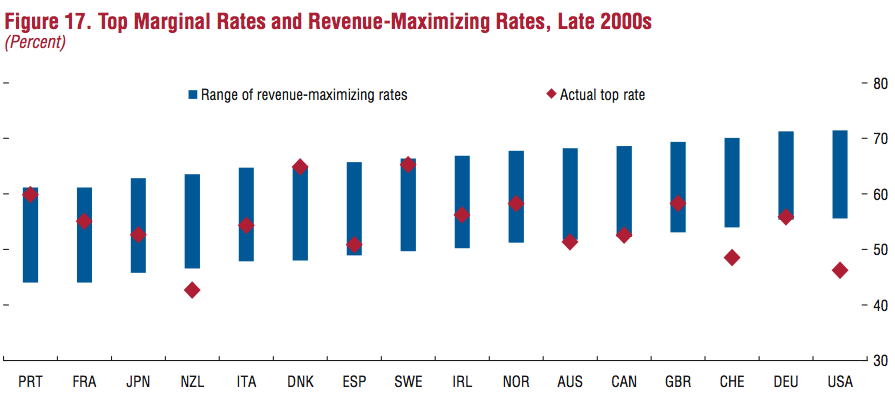
The first looks at major industrial nations, and compares what the IMF calls their Revenue-Maximizing Tax Rates (blue line) versus their actual top rate (red dot).

As you can see, some countries — Denmark and Sweden — are at the top of the revenue maximizing ranges. Other countries — Canada and Germany — are at the bottom of their revenue maximizing ranges.

Then there is the United States, which is simply far off the scale, way below the bottom of its revenue maximizing range.

If your concern is deficits, than you must take notice of how much money the USA is leaving on the table. I am not suggesting that the role of government should be to maximize their tax revenues, but rather to suggest that if you want to close the deficit, you need to at least be in a defendable range. The US is not.

click for ginormous charts
Top Marginal Rates
Source: IMF

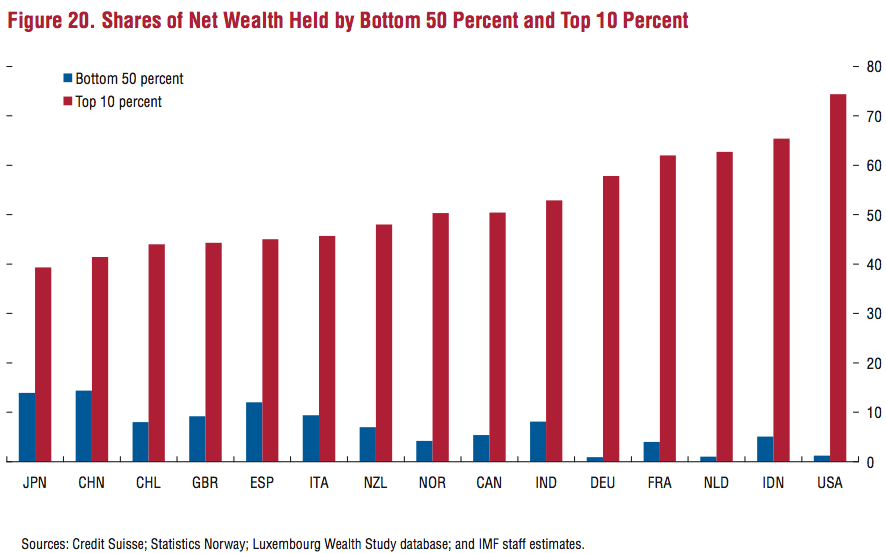
Not coincidentally, when we look at shares of Net Wealth held by the bottom 50% of he population versus the top 10%, the United States is off the scale. We are the most unequal nation in the world.

Shares of Net Wealth
Source: IMF

The inescapable conclusion presented to us by this data is that our tax policy is responsible for both the world’s greatest inequality among developed nations, and our ongoing deficits.

If you have a better explanation for our current conditions, or the net results of our tax policies, I would love to hear it.

Source:
Fiscal Monitor Taxing Times
World Economic and Financial Surveys
IMF October 2013
http://www.imf.org/external/pubs/ft/fm/2013/02/fmindex.htm

Did Monetary Policy Cause the Recovery? – John Hussman. A very nice demolition of our monetary policy charade for Janet Yellen to consider. Let’s hope she has the guts to make some heads roll [i.e., to bring back honest accounting].

[…] To address this question, a proper understanding of the credit crisis is essential. Much of the present faith in monetary policy derives from the belief that it was the central factor in ending the banking crisis during what is often called the Great Recession. On careful analysis, however, the clearest and most immediate event that ended the banking crisis was not monetary policy, but the abandonment of mark-to-market accounting by the Financial Accounting Standards Board on March 16, 2009, in response to Congressional pressure by the House Committee on Financial Services onMarch 12, 2009. The change to the accounting rule FAS 157 removed the risk of widespread bank insolvency by eliminating the need for banks to make their losses transparent. No mark-to-market losses, no need for added capital, no need for regulatory intervention, recievership, or even bailouts. Misattributing the recovery to monetary policy has contributed to a faith in its effectiveness that cannot even withstand scrutiny of the 2000-2002 and 2007-2009 recessions, and the accompanying market plunges. This faith is already wavering, but the loss of this faith will be one of the most painful aspects of the completion of the present market cycle. […]

The simple fact is that the belief in direct, reliable links between monetary policy and the economy - and even with the stock market - is contrary to the lessons from a century of history. Among the many things that are demonstrably nottrue - and can be demonstrated to be untrue even with simple scatterplots - are the notions that inflation and unemployment are negatively related over time (the actual correlation is close to zero and slightly positive), that higher inflation results in lower subsequent unemployment (the actual correlation is positive), that higher monetary growth results in subsequent employment gains (the correlation is almost exactly zero), and a wide range of similarly popular variants. Even "expectations augmented" variants turn out to be useless. Examining historical evidence would be a useful exercise for Econ 101 students, who gain an unrealistic sense of cause and effect as the result of studying diagrams instead of data.

Thursday, September 19, 2013

The Fed is (probably) insolvent; bank margins to suck more

John Hussman has come and said what many have believed for some time now, that the Fed is probably insolvent (here).

The Fed has become the dumping ground for bad assets. Here’s what happens: they take them in from the banks at some highly notional (what is called “mark to unicorn”) value and hold them as “reserves” against the bank’s putatively active lending; which may or may not occur because the Fed now pays interest on reserves even as the reserves are likely deteriorating in value.

The Fed is the proverbial carpet under which the bad debt of the banking system is swept. Hence, the creditors and owners of banks and bank holding companies are relieved of having to recognize losses, and the fiction of “simulative monetary policy” is maintained. As Zero Hedge is fond of pointing out, the only known transmission mechanism from loose money to anything is to asset bubbles, the current one being stocks again, with a bubblet appearing in real estate.

This is capitalism without failure writ large. The antidote, in the view of the “Washington [/New York] consensus” (to borrow a term) is “more of the same.”

Like Bernanke, Janet Yellen didn’t a thing coming of the last crisis (even though the world-wide ramp-up of housing pricing made front page news in “The Economist,” as I recall.

And I can say from personal experience that many in retail banking wondered what would happen to Consumption when the housing ATM was shut off.

Thus I believe MMT will win out in the end, as war and/or infrastructure projects demand funding. Whether a major inflation or hyperinflation gets going remains an open question to me, as I believe an inflation (wage-price spiral) is a labor market phenomenon accommodated by monetary policy, and there seems little indication that the PTB have any intention of raising anybody’s wages.

Bad debts, those destined for charge-off, don’t go away by themselves; they have to be charged off. A major deflation will occur when that reconciliation finally takes place. Even if accounting fiction remains in place, the fact that such debts when returned to the banking system do not contribute revenues tells us bank margins are going to get a lot thinner in the future. A bank may be able to dress up its balance sheet but not so much its income statement.

Thursday, September 27, 2012

If we were a democracy…

Via: Reuters

Fighting Recession the Icelandic Way

Few countries blew up more spectacularly than Iceland in the 2008 financial crisis. The local stock market plunged 90 percent; unemployment rose ninefold; inflation shot to more than 18 percent; the country’s biggest banks all failed.

This was no post-Lehman Brothers recession: It was a depression.

Since then, Iceland has turned in a pretty impressive performance. It has repaid International Monetary Fund rescue loans ahead of schedule. Growth this year will be about 2.5 percent, better than most developed economies. Unemployment has fallen by half. In February, Fitch Ratings restored the country’s investment-grade status, approvingly citing its “unorthodox crisis policy response.”

You can say that again. Iceland’s approach was the polar opposite of the U.S. and Europe, which rescued their banks and did little to aid indebted homeowners. Although lessons drawn from Iceland, with just 320,000 people and an economy based on fishing, aluminum production and tourism, might not be readily transferable to bigger countries, its rebound suggests there’s more than one way to recover from a financial meltdown.

Nothing distinguishes Iceland as much as its aid to consumers. To homeowners with negative equity, the country offered write-offs that would wipe out debt above 110 percent of the property value. The government also provided means-tested subsidies to reduce mortgage-interest expenses: Those with lower earnings, less home equity and children were granted the most generous support.

Debt Relief

In June 2010, the nation’s Supreme Court gave debtors another break: Bank loans that were indexed to foreign currencies were declared illegal. Because the Icelandic krona plunged 80 percent during the crisis, the cost of repaying foreign debt more than doubled. The ruling let consumers repay the banks as if the loans were in krona.

These policies helped consumers erase debt equal to 13 percent of Iceland’s $14 billion economy. Now, consumers have money to spend on other things. It is no accident that the IMF, which granted Iceland loans without imposing its usual austerity strictures, says the recovery is driven by domestic demand.

In addition to easing consumer debt, Iceland reduced government spending and increased revenue by raising taxes and cutting deductions that mainly benefited the well-off, a path the U.S. might profitably emulate. In fact, relief for overburdened U.S. consumers is a cause promoted by former U.S. Federal Deposit Insurance Corp. Chairman Sheila Bair in a new book published this week. Bair would have done more to aid sinking homeowners and done less for banks, but she says her efforts were blocked by Treasury Secretary Timothy Geithner and others.

It worked in Iceland. A deficit that reached 13.5 percent of gross domestic product in 2009 fell to 2.3 percent last year. The IMF predicts Iceland will have a primary surplus (excluding interest on debt) of 1.5 percent this year.

As for the banking industry, Iceland never had an option to adopt the too-big-to-fail policy that led governments in the U.S. and Europe to prop up their banks. Assets held by Iceland’s three largest lenders had swelled to nine times the size of the economy. After they defaulted on $85 billion in debt, the government seized control of them.

Initial plans to repay foreign creditors, mostly U.K. and Dutch depositors, collapsed in 2009 as street protests led to the demise of the government. Repayment of obligations to overseas creditors was either postponed or written off, leaving the reconstituted banks with much smaller domestic operations. Twice, Icelanders rejected national referendums on repaying foreign depositors, who are pressing their claims in European courts.

Holding Accountable

A new government led by Johanna Sigurdardottir embarked on a campaign to hold accountable the so-called neo-Viking bankers at the center of Iceland’s crisis. Instead of picking a prosecutor from law firms in Reykjavik, which had depended on the banks for business, the government drafted an investigator from a remote village. Although a number of bankers fled the country to avoid prosecution, the former chiefs of two of the three biggest banks have been indicted and are standing trial.

Undoing the damage caused by the crisis is a work in progress; not every Icelandic innovation would be feasible in the U.S. or Europe. Iceland’s debt stands at almost 100 percent of GDP. Many of the country’s professionals have left for Norway and Denmark amid a dearth of jobs. Iceland still must figure out how to ease constraints that barred investors from withdrawing as much as $8 billion from the country and transferring it overseas. Inflation remains stubbornly high. To counter that, and to prevent capital flight, Iceland’s central bank has increased interest rates five times in the past year. But raising interest rates makes credit more expensive, checking growth.

Iceland’s central bank on Sept. 18 released a report suggesting the country go slow with plans to enter the European Union, a process started in 2010 when the euro seemed sounder than the krona. Becoming a member won’t be easy: If the issue were put to a referendum, Icelanders would probably reject admission. And why would Iceland want to join now? Euro-member nations such as Greece and Ireland offer testimony to the risks of being yoked to a currency along with stronger economies.

Devaluation of the kind Iceland suffered is never fun. Reneging on debts leaves a legacy of violated trust. But it still looks better than recession with no obvious way out.

Wednesday, May 12, 2010

The collapse of effective demand (cont.)

First quarter 2010 data on the components of nominal aggregate demand show only consumption and government spending above pre-recession levels.  Investment spending is at early 2003 levels in dollars and would be lower in real terms. 

image

The uptrend in consumption is not supported by “real” personal income growth as pointed out by contraryinvestor.com in their May note—it’s mostly coming from government transfer payments.


Consumption out of disposable income is soaring again as consumers get tired of saving.

image

The picture of final sales to domestic purchasers shows domestic nominal demand at 2007 levels.

image

Employment/population has improved slightly, it is still at early 1980s levels, and the labor market continues to be very slack, with the unemployed experiencing extreme difficulties in finding a new job.

image

If the government experiences any trouble at all in floating its debt, the transfers to the lower income brackets will probably be diminished, causing a collapse of consumption spending.  The lifting of the “emergency” extensions of unemployment benefits would fall into this category.

The government could kill the economy more quickly in a number of ways, including requiring 1099s to be filed for all expenses over $600 paid by any business that would kill small business; by the imposition of a VAT that would kill small business; by a tax increase on any middle- or lower-income bracket.

The rich have conspired to suck a disproportionate amount of the income from corporate America to themselves, while keeping marginal tax rates on that income at historically low levels.  There is not organic personal income growth to support a recovery.  A “classic Keynesian” prescription would be for government to debt-finance a massive government investment injection to aggregate demand, but the bond market probably won’t like that.  Keynesianism as practiced by the mainstream has ignored debt/GDP, now at record levels. 

In the coming collapse of aggregate demand, the rich will have to answer the question, “Am I my brother’s keeper?”

Thursday, November 5, 2009

Magical misdirection from the ruling class

Reading the summaries of the Treasury-blogger love-fest (see interfluidity) brings to mind some recent stuff I’ve read about magic, that it’s all about misdirection.  Get the people looking in the wrong places and you can fool them every time.

The cause of our current collapse of effective demand, which is not going to go away soon (proof:  consumption is falling 5-10 percentage points from 71 percent of GDP, and the government is too broke to make up the aggregate demand with government investment spending, not to mention that they’re too incompetent to do it, and private investment is still to scared to jump in) is not fundamentally too much debt, although that is a proximate cause, it is mal-distribution of income (and increasingly and massively so, of wealth). 

Once the glorification of greed really got going 30 years ago under Reagan, the rich started to manipulate the system (taxes, incomes) more and more to their benefit, with the assent of the masses, who all expected to grab the gold ring themselves at some point.  As I point here, as the rich started to pull away, everyone else took on too much debt to try to keep up.  The way things are going, I am not alone in worrying about the US becoming a neo-feudal society; Emmanuel Saez, the establishment economics profession’s leading expert on income and wealth inequality, shares the concern.  I qualify the profession because the best research on what’s actually happening has been coming from alternative sources for some time now, e.g., Robert Prechter’s book Conquering the Crash, which was early on the timing, as is so often the case, but got the big picture right, which is more than you can say for Bob Rubin, Larry Summers, or any of the other clowns in Washington with the possible exception of Ron Paul.

So all the talk about reforming regulation (Right!  We’ll trust them to do their jobs next time?), putting in a systemic risk regulator (we already had one, called the Fed, totally compromised by Wall Street—they let the whole thing happen so the Wall Street bankers could get rich quick), about “too big too fail” and so on ad nauseum is pure misdirection, a shell game.  So long as the crooks are running the show there will be no reform.

And why don’t shareholders, who by and large own the companies of America through their pension funds, and who, by and large, are not fat cats—why don’t the shareholders attack the obscene compensation the small club or CEOs and board members arrange for themselves?  Peter Drucker wrote about “pension fund socialism” thirty years ago.  It didn’t happen, did it?  The pension administrators are in on the game.  Peter, with whom I discussed this years ago, must be rolling over in his grave

Obscene greediness needs to become so socially unacceptable that its practitioners wither away.  Or go away.  And lots of luck trying to get your money out of the country.

This is why when I write to my elected representatives I stress that America is a fiscal basket case, and that we need to begin to practice triage, providing necessary human services—a poverty level dole, education and health care—to the unemployed and abandon all stupid imperial ambitions and obscene bail-outs for the well-heeled.

And for crying out loud, get the investment banks out of the Fed’s cookie jar.  The carry trade that’s happening now is obscene beyond measure and “will not end well.”

Monday, November 2, 2009

Debt deflation

Nice presentation on the unfolding of debt deflation from David Meier that, however, does not cut to the core problem that causes debt deflation and that makes the reflationist “solution” risible:  we have too much debt.   It’s the debt, stupid!  Prudent lenders have always helped their borrowers by examining the cash flows of applicants and making sure that the credit extended isn’t going to put the borrower underwater.  On the other hand, if you’re writing trash loans that you’re going to unload into a big Wall Street securitization that is going to get a triple-A credit rating from a rating agency paid by the investment bank floating the Structured Investment Vehicle (and possible taking a short position in it at the same time…), then… well let’s just say that isn’t banking, that’s fraud, and everyone loses except the Wall Street sharpies who invented the shell game and sold it to those bankers greedy enough to go for it (with full knowledge of what they were doing, IMHO—committing fraud to get obscenely rich quick).  The borrower who also falls for the ruse then loses his or her house.

What is the solution to debt deflation?  Restore honesty and transparency to the financial statements.  Write off bad debts, get society back a level of indebtedness that it can handle.  Provide a livable dole, health insurance and education to the people.  Stop imperial overextension, stupid wars, excessive and corrupt government spending.  Get real, in other words, about our fiscal position.  America was the world’s greatest creditor in 1933; today America is the world’s greatest debtor.  Reflation won’t work because any increase in interest rates given our debt load will cause interest payments to balloon to unmanageable levels faster than incomes can catch up.

Note that those who keep their jobs and houses don’t much get hurt in a debt deflation (see the comment from a friend of Jesse’s in Japan regarding their “lost decade”; turns out it wasn’t bad at all).  The lucky employed can refinance at lower rates, and get more for their money at the market.  Those who become collaterally unemployed through no fault of their own require social support, if our society believes we share a responsibility to care for one another.  Seems to be an open question among those on the right; while the question I have about those on the left is whether they, like the Wall Street grifters, will pile too much debt on the American people. 

Debt Deflation October 2009

Thursday, October 1, 2009

Reading assignment for President Obama

In the Financial Times (click through on title; FT has asked us not to repost):

This time will never be different

Review by Martin Wolf

Published: September 28 2009 03:18 | Last updated: September 28 2009 03:18

This Time Is Different: Eight Centuries of Financial Folly
By Carmen Reinhart and Kenneth Rogoff

Tuesday, September 1, 2009

The bubble at the end of the age

Before commenting on the stock market, which everyone cares about, I must indulge a small obsession with the way that mainstream economists are able to ignore relevant research in psychology even when they are doing inherently psychological work themselves, and even when the relevant work in psychology was actually published by an economist—but in a journal with “psychology” in the title. 

I refer of course to the article by Robert Shiller in Sunday’s New York Times, “An Echo Chamber of Boom and Bust,” which apparently resulted from Shiller talking to himself in his office.  In their book on “animal spirits” Shiller and Akerlof ignore a seminal article in the Journal of Economic Psychology relating “animal spirits” to the first law of psychology, the Wundt Curve describing sensitivity to adaptation level. (see this and this).  The obscure economist who wrote these papers might reasonably be really pissed off at the arrogance of Shiller and Akerlof.  I have it on good authority that Shiller declined to respond to correspondence on the subject.

Paul Samuelson once said words to the effect that, "As economists, we don’t care what other people think of our work—we write for ourselves.”

I’m just a blogger, as Calculated Risk likes to say (and CR is someone who does respond to emails, BTW). 

As August has come to a close and a lot of folks are looking for a stock market pullback (and yours truly is slightly bloody from a small –2 beta position on the NDX), I thought it would be appropriate to update the Coppock Guide and my own “animal spirits” of the stock market oscillator that are both monthly models. 

The picture is pretty astoundingly bullish on a pure emotion basis.  Of course, it would require a veritable tsunami of liquidity to float the market on top of an economy that is in a depression.  But that’s what we have a Federal Reserve and Goldman Sachs for! 

Here’s the picture:

image

Click on graph to see bigger image in new window.

Now, I am as blown away as anyone to think that the U.S. stock market would have the unmitigated chutzpah to complete a gigantic head-and-shoulders pattern by climbing another ~50 percent from today’s levels, but this is what the emotional nature of the market wants, and it’s what Ben Bernanke would most like to deliver.  It might happen after the current pull back, as more economic indicators stabilize, and the dollar rallies on weakness in foreign economies.

It could be the bubble at the end of the age for America.  The way things are going the next collapse, due by my reckoning in 2013 or 2014, will be worse than this one.  The stock market will see new lows, in real terms if not in nominal terms.  If, as many expect, the government responds to fiscal bankruptcy by starting a big hot war and getting an inflation or hyper-inflation going, the stock market could continue to go up.

Next “animal spirits” update will be after the unemployment rate data is released on Friday.

Wednesday, August 26, 2009

How can change come?

For me the litmus test of whether Bernanke will ultimately fail and lead the country into deeper depression—or whether he will reform the financial system—begins with this:  now that the immediate crisis is averted, over coming months does he weed out the bad debts and bad banks, letting the losses fall where they should according to law, or will he attempt to sweep them under the carpet as I suggested yesterday, to try to make them disappear into the black hole of the Fed?  The latter would complete the massive transfer of wealth from ordinary Americans to the financial elite that Hank Paulson initiated.  If Bernanke temporizes and “lets zombie banks run” we are assured a prolonged liquidity trap, more asset bubbles as the Goldman Sachs’s and other trading banks take advantage of free money from the Fed, and a grinding immiseration of the national psyche. 

My proposal for fiscal policy is to provide livable workfare and health benefits to the unemployed before spending a nickel on anything else.  Ron Paul suggests bringing troops home to pay for national health insurance—that at this moment in history to cut everyone loose as his libertarian principles would require would be inhumane.  If the fiscal stimulus is distributed anything like the financial bailouts were, it will go to the richest Americans.  The political system has been corrupted by money and serves moneyed interests above all others. 

Let’s forget macroeconomic models, “fiscal stimulus” and “quantitative easing.”  Let’s concentrate on the American people.  The nation is a fiscal basket case—and the people don’t trust the government to spend their money any more.  They didn’t agree with the bailouts and no one listened to them.  They’re right to be concerned with the deficits.  They don’t trust the financial markets any more.  They have no idea how to invest their growing savings.

Let’s stop all the academic nonsense and help out the American people.  The American empire is showing all the classic signs of elitist, hubristic collapse.  It never ceases to amaze me how even commentators on the left can ignore what’s going on right under their noses while debating macroeconomic figments.  In this context the way that most of academic economics has circled its wagons to support Bernanke is particularly pathetic.  They did the same for Greenspan, while it was the “tinfoil hats” who were critical.

How does change come when the President and Congress are so clearly compromised?

Saturday, August 15, 2009

Will the pulse of the postwar business cycle stop?

Warning:  this is research not investment advice.  You invest at your own risk.

This site is dedicated to the proposition that “animal spirits” or confidence levels are a prime—if not the prime—driver of the business cycle.  My models have not sent a false signal of recession in over a decade in real time, and in over fifty years in back testing.  So while the markets made a pretty big deal of the drop in the Michigan consumer sentiment series on Friday, the reported number is well within the range of random variation around a rising trend. 

Click on graph for larger image in new window.

image

Why might the pulse of the postwar business cycle stop?  The ongoing collapse of effective demand that so many of us have written about (see this and this).  Briefly, if consumption returns to a long-term trend share of about 65 percent from over 70 percent of GDP, that’s a ~5 percentage point drop.  Private investment demand has fallen ~20 percent year-over-year recently, and the residential portion of that is not going to return to previous levels any time soon.  Capacity utilization is still quite low.  The government’s stimulus falls far short of replacing this lost demand. 

Anticipation of a deflationary collapse might invalidate the Big Mo in the stock market (which is “discounting a V-shaped robust recovery”).  Short rates would rise as T-bill auctions are crowded with refugees from the long end, and the 1/10 yield curve would invert, the reliable recession signal I use in my recession forecasting model.  Unemployment would shoot up even further, and “animal spirits” would collapse. 

All this may happen, but turning the macro economy is like turning a supertanker, it takes time.  Even if the yield curve inverted this fall, history suggests the collapse would not come until a year or so later in 2010.  In the meanwhile we are likely to see a stabilization and perhaps weak growth of real output in absolute terms although the percentages might seem high.  Industrial production ticked up for the first time in nine months, often a sign of recession’s end.

Of course, a natural catastrophe or a hot war might break the mould immediately, probably in the direction of hyperinflation.

So we will probably witness yet another act of our long-running national drama, “Fake Democracy,” or “Money Gets What Money Wants.”  The President has already gutted the health care “reform” bill by giving away price negotiation with the drug companies and the possibility of a public option.  Wall Street continues to defecate in the faces of the American people paying themselves outsized bonuses while accepting welfare from the Feds… yada yada yada. 

Abject failure of the existing system would be consistent with our over-arching hypothesis of Strauss and Howe of a revolutionary change in the American social contract within the next two decades (see this and links for an introduction.  However, as a previous post indicates, we could as easily go toward neo-feudalism as toward a reformed democracy.

Big recessions and depressions tend to happen at the beginning of decades:  the Great Depression, the recessions of 1973-1974 and 1980-1982.  We may see one last hurrah from a stock market bid up by computers playing chicken while the insiders sell all they can—or the stock market may begin to discount the deflationary collapse before the yield curve inverts.  Why not have a sucker’s rally on free Fed money and a carry trade that Wall Street may find too good to pass up?  If the dollar rallies as Bob Prechter forecasts, it might bring in international hot money.

Hang on, we’ve only just begun this rollercoaster ride.

Wednesday, August 12, 2009

The latest Fed bubble

Via:  Fortune  The answer to the question below is “yes.”  And this is appearing in the mainstream financial press!  That’s cause for some hope, although it’s doubtful the prostitutes in Congress will have the courage to sacrifice their rich financial donor dollars to do the right thing.  Can there be any doubt that “activist monetary policy” accompanied by complete ignorance of financial intermediary management skills can do no more than cause continuous consumer price inflation until consumers are tapped out, and then blow serial asset price bubbles?  The Federal Reserve System, our systemic risk Creator….  Alan Greenspan created the pre-conditions for this depression, Ben Bernanke will destroy our currency “fixing” it using his magic hammer.  Worse yet is that central banks throughout the world are imitating our idiots.  Monetary chaos looms.

Stocks: The latest Fed bubble

Are the government programs supporting the financial sector reinflating global stock markets even as economies stumble?

By Colin Barr, senior writer

Last Updated: August 12, 2009: 3:52 AM ET

NEW YORK (Fortune) -- The Federal Reserve has spent the past year cleaning up after a housing bubble it helped create. But along the way it may have pumped up another bubble, this time in stocks.

To head off the worst downturn since the Great Depression, the central bank has slashed interest rates while funneling money to banks.

The Fed has mostly won praise for its efforts. The pace of job losses has slowed, and there has been a modest recovery in output.

At the same time, stocks have bounced back with startling speed. Since global markets hit their bottom in March, the S&P 500 has jumped 51% -- even as the outlook for economic recovery remains dim.

"This is the most speculative momentum-driven equity market since the early 1930s," Gluskin Sheff economist David Rosenberg wrote in a note to clients Monday.

Of course, stocks have rallied in part because investors perceive the worst-case scenario -- a 1930s-style Depression -- is off the table. And while the gains have been remarkable, they come after an even bigger decline. The S&P is still down 16% since Lehman Brothers collapsed in September.

But while most people take the rise in stocks as a hopeful sign for the economy, some see evidence that the Fed has been financing a speculative mania that could end in another damaging rout.

Recent weeks have brought huge rallies in some of the lowest-quality stocks -- including firms such as AIG (AIG, Fortune 500), Fannie Mae (FNM, Fortune 500) and Freddie Mac (FRE, Fortune 500) that are being propped up by the government and are unlikely to return to health any time soon.

What's more, this year has brought an 80% surge in emerging market stocks, while the dollar has posted a 10% decline since March. A declining dollar and surging emerging markets were the hallmarks of the credit-fueled bull run earlier this decade.

"We have put the band back together on a lot of this," said Howard Simons, a strategist at Bianco Research in Chicago. "That couldn't have happened without liquidity."

Though liquidity is admittedly a nebulous concept, there's no question that central bankers around the globe have poured huge amounts of money into the markets to ease the financial crisis. Given free money, investors' appetite for risk shoots higher and they gobble up stocks.

That's good, except when the outlook for economic growth doesn't seem to support the higher stock values.

"Many observers are wondering whether the strong stock market rebound since mid-March is already a forerunner of the next recovery or simply driven by a reflux of liquidity into riskier asset markets," Deutsche Bank Research analyst Sebastian Becker wrote in a report last month.

Rosenberg, who notes that consumer credit has dropped an unprecedented five straight months, said it's far from clear the recession is over. He says the risk of a market relapse later this year is high.

Simons said another factor that could work against recovery is that short-term interest rates could soon head higher, judging by action in futures markets. That could raise companies' borrowing costs at a time when policymakers have committed to holding rates near zero to restore economic growth.

Fed officials have stressed that they will start to unwind their financial support programs at the earliest sign of inflation. Given the cost of cleaning up after the last bubble, Becker writes that "this time, policymakers are unlikely to remain inactive should they suspect the formation of another asset price bubble."

But it's clear that bankers are loath to pull back on their support for the financial system before it's clear the economy has staged a stronger recovery. And the Fed has a long and painful history of ignoring asset price inflation.

"The central bankers have this textbook belief that the only inflation is the kind that appears in consumer price indexes," said Simons. "They don't believe what they're doing could cause an asset price bubble."

For now, Fed chief Ben Bernanke and other central bankers can console themselves for now with stable consumer price inflation readings in major economies.

But comparing the bankers with a driver pulled over for speeding for the umpteenth time, Simons said, "At some point, you have to say maybe your speedometer's broken."

Tuesday, August 4, 2009

Markets built on sand

Via:  George Washington  Can you spot which shell the bean is under?  Nice job, George.

The Real Economy Versus the Make-Believe World of the Government and Financial Giants


In the real economy, unemployment is at Depression-era levels (see this, this and this).

In the real economy, bank loan loss rates will be higher than the Depression.

In the real economy, government revenue is at its lowest level since the Depression, and most states are on the verge of bankruptcy.

In the real economy, the world economy is crashing faster than during the Depression (and see this).

But in the make-believe world of the government and the financial giants, the recession is over.

How do they do it?

Well, as I noted a couple of days ago, the boys use:

  • High-frequency trading, program trading-based frontrunning, and other computer-based manipulation of the markets
  • Creation and manipulation of bubbles
  • The Plunge Protection Team
  • Intervention in the gold, currency markets, and bond markets
  • Bear raids, naked short selling, and credit default swap holders driving companies into bankruptcy

In addition:

  • Years ago, the government reporting some basic economic indicators like M3, and moved away from real economic indicators like U-6 unemployment and inflation and substituted economic indicators like "U-3" and "core inflation" to cover up what is really happening
  • Normal accounting and reporting rules have been suspended, so that companies can pretend that worthless derivatives, CDOs, subprime mortgages and other "toxic assets" are worth perhaps time times more than they are really worth. Indeed, as of 2006, "President George W. Bush has bestowed on his intelligence czar ... broad authority, in the name of national security, to excuse publicly traded companies from their usual accounting and securities-disclosure obligations." One or more treasury department officials also actively allowed banks to "cook their books"
  • The government also uses its preferred dealers to launder money through the Exchange Stabilization Fund (ESF), to prop up the dollar or otherwise game currencies
  • The largest derivatives holders use their Counterparty Risk Management Policy Group (CRMPG) to literally collude - exchange secret information and formulate coordinated mutually beneficial actions - all with the government's blessings
  • The sales of U.S. Treasury bonds are heavily gamed. Indeed, as Rob Kirby and Ellen Brown point out, Bernanke and the boys apparently use hedge funds in the Cayman Islands to launder huge sums of dollars printed by the Fed to secretly buy U.S. treasuries:
In 2005, ... this scheme evidently went into high gear, when China and Japan, the two largest purchasers of U.S. federal debt, cut back on their purchases of U.S. securities. Market "bears" had long warned that when foreign creditors quit rolling over their U.S. bonds, the U.S. economy would collapse. They were therefore predicting the worst; but somehow, no disaster resulted. The bonds were still getting sold. The question was, to whom? The Fed identified the buyers as a mysterious new U.S. creditor group called "Caribbean banks." The financial press said they were offshore hedge funds. But Canadian analyst Rob Kirby, writing in March 2005, said that if they were hedge funds, they must have performed extremely poorly for their investors, raking in losses of 40 percent in January 2005 alone; and no such losses were reported by the hedge fund community. He wrote:
The foregoing suggests that hedge funds categorically did not buy these securities. The explanations being offered up as plausible by officialdom and fed to us by the main stream financial press are not consistent with empirical facts or market observations. There are no wide spread or significant losses being reported by the hedge fund community from ill gotten losses in the Treasury market. . . . [W]ho else in the world has pockets that deep, to buy 23 billion bucks worth of securities in a single month? One might surmise that a printing press would be required to come up with that kind of cash on such short notice.4

In September 2005, this bit of wizardry happened again, after Venezuela liquidated roughly $20 billion in U.S. Treasury securities following U.S. threats to that country. Again the anticipated response was a plunge in the dollar, and again no disaster ensued. Other buyers had stepped in to take up the slack, and chief among them were the mysterious "Caribbean banking centers." Rob Kirby wrote:

I wonder who really bought Venezuela's 20 or so billion they "pitched." Whoever it was, perhaps their last name ends with Snow [referring to then-Treasury Secretary John Snow] or Greenspan.

Those incidents were apparently just dress rehearsals for bigger things to come. In late 2005, the Federal Reserve (or "Fed") announced that beginning in March 2006, it would no longer be publishing figures for M3 (the largest measure of the money supply). M3 has been the main staple of money supply measurement and transparent disclosure for the last half-century, the figure on which the world has relied in determining the soundness of the dollar. But the curtain was now to drop. What was it that we weren't supposed to know? March 2006 was also the month Iran announced it would begin selling oil in Euros. Some observers suspected that the Fed was gearing up to use newly-printed dollars to buy back a flood of U.S. securities dumped by foreign central banks. Another possibility was that the Fed had already been engaging in massive dollar printing to conceal a major derivatives default and was hiding the evidence. [See this and this.]

But the problem isn't just that the government and financial giants are hiding the bad news in the real economy.

The bigger problem is that the government has been strengthening the parasite - the fake economy of derivatives and securitization and leverage and cut-outs and front men and cooked books - and poisoning the real economy.

Tuesday, June 16, 2009

Tight Spot for Fed, Blind Spot for Investors

Via:  Caijing.com.cn  h/t Zero Hedge.  Pretty well sums up the macro circus of the last four decades.  I liked the fact that he recognizes the role of “animal spirits” in what’s happening now.

Market chatter over green shoots and rising prices has fueled a bear market rally that won't last, despite policymaker 'noise.'

By Andy Xie, guest economist to Caijing and a board member of Rosetta Stone Advisors Ltd.

(Caijing Magazine) A combination of growth optimism and inflation fear has catapulted asset markets in the past few weeks. These two concerns should drive markets in different directions: Inflation fear, for example, should limit room for stimulus and prompt stock markets to retreat. But the investment camps expressing these opposite concerns go separate ways, each pumping up what seems believable. As a result, stock and commodity markets are mirroring the behavior seen during the giddy days of 2007.

Regardless of what investors or speculators say to justify their punting, the real driving force is the return of animal spirit. After living in fear for more than a year, they just couldn't sit around any longer. So they decided to inch back. The resulting market appreciation emboldened more people. All sorts of theories began to surface to justify the market trend. Now that the rising trend has been around for three months globally and seven months in China, even the most timid have been unable to resist. They're jumping in, in droves.

When the least informed and most credulous get into the market, the market is usually peaking. A rising economy and growing income produces more funds to fuel the market. But the global economy is now stuck with years of slow growth. Strong economic growth won't follow the current stock market surge. This is a bear market rally. People who jump in now will lose big.
Over the past three weeks, the dollar dove while oil and treasury yields surged. These price movements exhibited typical symptoms of inflation fear, which is complicating policymaking around the world. The United States, in particular, could be bottled in. The federal government's fiscal stimulus and liquidity pumping by the Federal Reserve are twin instruments for propping up the bursting U.S. economy. The fiscal deficit could top US$ 2 trillion (15 percent of GDP) in 2009. That would increase by one-third the total stock of federal government debt outstanding. Such a massive amount of federal debt paper needs a buoyant Treasury to absorb. If the Treasury market is a bear market, absorption becomes a huge problem.

U.S. Treasury Secretary Timothy Geithner recently visited China to, among other things, persuade China to buy more Treasuries. According to a Brookings Institution estimate, China holds US$ 1.7 trillion in U.S. Treasuries and GSE paper (about 15 percent of the total stock). If China stops buying, it could plunge the Treasury market into deep bear territory. If China does not buy, the Treasury market will get worse. But China can't prop up the market by buying.

In the past few years, purchases by central banks around the world have dominated demand for Treasuries. Central banks have been buying because their currencies are linked to the dollar. Hence, such demand is not price sensitive. The demand level is proportionate to the U.S. current account deficit, which determines the amount of dollars held by foreign central banks. The bigger the U.S. current account deficit, the greater the demand for Treasuries. This is why the Treasury yield was trending down during the bulging U.S. current account deficit period 2001-'08.

This dynamic in the Treasury market was changed by the bursting of the U.S. credit-cum-property bubble. It is decreasing U.S. consumption and the U.S. current account deficit. The 2009 deficit is probably under US$ 400 billion, halved from the peak. That means non-U.S. central banks have much less money to buy, while the supply is surging. It means central banks no longer determine Treasury pricing. American institutions and families are now marginal buyers. This switch in who determines price is shifting Treasury yields significantly higher.

The 10-year Treasury yield historically averages about 6 percent, with about 3.5 percent inflation and a real yield of 2.5 percent. This reflects the preferences of marginal buyers in the United States. Foreign central banks have pushed down the yield requirement substantially over the past seven years. If marginal buyers become American again, as I believe, Treasury yields will surge even higher from current levels. Future inflation will average more than 3.5 percent, I believe. Some policy thinkers in the United States believe the Fed should target inflation between 5 and 6 percent. The Treasury yield could rise to between 7.5 and 8.5 percent from the current 3.5 percent.

A massive supply of Treasuries would only worsen the market. The Federal Reserve has been trying to prop the Treasury market by buying more than US$ 300 billion – a purchase that's backfired. Treasury investors are terrified by the inflation implication of the Fed action. It is equivalent to monetizing national debt. As the federal deficit will remain sky-high for years to come, the monetization could become much larger, which might lead to hyperinflation. This is why the Treasury yield has surged in the past three weeks.

One possible response is to finance the U.S. budget deficit with short-term financing. As the Fed controls short-term interest rates, such a strategy could avoid the pain of high interest rates. But this strategy could crash the dollar.

The dollar index-DXY has fallen 10 percent from the March level, even though the U.S. trade deficit has declined substantially. It reflects the market's expectations that the Fed's monetary policy will lead to inflation and a dollar crash. The cause of dollar weakness is the outflow of U.S. money, in my view. It is the primary cause of a surge in emerging markets and commodities. Most U.S. analysts think the dollar's weakness is due to foreigners buying less of it. This is probably incorrect.

The dollar's weakness can limit Fed policy options. It heightens inflation risks; a weak dollar imports inflation and, more importantly, increases inflation expectations, which can be self-fulfilling in today's environment. The Fed has released and committed US$ 12 trillion (83 percent of GDP) for bailing out the financial system. This massive overhang in money supply could cause hyperinflation if not withdrawn in time. So far, the market is still giving the Fed the benefit of the doubt, believing it will indeed withdraw the money. Dollar weakness reflects the market's wavering confidence in the Fed. If the wavering continues, it could lead to a dollar collapse and make inflation self-fulfilling.

The Fed may have to change its stance, even using token gestures, to assure the market it won't release too much money. For example, signaling rate hikes would soothe the market. But the economy is still in terrible shape; unemployment may surpass 10 percent this year. Any suggestion of hiking interest rates would dampen growth expectations. The Fed is caught between a rock and a hard place.

Oil prices have doubled since a March low, even though global demand continues to decline. The driving forces again are expectations of inflation and a weaker dollar. As U.S.-based funds flee, some of the money has flowed into oil ETFs. This initially impacted futures prices, creating a huge gap between cash and futures prices. The gap increased inventory demand as investors tried to profit from the gap. Rising inventory demand caused spot prices to reach parity with futures prices. Rising oil prices, though, lead to inflation and depress growth. It is a stagflation factor. If the Fed doesn't rein in weak dollar expectations, stagflation will arrive sooner than I previously expected.

Stagflation in the 1970s spawned the development of rational expectation theory in economics. Monetary stimulus works by fooling people into believing in money's value while the central bank cheapens it. This perception gap stimulates the economy by fooling people into demanding more money than they should. Rational expectation theory clarified the underpinning for Keynesian liquidity theory. However, as they say, people can't be fooled three times. Central banks that tried to use stimuli to solve structural problems in the '70s saw their stimuli didn't work. People saw through what they tried again and again, and began behaving accordingly, which translated monetary stimulus straight into inflation without stimulating economic growth.

Rational expectation theory discredited Keynesian theory and laid the foundation for Paul Volker's tough love policy, which jagged up interest rates and triggered a recession. The recession convinced people that the central bank was serious about cooling inflation, so they adjusted their behavior accordingly. Inflation expectations fell sharply afterward. The credibility that Volker brought to the Fed was exploited by Alan Greenspan, who kept pumping money to solve economic problems. As I have argued before, special factors made Greenspan's approach effective at the same. Its byproduct was asset bubbles. As the environment has changed, rational expectation theory will again exert force on the impact of monetary policy.

Movements in Treasury yields, oil and the dollar underscore the return of rational expectation. Policymakers have to take actions to dent the speed of its returning. Otherwise, the stimulus will lose traction everywhere, and the global economy will slump. I expect at least gestures from U.S. policymakers to assuage market concerns about rampant fiscal and monetary expansion. The noise would be to emphasize the "temporary" nature of the stimulus. The market will probably be fooled again. It will fully wake up only in 2010. The United States has no way out but to print money. As a rational country, it will do what it has to, regardless of its rhetoric. This is why I expect a second dip for the global economy in 2010.

While inflation expectations are causing some in the investor community to act, the rest are betting on strong economic recovery. Massive amounts of money have flowed into emerging markets, making it look like a runaway train. Many bystanders can't take it any longer and are jumping in. Markets, after trending up for three months, are gapping up. Unfortunately for the last-minute bulls, current market movements suggest peaking. If you buy now, you have a 90 percent chance of losing money when you try to get out.

Contrary to all the market noise, there are no signs of a significant economic recovery. So-called green shoots in the global economy are mostly due to inventory cycles. Stimuli might juice up growth a bit in the second half 2009. Nothing, however, suggests a lasting recovery. Markets are trading on imagination.

The return of funds flowing into property is even more ridiculous.  A property burst usually lasts for more than three years. The current burst is larger than usual. The property market is likely to remain in bear territory for much longer. The bulls are talking about inflation as the bullish factor for property. Unfortunately, property prices have risen already and need to come down even as CPI rises. Then the two can reach parity.

While rational expectation is returning to part of the investment community, most investors are still trapped by institutional weakness, which makes them behave irrationally. The Greenspan era has nurtured a vast financial sector. All the people in this business need something to do. Since they invest other people's money, they are biased toward bullish sentiment. Otherwise, if they say it's all bad, their investors will take back the money, and they will lose their jobs. Governments know that, and create noise to give them excuses to be bullish.

This institutional weakness has been a catastrophe for people who trust investment professionals. In the past two decades, equity investors have done worse than those who held U.S. market bonds, and who lost big in Japan and emerging markets in general. It is astonishing that a value-destroying industry has lasted so long. The greater irony is that salaries in this industry have been two to three times above what's paid in other sector. The key to its survival is volatility. As markets collapse and surge, possibilities for getting rich quickly are created. Unfortunately, most people don't get out when markets are high, as they are now. They only take a ride.

Indeed, most people who invest in the stock market get poorer. Look at Japan, Korea and Taiwan: Even though their per capita incomes have risen enormously over the past three decades, investors in these stock markets lost money. Economic growth is a necessary but not sufficient condition for investors to make money in the stock market. Most countries, unfortunately, don't possess the conditions for stock markets to reflect economic growth. The key is good corporate governance. It requires rule of law and good morality. Neither is apparent in most markets.

It's a widely accepted notion that long term stock investors make money. Actually, this is not true. Most companies don't last for more than 20 years. How can long term investment make money for you? The bankruptcy of General Motors should remind people that this notion is ridiculous. General Motors was a symbol of the U.S. economy, a century-old company that succumbed to bankruptcy. In the long run, all companies go bankrupt.

Property on the surface is better than the stock market. It is something physical that investors can touch. However, it doesn't hold much value in the long run either. Look at Japan: Its property prices are lower than they were three decades ago. U.S. property prices will likely bottom below levels of 20 years ago, after adjusting for inflation.

China's property market holds even less value in the long run. Chinese properties are sitting on land leased for 70 years for residential properties and 50 years for commercial properties. Their residual values are zero at the end. The hope for perpetual appreciation is a joke. If you accept zero value at the end of 70 years, the property value should only be the use value during those 70 years. The use value is fully reflected in rental yield. The current rental yield is half the mortgage interest rate. How could properties not be overvalued? The bulls want buyers to ignore rental yield and focus on appreciation. But appreciation in the long run isn't possible. Depreciation is, as the end value is zero.

The world is setting up for a big crash, again. Since the last bubble burst, governments around the world have not been focusing on reforms. They are trying to pump a new bubble to solve existing problems. Before inflation appears, this strategy works. As inflation expectation rises, its effectiveness is threatened. When inflation appears in 2010, another crash will come.
If you are a speculator and confident you can get out before it crashes, this is your market. If you think this market is for real, you are making a mistake and should get out as soon as possible. If you lost money during your last three market entries, stay away from this one – as far as you can.

Thursday, May 14, 2009

Ben’s first bubble

It is now clear, by our “animal spirits” lights and the granddaddy of all long-term momentum oscillators (see last two posts), that as it concerns Depression II, history is going to repeat as farce.

You cannot have the degree of simultaneous stimulation from monetary and fiscal policy that we have now without it hitting something, sooner of later.  As we sagely commented yesterday, it would appear that Ben’s First Bubble will be in the stock market.

This follows in the Greenspan (modern Fed chief model) tradition.  Old Alan the Appeaser’s first bubble was in the stock market.  As his first official act, Greenspan blew the Stock Market Bubble of 1987 that appears so like a mini-bubble to modern eyes, so quaint and harmless and quickly reflated.  Since the Crash of 1987 occurred at a time of very high, actually peaking, “animal spirits,” (see this) in our view the fabled Plunge Protection Team was entirely unnecessary—but what the hell, Arch, when you got an opportunity to blow up a bubble, you blow.  We’ve had bubbles in stocks, housing and commodities just in this decade.

So here is our view:  A tsunami of liquidity is going hit the stock market in a few months.  Why not housing?  Once burned, twice shy, plus they’ve tightened credit so ordinary folks can’t play the leverage game the rich can play, and the securitization markets are dead and the banks won’t book the trash.  Just when we beginning to have fun!  Why not consumer goods—good old-fashioned inflation?  Too much labor market fear and slack, dummy!  People are taking pay cuts, for crying out loud!  Sure, we’re starting to see stagflationary increases in commodities, like food and energy, but they don’t count, stupid!  They’re not core [inflation]!  Why not commodities?  We’ve got supertankers sitting off Singapore harbor inventorying oil, that’s why!  Glut glut glut!  So what does that leave?  The stock market!

Now, I feel the pain of the investment bankers who’ve lost their world as much as the next guy (not much), but there’s still Goldman and Morgan Stanley, and I know that other at-liberty IBs are joining hedge funds.  Yes, the big money folks are applying their blades to their whetstones in anticipation of extracting further wealth from the American economy.  At some point someone’s going to make a killing shorting the American dollar (not anytime soon, in our view) while blaming the entire thing on the American government.

We urge President Obama and the Congress to consider addressing the needs for food, shelter and health care for the American people, because the next crisis is going to be worse than this one, and you, Mr. President, and your bought-and-paid-for Congress, bless your hearts, do not have the power to stop the big money vandals from gutting our economy again.  And how about raising marginal tax rates on incomes over $1 million to 90 percent to bring these people down to earth?  What do they think they are, gods?  This is getting old.

We hope to be proven wrong. 

Peace.

Wednesday, May 13, 2009

‘Animal spirits’ in America and the stock market oscillator

Yesterday we introduced the “animal spirits” stock market oscillator that shocked us with its apparent prediction of a “real” bottom in the stock market.  (Remember that our models are literally models of emotion, not rational decision making.)  Today for your viewing pleasure we offer a graph of the consumer confidence measure together with the stock market oscillator.  What it shows is remarkable:  the current simultaneous apparent bottoming of the confidence indicator and the stock market oscillator is a fairly rare occurrence.  Since 1960 it happened only in 1970, 1974, 1982, 1990, and with the stock market bottom lagging the real economy bottom, in 2001-2002.

Click to enlarge.  This is research, not investment advice.  Invest at your own risk.

image

What would drive this rally?  Sheer liquidity, just like all the other rallies recently.  There are trillions of dollars on the sidelines.  Helicopter Ben is printing money like mad, and there’s a huge carry-trade opportunity for well-heeled borrowers.  If the market makes a massive head-and-shoulders top between now and 2011 or 2012, the next crash will probably be worse than this one—just as the 1973-1974 bear market was worse than the sharp 1970 bear, and was followed by the 1980-1982 double dip, recessions that quenched the ‘Sixties guns-and-butter inflation.  It will take several market crashes and failures of effective demand to wring the bad debt out of the system.  Activist macroeconomic policy, thy name is Volatility.

The current situation is that Americans are tired of being down (“been down so long it looks like up to me”) and their “animal spirits” are rebounding.  This rally is a dangerous bear market rally with the ultimate bottom still years away.  Our long-term view is that we Americans are going further down and must confront and defeat our deepest demons of greedy national identity to emerge safely.

So the next inflation, it seems, will be an asset inflation (“Ladies and gentlemen, place your bets”), a super-suckers’ rally that will probably end up transferring wealth from working people to Wall Street, contributing to the expropriation of the assets of working Americans in the monetary shell game run by the Fed, and leading to the critical distributional inequities that we believe will precipitate the next great American crisis.