Friday, March 26, 2010

The “shop till you drop” economy

With the collapse of Investment, Consumption has roared to record highs as a percentage of GDP.  Data to 2009Q4.  Who would want to invest in the United States when there are fiscally solvent, rapidly growing emerging economies to invest in? 

image

GDPI = Gross Domestic Private Investment; PCEC = Personal Consumption Expenditures.  Both in current dollar terms.

Monday, March 22, 2010

A blow-off move coming in technology?

The next major resistance for the NDX is the 2007 high.  It has blown through the 61.8% retracement level.  Following the trend line it would take about another three months to reach the old high.  The high might come about the time of the summer solstice.  The secular bear market would continue after that.  The S&P 500 is approaching 61.8% retracement levels, and seems about done.

image

Friday, March 19, 2010

It was a wonderful life

It was a wonderful life – Jim Quinn, another devotee of the Strauss and Howe thesis that we’re entering “the fourth [generational] turning” into Secular Winter.  Quinn writes with passion and color, so I recommend his article.  It’s important to remember that as America enters into the Crisis, which is essentially inevitable, the Resolution is a matter of Choice, Collective Choice, if we can figure out a way to do it.

Last weekend I reread Strauss and Howe’s dispensations on how to conduct oneself in preparation for the Winter.  In summary, they counsel to their readers in the mid-Nineties:

  • Prepare values:  Forge the consensus and uplift the culture, but don’t expect near-term results.
  • Prepare institutions:  Clear the debris and find out what works, but don’t try building anything big.
  • Prepare politics:  Define challenges bluntly and stress duties over rights, but don’t attempt reforms that can’t now be accomplished.
  • Prepare society:  Require community teamwork to solve local problems, but don’t try this on a national scale.
  • Prepare youth:  Treat children as the nation’s highest priority, but don’t do their work for them.
  • Prepare elders:  Tell future elders they will need to be more self-sufficient, but don’t attempt deep cuts in benefits to current elders.
  • Prepare the economy:  Correct fundamentals, but don’t try to fine tune current performance.
  • Prepare the defense:  Expect the worst and prepare to mobilize, but don’t precommit to any one response.

On a personal level, they counsel:

  • Rectify:  Return to the classic virtues.
  • Converge:  Heed emerging community norms [and choose your community wisely].
  • Bond:  Build personal relationships of all kinds.
  • Gather:  Prepare yourself (and your children) for teamwork.
  • Root:  Look to your family for support.
  • Brace:  Gird for the weakening or collapse of public support mechanisms.
  • Hedge:  Diversify everything you do.

I suppose it’s par for the course the nation would have flunked all the “prepare” admonitions given a over a decade ago, otherwise we wouldn’t face the Crisis that we do.  Bill Clinton and his Republican Congress admirably got the budget into balance, but the money men exploited one of Bubba’s weaknesses and liberalized the credit markets, setting the stage for the current financial crisis, with the ever accommodating help of Alan Greenspan and his Mini-Me, Ben Bernanke.

My surmise is that we are entering an Age of Nonlinearity such as no one living (or who has ever lived) has ever experienced.  I believe personal intentionality will play a transcendent role in the dynamics of what comes, so I’d add one more prescription to those above:  Do unto others as you would have them do unto you.  Reputation effects are likely to matter in the Crisis.

Here are some links to previous articles on The Fourth Turning with embedded links to the book:

The Crisis at the End of the Saeculum

Onward to Ekpyrosis, Death and Rebirth of American...

Should be read in conjunction with that oldie-but goodie, “Finite-time singularity in the dynamics of the world population, economic and financial indices” found here.  The physicists predict the Singularity (not the Kurzweil one) at the End of the Growth Era within the lifetimes of the Baby Boomers….

Monday, March 15, 2010

Theories of social collapse

Why the demise of civilisation may be inevitable – New Scientist

The collapse of effective demand (cont.)

“Effective demand” is the dollars flowing into actual demand.  In a collapse of effective demand most people simply don’t have or spend enough money, and aggregate demand collapses.  This is where I think we are heading. 

Final dollar sales to domestic purchasers are on a downward trend…this the flow of money in dollar terms from Americans into the spending stream….

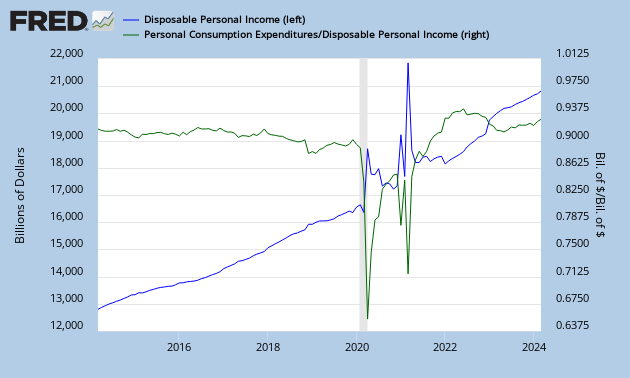
…even as dollar disposable income staggers upward with help from occasional fiscal injections with the rate of consumption spending out of disposable income returning to a long-term trend rate of 93 percent…
…while the components of nominal (dollar) aggregate demand, Y = C + I + G + (X – M), show chronic weakness in investment and net exports, with consumption growing fastest and government spending chugging ahead….


Of components contributing demand, only consumption has risen to pre-Great Recession levels in dollar terms.  Any whiff of inflation is translated immediately into lower real purchasing power. Private domestic investment is at 2002 levels in dollar terms; it is at 1998 levels inflation-adjusted.  Consumption depends on the household sector that depends on jobs and income to spend.  Wisely, Congress extended unemployment benefits through 2010.  But a second round of exotic mortgage rate resets is due later in 2010 and 2011, and it is more difficult than any time in the past 30 years to get a job in America…

…while a strong dollar, so necessary to our continued successful Treasury auctions, hurts us in exporting manufactured goods, the United States still having the largest industrial output of any nation, and the developing world growing much faster than we are and in need of manufactured capital goods. Our net exports are solidly negative and cannot be counted on to pull up aggregate demand in the near future, though they may drag it down less.

Thus a rebalancing of domestic demand would seem to be required to forestall a potential humanitarian disaster in the United States, namely entrance into a depression as domestic effective demand collapses. As I have maintained all along, the government needs to provide poverty level workfare to the unemployed and health care to all Americans.  The next recession is likely to be even more severe than the recent one.  Those to whom much has been given (as all products are joint) need to step up to the plate.

However, it may be that Americans’ collective distrust of government, and the power of entrenched interests, will prevent any rebalancing.  The trash talk about the Democrat’s health bill is illustrative.  The bill applies tax surcharges only to small business owners making more than $1 million a year, affecting only about 1 percent of small business owners.  If the health bill goes down, I would guess that the odds of an equitable rebalancing of demand diminish radically.

America may fracture in this case, with state and local governance becoming much more important.  

The last great leveling of the income distribution, that “corrected” the imbalances of the 1920s and the Great Depression (the New Deal didn’t do it) occurred in a few short years in the early 1940s, as the United States entered into a world war.

Can the income distribution become more equitable without another world war?  Or do we collapse into neo-feudalism and a rigid class system for generations to come?

Thursday, March 11, 2010

The collapse of demand is not a stupid “macro” problem

I get emails from a reader occasionally who supports someone named Mosler, an automobile magnate, for president.  Here’s the latest:

In Defense of Deficits

http://www.thenation.com/doc/20100322/galbraith  Latest from Galbraith, a Warren Mosler supporter. Also Auerback responds to Rogoff nonsense http://www.newdeal20.org/?p=8682

Here is my response:

If you persist in treating this as a "macro" problem, you will guarantee a bad solution, whether it's excessive deficit spending or excessive fiscal tightness.

It's a distributional problem.  There's enough to go around, it's just not going around.

The financiers will play a big deficit/inflation scenario the way they played the bubble--lever up and rip everyone else off.

You're barking up the wrong tree, just like they want you to.

Repeat:  as long as you frame it as a "macro" problem, you will get a "macro" answer, and they're all clumsy, stupid and wrong.

Cheers,

Benign


Sunday, March 7, 2010

‘Animal spirits’ update

“Animal spirits” or confidence levels continue to improve as Americans adapt to higher levels of unemployment and fear fades.  A plausible forecast for unemployment suggests that confidence will rise to about zero in about 2012, suggesting the next presidential election will be bitterly fought.

image

The probability of an NBER-type downturn in the next year is about zero.  The conditions for a collapse of confidence will not exist unless unemployment spikes higher than it already is above adaptation level, as it did in late 1981 and 1982. Nor is the yield curve is suggesting a collapse is in the cards near-term.

image

The labor market continues to look very sick.  The trend in the labor market suggests that the next recession, when it does arrive in about 2013 or 2014, will be worse than this past one in terms of unemployment.

image