Tuesday, July 9, 2013

The signature of incipient depression (take 2)

I almost titled this, “It’s the distribution, stupid,” but there’s more to it than that.  A while ago I published a piece called The signature of incipient depression that pointed out the similarity of the current period (still applies, two years later) to 1929, pre-The Great Depression:  namely, the very high total nonfinancial debt to GDP, and the extreme inequality of the income and wealth distributions.  Today I can add declining real incomes for the ~90+ percent as the third leg of the stool.

In a consumer-based economy, effective demand collapses when most people’s real incomes are falling, as they are now.  I’m putting up graphs of the three main elements of this signature of incipient depression, mostly in response to a stupid piece in Quartz from someone “refuting” Reinhart and Rogoff (here).  Not that they’re wrong, or that the No Exit situation that the fiscal authorities are in won’t prevent them from blowing the biggest debt bubble in world history over the next six years as posited in When will the financial singularity occur? ~2020.  Another six years might seem like a long time to kick the can down the road, but it would make this episode of ZIRP approximately as long as the previous one (1934-1946).

It is always possible for an economist—an ideological cheerleader—to miss the forest for the trees.  The most powerful fiscal remedies available to us now are steeply progressive income and wealth taxes, and a program of food and shelter and basic medical care in exchange for work for the dispossessed, who may be expected to become numerous if present trends continue.  Or perhaps a negative income tax with the elimination of the minimum wage.  And put health insurance on a hybrid single payer system so that everyone gets at least some coverage.

The point being:  The US economy still sports the signature of incipient depression.  As the focus ostensibly turns to fiscal policy for the remainder of the decade I suppose the best advice is to try to get on the gravy train if you can.  The next decade will be the Depression 2.0 decade, in all likelihood, the true test of democracy vs. fascism—we’re not there yet.  And given how piggy the 1 percent are world-wide we might not see much inflation until about 2020 either—except of course that rolling through asset markets.  My best guess is that the Feds will tase the labor market with a little more monetary tough love (also part of the “wash and rinse” cycle in the stock and metal markets, one for the Gipper, so to speak) so that the big boys can get nice and levered up for the big ramping up in asset markets to come in the second half of the decade.  Ordinary working people are hosed pretty much everywhere, it seems.  Just my guess.
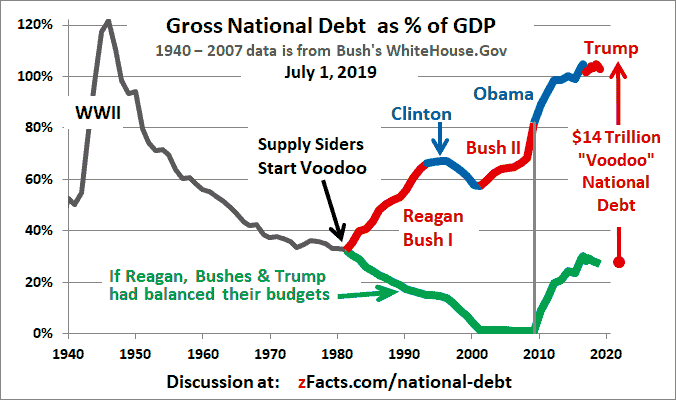
The debt situation is worse if you look at all nonfinancial debt:

Here’s a longer-term picture of household income:

And that’s using the government’s phony hedonically adjusted inflation measure.

Friday, July 5, 2013

‘Animals spirits’ update: The Ben vs. Barack

With U = 7.6, same as last month, the topping process in animal spirits seems to be underway.  The adaptation level of U is 8.5, down 0.1 from last month.  I am assuming that U will stabilize for a few months and then shoot up as self-organized criticality in the labor market kicks in.  The interesting thing about this cycle, like the one in the early Seventies, is that consumer sentiment as measured by the Michigan index seems to be looking through the next slump to the next expansion already.

image

The political economy of the situation, in my read, is as follows:  Obomba would be better off to take his recession now so that the economy is coming back in 2016 for Hillary or whoever.  But the Congressional elections next year could swing radically Republican if the economy is in recession (as I expect it to be).  If Ben continues to taper, he may help the Democrat in 2016, but it may hardly matter, as the Congress will have gone to the Republicans and the people may be convinced that the Democratic (and democratic) agenda has failed, and they will opt for a “strong leader.” 

The one thing Republican administrations are really good at is shutting the economy down (reference).  But would be consistent with their ultimate agenda of bringing feudalism back to the Western world, IMHO. 

And since Ben is a servant of Wall Street, which today favors the Republicans, he will continue with the taper, executing a “wash and rinse” cycle on the stock and bond markets similar to that of the early Seventies.  The inflation gets going in a few years, along with a perhaps MMT-validated increase in deficit spending (see Warren Mosler’s profile in the NYT here), which is all of course consistent with my and others’ hypothesis of a credit super nova yet to come, as the sovereigns, slaves to the banks (at least in the West), compete in a race to debase.  We have Sornette’s forecast of the date for the phase transition in to what can only be a world-wide deflation as about 2020.  And all this is consistent with the very prescient prophecies of Strauss and Howe in the The Fourth Turning.

Interesting times. 

P.S.  I am still unemployed, so anyone knowing of opportunities for a non-derivatives oriented finance geek, please let me know.

Tuesday, July 2, 2013

When will the financial singularity occur? ~2020

Didier Sornette has some great stuff out now.  See his Ted talk and this white paper, “The Illusion of the Perpetual Money Machine,” in which he he pretty well demolishes the con game that the economics profession—slave to Wall Street—has been playing at the great expense of the people of the world.  I’ve written previously about the faster than exponential growth theory of singularities, financial and otherwise (see here).

image

The bad debt will be cleared.  Sornette indicates that his models show that the anticipated phase transition out of the growth era, originally forecast for 2030-2060 in his work with Johansen, has begun.

Andrew Jackson’s last words before dying were, “I killed the Bank!”

Where is our Andrew Jackson?

Friday, June 28, 2013

Coppock curve update

N.B.  The following is research, not investment advice.  You invest at your own risk, unlike the Wall Street banks, who also invest at your risk.

The Coppock curve is tracking downward.

image

image

The Coppock curve sends a long-term bottom signal when it turns up from a negative reading.  Assuming the curve does not bounce up again—anything is possible but it has only bounced from this low before once, in 2012—how long until the next major market bottom?  The mean number of months from a similar Coppock value ~67 to the next bottom (the signal in 2001 was the only false positive and is ignored, taking the second signal in 2002 as the true signal) was 11.6 months, with a max of 19 and a min of 5.

image

So the average expectation would be for a bottom in the summer of 2014, a very crude second degree polynomial fit to the the series of signal leads gives a lead time of ~8 months for a bottom in spring 2014, which has a certain harmonic resonance with the Seventies big bottom which was in March 1974.

By the way, long interest rates rose all the way up to the bottom in 1974—and beyond, of course.  However, if the world economy hits an air pocket (failure of effective demand) we could see stock prices falling and further disinflation or deflation.  Remember, the last ZIRP lasted from 1934 to 1946, a dozen years.  It could be 2021 before short rates rise.  It is really hard for me to imagine a scenario where inflation takes off except for isolated supply shocks in the current environment.

Pushing on a string seems to work for the stock market, if not the economy.

Wednesday, June 26, 2013

Will consumption collapse?

Running at about 70 percent of GDP, consumption has been above long-term averages for a while, with much of it financed by debt.  Households are deleveraging where they can.  Where will consumption go?

image

Of course, for the majority of consumers, the weakness in real disposable income has been greater than depicted because of the great degree of inequality in the income distribution.  Government spending won’t pick up the slack, and neither will investment, from all appearances:

Graph of Shares of gross domestic product: Gross private domestic investment: Fixed investment: Nonresidential

John Robb on a roll

Robb has been posting a lot this month, with the Snowden disclosures.  He shares my view that the nation state, while weakening, is entering a regime of “positive control” of the population that is roughly equivalent to neo-feudalism, a view I first expressed in 2009 in “On the coming neo-feudalism,” linked to by Yves at www.nakedcapitalism.com. 

Start with http://globalguerrillas.typepad.com/globalguerrillas/2013/06/the-nsa-story-and-the-negative-security-it-delivers-to-everyone.html and follow the forward links to get John’s take on things.  I have added him back to my list of blogs I follow.

Here is my current “big picture”:

Unless the corporations, which are the dominant form of social organization on the planet, naturally adapt according to the principles suggested by Wilkinson et al.’s findings, i.e., that it will be optimal for them to flatten the income distribution within their structures as it will lead to lower health care costs as well as productivity improvements—if there is no natural countervailing movement toward greater equality of outcomes (and I am assuming here that the rich continue to “own” the politicians, so that no reform via taxation is possible), then we have the following probable sequence:  neo-feudalism + “free market” capitalism + bought-and-paid-for government by the 1% + insatiable greed triggered by great wealth => immiseration of the proletariat and Marx’s revolution—with either true social reform following or a very bloody suppression indeed by the forces of “positive control” with a rinse and repeat cycle.

There certainly is the possibility of a dystopian future ahead.  The passivity, and—I will say it—the lazy stupidity of the American people make it much more probable to happen.  What can you do, if demonstrating in the streets is likely to get you sent to jail and the unemployment lines?  Give money to progressive organizations that are reputable.  Support local efforts to expose corrupt politicians.

The only person offering a solution to the larger “bootstrapping problem” of reforming American democracy that I can see is Lawrence Lessig, whose “money bomb” idea is as follows:  raise X hundreds of millions of dollars from billionaires who are committed to reform and use it to secure the election of reformers to the House and Senate, whose charge is to push through legislation to get the money out of politics, or to vastly reduce its power.  See Lessig with Bill Moyers.

Former Republican presidential candidate John Huntsman referred to the American campaign finance system as “an abomination.”

Sunday, June 16, 2013

Change to "Blogs I read regularly"

I have added "Fabius Maximus" to my list.  Since John Robb has turned his interest to his new site, "Resilient Communities", which is mostly about gardening, and stopped updating (much) his "Global Guerillas," I have turned to "Fabius Maximus" for incisive bashing of the greed and perversity of the military-industrial-financial-media complex from former ranking military intelligence insiders, who should know.  There's a depth of content there, with plenty of back-links, so it's worth an extended visit.

Another site I've added is Michael Snyder's "Economic Collapse Blog," which provides nice sets of authoritative links within a fundy Christian rant that generally tries to tell people to prepare themselves for the collapse by buying some of the many products advertised on the site.

I was talking with a Washington insider in the health industry (who is "on the bus" and has benefited financially from Obamacare, which I support, once debugged) recently about the state of economy and got a dose of apparatchiki-speak.  When I questioned the health of the economy, he said, "It's getting better!  It's growing!"

I asked how an economy in which the vast majority of households' real incomes are declining could possibly be described as "getting better."  He simply repeated his assertion.

Under continuous attack, the Democrats are becoming more and more rigid, brittle, and breakable--and willing to commit unethical uses of power to survive.  I'm sure this is the Republican strategy.

The Crisis looms.